Europe
Europeans increasingly doubt US would defend them in a conflict, ECFR survey finds

People across Europe are losing confidence that the United States would come to their defense in the event of a military attack. Increasingly viewing Washington as, at best, a necessary partner rather than an ally, Europeans are placing greater trust in their continental neighbors during security crises.
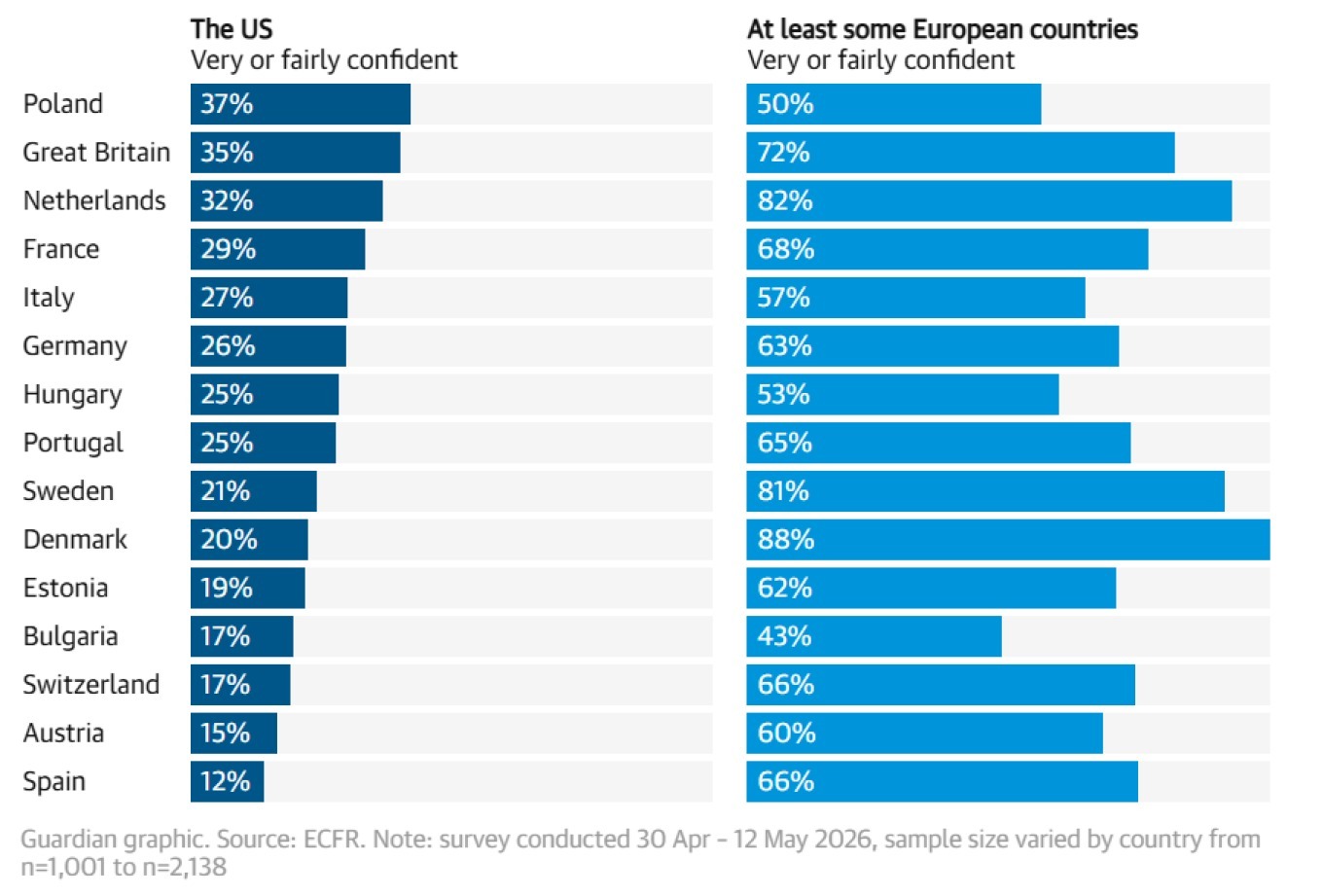
A public opinion survey conducted in May by the European Council on Foreign Relations (ECFR) across 15 countries found that in none of the participating states did a majority believe the United States would come to their aid in the event of an attack.
By contrast, confidence in support from other European countries remains high.
Trust in US declines even in staunch ally Poland
Even in Poland, one of Washington’s strongest supporters in Europe, only 37% of respondents said they had complete or sufficient confidence that the United States would provide military assistance.
In Spain, which has taken one of the strongest positions against President Donald Trump’s military actions toward Iran, that figure fell to just 12%. Across all 15 countries surveyed, only 23.8% of respondents said they believed the United States would protect them in the event of an attack.
Meanwhile, in every country except Bulgaria, a majority of respondents said they were confident that at least one European partner would come to their assistance during a crisis.
Average confidence in support from fellow European countries stood at 65.1%.
Yana Kobzova, ECFR senior policy fellow and co-author of the report, said the findings demonstrated clear support for reducing dependence on Washington.
“Across the continent, there is clear support for the idea of reducing dependence on Washington. Europeans are becoming increasingly willing to increase defense spending and, more importantly, are displaying striking confidence that neighboring countries would come to their aid in a crisis,” Kobzova said.
Pavel Zerka, the report’s other co-author, argued that public demand for greater independence and a hedge against the possibility of US disengagement presents European leaders with an opportunity to move “further and faster” on security policy.
Despite this trend, however, Europeans continue to express confidence in NATO and are not enthusiastic about replacing the alliance entirely with a purely European military bloc. While 29% of respondents said such a change would be a good idea, 28% opposed it.

Actions during the Trump era seen as a turning point
The ECFR analysis also identified several factors behind the shift in European public opinion.
According to the report, these include Donald Trump’s threat to annex Greenland, his military actions toward Iran without what the report described as a clear plan and his subsequent expectation that Europeans help address the resulting problems.
The report also cited Trump’s pressure on Kyiv rather than Moscow in pursuit of a peace agreement to end the war in Ukraine, his failure to secure results from that approach, his questioning of US commitments to NATO and his decision to withdraw part of the American military presence from Europe.
The survey, conducted in Austria, Bulgaria, Denmark, Estonia, France, Germany, Hungary, Italy, the Netherlands, Poland, Portugal, Spain, Sweden, Switzerland and the United Kingdom, found that the share of respondents who view the United States as “an ally that shares our interests and values” has fallen to an average of 11%.
That figure stood at 16% six months ago and 22% in November 2024.
Current data show growing support for the view that the United States is a “necessary partner,” while 13% of respondents described Washington as a “rival” and 12% viewed it directly as an “enemy.”