Diplomacy
Experts warn US-China tensions rooted in structural miscalculations, not short-term policy shifts

A panel of academics and policy analysts convened by Harici Media offered diagnoses of US-China relations that diverged in some respects but overlapped in others. The relationship was framed as a product of structural tensions, shifting global priorities, and competing civilizational outlooks rather than short-term policy choices.
Opening the discussion, the moderator noted that the webinar took place against a backdrop of intensifying global crises, including the prolonged war in Ukraine, escalating tensions involving Iran, and instability in Venezuela. These developments, he suggested, have unfolded alongside a US foreign policy that appears at once interventionist and strategically ambiguous, particularly in its approach to China.
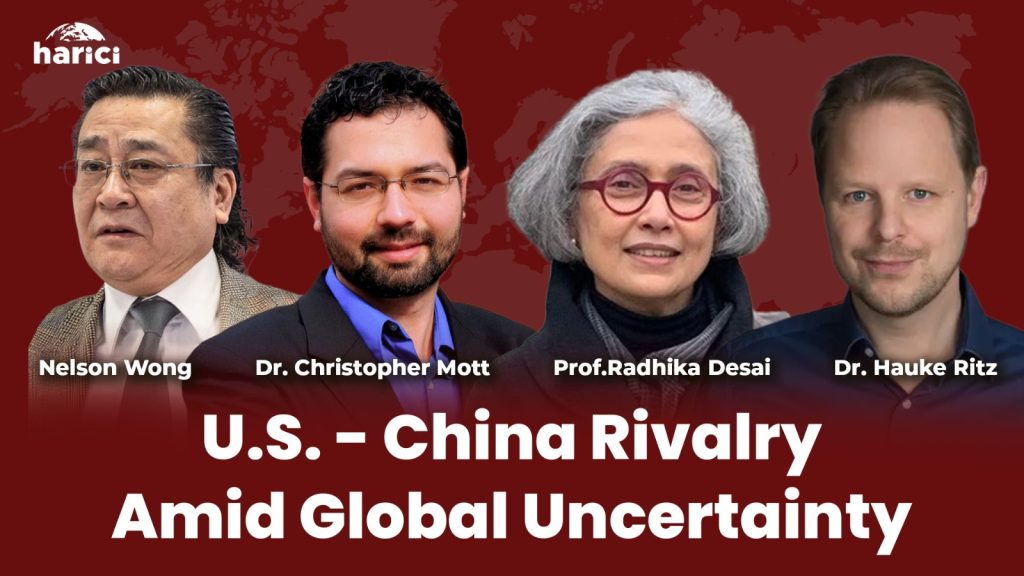
The panel brought together Professor Radika Desai, a political economist at the University of Manitoba; Dr Christopher Mott, a Washington fellow at the Institute for Peace and Diplomacy; Nelson Wong, vice chairman of the Shanghai Center for RimPac and International Studies; and German philosopher and writer Dr Hauke Ritz.

“The United States assumed China would remain subordinate”
Desai argued that the roots of current tensions lie in long-standing structural miscalculations rather than recent political shifts.
Desai said, “The real source of the difficulty in Sino-US relations actually comes from the original assumptions under which the United States created the opening to China.”
She added that Washington initially expected Beijing to accept a subordinate role within a US-led global order. Desai said, “The United States imagined that China would very happily accept a subordinate position… in which the US could profit from China in a variety of different ways.”
That assumption, she said, collapsed as China moved up the value chain and rejected a complementary economic role limited to low-value production. Desai pointed to successive administrations, from George W Bush’s tariffs to Barack Obama’s “pivot to Asia” and Donald Trump’s trade war, as evidence of a consistent trajectory.
Desai said, “On the one hand the United States would dearly wish to subordinate China, on the other hand it is impossible to do so.”
She also described China as increasingly perceived as a stabilizing force amid what she characterized as Western-driven disruption. Desai said, “China increasingly appears as an oasis of predictability, stability.”
Turning to US domestic dynamics, she linked foreign policy volatility to internal political and economic pressures. Desai said, “There is no method in Trump’s madness… what you see are frequent changes of direction and policy.”
She argued that US leaders face structural constraints that prevent them from fulfilling electoral promises, contributing to erratic policymaking. Desai said, “The internal crisis of the United States has reached a very critical point.”
“They can’t quit the Middle East”
Mott broadly agreed with Desai’s assessment but focused on strategic incoherence within US foreign policy.
Mott said, “I agree with everything that Professor Desai said… that’s a very good summary of where we are right now.”
He traced Washington’s earlier goal of prioritizing competition with China through a “pivot to Asia,” while noting that successive administrations have repeatedly been drawn back into Middle Eastern conflicts.
Mott said, “Every single subsequent president gets dragged back to the Middle East… they can’t quit the Middle East.”
He cited interventions in Libya and Syria, as well as continued engagement with Iran and Israel, as evidence of a persistent pattern. Mott argued that electoral promises of reduced interventionism often translate into deeper involvement once in office.
Mott said, “People promise less interventionism… and then they double down on their predecessor’s level of interventionism.”
He also pointed to the centrality of US alliances, particularly with Israel, in shaping policy. Mott said, “There is one ally that is favored in DC more than any other ally.”
While acknowledging China as a peer competitor, he suggested that US strategic focus has shifted away from direct confrontation with Beijing. Mott said, “Competition with China is deemphasized… but very much interventionist towards the Global South.”
He characterized current US strategy as an attempt to maintain declining unipolar dominance through coercive measures. Mott said, “They are attempting to shore up a fading unipolarity through a kind of hard power doctrine.”
“China wants to manage itself, the US wants to manage everyone else”
Wong offered a perspective rooted in cultural and historical differences, emphasizing China’s preference for pragmatism and restraint.
Wong said, “China always wants to manage itself but the US always wants to manage everyone else’s business.”
He argued that Western narratives dominate global discourse, while China adopts a more reactive posture. Wong said, “China is extremely passive when it comes to dealing with the outside world.”
According to Wong, China’s rise has been shaped as much by external perceptions as by internal ambition. Wong said, “The confidence of China… has actually been pushed up by the outside world.”
He stressed that Beijing does not seek confrontation and prioritizes economic engagement. Wong said, “China never wants to destroy the relation with the US… it’s a big market.”
At the same time, he underscored firm red lines, particularly regarding Taiwan. Wong said, “China will never recognize Taiwan as an independent entity, never.”
He described Taiwan as a core national issue shaped by historical narratives, while reiterating that Beijing prefers peaceful reunification. Wong said, “China always wants to seek a peaceful reunification… there is no timetable.”
On economic tensions, Wong highlighted China’s preparedness for trade conflict. Wong said, “China has been prepared for this for over a decade… we have weapons and started to fight back.”
He noted that China has reduced its dependence on US exports and diversified markets. Wong said, “China’s export to the US has been reduced… from about 20% to below 8%.”
Despite tensions, Wong maintained that neither side seeks military conflict. Wong said, “We do not foresee any immediate threat of a war between the two countries.”
“Europe is at a crossroads”
Ritz framed the debate in terms of Europe’s strategic and cultural trajectory, arguing that the continent remains constrained by its alignment with the US.
Ritz said, “The ability of those leaders… to think about an independent course of Europe is limited.”
He pointed to emerging dissent within Europe, citing countries such as Hungary, Slovakia and Spain as examples of growing interest in alternative paths.
Ritz suggested that change may be driven not from Europe itself but from shifts in the Middle East. Ritz said, “The attack of the United States… has disrupted the global economy to such a large extent.”
He argued that Iran’s resistance could reshape regional dynamics and weaken US influence. Ritz said, “Iran plays in the Middle East a similar role as Russia plays in Europe.”
In his view, Europe’s dependence on the US has eroded its cultural and strategic autonomy. Ritz said, “We have lost the connection to our ancient roots… we have become multicultural societies driven by consumption.”
He called for a rediscovery of European intellectual traditions and a reorientation toward dialogue with other civilizations. Ritz said, “We have to regain this curiosity about different cultures.”
Ritz also predicted a long-term realignment involving closer ties between Europe, Russia and China. Ritz said, “The way to Moscow goes over Beijing.”
“Regionalization is inevitable”
Returning to strategic considerations, Mott argued that global geopolitics is moving toward regionalization, with alliances becoming more geographically anchored.
Mott said, “Geography has a gravity… alliances that were built generations ago do not.”
He questioned the feasibility of US-led deterrence strategies in Asia, particularly regarding Taiwan, noting the limitations of allied contributions.
Mott said, “I think it is extremely debatable… whether everyone would be on board with a kinetic defense of Taiwan.”
He suggested that countries in Asia and elsewhere will increasingly prioritize regional arrangements over global alignments. Mott said, “There will be a breakup of the assumptions of globalized diplomacy.”
“Trump seeks a ‘victory’ but lacks leverage”
Desai, returning in the final segment, argued that US policy is driven by a search for symbolic victories rather than coherent strategy.
Desai said, “This has nothing to do with controlling the Persian Gulf… this has to do with trying to produce some kind of military victory.”
She dismissed claims of US success in Venezuela and predicted failure in Iran. Desai said, “The United States is losing in Iran… it does not have what it takes to win.”
On US-China relations, she argued that Washington lacks leverage. Desai said, “Trump did not have the upper hand even beforehand.”
She pointed to China’s control over rare earths and its willingness to resist pressure. Desai said, “China has shown that it knows how to stand up to him.”
Desai concluded that global instability reflects deeper structural shifts. Desai said, “We are looking at the consequences of the United States going out of control.”
