Diplomacy
Experts warn US-Iran war launched on ‘false premises’ risks decades of instability with no clear endgame

A panel of international affairs scholars has delivered a blunt assessment of the ongoing US-Israeli military campaign against Iran, warning that the conflict was launched on “false premises,” has no discernible strategic objective, and risks drawing major powers into a broader confrontation that could reshape the global order for decades.
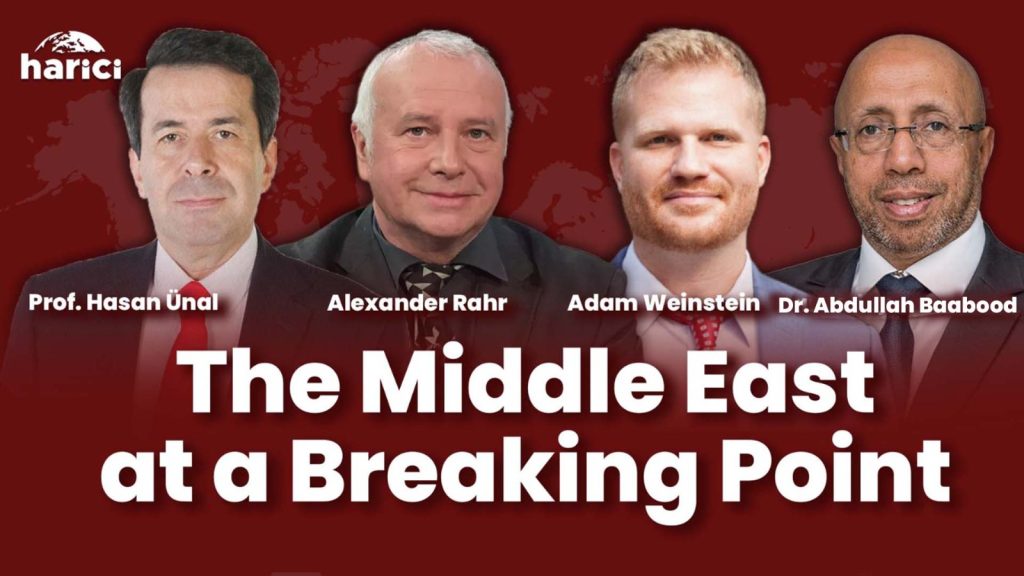
Speaking during a webinar hosted by Harici Media, titled “The Middle East at a Breaking Point: Escalation Scenarios and Future Outlooks,” three analysts — from Oman, the US, and Germany — painted a picture of a region engulfed by a war none of its inhabitants chose, waged by powers whose aims remain opaque even to close observers.
The panel was moderated by Hassan Ünal of Başkent University in Ankara, who also serves as director of the New World Research Center.

“The war has been decided between Tel Aviv and Washington and we are paying the price”
Abdullah Baaboud, a member of Waseda University’s Qatari Chair of Islamic Studies and a native of Oman, opened with a sharp indictment from the perspective of the Gulf Cooperation Council states. Speaking from Oman — one of Iran’s nearest neighbors — Baaboud said the war had been “decided illegally against a neighboring country” and launched under fabricated justifications.
“There are no strong excuses to enter into war,” Baaboud said. “The most powerful country in the world is conducting it with another powerful country in the Middle East. Both are nuclear powers, and they’re conducting it against a neighboring state under the false premises of nuclear arms or regime change or regional policy or missile technology.”
He noted that even the war’s architects appeared unable to articulate coherent objectives. “Even the people who created and entered into the war are not clear about their war objectives and the reasons for their war,” he said.
Baaboud revealed that Oman had been deeply involved in mediating between Washington and Tehran prior to the outbreak of hostilities — just as it had during last year’s so-called Twelve Days War. According to Baaboud, Oman’s foreign minister had indicated that Iran had agreed to virtually all US demands, going “way beyond” the 2015 JCPOA nuclear deal. Tehran had accepted conditions on enrichment, stockpiling, and was prepared to discuss missile technology and regional policy. In return, Iran sought assurances that sanctions would be lifted and it would be permitted to trade freely with its neighbors.
“We were all very hopeful that this is going to avert a devastating war for the region,” Baaboud said. “And you all know what is going on now.”
He described a conflict in which not only military sites but civilian infrastructure, schools, and leadership figures had been struck. Iran, for its part, had retaliated against US bases, Israel, and Gulf states it suspected of hosting American forces. “We have become a victim of this war, not a war of our choice,” Baaboud said. Iran’s closure or attempted closure of the Strait of Hormuz and attacks on oil installations had prompted some regional states to suspend exports, a development Baaboud warned would deliver a “huge impact on the world economy and the world energy needs.”
Looking ahead, he cast the conflict as an accelerant of the Gulf’s pivot toward Asia. “Their policies in the region are actually so perplexing for us that they are pushing us more towards Asia, towards China,” he said. The war, coming on the heels of what Baaboud described as “genocide and ethnic cleansing” in Gaza, had generated a profound crisis of confidence in the US as a strategic partner. “I think we are at a very serious inflection point where things are changing,” he warned. “It is madness, and we are paying a very high cost for this madness.”
“It’s not that difficult to manipulate President Trump”
Adam Weinstein, deputy director of the Middle East Program at the Quincy Institute for Responsible Statecraft, offered a forensic account of the policy failures that led to the current conflagration. He traced the conflict’s origins to the unraveling of the JCPOA, noting that even the Obama administration had undermined the deal’s spirit by imposing new sanctions while removing others.
“I think the approach of the Obama administration to the JCPOA was to treat it as if it was some type of corporate contract in which you could find loopholes,” Weinstein said. The first Trump administration then “destroyed that agreement” and assassinated Qasem Soleimani, steps that drew bipartisan applause in Washington even as they moved the US closer to open conflict.
Weinstein reserved particular scorn for the Washington policy establishment’s refusal to heed warnings. “If you were in the minority of voices that warned that this was creating the conditions for a potential war, you were sort of cast aside as being prone to hyperbole and being alarmist,” he said. Even weeks before the strikes began, the prevailing mood in Washington held that the Trump administration might conduct limited operations as a “coercive negotiating tactic” but would never embark on full-scale war. “Anyone who said otherwise was kind of deemed an alarmist. I mean, that’s just a fact.”
He was equally blunt about Iran’s miscalculations. The late Supreme Leader Ali Khamenei, Weinstein said, had fatally misjudged the nature of the administration he was dealing with — one in which provocative social media posts could tip the balance from negotiation to invasion. “The late Supreme Leader was tweeting out AI images of US ships being sunk to the bottom of the sea and threatening to use Chinese weapons against US ships,” Weinstein recounted. “With a normal administration, that would be seen as domestic rhetoric and would be ignored. But with somebody like President Trump who quite literally spends a lot of time on Twitter, that has the power to shift his decision from maybe giving negotiations a little more time to invading the country.”
On Israel’s role, Weinstein was characteristically direct. “A lot of people give the Israelis a little too much credit. They claim that the Israelis have manipulated Trump or pushed Trump into embarking on this regime change war. It’s not that difficult to manipulate President Trump,” he said. “I think they’ve done it masterfully, but it’s not that difficult of a task.”
Weinstein dismantled the notion that the Trump administration was executing a sophisticated strategy. Conservative circles, he said, had convinced themselves that the successful abduction of Venezuelan President Maduro provided a blueprint for regime change in Iran. “The problem is that Iran is not Venezuela,” Weinstein said. “The Iranian regime has been preparing for this moment and the decapitation of the Supreme Leader for decades.” Unlike Syria, there was no organized opposition figure capable of uniting a critical mass of Iranians.
The Iranian diaspora, he argued, bore partial responsibility for Washington’s miscalculations. “Diasporas don’t necessarily give the best advice. They gave terrible advice on Iraq, they gave really incorrect advice on Afghanistan,” he said. The expected mass uprising had failed to materialize because there was no unifying leader and because the regime’s repressive apparatus — the Basij and the IRGC — had deployed immediately to suppress dissent.
Weinstein described the war’s supreme irony: a president who campaigned against nation-building was now inextricably engaged in it. “When you gratuitously bomb the capital of a large country like Iran and you bomb its government facilities, whether you like it or not, now you’re in the business of nation building,” he said. “We’ve created another generational crisis.”
The new supreme leader, he noted, was “as ideological as his father” but now carried “the added chip on his shoulder that his father, mother, wife, and one of his children were killed by the United States.” Day-to-day authority, meanwhile, had passed to the IRGC. “We’ve just made things a lot worse for ourselves,” Weinstein said.
He concluded with a bitter observation about squandered opportunity. Trump, he argued, had been uniquely positioned — as an iconoclastic second-term president with an obedient party — to negotiate a comprehensive deal with Iran, even to open a US embassy in Tehran. “Instead, he chose to repeat the mistakes of his predecessors, mistakes that he spent his entire political career criticizing.”
“The unipolar world is gone — it’s really gone”
The third panelist, a German analyst identified as Mr. Rahr, situated the Iran conflict within a sweeping geopolitical framework. He warned that the war carried the risk of a broader confrontation between nuclear powers, noting that direct or indirect clashes involving the US, Israel, China, or Russia were “at least conceivable.”
Rahr identified an unspoken US strategic objective: pushing China out of the Middle East and limiting its influence over Persian Gulf energy resources. He noted that China was closely observing the military situation, “particularly the strength and weakness of American air defense systems,” and suggested that Washington’s violation of international law in attacking Iran could influence Beijing’s strategic calculations regarding Taiwan.
On Europe, Rahr delivered a withering verdict. The continent, he said, was “simply too weak and disunited to create an autonomous pole in the multipolar world.” He identified a widening rift between northern European states — Scandinavia, Germany, Poland, the Baltics — focused on militarizing against Russia, and southern nations such as Spain, Italy, and Greece, which favored normalized relations with Moscow and were “more sympathetic to the Arab point of view.”
Europe’s strategy, such as it was, amounted to waiting for a change of administration in Washington. “The only strategy which I detect today in Europe is to wait until Trump maybe will be ousted by the Democrats, another president will be in power,” Rahr said. “But this is not a strategy.”
He argued that northern European states were supporting the US war against Iran as a transactional calculation: backing Trump in the Middle East in exchange for American support against Russia in Ukraine. Europe’s growing raw materials shortage, meanwhile, was driving deindustrialization while American energy and arms industries enjoyed “an unprecedented boom.”
Rahr’s personal forecast envisioned a tripolar world order: the US with a dependent Europe, China as the dominant partner in its relationship with Russia, and a volatile Middle East where “a coalition of Islamist forces could attempt to establish a new political order.” A long-term American-Israeli security architecture in the region, he warned, “would effectively mark a return to a new Cold War era” — one he judged unsustainable.
“We’ve lived through Pax Americana — and look at the result”
During the question-and-answer session, Baaboud traced the historical arc of Gulf security from British withdrawal to what he termed Pax Americana, cataloguing the crises that followed: the Iranian revolution, the Iran-Iraq war, the invasion of Kuwait, the invasion of Iraq, and the current conflict. He argued that the US was now positioning Israel as its regional security guarantor — a “Greater Israel” being “pushed down our throats” — after Iran and Saudi Arabia had both ceased to serve that function.
He also lamented Europe’s failure to build meaningful partnerships with the Middle East, noting that the Euro-Arab, Euro-Gulf, and Euro-Mediterranean dialogues had all collapsed. “We can’t talk about a particular European project that has been successful in this region,” Baaboud said, even as Europe remained “the most affected region by the development and the chaos in the Middle East.”
Weinstein, asked to assess how the war might end, offered a cautious and self-consciously uncertain projection. “If I had to make an educated guess, I would say that it ends in some sort of stalemate or negotiated settlement with an updated Iranian regime that is not any better on human rights or democracy but might be willing to make a few concessions to the Trump administration to stop the war,” he said. He dismissed the optimistic scenario of a democratic Iran emerging within five years as unrealistic given current conditions. “Anyone who says they know what’s going to happen in the next few years, including people in the US government, are lying,” he added.
He characterized the broader pattern as endemic to American foreign policy. “This is the US approach to the Middle East: to create seismic change and complete instability and have no idea how it’s going to end. And this is the US approach to the Middle East for the last 25 years. And we’re back at it again.”
Rahr closed the discussion by declaring the post-Cold War unipolar order defunct. “The unipolar world is gone. It’s really gone. And a new thing has to be created, probably a new Yalta,” he said. He expressed doubt that regional states would accept a Greater Israel but acknowledged the vacuum left by the war would need to be filled. “The Americans will return home after the war. The Chinese are economically intelligent. The Russians are out for the moment,” he said. “The vacuum will be filled by something which I don’t yet understand by whom, but it will be filled.”
