Diplomacy
Global Geopolitics debuts with high-level experts discussing the rise of multipolarity

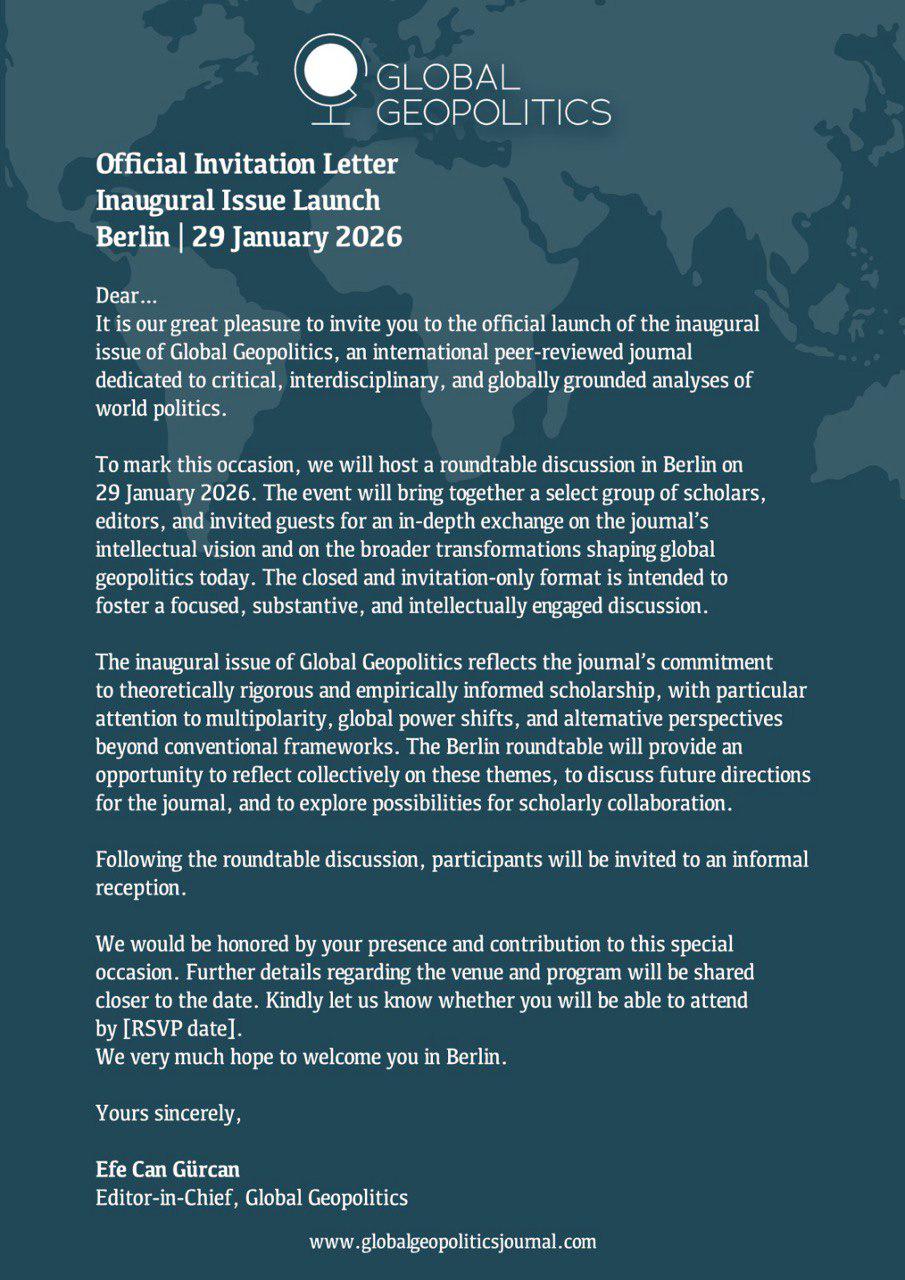
Global Geopolitics, an international peer-reviewed journal supported by the Berlin-based Eurasia Society, has officially launched its inaugural issue during a roundtable discussion in Berlin. Under the leadership of Editor-in-Chief Efecan Gürcan, the launch event featured international experts who examined shifting global power dynamics and the ongoing processes of multipolarity.
Designed as an international peer-reviewed publication, Global Geopolitics presented its first issue to readers at a specialized launch event in Berlin.
The journal, which aims to provide critical, interdisciplinary, and field-oriented analysis of global politics, has now commenced its publishing life.
By moving beyond traditional frameworks of world politics, the publication intends to offer alternative perspectives and examine changes in the global distribution of power and multipolarity with theoretical rigor.

Roundtable meeting addresses global transformations
To mark the release of the debut issue, a closed-door roundtable meeting was held in Berlin with the support of the Eurasia Society. The session focused on the journal’s intellectual vision and the transformations currently shaping global geopolitics.
Notable participants included Alexander Rahr, President of the Eurasia Society; Dr. Christopher Mott of the Institute for Peace and Diplomacy; journalist and author Thomas Fazi; and Prof. Jagannath Panda, Head of the Institute for Security and Development Policy. These experts evaluated the challenges facing the current international system and explored opportunities for future academic collaboration.
The journal’s administrative and editorial structure brings together scholars from diverse geographies. Led by Editor-in-Chief Efecan Gürcan, the team includes Managing Editor Serdar Yurtçiçek and language editor Shaoxuan Yi, a doctoral candidate from Shanghai University.
The Editorial Board of Global Geopolitics is composed of specialized academics from countries including Türkiye, China, India, Japan, Canada, Brazil, and Peru. The board members are as follows:
-
B R Deepak (Professor, Jawaharlal Nehru University, India)
-
Barış Doster (Professor, Marmara University, Türkiye)
-
Giray Fidan (Professor, Ankara Hacı Bayram Veli University, Türkiye)
-
Changgang Guo (Professor, Shanghai Academy of Social Sciences, China)
-
Pascal Lottaz (Associate Professor, Kyoto University, Japan)
-
Gerardo Otero (Professor, Simon Fraser University, Canada)
-
Radhika Desai (Professor, University of Manitoba, Canada)
-
Rajiv Ranjan (Associate Professor, University of Delhi, India)
-
Lihong Song (Professor, Tsinghua University, China)
-
Degang Sun (Professor, Fudan University, China)
-
Hasan Ünal (Professor, Başkent University, Türkiye)
-
Jonnas Esmeraldo Marques de Vasconcelos (Professor, Federal University of Bahia, Brazil)
-
Gaston Antonio Zapata Velasco (Professor, Pontifical Catholic University of Peru, Peru)
The journal’s management stated that following the release of the first issue, they will continue to expand the scope of academic work and encourage research based on empirical data.