Middle East
Journalist Dursunoğlu warns Iran removed missile limits as Gulf risks widen

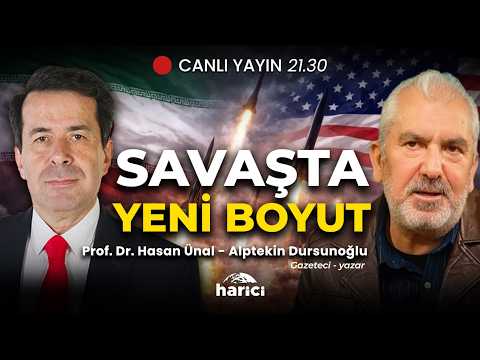
In an extensive broadcast on the Harici digital platform’s Strategic Compass programme, prominent Turkish international relations scholar Prof. Dr. Hasan Ünal and investigative journalist Alptekin Dursunoğlu, editor-in-chief of the specialized regional outlet Yakin Doğu Haber, delivered a comprehensive operational assessment of escalating geopolitical turbulence across the Middle East.
The dialogue dissected the severe institutional, political, and strategic crises currently paralyzing the Tel Aviv and Washington administrations, the profound doctrinal evolution in the Islamic Republic of Iran’s defence apparatus, and the operational collapse of the Saudi-led military campaign in Yemen.
Setting the analytical framework, Prof. Dr. Ünal noted that regional stability remains held hostage by political leaderships in Washington and Tel Aviv whose military ambitions diverge sharply from institutional reality. Ünal asserted that US President Donald Trump and Israeli Prime Minister Benjamin Netanyahu are functioning under immense domestic and international vulnerability, observing that the wider West Asian arena has been left swaying under the command of two unpredictable figures whose room for operational manoeuvre has contracted severely following domestic political defeats.
Turning directly to the internal institutional turmoil inside the Israeli security and defence establishment, Dursunoğlu detailed the unprecedented breakdown in the civil-military chain of command that surfaced in the Israeli press following the national elections. Specifically addressing the Israeli Chief of Staff, Lieutenant-General Eyal Zamir, Dursunoğlu underscored that the military top tier actively resisted prime ministerial instructions designed to embroil the country in an existential conflict.
“Before the Israeli elections, Netanyahu made a serious demand for war,” Dursunoğlu stated, detailing the internal Israeli deliberations. “However, the Chief of General Staff, Eyal Zamir, did not heed this. We learned from the Israeli press after the elections that outright insubordination had effectively taken place. It was noted with irony that in the Middle East’s supposedly sole democracy, the military commander was subordinate to the political will, yet refused to listen to that political will. This is likely an unprecedented development in the short history of that regime.”
Dursunoğlu observed that this refusal followed a direct appeal by the domestic political opposition, known as the Change Bloc under the leadership of Gadi Eisenkot, who had cautioned the general staff against acting as a political instrument. Dursunoğlu explained: “Prior to that, the Change Bloc warned the Chief of General Staff directly. It was anticipated that Netanyahu would attempt to sway the elections in his own favour by launching a war against Iran, which prompted the warning not to enter such an adventure.”
Addressing the persistent rumours that the US administration might launch an assault using massive conventional munitions, Dursunoğlu dismissed the strategic utility of deploying ordnance such as the GBU-43/B Massive Ordnance Air Blast. “Your own military experts state that this bomb detonates prior to impact to devastate wide open areas,” he noted. “That was why it was dropped in Afghanistan, to eliminate dispersed headquarters across broad surface terrain without targeting each facility individually. But your own assessments state that the Iranian facility is carved deep into granite, under hundreds of metres of mountain rock. What is the Mother of All Bombs supposed to do against that? It is widely recognized that even tactical nuclear strikes could not affect it.”
“What objective will you achieve in a short strike that you failed to secure in 40 days?”
Scrutinizing the strategic logic of Tel Aviv and Washington threatening an intense, three-day air blitz against Iranian sovereign territory, Dursunoğlu questioned the credibility of the entire premise when compared to earlier operational outcomes.
“There is an unavoidable military reality to confront,” Dursunoğlu stressed. “What objective will you achieve in an intense, short-duration strike that you failed to achieve during the 40-day war? Moreover, the Iranian side is explicitly warning that the Iran of today is fundamentally different from the past. Tehran states clearly that while you may possess the capability to initiate hostilities, you will not be the party that determines when a ceasefire takes place.”
Dursunoğlu pointed out that Washington’s quiet diplomatic manoeuvres contradict its public posturing. He highlighted that despite aggressive posturing from cabinet hardliners, substantive communications to Tehran had taken a noticeably conciliatory posture through alternative channels.
“If the United States is serious about these existential military threats, why is Vice President JD Vance sending a letter directly to Mohsen Rezaee?” Dursunoğlu asked. “Why are the hawks like Trump himself, Hegseth, or Rubio sidelined in this instance, while Vance sends a letter to Mohsen Rezaee characterized by a completely softened, polite tone proposing dialogue? Iran’s answer has been resolute: seven explicit conditions have been placed on the table. Tehran is demanding concrete implementation before any meaningful talks can proceed, stating frankly that it possesses zero trust in American commitments.”
Dursunoğlu emphasized that institutional rationality within both the US and Israeli armed forces acts as an impediment to reckless unilateral strikes. “Both regimes contain institutional architectures, professional armed forces, intelligence agencies, that are not required to sacrifice sovereign national interests purely for the immediate political survival of individual leaders,” Dursunoğlu argued. “Military analysts and security figures inside Israel are openly voicing this apprehension: if the US posture recedes following the shifts in Congress, how can Israel sustain an isolated conflict against Iran?”
“Iran has lifted the 2,000-kilometre missile limit”
Examining Iran’s revised deterrence architecture, Dursunoğlu revealed that the parameters governing Iranian retaliatory measures have expanded dramatically, both technologically and geographically. He underscored that Tehran’s strategic calculations no longer adhere to previous voluntary self-restraints.
“Iran has formally stated that if an attack occurs, there will no longer be any geographical boundaries,” Dursunoğlu remarked. “This stance is not confined to the immediate theatre. Iran has lifted the 2,000-kilometre missile limit that had previously governed its strategic arsenal. Historically, when the late leader Ayatollah Seyed Ali Khamenei was questioned on this, he confirmed that while the armed forces possessed the technical capability to exceed that range, he had restrained it specifically to avoid handing European capitals and Netanyahu an excuse to construct an Iranian threat narrative.”
Dursunoğlu stated that this self-imposed doctrine is now defunct: “Today, that limit has been discarded entirely. Mojtaba Khamenei, the commanders of the Islamic Revolutionary Guard Corps, and Mohsen Rezaee have all affirmed that geographical limitations no longer apply. This implies directly that US facilities across Europe and broader regional perimeters are within scope. If Iranian energy infrastructure is struck, the vulnerability extends outward. While the closure of the Strait of Hormuz could theoretically be reversed via maritime agreements, a sustained strike against Iranian energy networks could trigger the absolute flattening of primary export terminals and processing facilities across the Gulf, including Fujairah and Yanbu.”
Dursunoğlu argued that the operational assumptions under which Western strategists operated have been completely invalidated by Iranian technological demonstrations. “The entire narrative that Iran lacked advanced signal processing, satellite data links, and long-range operational precision has collapsed,” Dursunoğlu asserted. “Iran demonstrated these sophisticated capabilities in full measure, neutralizing the element of surprise that the adversaries relied upon earlier in the conflict.”
“All options are on the table, including the ground invasion of Gulf monarchies”
Expanding on the systemic consequences of an unconstrained regional conflagration, Prof. Dr. Ünal and Dursunoğlu explored the absolute vulnerability of the Arabian Peninsula, where political geography itself faces radical transformation if open hostilities commence.
“Should a wide-scale regional confrontation break out, the traditional American phrase that all options are on the table will apply in reverse,” Dursunoğlu declared. “At that juncture, the ground invasion of Kuwait is on the table, Bahrain is on the table, the Emirates are on the table, and the Saudi state will face unprecedented devastation from both the north and the south. When Iran states that it will dictate the operational scope and duration of the war, this encompasses the reality of ground manoeuvres that could dissolve the current political map of the Gulf.”
Prof. Dr. Ünal contextualized this vulnerability by analysing the asymmetric demographics and geography of the Gulf states. Ünal pointed out that significant Shiite populations across Kuwait, eastern Saudi Arabia, and Bahrain remain acutely disenfranchised, creating vast internal faultlines should regional conflict erupt. In Bahrain specifically, where an estimated 70% of the indigenous population is Shiite, systemic political repression by the ruling monarchy has established an exceptionally volatile internal environment. Furthermore, Ünal emphasized that Saudi Arabia’s principal oil extraction assets reside squarely within its historically marginalized Eastern Province, meaning that any systemic internal or external military destabilization would instantly paralyze the kingdom’s economic foundation.
Addressing the military dynamics in Yemen, Dursunoğlu and Ünal observed that the Saudi state apparatus has become thoroughly mired in a strategic quagmire against the Ansarullah movement. Ünal underscored that the Ansarullah forces have executed precision strikes deep into Saudi territory, consistently targeting critical infrastructure belonging to the state oil firm Aramco in Yanbu and elsewhere, alongside regional administrative hubs and major international airports.
Dursunoğlu detailed the extreme disparity in air defence effectiveness between different theatres, pointing out that Western partners have failed to provide the Gulf monarchies with an impervious operational umbrella: “Consider a goal in a football match to represent territory. Israel’s territorial footprint is protected by multiple layered air defence umbrellas deployed in extreme density, yet even that barrier was repeatedly penetrated during recent engagements. Saudi Arabia’s landmass is vastly larger, and no state on earth possesses the defensive inventory to establish comparable multi-tier coverage across such a huge geographical scale. Consequently, Yemeni missiles and drones easily penetrate Saudi airspace and strike designated strategic targets at will.”
Dursunoğlu underlined the total failure of the Saudi ground intervention: “When the campaign was initiated in July with an equipped mercenary proxy force of 70,000 intended to march onto Sanaa, the expectation was a swift victory. Today, Ansarullah is not retreating; their units are steadily advancing towards the gates of Aden. Riyadh cannot safeguard its own critical infrastructure, its domestic proxy forces are collapsing across southern Yemen, and its historical border areas adjacent to northern Yemen face persistent strategic exposure.”
“Netanyahu is politically finished, while Washington braces for a lame-duck presidency”
Assessing the executive dynamics in Washington and Tel Aviv, Dursunoğlu identified deep systemic exhaustion and the prospect of cascading political crises that threaten the immediate survival of both administrations.
“In Washington, the drive toward accountability has targeted figures like Pete Hegseth,” Dursunoğlu stated, detailing the mounting pressure exerted by congressional Democrats. “The political opposition is demanding his removal, creating an acute dilemma for the Trump administration. If Hegseth is sacrificed, the evidentiary trail leads directly upward to executive orders issued by Trump himself. While there are suggestions that Israel could serve as a convenient scapegoat for failures in West Asia, sacrificing key officials will only accelerate moves toward congressional impeachment once the balance of power solidifies in January.”
In Israel, Dursunoğlu outlined an equally fragile matrix confronting the Likud establishment. With Gadi Eisenkot tasked with exploring coalition options, the domestic balance rests on razor-thin parliamentary mathematics. “Eisenkot faces the difficult task of cobbling together a 61-seat majority through arrangements with either Haredi factions or outside confidence from Arab lists, both of which provoke fierce resistance within the Zionist political spectrum,” Dursunoğlu explained. “The Haredi parties, representing Ashkenazi United Torah Judaism and Sephardic Shas, remain fixated entirely on preserving broad military draft exemptions for their communities. If Eisenkot provides credible assurances on this front, a viable alternative coalition can emerge. Alternatively, the defection of merely three to four Likud lawmakers would decisively break Netanyahu’s grip on the Knesset.”
Dursunoğlu characterized Netanyahu’s persistent war agitation as a desperate strategy of personal preservation: “Netanyahu is the actor with the most existential requirement for active war, precisely because the collapse of military momentum leaves him immediately exposed to electoral annihilation and legal reckoning. Yet the Israeli military apparatus is exhausted. The army has run out of operational manpower, which is precisely why the bitter domestic fight over drafting the ultra-Orthodox has escalated so violently. The Israeli Chief of Staff himself admitted on multiple occasions in internal assessments that the military structure was raising red flags over systemic institutional collapse under the weight of prolonged multi-front warfare.”
Addressing the friction between the US and Israeli leaderships, Dursunoğlu highlighted reporting from Israeli daily Yedioth Ahronoth concerning explosive arguments between Trump and Netanyahu over direct military commitments. “Reporting indicates that violent shouting matches, described literally as emerging from hell, have characterized recent exchanges between Trump and Netanyahu,” Dursunoğlu noted. “Netanyahu continues to plead for a direct, collaborative American offensive against Iranian sovereign territory, but Trump recognizes the prohibitive domestic and military price tag and refuses to commit forces to an unwinnable strategic morass.”
Prof. Dr. Ünal concluded the discussion by noting that the traditional pro-Israel consensus in the US capital is fracturing irreparably under the weight of Netanyahu’s international isolation. “Netanyahu has become an absolute object of hatred globally, severely complicating the lobbying efforts of pro-Israel organizations across Western capitals,” Ünal observed. “With generational political shifts evidenced in US metropolitan hubs like New York, where substantial portions of the Jewish electorate are backing progressive, anti-war candidates, future administrations in Washington will inevitably tilt toward restrictive policies and potential sanctions against Israeli unilateralism. The era when Tel Aviv could dictate unconditional US military interventions across the Middle East has definitively closed.”