Interview
“The AfD is not a fascist party, but a party for fascists”

Following the Alternative for Germany (AfD)’s major victory in the Saxony-Anhalt state elections, significant uncertainty regarding Germany’s future has emerged. Subsequently, in Berlin, Die Linke (The Left) pulled off a major surprise by becoming the leading party, after which a massive counter-campaign began in the mainstream media and the political establishment.
The future is uncertain, but certain signs are evident: the political center, represented by the CDU/CSU, SPD, and the Greens, has crumbled with a loud crack and is on the verge of collapse. We are moving toward a model in which the U.S. will scale back its role in the war in Ukraine, allowing Europe’s “Big Three” (Germany, Britain, and France) to take a more prominent role. While German capital, reliant on cheap Russian gas and despite alarm bells ringing in its industrial sector, is trying to strain relations with China, pessimism and war mongering are on the rise in Berlin.
We discussed all of this with journalist Arnold Schölzel at the Berlin office of Germany’s only left-wing daily newspaper, junge Welt. Schölzel’s biography is quite interesting and deserves a more detailed account; but for now, let’s just say this much: As a young man, he was among those who fled from West Germany to East Germany (the German Democratic Republic—GDR) in 1967. He made this decision because he could no longer tolerate the “old” Nazi influence while serving in the German Armed Forces (Bundeswehr). Schölzel says that throughout the entire history of the GDR, nearly one million people crossed from the West into the country. In a world where escapes from “behind the Wall” to the West are constantly recounted, this issue deserves closer scrutiny.
We spoke with Schölzel on a wide range of topics, from the rise of the AfD to the war in Ukraine, and from German mainstream politics to the “transatlantic right.” The journalist, who emphasizes the prevailing uncertainty, believes that within German big business, there is a segment more inclined toward cooperation with Russia alongside those who favor a more aggressive stance against it. Nevertheless, Schölzel believes that a significant segment of the German business and political class sincerely believes it can bring Russia to its knees and reduce the Russian Federation to a sort of colonial position. In his view, the AfD serves as a “reserve force” kept in reserve precisely for this climate of uncertainty, and it is possible for the party to radicalize even further to the right under different circumstances.
Let’s start with current German politics. What are your thoughts, in particular, on the Russia-Ukraine war and the U.S.’s recent “peace” initiative? Does the U.S. truly want peace, or is it trying to buy time and push its European allies forward?
This is definitely one of Trump’s goals—namely, getting Western Europeans to foot the bill for the war. I believe he reiterated this yesterday [October 18]; it has always been his goal. Western Europeans have also accepted this with great enthusiasm.
I, however, have serious concerns about this for two reasons. One is the long-standing geopolitical tradition of the U.S. and the United Kingdom opposing cooperation between Russia and Western Europe—particularly Germany—on the continent; this has been the case for 120 years. This is a very clear policy. The interests of the U.S. and the entire Anglo-Saxon world are clear. So this relates to the “Heartland” theory outlined by [Zbigniew] Brzezinski in his book The Grand Chessboard, doesn’t it? Whoever plays the Eurasia card poses a threat to U.S. global power. This is understandable.
Here’s what I think: If they aim to create discord between Russia and Western Europe—and especially Germany—they might miscalculate, just as I believe they did during the First and Second World Wars. I firmly believe this: I call it German imperialism; German imperialism still wants a place in the sun. Everything starts with that. In 1897, [Bernhard] von Bülow—then Foreign Minister and later Chancellor—made this declaration. It was a declaration that Germany was challenging Great Britain at the time—and, of course, the United States as well—and asserting its own claims to the status of a world power, a great power.
My counterparts in Russia do not believe me, but I suspect that there are still factions within German big business who hold this view: We must secure a position as a great power here on our own. As far as I know, the debate once again revolves around the following question: Will we achieve this through cooperation with Russia, or through an anti-Russian policy that will ultimately weaken Russia to the point of collapse?
In my view, this constellation stems from geography, economics, and—in my eyes—a denial of reality: namely, German foreign policy’s refusal to acknowledge the actual balance of power on the continent.
The prevailing belief in Germany—and I think this is the dominant policy right now—is that Russia can be brought to heel. We hear this over and over again. There are people like Kiesewetter, who are constantly featured on German public television; Roderich Kiesewetter, the foreign policy expert. Morning and night, it’s Kiesewetter, Ms. [Claudia] Major, and many others whose names I’ve forgotten.¹
So within the circle of German foreign policy and security experts, there is a group—behind which, I believe, lie rigid interests—and they believe that Germany, as the leading nation of the EU, is still so powerful that this leader can finally bring Russia to heel.
[German Foreign Minister Johann] Wadephul actually drew a comparison on faz to the collapse of the Soviet Union. This is actually a template: just as we diminished the Soviet Union, we will now diminish the Russian Federation. I see this as madness. I’ll say it again: my Russian counterparts—for example, Fyodor Lukyanov, whom I speak with from time to time—can’t believe that I think German politicians are this crazy, but to be honest, I’m afraid. I’m afraid they actually believe this. As I said, Wadephul repeated this in faz. And this is, of course, a very, very dangerous game—everyone knows that, right? Because this war between Ukraine and Russia could escalate into a larger war at any moment, and there are people who are clearly willing to take that risk.
The U.S., in its current form, seems to be standing somewhat on the sidelines, I suppose. Last week, Der Spiegel published an interview with NATO Supreme Commander General Alexus Grynkewich and the Inspector General of the German Armed Forces (Bundeswehr). You read different things there. There, contrary to the rhetoric of these war hawks in German foreign policy, it states that Russia is not planning a war. Russia is not planning a war. Grynkewich said that we are far superior militarily. That’s precisely why Russia shouldn’t be allowed to take the initiative. But what isn’t clear from this interview is that we want to corner and weaken Russia. You hear this from the Germans—and, of course, from the coalition of the willing that is effectively led by Germany now that Joe Biden is gone—don’t you?
We’ve heard many reports that the U.S. will withdraw from Europe and that the U.S. is trying to dismantle NATO. But at the same time, they’re somehow forcing Germany to take on NATO’s leadership; the Trump administration, it seems, is saying we want Germany to lead Europe. And this process of rearmament—and perhaps the militarization of German culture—is steadily increasing, because every time I come to Berlin, it feels like there’s more and more war mongering in the air—much more. But it’s hard to understand what German big capital, the big bourgeoisie, is trying to do in Ukraine. Of course, they have some major investments, particularly in the arms and defense industries. I suppose this also serves as a kind of laboratory for war efforts, digitalization, or things like that, but still, Germany—or at least some German bourgeois circles—is also facing some difficulties due to the war in Ukraine. How can we reconcile these conflicting interests of the German bourgeoisie and what they plan to do in Ukraine? Why are they doing this?
I truly believe the real target is Russia—the collapse of Russia, just as it was with the Soviet Union. Russia is made up of more than 80 different nations and ethnic groups. There are also many, many different nationalities within the Russian Federation itself. I think they tried this in the 1990s and 2000s in Chechnya, the Caucasus, and generally in places like Tatarstan by playing the “national card” against the Muslim population. This failed, just as efforts to play the “national card” and foment national division in China—through Tibet or Xinjiang, that is, the Uyghurs—have failed.
Now, the openly declared goal in Russia—which possesses immense natural resource wealth—is to weaken Russia politically to such an extent that it regresses to a semi-dependent or colonial status.
I always recall a pioneer of German foreign policy from the era of the German Empire. His name was Paul Rohrbach. In 1916, he uttered this memorable phrase: Whoever controls Kiev can bring Moscow to its knees. This actually comes from Brzezinski—and yes, from 70 to 80 years ago. I get the impression that a large portion of German capital has abandoned the idea that it could achieve its own goals through cooperation with Russia. I view even the fact that Siemens has almost completely withdrawn from Russia as a very, very serious warning sign. Siemens had been operating in Russia since around 1860. Lenin’s plan—communism, Soviet rule, plus electrification—was largely carried out by Siemens.
Therefore, abandoning this trade and withdrawing is, in my view, a very serious warning sign that German big business has other plans regarding cooperation with Russia. In addition, I believe Donald Trump—though this began under Biden—told the Western Europeans: “What you do with Russia is now your story; we have our own issues with China.” I believe this is the backdrop to what is happening right now.
So the question is: What will the future of U.S.-China relations look like? This situation, of course, is affecting these alignments in Europe. Frankly, I’m not sure about this issue. German big business is clearly split on the matter of China. On the one hand, they argue that if we don’t cooperate with China, we’ll fall behind technologically and economically. On the other hand, I think they’re trying by any means necessary to break away from this close bond with China, this economic integration, and—though I don’t yet have a clear idea of how it will play out—they’re trying to gain independence through a policy that forces China to make concessions that will weaken Russia.
This seems a bit contradictory, because, of course, the cooperation between China and Russia is on such a scale that there’s no sign China is abandoning Russia. I don’t believe that. But China will likely take its own position there as well. I don’t know which one, but this is very, very complex.

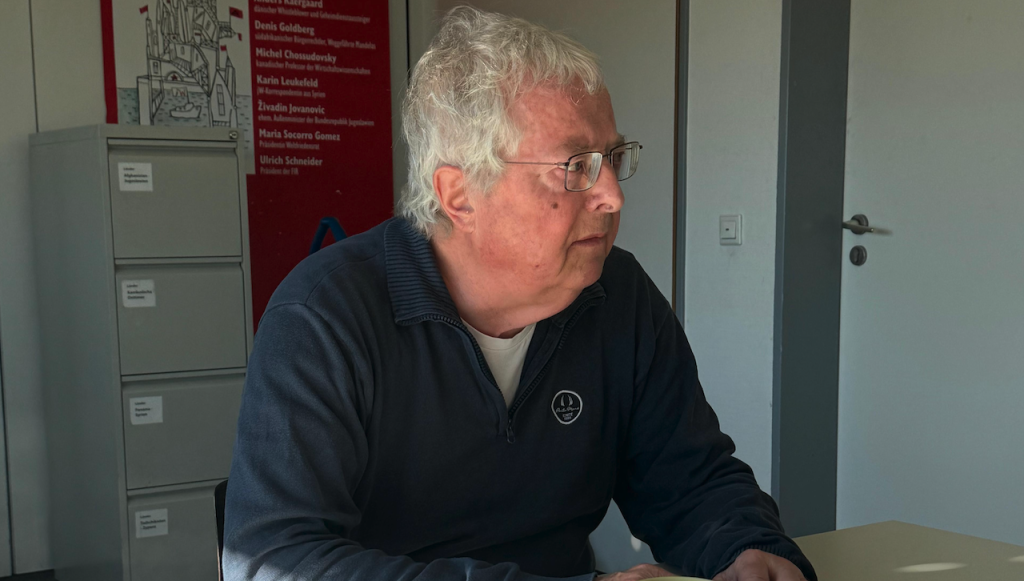
Arnold Schölzel
Where does the AfD fit into this picture, and what position does it hold? This party is polling at 30 percent—could you explain how the AfD positions itself regarding the war and in relation to German big business?
I think this is also an expression of the internal contradictions within German big business. They are not in agreement on policies regarding the war and relations with Russia, and fortunately, nothing has been decided yet. As I said, there is an aggressive faction; but alongside that, of course, there is also a sufficient number of companies and segments of capital that favor a reasonable policy toward Russia—one that seeks cooperation. There were many German companies at the recent International Economic Forum in St. Petersburg. Gerhard Schröder has now taken on this role at Globus. Other major German companies are also still operating in Russia. For example, Metro and the automakers haven’t shut all their doors. At least they haven’t completely abandoned their factories.
As for the AfD, in my view, it serves as a political reserve in the broader political landscape. In other words, I believe that in a situation where the economic crisis may be deepening and a political crisis is unfolding in the Federal Republic, the AfD acts as a “transatlantic right-wing” reserve—particularly, of course, to support the CDU.
Magdeburg [the capital of the state of Saxony-Anhalt] is perhaps a laboratory where such a scenario is being tested. There are also influential forces that have finally forced Friedrich Merz to tear down this so-called “firewall” (Brandmauer) against the AfD.
So far, it has been said that this is merely a rumor, but it is reported, for example, that Axel Springer CEO Mathias Döpfner has twice asked Merz to pursue a more cooperative policy toward the AfD. This is just a rumor, but it has never actually been denied either.
And Döpfner has very good relationships with Peter Thiel and Elon Musk.
He recently presented Peter Thiel with the Axel Springer Award and had a long conversation with him. And the truly interesting thing here—which reinforces the argument that Sevim Dağdelen and I have made regarding the AfD’s ties to the transatlantic right— —is Peter Thiel’s remarks, his lengthy conversation with Matthias Döpfner at the award ceremony, and now his connections with various figures from U.S. big business. For example, Jamie Dimon, CEO of JP Morgan Chase—the largest bank in the U.S.—says that what Trump is doing here is threatening our allies, presenting the withdrawal of NATO from Western Europe not as an actual policy but as a threat… Dimon said this is going in the wrong direction, that it’s the wrong policy, and that we need to “win back the old West.” This means reestablishing sensible cooperation not only with Western Europe but also with Japan, the Philippines, and South Korea—in other words, rebuilding the old West. He didn’t say what this means politically in terms of China policy, but I’m skeptical that it will be a good thing. Therefore, this will likely be more in line with the Democrats’ traditional policy: pursuing a more liberal stance domestically compared to Trump and the entire MAGA movement, but adopting a tougher stance abroad toward China and Russia.
And to me, it makes a lot of sense for them to ally with the AfD to reestablish the “old West.” For U.S. capital, this is probably more appealing than the U.S.’s confrontational policy toward Western Europe. But all of this is in such flux right now that it’s hard to say what kind of realistic policy will emerge from it. I have to admit that. In other words, things are at a stage where it’s difficult to say where they’re really headed. I’ll say it again: interests in Germany—within German big business—appear to be divided. There are at least two: an aggressive variant and a cooperative variant. The AfD likely serves both of them—it makes no difference to them. They are, as we might say, a “reserve force”—a recreational reserve for big politics. Whether this will actually materialize is another matter, depending on the CDU’s election results. There, Friedrich Merz is consistently dragging down the CDU’s vote share; so much so that the necessity of bringing the AfD on board is increasing rather than decreasing.
Of course, decisions are primarily made at the economic level, and these are later reflected in politics—including policy toward Russia and China. But as I said, it’s very hard to say which faction will prevail there.
Do you think the AfD will turn into a new CDU—or a “CDU 2.0”—once it grows large enough?
Absolutely. The AfD was a breakaway from the CDU. It was founded by CDU members. In East Germany—for example, in Saxony—its leadership consists primarily of former CDU members who came of age under Kurt Biedenkopf’s leadership in the 1990s. The AfD, which is particularly strong in Saxony, is, in my view, a product of the CDU.
Of course, it could always return. A shift toward radicalization could also occur; the AfD has brought together elements that were banned in the old CDU of the Federal Republic—namely, anti-Semites, racists, and supporters of the U.S. Open fascists are welcomed with open arms in the AfD. My view is this: The AfD is not a fascist party, but it is a party for fascists. Of course, radicalization could also occur in this context.
This also depends on developments within the EU. Take Italy, for example—things are going a bit differently there than expected; that is, there is no radicalization under Meloni. But if Marine Le Pen becomes president in France next year, we will likely have to reassess where things are headed here in Germany as well. Right now, so many things are up in the air.
Does the same apply to Die Linke (The Left)? Because I think I read an article in your newspaper, *Junge Welt*, suggesting that Die Linke is increasingly becoming the party of the urban, trendy crowd—in other words, sort of like a new SPD. Is that true?
Yes. Even though it won the election in Berlin, it’s constantly losing ground, especially in East Germany. Up until 10 years ago, its voter base across all of East Germany was around 20 percent; now it’s mostly below 10 percent, and here in Berlin there’s a notable exception where the vote largely comes from the immigrant population—or people of immigrant origin. Elif Eralp, the lead candidate, played a major role in this.
It’s also worth noting that there were 2.5 million eligible voters in Berlin, and because voting was permitted for the first time starting at age 16, there were a large number of young people. However, there was also a record number of people—1.4 million—who have lived in Berlin for years but lack the right to vote. These are, of course—I think nearly 1 million of them—people without German passports, which had never been seen before.
The Left’s entire platform, in my opinion, is indeed a social democratic one. I think it will be very difficult for the Left to repeat this election victory. They won’t be able to repeat this victory in future elections.
However, mainstream parties like the CDU, SPD, and the Greens seem to be trying to normalize the AfD by portraying Die Linke in Berlin as anti-Semitic or something similar. Because I’ve read some news articles or watched videos in publications like *Die Welt* where it’s claimed that the AfD is already more “normal” than Die Linke. Is it possible to use Die Linke to normalize the AfD?
Yes. When the AfD won the election in Saxony-Anhalt, [CSU leader and Bavarian State Premier] Markus Söder said this was democracy. But when the Left Party won in Berlin, he said, “We’ll cut off all the money we give them; we’ll do this, we’ll do that.” I can say that for the CSU and Markus Söder, the question is also about how to deal with the AfD, and I think they’ve already decided how to manage their policies regarding the AfD.
But there’s still a kind of division within the CDU regarding how to deal with the AfD. Because one part of the party wants to ban this party, while the other part says, “No, don’t do that.” Is it possible to ban this party?
The “C” in the names of the Union parties stands for “Christian.” There are major Christian churches—Catholics, Roman Catholics, and Lutherans—and they are very powerful within the CDU/CSU. And there are also Jews. Take Karin Prien, for example, the minister of youth and social affairs. Prien comes from a Jewish family, and I don’t think there would be any cooperation between her and the AfD, for instance. So you’re right, the CDU is also divided internally, and this will lead to major problems.
You mentioned China, but there have been many debates in Germany recently that are critical of China. I think for the past few years, both German government officials and major sectors like the automotive industry have been taking a cautious stance toward China. For example, they didn’t want any tariffs imposed on China. But recently, they’ve changed their stance and adopted a harsh rhetoric similar to that used against Russia.
No, the situation is more complex. Do you remember Annalena Baerbock, that famous foreign minister? She presented a China strategy, didn’t she? In that strategy, China was defined as a “partner, competitor, and systemic adversary.” The result was supposed to be “decoupling” [economic separation].
Looking at it today, I can say that this has failed. No one is talking about this China strategy anymore, and I think the strategy is only three years old. No one is talking about it anymore. Furthermore, “decoupling” later evolved into a cautious—very cautious—process of “risk reduction” [derisking]. These are the famous supply chain issues. In other words, you want to avoid putting all your eggs in one basket; you don’t want to remain dependent on shipments from China in the event of a crisis.
On the other hand, I visited China for the first time last year, and the Chinese press is writing things about German executives that are completely different from what you read here in the business section of the *Handelsblatt* or in the *Süddeutsche Zeitung*. German executives in China—especially in the automotive sector—are saying that we shouldn’t just manufacture here; we actually need to conduct research and development activities here as well.
BMW established its own research and development facility in China last year. The situation is the same for VW. The reasoning is this: They are, so to speak, at the forefront of the world—at the forefront of global technology—and if we aren’t part of that, we’ll miss out on opportunities in the global market.
For German companies, the issues at stake are now entirely different and strategic—not just in this sector, but in sectors like artificial intelligence as well. They’re stating this quite clearly: Germany has fallen so far behind in certain technical fields that it can only keep up by collaborating with China.
As for the tone in German politics… If I were in their shoes, I’d be cautious. Politicians have become more cautious in their stance, but the German media has not. Even in the business newspapers here, you don’t hear about what’s really happening technologically in China.
Of course, there are exceptions. Today’s economic section of *faz* reports that China has almost caught up with Nvidia in the software sector. Even just a short time ago, it was being said that China lagged months, even years, behind Nvidia and major U.S. tech companies in the field of AI software. Today’s *Faz* notes that the two are now very close and, above all, emphasizes that China’s strategy is to make everything open-source. This means it’s incredibly cheap and accessible to everyone. Consequently, *Faz* describes this, so to speak, as massive competition: The Germans will join this competition too; naturally, they’ll gravitate toward what’s cheaper, won’t they?
At the investment forum that began today (October 19) in Berlin, the Chancellor is expected to meet with Nvidia CEO Jensen Huang. In an interview he gave to the Bild newspaper in London just before heading to Berlin, he said it broke his heart to see how far behind Germany has fallen in the technology sector. According to him, Germany (after all, they’re always polite) has very talented people, but now they really need to get down to business.
To be honest, I was in China merely as a sort of political tourist, but when I read about what’s been happening in Germany, I learned this: an economic stagnation that’s been ongoing since 2019. We’ve been in a recession since 2019, and wages have been affected as well—which, of course, is a major source of discontent among the public. This is precisely the ground on which the AfD has actually grown.
The issue isn’t just peace with Russia; first and foremost, of course, it’s the loss of industry and blue-collar jobs. We’re talking about hundreds of thousands of jobs; in the automotive electronics sector alone, 10,000 jobs are being lost every month right now. The problem is that there has been a decline in investment. Foreign investment in Germany has not yet returned to 2019 levels.
That is precisely why we are organizing an investment summit like the one taking place here today. When I returned from China as a political tourist, I said, “One gets the impression—perhaps a bit exaggerated and not entirely accurate—that Germany resembles an industrial museum compared to China and what is on display there.”
This is a clear strategy, and the Federal Republic must confront it: I believe it is precisely this situation—this weakness and decline—that is the reason we are holding an investment conference here today. In other words, the aggressiveness in politics stems in part from this weakness. As we can see, we are losing ground, and that is a problem.
In France and other European countries, many groups—especially young people—are taking to the streets, but there’s no similar trend in Germany. For example, if we compare the number of participants at the peace rally we witnessed in Berlin three years ago with those at this year’s events, there’s a clear drop in attendance. What do you make of that?
That’s true. However, there has also been a “School Strike” ongoing in Germany for over a year now. In these protests, young people are mounting significant resistance against mandatory military service. Even though there isn’t the same level of street activism as in France, the School Strikes appear to be quite significant for a country like Germany.
¹ Roderich Kiesewetter: A CDU member of parliament and the party’s foreign policy spokesperson. He is known for his hardline stance toward Russia. Claudia Major: A German expert on security and defense policy born in East Berlin. While she argues that striking Russia’s interior regions is legitimate, her recent meeting with Chechen separatists also made headlines in Germany. (Editor’s note)