Middle East
Palestinian factions confront legitimacy crisis at Istanbul talks

A meeting organised in Istanbul by the Palestinian Dialogue Group has revealed that the election debate points to a crisis far larger than the ballot itself.
Elections are back on the agenda in Palestine. Yet a question looms larger than whether ballot boxes will be set up: can Palestinian politics overcome years of accumulated legitimacy crises?
At the gathering in Istanbul on 12 September, two figures close to Fatah and Hamas, an independent Palestinian researcher, and a journalist came together around the same table. Hosted and moderated by the head of the Palestinian Dialogue Group, Sadiq Abu Amer, the meeting included Mamoun Sweidan, who serves as an adviser at ministerial and gubernatorial rank in the Palestinian Presidency Court; Prof. Dr Maher Hamed Al-Houli, adviser to the head of the Hamas Political Bureau; and independent researcher and journalist Majed Azzam.
For Palestinian observers, one of the most striking aspects of the meeting was the gathering of senior figures from Fatah and Hamas circles in a debate of this scale for the first time.
To summarise the mood of the gathering in two sentences: the cause faces grave peril. Yet there is no magic formula to overcome the hurdles.
28 November: An election or a political turning point?
According to the timetable of the Palestinian Central Elections Commission, elections for the 132-seat Legislative Council are scheduled to take place on 28 November 2026 across the West Bank, East Jerusalem, and the Gaza Strip.
Candidate registrations will run from 26 September to 7 October, followed by the election campaign between 6 and 26 November.
If the polls go ahead, Palestinians will elect a new Legislative Council for the first time since 2006.
However, although the election timetable has been announced, political and on-the-ground conditions remain uncertain.
The new reality emerging in Gaza following the war, whether voting can be conducted in East Jerusalem, the Fatah-Hamas divide, and the future administration of Gaza represent core obstacles facing the vote.
The Central Elections Commission continues its preparations. Contacts are underway in Gaza with civil society organisations, political groups, and local actors, alongside inspections of prospective polling centres.
Yet criticism focuses on the very same point: preparations started late, and the feasibility of the 28 November timetable remains disputed.
It is precisely here that the election debate ceases to be a technical matter.
A legitimacy crisis accumulated over two decades
In Palestine, the problem is not merely when ballot boxes will be placed.
A new Legislative Council has not been elected since 2006. The Fatah-Hamas rift has become entrenched. The renewal of Palestinian political institutions and the transfer of power through the ballot box have failed to materialise.
For this reason, the planned elections are no ordinary vote.
If ballot boxes are re-established after a gap of nearly two decades, the issue will not merely be the selection of new lawmakers. Whether the Palestinian political system can regain legitimacy will also be put to the test.
Yet holding elections will not eliminate division on its own.
The fundamental question is this:
Will Palestinians respect the election outcomes even when the results fall outside their own political calculations?
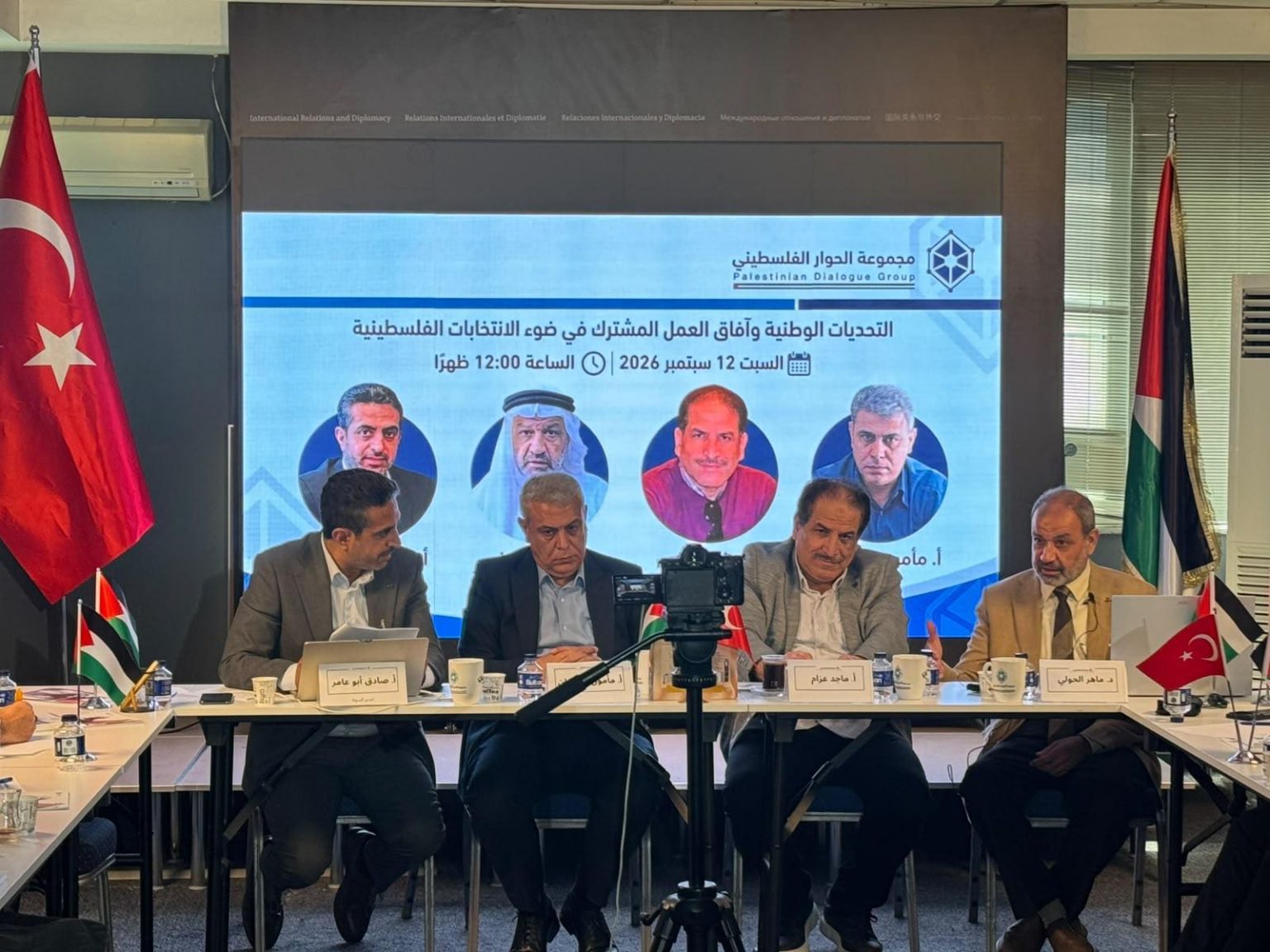

Sweidan: “We went from a national committee to a Peace Council”
The future of Gaza took centre stage in Mamoun Sweidan’s address.
Sweidan explained that following the war, the idea of creating a “national committee” composed of Palestinians to govern Gaza had been raised.
Stating that this committee needed to be formed within the institutional framework of the Palestinian National Authority, Sweidan noted that the political factions, foremost Fatah and Hamas, could not agree on representation quotas for the body.
The problem, in short, was this: everyone wants a national committee, but no consensus can be reached on who will sit on it and in what proportions.
According to Sweidan, prolonged delays eventually pushed the issue into a different arena.
Instead of a national committee, a dynamic emerged in which an international mechanism assumed a greater role in Gaza’s future.
At this point, Sweidan criticised Hamas.
In his view, the initial concept of a national committee established by Palestinians drifted towards an externally shaped “Peace Council” model.
This question lies at the heart of the debate:
Will Palestinians decide Gaza’s future, or will decision-making mechanisms shift increasingly into the hands of external actors?
Al-Houli: “We must not abandon elections”
Prof. Dr Maher Hamed Al-Houli, adviser to the head of the Hamas Political Bureau, argued that elections must not be abandoned.
Al-Houli noted that the election call should be approached positively. However, he stressed that Palestinians must base their decisions on the broader national interest rather than external pressures.
Recalling the 1996 and 2006 elections, Al-Houli maintained that those polls were fair and transparent.
He stated that both Palestinian factions and the international community must respect the results emerging from the ballot box.
Another topic Al-Houli highlighted was societal participation.
He noted that families, clans, mukhtars, opinion leaders, and reconciliation figures could assume a more active role in the electoral process.
He suggested that these actors should not only guide voters to the polls, but also play a part in resolving disputes between Fatah and Hamas. He added that they could even participate in the elections through independent candidates or electoral lists.
Al-Houli’s approach thus shifted the election discussion to another dimension:
Will a new election merely refresh the old political structure, or will it open the path for new actors to enter politics?
Azzam: “In my view, elections will not take place”
Independent researcher and journalist Majed Azzam took a more distant view of the electoral timetable.
Stating that he was speaking neither pessimistically nor optimistically, but offering a realistic and objective assessment, Azzam said: “In my view, elections will not take place, and I am saddened by this.”
Azzam’s primary objection rests on an assertion broader than the election date itself.
According to him, electoral rhetoric could be a “smoke grenade” concealing an entirely different political process.
Azzam raised the claim that preparations are underway to form the Palestinian National Council through appointment rather than through elections.
If this claim proves true, the direction of the debate changes completely.
The question then ceases to be “When will elections occur?” but rather “If elections do not take place, how will the Palestinian political system be reconstituted?”
Can there be an election without Gaza?
The fate of Palestinian elections cannot be separated from Gaza.
The commission is proceeding with technical preparations. However, the destruction wrought by the war in Gaza, the dispersal of the population, infrastructure breakdowns, and disputes over future governance pose severe challenges to the electoral process.
Alongside this, the question of East Jerusalem remains unresolved.
Consequently, 28 November is not merely a matter of ballot boxes.
Under which political framework Gaza will be governed, how election results will be implemented there, and how relations between the Palestinian Authority and Hamas will be structured are all components of the same equation.
A new generation enters politics
Another critical reality is demographic shift.
Since the 2006 vote, an entire Palestinian generation has reached adulthood. A substantial proportion of these individuals have never cast a ballot in any general election in their lives.
Therefore, if elections take place, a new Legislative Council will not be all that is chosen.
Simultaneously, a new generation of voters will become direct participants in political decision-making for the first time.
For this reason, how youth, independents, and societal actors will be integrated into the political system stands as another major subject within the election debate.
A common goal, divergent roadmaps
It is not possible to say that the Istanbul meeting produced a shared political roadmap.
Sweidan advocates safeguarding Palestinian institutions and national decision-making, arguing that Gaza’s future must be determined within a Palestinian framework. He considers Hamas’s posture to have created fertile ground for external actors to intervene further.
Al-Houli says elections must not be abandoned. In his view, elections should reflect the will of the Palestinian people rather than external pressures, and societal participation must be expanded.
Azzam, by contrast, does not believe elections will be held at all. He suspects that another political restructuring may be underway behind the cover of the election debate.
Where these three approaches converge is far more significant:
The Palestinian cause confronts a profound existential crisis.
The future under debate is not simply that of Hamas or Fatah, but that of the Palestinian political structure as a whole.
Elections are not a magic formula
This remains one of the strongest messages left behind by the Istanbul meeting.
Elections may be vital for renewing legitimacy. Yet they cannot end division on their own.
They may establish a new Legislative Council. Yet they cannot resolve all the problems of the Palestinian political system.
They may bring youth and independents into politics. Yet the factions must accept the outcome of the vote.
For this reason, the significance of 28 November reaches far beyond the ballot box.
If elections are held, a new political space will open before Palestinians.
If they are not held, the question of how to fill the political vacuum will grow even larger.
And perhaps the real question will be this:
Will 28 November mark another milestone in years of ongoing division, or will it herald the beginning of renewed unity in Palestinian politics?
We shall see together.
For now, the only certainty is this: the question of elections in Palestine is no longer merely a question of elections.