
Diplomacy
US midterm losses will turn Trump into a lame duck, Prof. Doster says

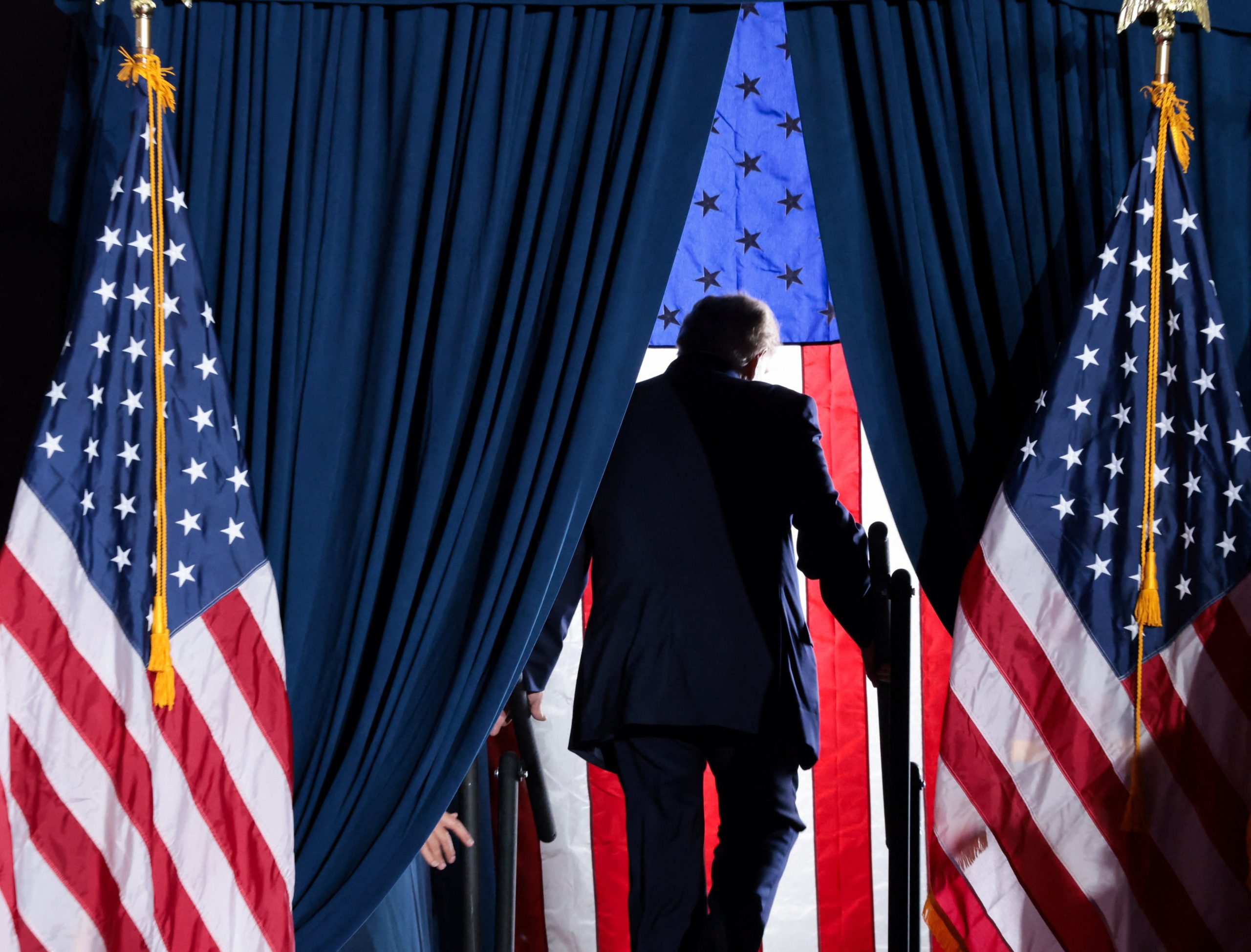
In an in-depth geopolitical evaluation broadcast, Turkish academic and international relations specialist Professor Dr Barış Doster, a faculty member at Marmara University, joined Harici YouTube channel to analyze the domestic dynamics and sweeping foreign policy consequences of the US congressional midterm elections.
The comprehensive discussion examined the prospect of a fractured mandate for the administration of US President Donald Trump, assessing the direct ramifications for Washington’s strategic posture across the Middle East, the grinding war in Ukraine, and great-power competition with Beijing and Moscow ahead of the Asia-Pacific Economic Cooperation (APEC) Leaders’ Summit in Shenzhen.
Setting the framework of the broadcast, journalist Elif İlhamoğlu Akkoç noted that voters across the US were heading to the ballot box for the pivotal midterms to determine the composition of the entire 435-seat House of Representatives and 35 seats of the 100-seat Senate. She observed that nationwide survey averages pointed to prospective Democratic leads in both chambers, even as battleground states such as Michigan, Texas, Kansas, Alaska, and Ohio remained decisive in establishing the legislative arithmetic that will govern the remaining two years of Trump’s presidential term.
“A Trump who has fallen into the minority in both wings of Congress”
Addressing the electoral dynamics, Doster pointed out that the volume of early and advance voting across the US had surpassed previous cycles, signaling an elevated level of voter turnout. Doster highlighted that polling and public opinion research organizations indicated a very high likelihood of a Democratic majority in the House of Representatives, alongside the distinct possibility of Democrats securing the Senate leg of Congress as well.
“If these polls, these surveys are correct, and you know I am not someone who has good relations with pollsters, this is highly probable,” Doster said. Evaluating the immediate domestic institutional impact, he explained: “A Trump who has fallen into the minority in both wings of Congress, a Trump who has fallen into a ‘lame duck’ status in US political science terminology, considering the social, cultural, class, political, and ideological divisions, fault lines, separations, and polarizations in the US, will be a Trump whose hand is very weakened.”
Doster maintained that an opposition-controlled legislature would actively seek to constrain executive authority, forcing the administration into constitutional confrontations and unilateral maneuvers. “The Democratic majority in both wings of Congress, if that is the case, we do not know yet because we do not have the election results, will try to restrain and check Trump as much as possible,” Doster said. “And in return, what will Trump do? He will try to get things done with executive orders to the extent that the US system allows. He will use his veto card, and so on and so forth. So, in the coming days, if Trump loses the majority, whether in one wing or both wings, it means bigger tensions and bigger debates await us in US politics. Will this inevitably reflect on US foreign policy as well? Yes, it will reflect.”
“The US voter cares more about their car’s fuel than where their soldiers are occupying”
Responding to questions from İlhamoğlu Akkoç regarding Trump’s campaign pledges to suppress inflation, improve everyday living conditions, and terminate overseas military interventions, Doster stressed that fundamental economic determinants consistently outweigh foreign policy considerations in voter psychology worldwide.
“My dear colleague Elif, you and I, in all the books written about voter behavior in the world, all research conducted, and all articles penned, what always emerges most clearly? This emerges. What is the most important, primary factor influencing voter behavior? It is the economic trend,” Doster said. “It is the cost of living, inflation, unemployment figures, and so on and so forth. This is as valid for our voters as it is for US voters.”
Weighing the political durability of security developments against domestic material welfare, Doster continued: “Does your success in foreign policy affect the voter? It does. But if there is inflation, high cost of living, poverty, and unemployment, that effect remains limited. Does a success in foreign policy or, say, the fight against terrorism affect the voter? Undoubtedly, it does. But is its impact on the voter, its lasting effect in the eyes of the voter, longer, or is the government’s success in the economy longer-lasting? Of course, economic success is longer-lasting.”
Doster observed that empirical voting patterns affirm this persistent reality: “What have we been saying together in our programs from the beginning? The US voter cares more about their car’s fuel, their fuel, their gallons, their gasoline, than where their country or soldiers are occupying. And these polls and other articles written regarding the US elections have confirmed both you and me. It has reaffirmed it once again. So, the voter here is not looking at whether Trump pulls out troops or not, or his success regarding the Russia issue. The voter will cast their vote at the ballot box by considering the money entering or leaving their pocket.”
“Every country has its own unique conditions, realities, and political climate”
The dialogue subsequently reviewed broader international electoral contests, with İlhamoğlu Akkoç noting political reverses for Trump-aligned figures globally, including Viktor Orban in Hungary, Jair Bolsonaro’s political camp in Brazil following Luiz Inacio Lula da Silva’s presidential triumph, and Prime Minister Benjamin Netanyahu’s inability to capture a governing majority in Israel’s Knesset.
Doster cautioned against conflating disparate national electoral results into a single international verdict on Trump, arguing that every sovereign state operates within its own localized socio-political parameters. “Now, every country’s own social, historical, political, cultural, class-based, and economic reality is different,” Doster stated. “Undoubtedly, voters with very high political consciousness or those who look at life from an anti-imperialist perspective like you and me might be happy that the candidates Trump supported lost. But what is the percentage of these voters? That is what needs to be asked.”
Analyzing the Brazilian presidential election, Doster recalled the structural strengths of Latin America’s largest nation, highlighting its independent defense and civil aviation industries. He underscored the turnaround achieved by Lula da Silva after trailing in the first round: “In the first round of the presidential elections, Lula da Silva was behind. It even caused a bit of pessimism. What happened? He had a very successful term. He operated very powerfully on social media. His fans and supporters ran a very strong campaign, and in the second round of the election, Lula da Silva, who was behind in the first round, caught up, smashed through, and took it.” Referring to former Brazilian President Jair Bolsonaro, whom Doster recalled labeling the “Tropical Trump,” he remarked on his post-election departure to the US: “As soon as he saw the results, he fled to the US. This should not surprise us.”
Nevertheless, Doster dismissed broad-brush interpretations: “Can one draw the conclusion that voters and citizens in different parts of the world are sending a message to Trump, based on Lula da Silva’s success, Orban’s failure in Hungary, or the fact that the genocidal murderer Netanyahu, despite being the largest party, could not secure enough seats in the Knesset to form a government alone? I do not think that conclusion follows. Because every country has its own, in legal terminology they call it sui generis, right? Its own unique conditions, realities, political climate, priorities, social and political demands, and expectations.”
“I do not see a nuclear option on the table”
Turning to tensions in the Middle East and assertions voiced by figures such as US commentator Tucker Carlson, alongside reporting in publications like The New York Times and The Washington Post suggesting prospective post-election US military strikes against Iran, Doster offered a skeptical assessment regarding the likelihood of an all-out military confrontation.
“As you will remember from our previous programs, I said that there would be some tensions around the Strait of Hormuz, some armed skirmishes, and some airstrikes by US imperialism,” Doster noted. “But, like that 40-day continuous, intense, uninterrupted bombardment we witnessed in recent months; a ruthless, barbaric massacre or a genocidal attack targeting all of Iran’s military targets, civilian targets, infrastructure, energy facilities, and even hospitals and schools in Iran, no, I said I do not expect that.”
Doster argued that domestic legislative gridlock and social polarization within the US would curtail executive militarism abroad. “Especially after the elections, I think a Trump who has lost both wings, both the Senate and the House of Representatives, will not have the same audacity he had before the election and will be more cautious,” Doster said. “Also, this polarization in US politics exists within US society as well; whether in terms of wealth and poverty, between whites, Hispanics, Latinos, and African Americans, or between Republicans and Democrats. As long as this polarization, this division, and this tension, in the sense of states bordering the ocean, more liberal states, and the more interior states, continues, and to the extent that it becomes cemented by these election results, I think Trump’s hand is weaker, will be weaker, and this will inevitably be reflected in Iran policy as well. Especially no matter how much the murderous, genocidal Netanyahu encourages or provokes it, I do not see a nuclear option on the table.”
“Iran has shown it possesses the military capacity, courage, and will to strike”
Weighing domestic political instability in Israel, where Netanyahu’s Likud emerged as the largest party but fell short of the 61-seat threshold in the 120-seat Knesset, İlhamoğlu Akkoç raised whether Netanyahu might initiate an aggressive foreign diversion against Iran to consolidate domestic power ahead of potential early elections, especially against rivals such as former Chief of General Staff Gadi Eizenkot.
Doster acknowledged the risk of political provocations while maintaining that structural strategic factors prohibit an unconstrained assault. Addressing Netanyahu’s domestic maneuvering, Doster remarked: “By pushing security-oriented rhetoric, by pushing the external threat, the Iran threat, to the forefront just as he consolidates his own voters, could he engage in every kind of provocation in the event of a possible election renewal or repetition, just to complete those missing seats? Yes. This genocidal, this murderer can do it. As he has done in the past.”
However, Doster outlined three critical barriers preventing such escalation: “One, a nuclear option means that Iran would also retaliate on the same scale with all its means and capabilities. Two, putting such a madness, such an option into play means further increasing the anti-Israel sentiment that has already risen and damaging the support for Israel, which has already hit rock bottom in global public opinion, including in the West. And a third point is this: Iran has shown repeatedly so far that it possesses the military technological capacity, the courage, and the will to strike Israel, and that it has an inventory and stock of weapons beyond what was estimated.”
Doster observed that Washington’s operational limits restrain Israeli action: “That is why I believe that Israel, while receiving all kinds of support from the US but not receiving it on the field, without receiving support on the field, in the combat zone, in the theater of war, and receiving all other kinds of US support outside of that, I do not think Israel could attempt such a thing from here on out, just as it has not dared to until now. In that case, I foresee that the Iran war will perhaps not flare up but rather dampen, in parallel with the election results.”
“Russia will not withdraw from the field without getting what it wants”
Shifting the discussion to the conflict in Ukraine, İlhamoğlu Akkoç pointed out that Trump’s stated ambition to settle the fighting within a week had stalled amid protracted positional warfare, even as prospective tripartite negotiations involving delegations from the US, Russia, and Ukraine were scheduled for 10-11 November in Abu Dhabi.
Reviewing Moscow’s operational characterization of the conflict, Doster said: “The Russians, in the Ukraine War, stated that they were primarily fighting against NATO, the Atlantic, and the West, and that they understood the military operation towards Ukraine as a special military operation. And they stated it repeatedly. When there was an armed Russian intervention into Ukrainian territory, there was an act of aggression. They said, ‘No friend, this is not like that.’ What did they say in their own terminology? They said this is a special military operation. They said, ‘We are fighting the real war against the West.'”
Assessing the trajectory of the campaign as it passes roughly its fifth year, Doster acknowledged that operational timelines had expanded: “Is there the desired speed from Russia’s perspective? Has the desired military and political result been achieved so far? No, it has not. It is Ukraine’s resilience and resistance, but not Ukraine’s own dynamics alone. You might say factors outside of Ukraine. Call it US support. Call it private military companies. Call it Europe’s support. Call it foreign intelligence. Call it whatever you want.”
Nevertheless, Doster argued that strategic realities ultimately favor Moscow: “At the end of the day, Russia is Russia. Russia will get what it wants. It will not withdraw from the field without getting what it wants. Russia will not walk away from the table. And at the end of the day, no matter how much Ukraine resists, it is the losing side. Well, whether this period will be 5 years, 6 years, 8 years, or 10 years, we cannot estimate that right now. But at the end of the day, Russia is the winner, a winner even if the cost is heavy. Ukraine will be the losing side in the end, even if it resists.”
“Ukraine will appear as a state with shrunk territory and battered industry”
Detailing the structural fallout for Ukraine, Doster outlined four enduring territorial and socioeconomic consequences: “One, Ukraine emerges somewhat smaller. It loses territory. Two, it also loses a portion of the Ukrainian cities and Ukrainian territories that border the Black Sea, that have a coast on the Black Sea. Three, with its industrial infrastructure heavily battered, it will rise from the war table. It will sit at the negotiation table like that. It will sign the peace like that. Four, it is a side that has lost its people very seriously. There is a serious loss of life in both Ukraine and Russia. Plus, in Ukraine, beyond those who died on the front, there is also an intense migration to the West. There is a qualified brain drain taking place.”
Summarizing the future configuration of the Ukrainian state, Doster said: “So, at the end of the day, Ukraine will appear before us as a state with a very weakened industry, its qualified people having left the country, its territory shrunk, and as a mediocre agricultural producer and grain producer. But whether it is 5 years, 7 years, or 8 years from today, I cannot know that right now.”
Regarding the outcome for Moscow, Doster concluded: “Although Russia is also battered, has lost many people, and is economically tired and worn out, at the end of the day, it achieves a great gain even if the cost is high. Ukraine’s NATO membership will be out of the question. Other neighboring countries considering NATO membership will also have to reconsider their decisions.”
“Foreign policy is a continuation of domestic policy”
Concluding the interview, İlhamoğlu Akkoç drew attention to the forthcoming APEC Leaders’ Summit scheduled for 18-19 November in Shenzhen, China, where Trump is expected to convene alongside Chinese President Xi Jinping and Russian President Vladimir Putin amid ongoing diplomatic talks over Ukraine and Iran.
Asked whether tangible accords could emerge from the tripartite gathering, Doster expressed deep skepticism, tying diplomatic bargaining power directly to electoral legitimacy: “There will not be any concrete outcome. If Trump emerges defeated in today’s elections, Trump will arrive at that table as a, to use the term from US literature, a lame duck. What do we always talk about? We talk about this in our lectures. That foreign policy is a continuation of domestic policy. Since there will be a weak Trump at the table, nothing will come out of it.”
Contrasting Trump’s political vulnerability with the institutional positioning of his counterparts, Doster underscored Beijing and Moscow’s consolidation: “Plus, there are two other strong leaders at that table alongside Trump. Okay, Trump is the US president, but who are the leaders beside him? The Chinese leader and the Russian leader. China is currently a great power that knows time is on its side. A strong economy. Russia, yes, it did not get what it wanted in Ukraine in the first year or the first two years. Things dragged on a bit. Things got a bit complicated, as you would put it, but in the end, Russia is still Russia.”
Doster observed that Western forecasts regarding Russia had failed to materialize: “Russia did not take a step back as a result of the expectations and wishes of Western commentators and analysts. It did not collapse either. It did not give up either. What were they saying? They were saying, domestically, the people will revolt. The Putin regime will be toppled. Russia will collapse and fall apart. None of these happened. Russia showed that its military resistance, its political resilience, and even its economic endurance were far stronger than what the Westerners had estimated, expected, or desired.”
“A US president whose hegemony capability is declining has the weakest hand”
Doster summarized the balance of power at the upcoming summit table, emphasizing that structural domestic decline directly diminishes external projection: “So, Putin also has a strong hand at that table. Xi Jinping already has a strong hand. But if the election results today go against Trump, who is the person who will sit at that table with a weak hand? It is the US president.”
Broadening his assessment to Washington’s standing on the global stage, Doster observed: “Let us move from domestic politics to foreign policy. The candidates he supported have lost the election. A US president whose economy is not doing well, whose imperialist capacity, hegemony capability, and global dominance are weakening and declining, is the leader with the weakest hand among the three sitting at that table, not just due to domestic politics, but due to foreign policy as well.”





Ukraine is expanding its attacks on Russian vessels from the Black Sea toward the Mediterranean and Baltic Seas, drawing both regions further into the war.
Over the weekend, Ukrainian drones struck two Russian vessels in the Libyan city of Benghazi, sinking a frigate.
In March, a fully laden Russian liquefied natural gas (LNG) tanker in the Mediterranean was severely damaged by Ukrainian maritime drones, narrowly averting an environmental disaster.
Since Kyiv began attacking civilian Russian vessels in the Baltic Sea with drones, state agencies in Finland have also been warning of an environmental disaster.
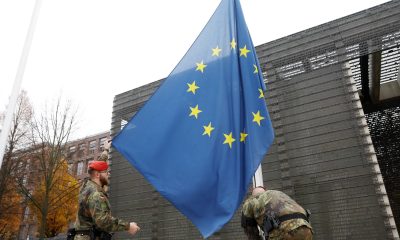
Uncertainty is also growing in the Baltic Sea for civilian vessels belonging to EU member states. Ukraine’s wartime actions are accompanied by measures taken by the EU and individual EU member states against Russian merchant ships.
These vessels, subject to EU sanctions, are described as a “shadow fleet” and are increasingly being boarded by EU military personnel.
This is now happening not only in the Baltic Sea, but also in the Mediterranean and the Indian Ocean.
The EU and “shadow fleet” battles in the Baltic Sea
Non-combat operations against Russian merchant vessels in the Baltic Sea have been conducted for some time by various EU member states.
In every case, the target is vessels belonging to the “shadow fleet”. These are Russian tankers or cargo ships placed under EU sanctions and therefore barred from calling at EU ports or using services from EU countries.
This includes insurance services in particular, as the United Kingdom has complied with the sanctions in principle, affecting British insurance companies that hold a particularly large share of the market.
Contrary to how European politicians and the media frequently portray it, trading with “shadow fleet” vessels is not illegal, because EU sanctions apply only to EU countries and not to the rest of the world.
Some EU member states, such as Germany, Finland, Sweden and Denmark, persistently look for pretexts to detain “shadow fleet” vessels.
However, this is permissible at most within the zone extending 12 miles off their own coasts, where national laws apply.
Because attempts to board and even seize Russian ships continue, soldiers are increasingly travelling aboard these vessels; some Russian merchant ships are escorted by warships.
EU expands maritime policing role toward the Indian Ocean
Meanwhile, some EU member states and the EU as a whole are also taking action against Russian vessels in the Mediterranean and the Indian Ocean.
In the Mediterranean, troops operating under the EU’s Operation EUNAVFOR MED IRINI have repeatedly boarded Russian merchant vessels on allegations that they were sailing under false flags.
On August 2, for instance, Italian military personnel boarded the tanker Toa Payoh by helicopter while it was en route from Cotonou in Benin to Istanbul. Authorities claimed this was a legal inspection.
Similar actions took place on August 31 and most recently on November 13.
The EU has now included measures against the Russian “shadow fleet” in Operation IRINI’s official mandate. In doing so, the EU is increasingly assuming the role of the world’s policeman.
France has now gone so far as to tow Russian ships in the middle of the Indian Ocean. On October 12, French troops boarded the tanker DF Peak roughly 830 kilometres south of the French colony of La Réunion and began towing the vessel toward the island.
Russia’s Embassy in Paris described the action as a “blatant violation of international law”, which fundamentally guarantees freedom of navigation for all, and termed it “outright piracy”.
Ukraine takes the war to the Mediterranean
Ukraine, meanwhile, has for some time been going a step further: using military force at sea against civilian Russian merchant vessels, and no longer only in the Black Sea, where it is a littoral state.
Since December 2024, Russian vessels in the Mediterranean have repeatedly been attacked and severely damaged by sea mines or maritime drones; since December 2025, they have also been targeted by aerial drones.
On March 3, 2026, Ukraine attacked the Russian LNG tanker Arctic Metagaz, which was bound for Egypt, using maritime drones likely launched from Libya.
The Security Service of Ukraine (SBU) is believed to be behind the attack. The tanker was carrying 62,000 metric tonnes of LNG.
The vessel drifted in the Mediterranean for more than two months; an environmental disaster was narrowly averted.
Over the weekend, two more attacks took place in the port of Benghazi off the Libyan coast using maritime drones.
A Russian cargo ship was severely damaged, and a Russian Navy frigate was sunk.
Libya is effectively divided in two. While Russia cooperates with the eastern part of the country around Benghazi, Ukraine is reported to have signed an agreement with the Tripoli government on a military presence in western Libya, enabling the launch of drone attacks.
Drone strikes threaten civilian shipping in the Baltic Sea
In its latest move, Ukraine is expanding drone strikes against Russian ships, including civilian merchant vessels, into the Baltic Sea.
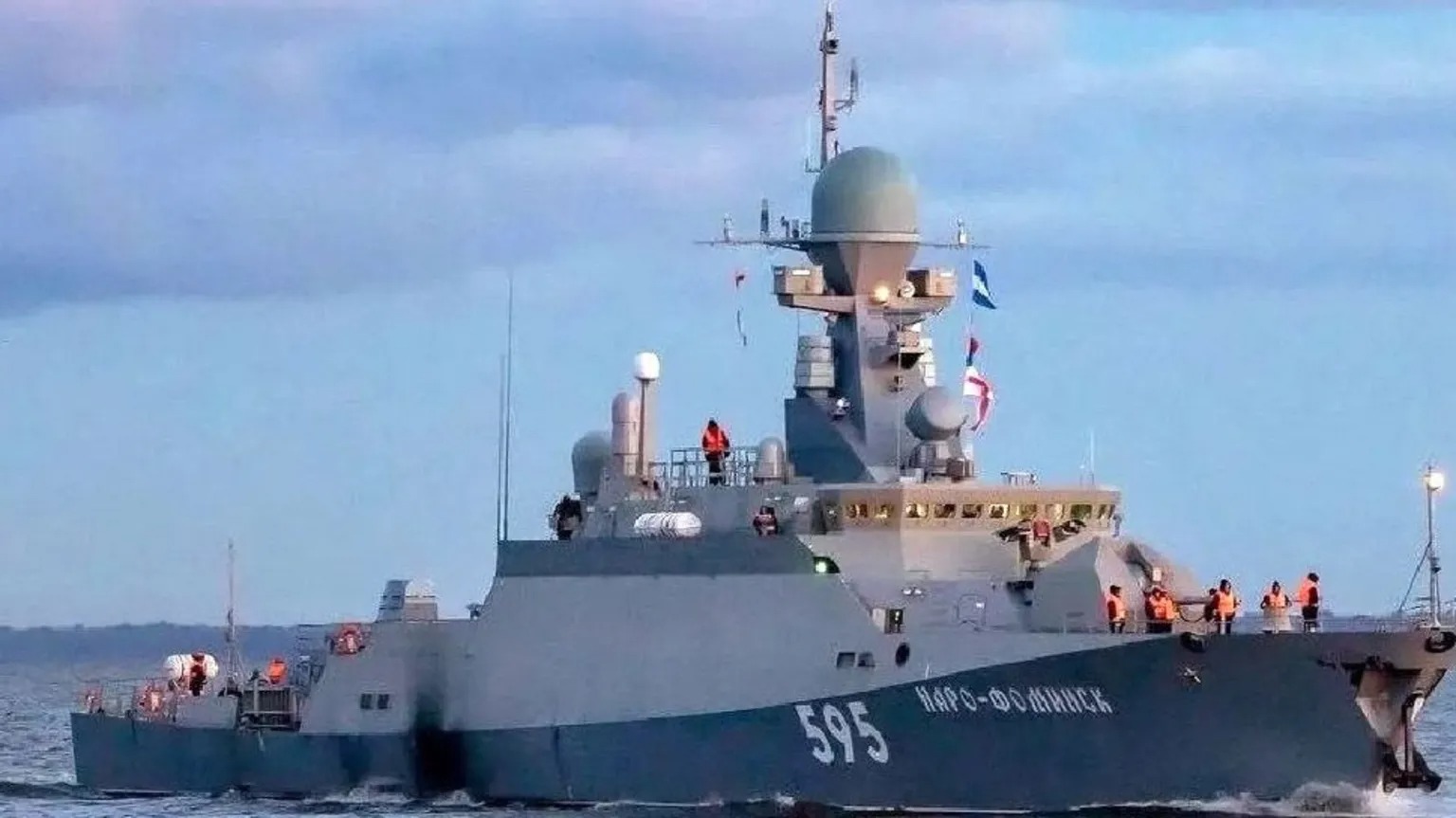
On November 11, near Russia’s Gogland Island in the maritime triangle between Russia, Finland and Estonia, Ukrainian drones attacked the Russian Navy’s Buyan-M class missile corvette Naro-Fominsk.
The incident marked the first known drone strike on a Russian warship in this part of the Baltic Sea.
The Naro-Fominsk had previously escorted vessels belonging to the “shadow fleet” to protect them from attacks by EU member states.
Ukraine’s attack can therefore also be interpreted as a step that paves the way for such strikes. Ukraine’s security service, the SBU, announced that it targeted the Naro-Fominsk as part of a broader drone operation against Russia’s Ust-Luga oil export terminal on the Baltic coast.
The SBU described the Russian vessel as a small Buyan-M type corvette carrying Kalibr and Oniks cruise missiles. There were also unconfirmed reports that Russian combat helicopters had been destroyed.
On Saturday, an attack was carried out on the cargo ship Sparta II; the vessel was severely damaged west of Gogland and is currently being towed to Russia. An environmental disaster was narrowly averted in this incident as well.
At the same time, civilian maritime shipping, including that of Western European countries, faces a growing danger of collateral damage caused by misdirected or downed drones.
If Ukraine destroys a Russian tanker in the Baltic Sea off the coast of Finland, where the Sparta II was hit, an oil spill off Finland will be virtually inevitable.
The same applies to Estonia and other countries bordering the Baltic Sea. In this way, Kyiv is dragging further parts of Europe into the war.
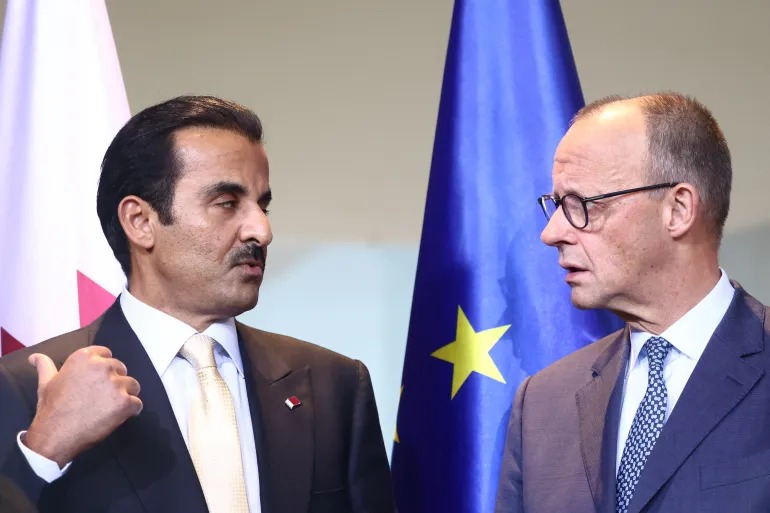
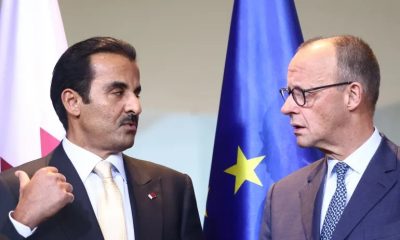
Qatar’s Emir Sheikh Tamim bin Hamad Al Thani held talks with German leaders in Berlin on expanding defence and diplomatic cooperation.
At a joint press conference with the emir on Friday, German Chancellor Friedrich Merz stated that Qatar had committed to an additional 15 billion euros ($16.5 billion) in investment, while the two governments planned closer cooperation in the fields of security and technology.
Merz noted that the investment would strengthen cooperation in artificial intelligence (AI), computer chips and aviation. He also expressed Germany’s interest in establishing partnerships with Qatar in the defence industry, while the two countries agreed to work together to improve protection against cyberattacks.
Sheikh Tamim also held talks with German President Frank-Walter Steinmeier, who proposed a regional security conference for the Middle East.
According to a joint statement from both countries, Friday’s talks addressed efforts to end the war against Iran and restore maritime traffic in the Strait of Hormuz.
Steinmeier proposed bringing regional governments together to build trust and resolve security disputes.
The emir invited Steinmeier to the Doha Forum, an international policy conference to be held in Qatar on December 5-6, to discuss the proposal in greater detail with other countries.
During the emir’s press conference with Merz, the German leader commended Qatar’s role in mediating between the US and Iran and called for the permanent reopening of the Strait of Hormuz. He also urged Tehran to halt its military nuclear programme.
Sheikh Tamim stressed that “peace and sustainable peace and security can only be achieved through a political settlement”, adding that dialogue was the only way forward. He also described Germany as an important partner.
Sheikha Alanoud bint Hamad Al Thani, a fellow at the Middle East Council on Global Affairs, a regional research institute, told Al Jazeera in Berlin that relations had previously been based primarily on trade.
“Now, however, we are seeing a strategic dialogue,” Sheikha Alanoud said, pointing to increasingly similar security concerns, including drone attacks targeting Qatar and hybrid warfare threats facing European countries.
This shift builds on a 2023 agreement to launch formal strategic talks between the two countries.
According to the Qatar News Agency (QNA), Sheikh Tamim told Steinmeier on Friday that Qatar wanted the first round of talks to take place.
Al Thani also met with Dr Hans Dieter Potsch, chairman of the supervisory board of the Volkswagen Group, and his accompanying delegation at his residence in Berlin on Friday.
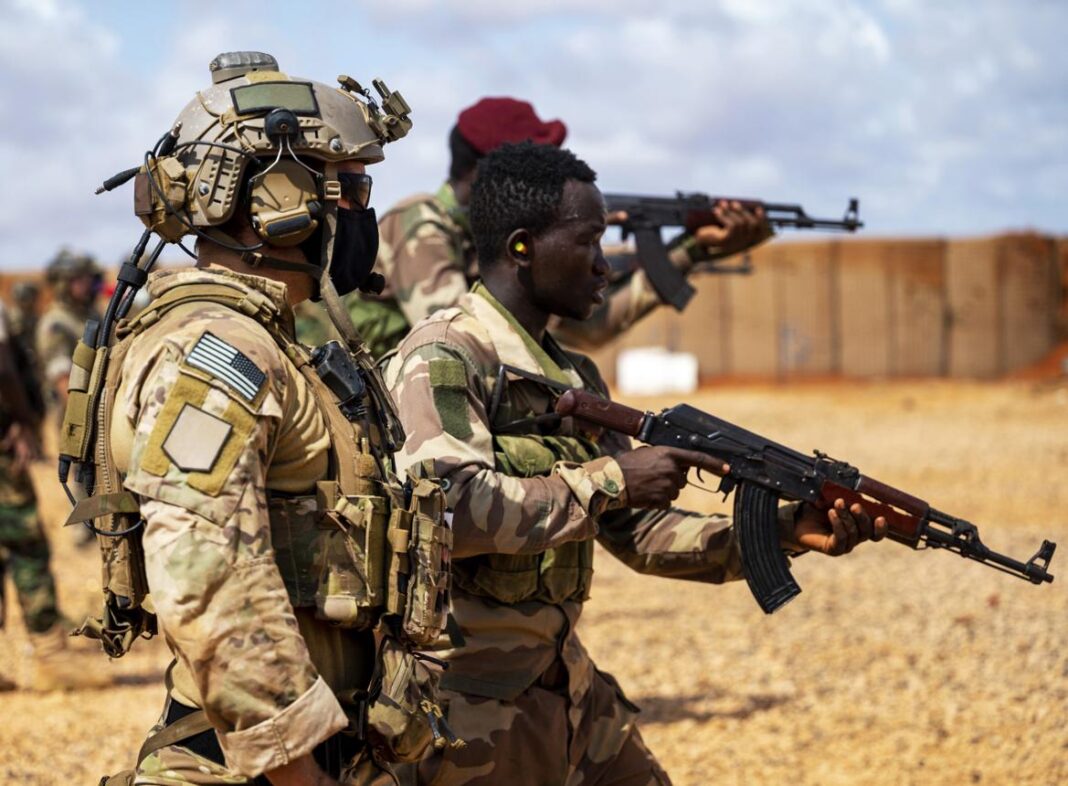
US military officials are reportedly preparing to return to base after an American security contractor operating in Somalia signed a new agreement covering the training and support of Somali security forces.
Having recently departed Baledogle Airfield in Somalia’s Lower Shabelle region, US officials plan to resume operations at the facility this week.
Meanwhile, recruitment has reportedly begun for new groups of Danab special forces personnel who will receive training and support from the US.
Bancroft Global Development, a contractor that has operated in Somalia for years providing military training, security assistance, and capacity-building, reportedly signed the new contract, paving the way for operations at the base to resume.
For an extended period, Bancroft Global Development has been involved in supporting and training Somali security forces, particularly the Danab forces, who play a critical role in the fight against Al-Shabaab.
Reports of activities resuming at Baledogle may be linked to efforts aimed at further strengthening the capabilities of the Danab forces, who are frequently deployed in combat missions and special operations targeting armed groups.
The formation of new Danab units may also indicate ongoing plans to train and develop Somali security forces in order to enhance their operational capabilities, combat skills, special operations capacity, and coordination with other security forces.
Located in Somalia’s Lower Shabelle region, Baledogle Airfield is one of the key installations supporting the training and development of Somali security forces, particularly the Danab special forces.
The base has long been associated with US military support. If confirmed, the return of US officials could signal continued military cooperation between the two countries, despite recent reports that US personnel and employees had withdrawn from the facility.
This development also comes at a time when Somalia is pursuing reforms to restructure its security forces.
The Federal Government continues to rely on support from international partners to bolster its military capacity and intensify operations against Al-Shabaab.
As one of Somalia’s most significant security partners over many years, the US provides assistance to Somali forces, particularly the Danab brigade, while simultaneously conducting operations targeting Al-Shabaab.
Furthermore, it has been reported that the US has extended its support for the AUSSOM and UNSOS missions to sustain security operations in Somalia and assist African Union forces operating in the country.

Politico weighs five scenarios for future Russia-Europe security talks

Jared Kushner warns Israel risks becoming a “global pariah”

Gulf states spend at least $6.7 billion extra on subsidies

Ukraine expands maritime strikes against Russian ships to three seas

Qatar pledges 15 billion euros in investment to Germany
-

 Opinion1 week ago
APEC Summit: How China Uses the Art of “Emotional Value” to Deal with Trump
-
 America2 weeks ago
Absent Democrats derail floor vote on Pete Hegseth impeachment
-
 Middle East2 weeks ago
Journalist Dursunoğlu warns Iran removed missile limits as Gulf risks widen
-
 Europe2 weeks ago
Germany threatens EU budget veto over long-term Ukraine aid
-
 Russia2 weeks ago
Europe ready for arms and missile control talks with Russia, FT says
-
 Russia2 weeks ago
US raises NATO-style guarantees for Kyiv ahead of Abu Dhabi talks
-
 Europe2 weeks ago
Fico accuses Merz of blackmail over threat to veto EU budget
-
 Diplomacy2 weeks ago
Vance leads indirect push for US-Iran ceasefire and nuclear talks
