Diplomacy
While the West breeds crises, Eurasia weaves peace and development, says Prof. Zhang

Editor’s note: Prof. Zhang Weiwei, Director of the China Institute at Fudan University and former interpreter for Deng Xiaoping, evaluated the imperatives of a multipolar world and China’s global role as a “civilization-state” at the East-West Forum held in Istanbul on September 25-26. Highlighting China’s distinct framework that integrates ancient history with modern capacity, Prof. Zhang underscored the tangible benefits that meritocracy, public order, and a peace-oriented approach deliver to global stability. In contrast to the Western posture that legitimizes military interventions and polarizes the world, he stated that frameworks such as the Shanghai Cooperation Organisation and ASEAN transform Eurasia into an arena of peace and development. Pointing out that Chinese philosophy sets the threshold for resorting to war at the highest level and centers on forging consensus out of conflict, Zhang noted that maximum restraint is exercised even in border disputes.
Well, I will try to present my view on this whole topic of the world in transition and China as a civilizational state as mentioned in the outline of the program for the conference.
As we all know, I think the world is already multipolar. If you look at the size of the GDP of four BRIC members, it’s already larger than G7; yet the multipolar world order is not yet born.
So that’s something we try to produce and shape, including our foreign East-West Forum here.
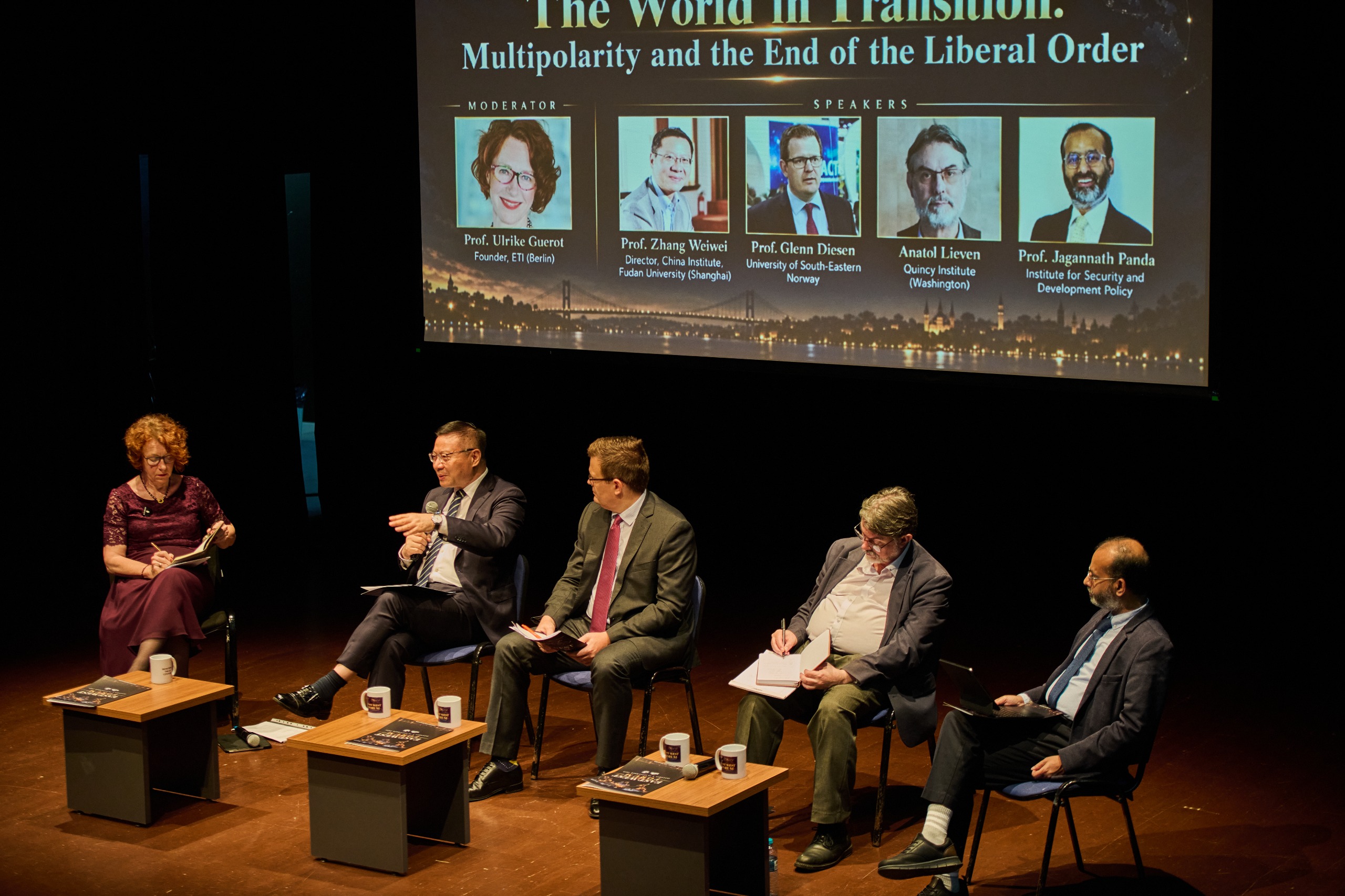

Well, here comes to the role of China. China is indeed a unique country and can make important contribution, perhaps already made very important contribution to a new global order, more fair and more just order.
How to define a civilizational state? It is an amalgam of the world’s longest continuous civilization with a super large modern state. I try to summarize this into four supers: Super large population, super large territory, super long history and super rich cultures. All these four supers, each of which is a blend of old and new, Asian and modern.
For instance, if you talk about the large population; yes, China has always been a populous country since ancient times, yet this population is very well educated.
Every year we produce more scientists and engineers than the Western countries combined. Same with this vast territory: It’s our inheritance from history, yet it’s also very modernized, connected with first-rate infrastructure, the best railway system, best highway system and best digital infrastructure. 5G into every village, no exception. Super long history, it’s also a combination of old and new.
If you look at China’s political system, if the Western system is about election, the Chinese system is about selection plus election: selection from the Chinese tradition and election we adapt from the Western tradition.
Same with super rich culture. If we talk about political culture, the most important priority in China is people’s livelihood. First, it’s very much Confucianism: Whatever you do, the state has to deliver to improve people’s livelihood, both in material terms and non-material terms.
An inaccurate analogy—very inaccurate, just for reference—would be something like dozens of Islamic nations or countries today have amalgamated into one nation with a centralized government, with a very modern economy and speaking the same language. Yes, it’s also a highly developed economy, but it’s one nation. Or another inaccurate analogy, which is not politically correct: Like the Roman Empire has continued to this day with all these different countries uniting into one and speaking Latin.
Yet in the case of China, with a very strong philosophical tradition, we treasure peace, peace above all. Most important thing; highly modern, but also from Asian tradition. This will be a kind of nation-state, a civilizational state, as I try to explain to you.
And now we look at the international order; let’s say we try to build a kind of new order much better than the one we have, from unipolarity to multipolarity. First, let’s look at the ideas or philosophies: In what way does China differ from the United States? Vastly different. For instance, if you look at the Chinese political philosophy, it’s never about “divide and rule”, it’s always about “unite and prosper”. Within China we practice this way, outside China in the world we do the same.
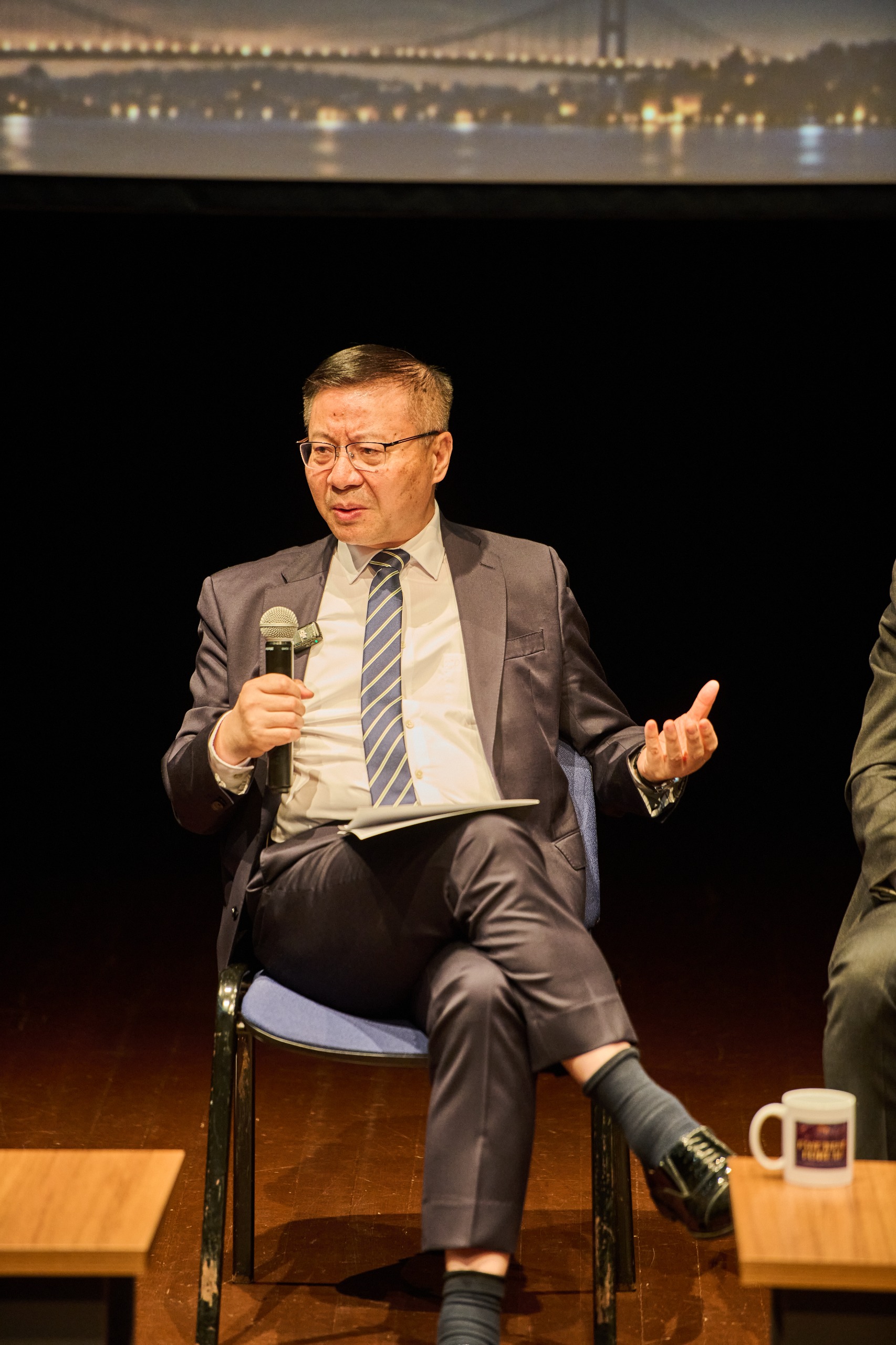

“The Chinese case is friend or potential friend”
And in terms of strategic policies for the United States or the Western philosophy in general, it’s “friend or foe”. You’re either a friend or enemy. But the Chinese case is “friend or potential friend”. In other words, you have a much longer view, longer vision as a civilizational state.
And then it’s very different from the trigger-happy United States. If you look at China’s history, China has the highest threshold for the use of force among the major powers. Of course, China has very clear red lines; this is very important. But also this is strongly influenced by Sun Tzu’s famous book The Art of War: The idea is you try to subdue your opponents or enemy without actual fighting.
So you have this philosophy, and then you have this philosophy of friend and potential friend; you can have already avoided so many wars, you can prevent a lot of wars from happening.
This is the way China handles this philosophical part. Of course, the most important thing is humanity: Humanity has won, rather than “on the table or on the menu”. This philosophy China rejects categorically; it’s very much against Chinese conscience.
Now when we talk about a shared future for mankind or one humanity, some people say it’s idealistic: How do you put this into practice, how to make this into something tangible? I was asked by an American scholar in Xiangshan Forum about this question: Why did Chinese leader Xi Jinping present this whole Global Governance Initiative at the Shanghai Cooperation Organization rather than the United Nations, a more serious forum?
I said it’s very, very simple to understand: Because the Shanghai Cooperation Organization is the embodiment of these four initiatives Xi Jinping has raised—on development, on security, on civilization, on governance. Exactly four pillars of Shanghai Cooperation; that’s my summary.
Now the Shanghai Cooperation Organization has become the world’s largest regional cooperation organization in terms of population, in terms of landmass and in terms of the results. It’s already larger in GDP than the G7.
Same with ASEAN; if you look at China’s partnership with ASEAN, it’s based on the same four pillars. As a result, China now contributes every year 30% to world economic growth; ASEAN produces roughly 7 to 8%.
With this kind of China-ASEAN cooperation, we contribute to close to 40% of global economic growth. Then you look at this whole Eurasian landmass, from Russia to Central Asia, to China, to Southeast Asia: This huge landmass has been a land of peace and development for the past five decades. It’s so important.
In many ways I say, if China had adopted the Western so-called liberal democracy system, maybe China had already produced a Donald Trump and the Third World War had already occurred. With the Chinese political system, as Professor Jeffrey Sachs said, you have the only adult in the room who can make rational decisions about the world, about China, about global affairs.
And finally, just to make a small comment on this practice: If you look at these regional organizations and what they have achieved as a result, both Central Asia and Southeast Asia were described as a “geopolitical curse” for many decades for understandable reasons—complicated geography, complicated religious traditions, complicated different political systems.
Yet today we can see with very high pride that they are geopolitical bonuses. Central Asia used to be landlocked countries; now they are land-linked. With this kind of positive note, China as a civilizational state has produced both ideas and practices for a possibly better world to come.
If you look at the opinion surveys done by reputable opinion survey agencies, what value Chinese treasure most is public order. That’s a vast country the size of 100 European countries put together; and so China hates the word “anarchic”.
So when we talk about the multipolar world order, if you look at the official language, it’s called a more just, orderly public order.
With China, ASEAN, and the Shanghai Cooperation Organization, it’s already possible to foresee—from a Chinese perspective—a future more benign, more just, and fairer international order to come.
I do want to discuss a bit about this China-Philippines case: If China were behaving like the United States, with China’s military power today we could dismantle the Philippine military force within 24 hours. But we did not do that; in whatever problems, we only use, at maximum, water cannons.
Even in our border clash with India, it’s not at all what other major powers would do; it was only fist fighting between soldiers, and then issues are being resolved gradually. At this moment the China-India leaders met each other and relations became more normalized. I hope the world will do better.
“In the Western so-called universal values, they never mention peace”
And now I want to make one or two points here. One is concerning liberal values.
If you look at Xi Jinping’s Global Governance Initiative, he mentioned what is called the common values—six of them: Peace, development, fairness, justice, democracy, and freedom. What’s most important is that peace is top on the list.
Because when you mention Western so-called universal values, they talk about human rights and democracy, but they never mention peace. In other words, the West reserves the right to use military force on Global South countries.
This is totally wrong; we don’t accept this. Peace is at the top of the list of these common values, and I think it is appreciated by most countries and most peoples in the world. Peace is number one.
And second, each civilization has its own values. But now we have the United Nations Charter, which is the broadest common denominator we can share.
When China says we should reform this current international order, we mean we should return to the United Nations Charter, which is the post-World War II arrangement that most countries accept.
With this “rules-based order”, it’s not the United Nations Charter; it’s the so-called liberal values dictated by the United States and the European countries—lieutenants of the United States—imposed on others.
Look at the Arab Spring: Millions died, hundreds of millions lost their homes and became homeless, and yet they don’t feel guilty. “We can do whatever we want because of this liberal order we promote.” We reject that categorically.
I was with Russian friends talking about the origin of the Ukrainian crisis; of course we think there is a problem with NATO’s eastward expansion. Five rounds of expansion.
I said: If you had stopped after four rounds, this crisis could have been avoided. As far as China is concerned, I don’t know why Russia tolerated five rounds of expansion; China would not even allow a single expansion into Asia.
