Diplomacy
Xi declares the SCO an effective force against hegemonism at Tianjin summit

On Monday, Chinese President Xi Jinping called on the leaders of Russia, India and other Asian countries to strengthen security and economic cooperation. He said that the Shanghai Cooperation Organisation had become an effective force against hegemony and power politics.
Xi made this statement in his speech at the 25th Summit of the Council of Heads of State of the Shanghai Cooperation Organisation (SCO). Indian Prime Minister Narendra Modi and Russian President Vladimir Putin were also among the attendees.
Xi said that members should “oppose Cold War thinking, bloc confrontation, and bullying.” He also called on them to “support the multilateral trading system centered on the World Trade Organization” and advocate for an “equal and orderly multipolar world.”
The Chinese leader urged the organization’s members to set aside their differences and enhance cooperation and solidarity, stating, “We must advocate for an equal and orderly multipolar world and a universally inclusive economic globalization, making the global governance system more equal and just.”
“The SCO has become an effective force against hegemonism and power politics by standing for international equality and justice, and by championing the inclusiveness and mutual learning of civilizations,” he said.
Xi stated that China aims to develop the SCO in “practical” ways. He announced plans to provide 2 billion yuan ($280 million) in grant aid to member countries this year, offer an additional 10 billion yuan in credit to member banks of the SCO Interbank Consortium over the next three years, and double the number of SCO special scholarships starting next year.
Xi also called for the prompt establishment of a center to address security threats and a counter-narcotics center.
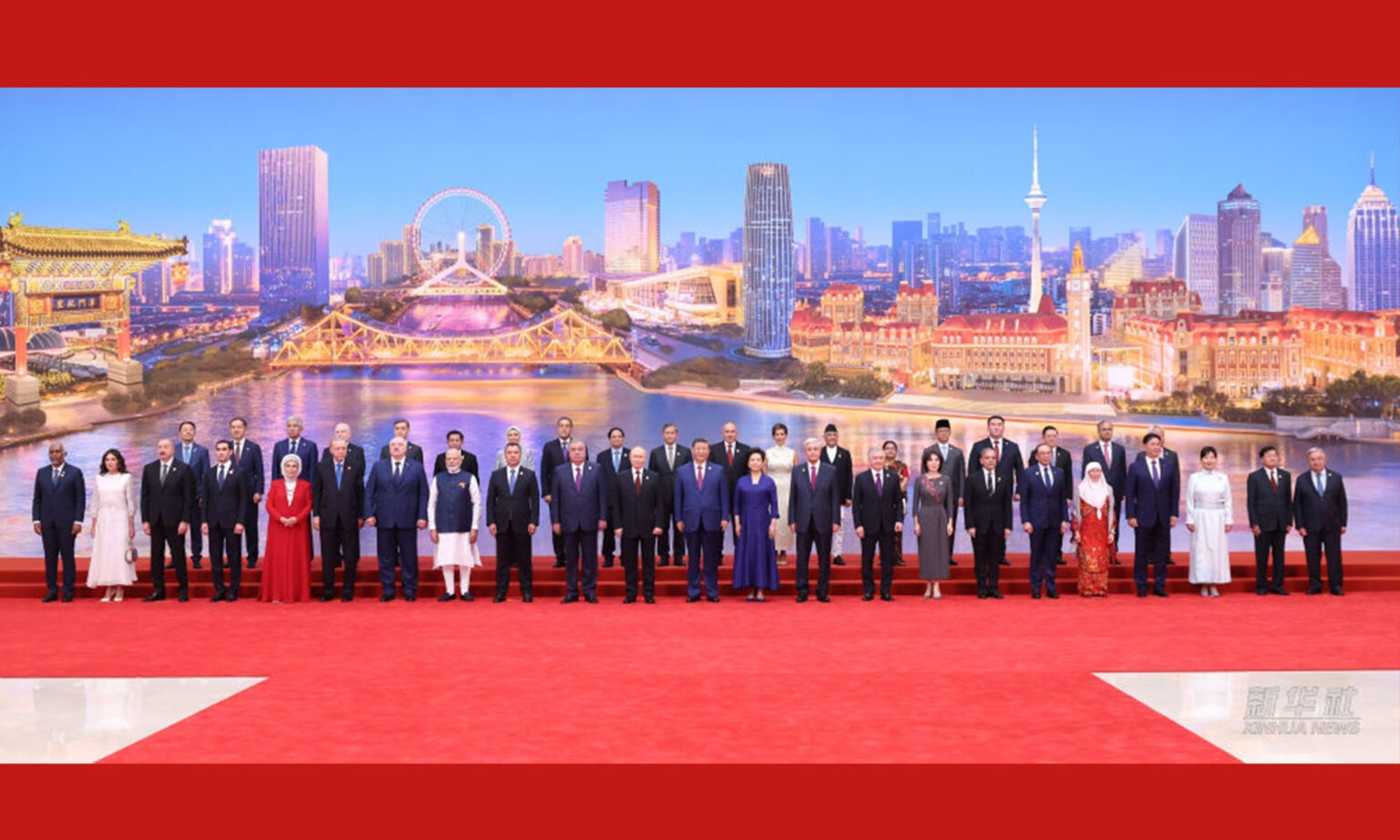
According to Chinese state media, more than 20 foreign leaders attended the summit held in the city of Tianjin, near Beijing, making it the group’s largest event to date.

Xi-Modi meeting
Xi met with Modi on Sunday, signaling his intention to forge warmer relations with India immediately after US President Donald Trump imposed additional tariffs on Indian goods to penalize its purchases of Russian oil.
Chinese Foreign Minister Wang Yi traveled to India before the summit and promised to meet India’s need for rare earth minerals, which are critical metals used in high-tech manufacturing. China imposed restrictions on rare earth element exports in April in retaliation for US tariffs.
China and India face a wide range of conflicts, from border issues to China’s support for Pakistan. However, analysts say that China, experiencing an economic slowdown at home, can benefit from India’s growing consumer market and its demand for the modernization of infrastructure and industry. For India, which has been penalized with a 50% tariff by the US, a move toward closer ties with China is also seen as strategic.
Xi-Putin friendship
The summit was interpreted as a demonstration of closer relations between China and Russia, as well as the friendship the two leaders have built over the years, highlighting Putin’s close relationship with Xi.
The personal chemistry between the two leaders was evident at the welcome dinner hosted by Xi and his wife, Peng Liyuan, for the participating leaders on Sunday evening.
Putin was photographed standing next to the Chinese president at the banquet, and the two were shown on television walking side-by-side as they entered the hall.
Two proposals from Pezeshkian
In his speech at the summit, Iranian President Masoud Pezeshkian proposed the establishment of a crisis committee composed of foreign ministers to manage regional crises.
Stating that the committee should be structured to intervene quickly in violations of members’ sovereignty, Pezeshkian said, “Iran believes that the Shanghai Cooperation Organisation, as one of the important pillars of the multipolarity of the international system, must take concrete steps to create a more peaceful world that is more conducive to economic cooperation.”
In this context, Pezeshkian presented two specific proposals from Iran: “the necessity of building peace” and “the necessity of strengthening financial cooperation to reduce the impact of unilateral sanctions.” He elaborated, “A committee composed of the foreign ministers of member states should be established to exchange views and consult on various crises threatening regional peace and security, to develop operational proposals for crisis management, and to provide a mechanism for their follow-up. This committee should have the authority to convene immediately at the request of a member in various potential and actual crises and should assume an appropriate role as the intellectual and operational arm of the organization. Especially when a member’s sovereignty is violated, this mechanism must react immediately and strive to support the member whose sovereignty has been violated through various channels.”
Pezeshkian noted that the unilateral sanctions of Western countries harm the economic relations of member states and, to solve this problem, proposed strengthening the “SCO Special Accounts” mechanism, which includes expanding payments in national currencies, establishing digital infrastructures, and creating a multilateral currency swap fund.
Erdoğan-Xi meeting
President Recep Tayyip Erdoğan, who was in Tianjin for the summit, also met with Chinese leader Xi Jinping.
Xi stated that China and Türkiye are major emerging countries with a spirit of independence, adding that the high-level development of bilateral relations serves the fundamental interests of both countries and the common interests of the Global South.
Xi called on both countries to grasp global trends such as peace, development, and win-win cooperation and to work together to build a more just and equitable global governance system.
Noting that next year marks the 55th anniversary of the establishment of diplomatic relations between China and Türkiye, Xi said the two sides should use this opportunity to strengthen bilateral ties. “The two countries should consolidate political mutual trust, support each other on issues concerning their core interests and major concerns, and strengthen cooperation in counter-terrorism and security,” he said.
Xi said the two countries should deepen practical cooperation and seek new opportunities for collaboration in new energy, 5G technology, and biomedicine. He also called for both sides to strengthen coordination within multilateral frameworks to uphold international justice and fairness.
President Erdoğan stated that Türkiye is ready to maintain close high-level relations with China, advance high-quality Belt and Road cooperation, and support the solid growth of bilateral relations by strengthening cooperation in areas such as infrastructure and new energy.
Erdoğan noted that Türkiye is ready to enhance cooperation with China within the SCO framework to contribute to the development and prosperity of the region and the world, and he praised China’s just stance on the Middle East issue.
President Erdoğan reiterated Türkiye’s support for the “One China” policy, emphasizing the strategic dimension of the relations between the two countries.
The meeting was also attended by Minister of Foreign Affairs Hakan Fidan, Minister of Energy and Natural Resources Alparslan Bayraktar, Minister of Treasury and Finance Mehmet Şimşek, Minister of National Defence Yaşar Güler, Minister of Industry and Technology Mehmet Fatih Kacır, Minister of Trade Ömer Bolat, Head of MİT İbrahim Kalın, and Türkiyes Ambassador to Beijing Selçuk Ünal.
On the Chinese side, senior officials including Cai Qi, First Secretary of the Central Committee of the Communist Party of China, and Foreign Minister Wang Yi were present.
At the summit, which will conclude on Monday, a joint declaration called the Tianjin Declaration and a 10-year development plan are expected to be prepared.
Some foreign leaders will remain in China to attend a military parade in Beijing on Wednesday to commemorate the 80th anniversary of the end of World War II.
Shanghai Cooperation Organisation
The SCO was initially formed in 1996 as an alliance for border security and economic cooperation by China, Russia, Kazakhstan, Kyrgyzstan, and Tajikistan. The group, then known as the “Shanghai Five,” was officially established in 2001 with the inclusion of Uzbekistan.
The membership processes for India and Pakistan were completed at the Astana Summit in Kazakhstan in 2017. With the accession of Iran at the Dushanbe Summit in Tajikistan in 2021 and Belarus at the Astana Summit in Kazakhstan in 2024, the organization’s membership has reached 10.
Mongolia and Afghanistan, whose status has been inactive since September 2021, are “observers” in the organization, while the SCO has a “dialogue partnership” with 14 countries, including Türkiye.
The total land area of the member countries covers approximately 65% of the Eurasian continent, representing 40% of the world’s population and 30% of the global gross domestic product.