Diplomacy
US softens sanctions roll-out as Iran threatens retaliation
Iran has announced that it will retaliate against expanded US sanctions that Washington said would sever the country’s “economic lifeline”. Tehran also expressed confidence that its primary trading partners would resist Washington’s pressure campaign.
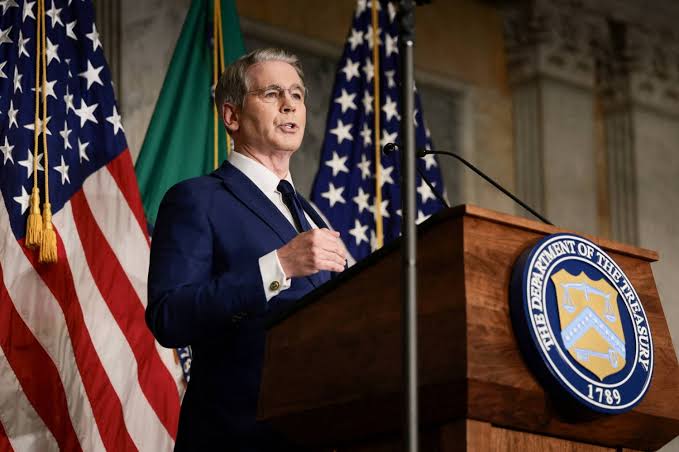
US Treasury Secretary Scott Bessent unveiled the new measures on Monday but refrained from deploying the harshest sanctions. Bessent said countries continuing to trade with Iran would face the risk of being excluded from the dollar-based financial system.
Bessent declined to name the targeted countries or disclose when the sanctions would take effect, stating instead that he would grant countries time to comply with the new directive.
The US Department of the Treasury announced new sanctions targeting 60 individuals, entities, and vessels, but the list omitted any Chinese financial institutions believed to facilitate Iran’s oil trade.
Prior to the announcement, Iran had threatened both a potential military response and further reductions in Gulf oil exports against any US economic measures.
Following the announcement of the sanctions, Iranian Economy Minister Ali Madanizadeh said: “We are fully prepared against US sanctions.”
Speaking to state television, Madanizadeh said: “Naturally, the enemies aim to launch an economic terror attack against us, but we also have our own tools and know how the game is played. Our defence is no longer so defensive; let the enemies await our attack.”
Madanizadeh stated that neither China nor Russia “accepted” the US measures, predicting that other nations would resist them as well.
According to a report by Press TV, Islamic Revolutionary Guard Corps spokesperson Brigadier General Hossein Mohebbi also stated that if Iran’s infrastructure were threatened, they would deal heavy blows to vital US interests and energy transit choke points.
Iran and the US signed an interim peace agreement in June, but the accord, known as the Islamabad Memorandum, soon stalled.
The Pakistani military said on Tuesday that mediator Pakistan had achieved “significant progress” in its recent talks with Tehran, focusing on measures such as preventing further escalation of the conflict and reopening the Strait of Hormuz.
Interior Minister Mohsin Naqvi, who accompanied Chief of Army Staff Asim Munir on his visit to Tehran, stated on his X account: “The Iranian President clearly shared his government’s perspective, and we had an extremely constructive exchange of views on the agenda items.”
Few signs of a diplomatic solution
Struggling to end an unpopular war that has elevated energy prices, President Donald Trump’s administration appears to be relying on increased economic pressure, even though Iran has been subjected to multiple tiers of US and international sanctions for decades that have heavily eroded its economy without deterring the country’s leadership.
Despite both parties having refrained from large-scale strikes for weeks, there are few signs that the war will reach a diplomatic resolution. The US is seeking new ways to halt Iranian attacks on maritime shipping in the Gulf and, more recently, through its allies in the Red Sea.
Nearly six months have passed since the US and Israel launched strikes against Iran. Thousands of people have lost their lives, predominantly in Iran and Lebanon.
Although the war has weakened a significant portion of Iran’s conventional military capacity, inflicted economic damage on the country, and led to the death of then Supreme Leader Ayatollah Ali Khamenei, Iran has retained sufficient missile and drone capabilities to strike US allies and bases in the Gulf and threaten oil tankers in the Strait of Hormuz.
The current status of Iran’s nuclear programme, which the US and Israel aimed to eliminate, remains not fully known.
Despite Monday’s developments, oil prices fell by more than $2 per barrel. Nevertheless, investors remained prepared for the prospect of fresh supply disruptions emerging from the Middle East.
China’s oil trade
Asked why he refrained from imposing harsher sanctions on Iran and why he did not disclose the targeted countries, Bessent replied: “Why would I want to blow up the global financial system?”
Bessent said he wanted to give countries and companies time to sever their ties with Iran.
Bessent had previously requested cooperation from China, which has been the largest buyer of Iranian oil for several years. However, the resumption of the US blockade on Iranian ports in mid-July has already reduced the flow of Iranian oil to China.
According to experts, Washington fears Beijing could retaliate against any sanctions on Chinese banks ahead of expected talks next month between Trump and Chinese President Xi Jinping. In particular, restrictions that China could impose on critical mineral exports are seen as a sensitive issue.
Asked about Chinese banks on Monday, Bessent said: “We want to make clear here today that no one is beyond the reach of US sanctions.”
The Chinese Ministry of Foreign Affairs stated that sanction and pressure tactics yielded no benefit, adding that Beijing would do whatever is necessary to protect China’s interests.
Diplomacy
Five minutes to doomsday – 1: Thiel in search of the Antichrist
On August 22, Pope Leo XIV visited San Marino, widely recognized as the “world’s oldest republic,” where he spoke in praise of Thomas More, the “patron saint of statesmen and politicians.”
More, who refused to recant his convictions even upon the scaffold, was for Leo the living embodiment of freedom and conscience. In his pursuit of truth, he felt accountable to no one save God—not even the king.
Addressing the Grand and General Council of San Marino, the Pope went on to declare his opposition to “the idolatry that fundamentally corrupts political and economic projects that arise in the name of freedom, yet are in truth enslaved to idols and power.” According to the Christian vision he espoused, “freedom and communion either stand or fall together.”
After dwelling at length on the meaning of the word “freedom” (libertas), which forms part of this small republic’s motto, the Pope came to the crux of the matter:
“In the historical context of a people and a state, this word undoubtedly expresses the desire for self-determination and freedom from dependence on other political authorities. I wish to emphasize that there can be no genuine civil liberty without personal freedom—that is, without respect for human dignity and the elevation of that dignity. This freedom is ultimately bestowed and safeguarded by God, whose voice echoes within the conscience of every human being.”
Ultimately, he commended the Republic of San Marino as a “laboratory of good governance” where it was possible to draw upon the principles of Catholic social teaching without compromising the secular character of the state. Catholic social teaching, in turn, signified “the pursuit of the common good, the universal destination of goods, the harmony between subsidiarity and solidarity, and social justice.”
Christopher Hale, who meticulously champions Pope Leo XIV’s “progressive” political agenda, writes—quite rightly—that these remarks by the head of the Holy See were directed against the “postliberalism” to which US Vice President JD Vance once adhered. According to Hale, the Pope was neutralizing Vance’s postliberal Catholicism.
The Battle of Utopias Among Catholic Factions
We will return to postliberalism and JD Vance later. But first, we must examine the Pope’s invocation of Thomas More.
Our protagonist is not More, but Bacon; yet the one who intimates the subtle link between the two is, once again, Peter Thiel.
In two essays co-authored with Sam Wolfe and published nine months apart, Thiel pursues his by now well-known inquiries into the Antichrist and the end times. In the first essay, titled “Voyages to the End of the World,” after a brief allusion to More, he turns his primary attention to Francis Bacon’s New Atlantis. The robust link between scientific knowledge and Christianity forged in Novum Organum had ruptured by the time Bacon wrote New Atlantis.
The island nation depicted by Bacon (whose lineage traces back to Utopia), Bensalem, has achieved extraordinary advancement through science and technology. The European Christians who, blown off course by fierce gales, happen upon the island by chance have their wounds tended with Bensalem’s advanced pharmaceuticals. The institution responsible for generating Bensalem’s technology is called “Solomon’s House” (an entity Thiel and Wolfe describe as “deep state–esque”). “Merchants of Light” or agents of this institution are dispatched to European shores to covertly acquire new scientific breakthroughs. Everything in the heavens and upon the earth is an object of inquiry. A Christian priest assures the castaways of the island’s Christian faith; nevertheless, Bensalem appears as a multicultural, polyglot society.
The narrative of the mariners (and the ship’s chaplain) in New Atlantis grows increasingly bizarre. The Europeans appear quite literally entranced by what they witness in Bensalem. Eventually, the “Father” of Solomon’s House makes his appearance (following Joabin, described as a “circumcised Jew”). The Bensalem delineated by the Father resembles a consummate techno-utopia. Moreover, we realize that it is unhesitatingly acknowledged as a deceptive utopia (there are “perspective-houses,” “sound-houses,” and “perfume-houses” designed to delight and deceive the senses). We see that Solomon’s House has orchestrated a division of labor for governing the island. A bureaucratic apparatus is at work. But who is the ruler of Bensalem? Let us follow Thiel and Wolfe:
“Only the wise Joabin, who knew the governance of Bensalem intimately, could assume this role. When we re-examine the clues Bacon left us concerning Joabin, we uncover Bensalem’s darkest secret: Joabin is the biblical Antichrist.”
Circumcised, Jewish, and… homosexual! We could only make sense of Joabin’s circumcision by positing that he was homosexual. Joabin’s being both Jewish and gay fulfilled two of the prophecies concerning the Antichrist found in the Book of Daniel (whom Thiel and Wolfe hail as “the first historian in history”):
“‘He shall regard neither the God of his fathers nor the desire of women’ (Dan. 11:37). We also know that Joabin descends from a lost tribe of Israel, referenced in Revelation 7:4–8 in connection with the Antichrist. According to Paul’s account, the words heralding the advent of the Antichrist are ‘Peace and safety!’ (1 Thess. 5:3). As we will recall, Bensalem translates to ‘son of peace’ or ‘son of safety.’ Furthermore, Joabin’s peculiar boast regarding Bensalem’s chastity must be evaluated in light of Saint Jerome’s speculation that the Antichrist would be born of a virgin. In the apocryphal ‘Testament of Solomon,’ Solomon commands demons to construct his temple. Solomon’s House—the rebuilt temple—employs the very same labor force.”
According to the authors, what was missing from Bacon’s narrative was not words, but deeds: namely, “the founding of a global, technocratic empire ruled by the Antichrist.”
Reminding the reader that the debate over who or what the Antichrist would be has raged for centuries, Thiel and Wolfe subsequently centered the debate on the means by which he would take over the world. The Jewish and gay Joabin had envisioned a trajectory from empiricism to empire: a path forged through technology, specifically through the submarines and aircraft of Bensalem’s engine-houses. The authors pointed to an eventual conquest of the Old World by Bensalem.
The Specter of the One-World State
“(…) He cast his gaze across the earth; he refused to halt at the borders of his own homeland; his enthusiasm for the future was vast enough to embrace the entire world; the vitality, the joys, and the sorrows in the lives of foreign nations moved him as profoundly as those of his own people. His was an imperialism born of love—the imperialism of a magnificent intellect that had soared above the barriers of nationality, a mind that valued freedom above all for its nobility. (…)
When it sets out to create the utopia of applied science, the bourgeois outlook expands to worldwide dimensions; it transforms into ‘communism,’ taking this word in a sufficiently broad and non-dogmatic sense. This is a disciplined enthusiasm. Yet what we require today is a sobering up of a world suffocating in the stifling grip of sentimental relics. Who was it that said Germans should be forbidden from using the word ‘Gemüt’ [disposition, sentiment] for fifty years? It was Germany’s greatest poet. The middle-class man has lost his way and is doomed to be cast aside in the coming epoch—unless, of course, he manages to liberate himself from the fatal sentimentality and life-draining principles that still govern his thought. He must boldly embrace the future. It is futile to hold reason in contempt and stubbornly cling to atavistic sentiments that appear utterly blind and meaningless under present conditions—this is a kind of desperate, pernicious, fatal sentimentality.
The new, socialized world, the world of planning and cooperation, will come; humanity will be spared needless suffering unworthy of the intellect; and this will be achieved through a grand and judicious endeavor that has already rallied beneath its banner all who have turned their backs on musty, reactionary, petty-bourgeois sentimentality. This world will come, for a rational material order appropriate to the present stage of humanity’s enlightenment must be created; otherwise, in the worst-case scenario, it will emerge through violent convulsions. But only then will the heart be able to reassert its claims with a clear conscience. The great sons of the bourgeois epoch—those who, by virtue of their capacity for spiritual development, rose above the level of their class—are living proof that within bourgeois nature lie endless possibilities, limitless avenues for self-emancipation and self-transcendence. Our age demands that the middle class remember these innate powers and take its stand upon them intellectually and morally. The right to rule depends on the conviction that one has a historical mission to fulfill. (…)”
These passionate and resonant words belong to Thomas Mann, reflecting upon Goethe in 1932, the centenary of the poet’s death. As Mann understood him, this German child of an epoch—born of the bourgeoisie yet transcending its boundaries—heralds a new humanity. The ascent to the heights was made possible only with the rise of the bourgeoisie. Now, the duty incumbent upon the diligent sons of this class is to refrain from standing in the way of a new, unified, and universal society—an ideal that Mann presents in the somewhat mystified form of “communism.” In any case, those who stand in its way will forfeit their claim to power.(1)
How profoundly anti-Thiel, is it not! Indeed, in the continuation of the aforementioned essay, Thiel and Wolfe point out that both during the Second World War and throughout the Cold War, it was not merely the universalist impulse inherent in communist thought that gained ground, but also similar visions of “one-world government” across the West, particularly in the United States: the United Nations, world peace, the quest for security against nuclear annihilation… All attested to the fact that the ideal of unity was still being championed within a polarized world.
The co-authors also cite several other works (a comic book, a manga) that probe the nexus between the Antichrist, the apocalypse, and one-world government. Yet the thesis is transparent: the Antichrist, exactly as in traditional Christian theological disputes, will resemble Christ and ostensibly praise him; he will utter soothing words like “peace,” “tranquility,” and “safety”; he will govern through machines and technology; and he will propagate global dominion.
Yet Thiel and Wolfe are still searching for a third path—the katechon that will halt or defer the advent of the Antichrist:
“From the standpoint of philosophy, the question ‘One world or none?’ admits of only one answer. Better red than dead. Theology reformulates the question thus: ‘Antichrist or Armageddon?’ The Christian answers: ‘Neither.’ He prays for new miracles, new technologies, and strange new possibilities.”
An article in Vanity Fair recounts how Christianity has gained currency in Silicon Valley.(2) It highlights another notion gaining momentum among certain figures in the Valley: the idea that technology is not intrinsically evil, but rather that bad technology is spawned by secular thought. This was the overarching theory posited by entrepreneur Reggie James in October 2024 at Hereticon, a conference for “troublemakers” backed by Founders Fund (Peter Thiel’s venture capital firm). Indeed, at the very same event, Thiel also spoke of the coming of the Antichrist.
Be that as it may, at this gathering, James introduced the concept of “SecuTech,” or “secular tech,” designed from a secular vantage point. Social media, for instance: in his view, it fed “postmodernist values like fighting over identity and representation.” The reporter continues: “Everyone on social media goes through an identity crisis and a kind of disinformation campaign. It’s not a bug. It’s a feature of postmodern design.”
Is there an antidote to SecuTech? According to James, there is, and it is dubbed “spiritual tech”: a technology that, while “not necessarily grounded in a religious framework,” is built on the premise that “interfaith values diverge from the values of postmodernist secular technology.” Yet, whether by mere coincidence or providential alignment, Catholic entrepreneur Luke Burgis—who around that time hosted a dinner on artificial intelligence at the Vatican—remarked to Vanity Fair that there is grave danger in “trying to map Christianity onto everything Silicon Valley is doing,” recalling the novel that has captivated certain Valley circles: brace yourselves—New Atlantis!
“The novel envisions a mysterious, semi-Christian society that controls the weather through technological experiments, overcomes aging, and establishes heaven on earth. These godlike endeavors also extend into sectors like defense technology; Burgis cautioned that this was ‘very clever branding’ because ‘it’s not always used that way.’ Yet Burgis added that there is also the concept of artificial superintelligence, which encompasses the notion that machines will soon rival and ultimately supplant human intelligence. ‘In Silicon Valley,’ Burgis said, ‘there is a strong tendency where they are trying to create something that takes the place of a god.’”
Do not wonder how such a thing could be. It seems everyone has their own New Atlantis… Yet the common thread, in both the Pope and Thiel, appears to be the rejection of earthly dominion. Thiel discerns the countenance of the Antichrist in the tyranny of the one-world state; Leo, largely intimating Trump, preaches that rebellion against foolish politicians (tyrants) is a mandate of God and conscience. Thiel believes that the pursuit of “peace” and “security” is an apocalyptic omen; the Pope proclaims “peace,” “concord,” and “democracy,” regarding the “secular” Republic of San Marino as an Edenic city-state with which Catholicism can peacefully coexist.
Could the Antichrist Be Pope Francis?
When his lectures on the Antichrist generated substantial public controversy, Thiel felt the need to articulate his stance once more—this time with even greater provocation.
The reason for his fascination with the Antichrist was straightforward: no one was talking about him. Yet throughout Christian history, countless clerics and thinkers had unceasingly debated the signs of the Antichrist’s emergence. Thiel had assumed that his lectures on the Antichrist in Rome would not attract any exceptional notice. He was mistaken; the Vatican reacted with far greater severity than usual.
Yet Thiel believed he had found a witness within the Holy See itself regarding the arrival of the end times. Pope Benedict XVI, who abdicated in 2013, had been declaring—whether in whispers or in outright cries—that the end of the world was at hand. Thiel followed this trail:
“Benedict believed that he was living in the end times. This assertion astounds us, for Benedict had chosen not to speak openly on the subject until the final years of his life—at a point when he had resigned the papacy, his allies within the Vatican administration had been purged, and almost no one was listening to him. We will never know why he waited. He may have feared compromising the authority grounded in his academic brilliance, since apocalyptic preaching is perceived as far removed from academic respectability. In a more charitable interpretation, Benedict may have believed that his apocalyptic forebodings would become self-fulfilling prophecies, unsettling his flock and driving them away from the Church.”
Emphasizing that young people “understand the existential perils” of climate change, artificial intelligence, demographic collapse, and nuclear weapons—and live in dread of them—Thiel contended that Benedict could have instructed the youth in the specificities of the biblical apocalypse, including the preceding era of “totalitarian peace” and “safety.” But events unfolded otherwise: Benedict’s successor would be Francis.
Yet Benedict, who retained the title of “Pope Emeritus” until his death, had left us clues. Could one possibility be the “liberal-leaning pope” who succeeded him? According to Joachim [of Fiore], the Antichrist would assume the papacy following a virtuous pope. Thiel and Wolfe relate:
“Many Joachimites believed that Pope Celestine V, who—like Benedict—abdicated at the age of eighty-five, was this virtuous pope, and consequently regarded his successor, Boniface VIII, as the Antichrist. Benedict knew all of this when, in 2009, a week after delivering a lecture on Tyconius’s theory of the bipartite Church, he placed his papal pallium(3) upon Celestine’s tomb. Did Benedict, one wonders, believe that Pope Francis was the Antichrist?”
Yet there is an even better candidate. Benedict, steeped in eschatology, had in a lecture delivered while still Joseph Ratzinger referenced Vladimir Solovyov’s A Short Tale of the Antichrist, remarking that the enemy of Jesus Christ would ingratiate himself with believers by having “earned a doctorate in theology at Tübingen and penned an exegetical work regarded as pioneering in the field”! According to Thiel and Wolfe, Ratzinger’s insinuation pointed to a single man: Hans Küng. The Swiss Küng was a “charismatic priest” and Ratzinger’s colleague at Tübingen. At the age of thirty-four, Küng had served as one of the youngest periti (experts) at the Second Vatican Council, and the Council adopted many of his proposals. Vatican expert Peter Hebblethwaite observed, “Never again would a theologian wield such immense influence.” As the authors recount: Küng later advocated euthanasia, rejected the doctrine of papal infallibility, was warmly received at the White House by John F. Kennedy, guided Tony Blair through his conversion to Catholicism, and was stripped of his mandate to teach Catholic theology by Pope John Paul II. “He exerted more influence over the Church than the average pope,” write Thiel and Wolfe.
The name itself is immaterial, but I must recall that Küng’s most renowned thesis was the Global Ethic Project (Weltethos). As stated on the project’s website: “Hans Küng was convinced that all religions and cultural traditions share certain fundamental ethical values. Over decades of scholarly research, he deepened this conviction, culminating in the establishment of the Global Ethic Foundation in Tübingen, Germany, in 1995.”
According to Küng, a Global Ethic signifies a fundamental ethical consensus spanning religions and cultures. All major world religions and philosophical traditions share certain core values: humanity and reciprocity; non-violence and respect for life; justice and solidarity; truthfulness and tolerance; equal rights and partnership; ecological responsibility.
I trust it is now clear how Thiel and Wolfe discern the footprints of the Antichrist in Küng’s ideas. The authors recall that the Catholic philosopher Robert Spaemann, a close friend of Benedict, trenchantly criticized the concept of Weltethos in 1996. Just as the Antichrist adopted the slogan “peace and safety,” Küng’s Weltethos likewise aimed at world peace: “No peace among nations without peace among religions. No peace among religions without dialogue between religions.” According to Thiel and Wolfe, this “obsession with peace” is the defining characteristic separating the Antichrist from Christ: the Antichrist declares, for instance, “Christ brought the sword; I shall bring peace.” Thiel and Wolfe write of the rest:
“He [the Antichrist] accuses Christ of ‘dividing humanity with concepts of good and evil’ and ‘threatening the world with the Last Judgment.’ In like manner, as Spaemann observes, ‘Küng’s gentle interpretation of Christianity’ discourages all thought of the end times. Spaemann writes: ‘Undoubtedly, Jesus, when speaking of the Last Judgment… did not expect an easy smile from his listeners.’ Küng, however, goes even further, casting aside not only the apocalypse, but also Christ’s warning that ‘if those days had not been cut short, no human being would be saved.’ In other words, Küng asks us to forget the Antichrist and the Great Tribulation. All we have is this world, and it is up to us to save it: survival is impossible without a Weltethos*.”*
The Liberal Consensus Versus Silicon Valley Heresy
An assessment in Fortune emphasizes that while Thiel develops his arguments with genuine theological gravity, all the archetypes he insinuates to be the Antichrist in fact point to the powers that seek to “regulate” him: a benevolent ruler; a figure who speaks the language of safety, ethics, and global coordination, who establishes harmonized regulatory regimes, and who invokes existential risks to legitimize sweeping institutional authority. The Antichrist appeals to “existential risks” (climate change, artificial intelligence, nuclear war) to legitimize a one-world state and its bureaucracy. He does not openly persecute Christianity; rather, he assimilates and internalizes it, carving out a space for it “within a technocratic order that promises to manage civilizational hazards on behalf of humanity.”
Thus does Pope Leo, whom Thiel playfully accused of being an “agent of the Chinese Communist Party” over his “regulatory” encyclical on AI, become an instrument of the Antichrist. In Thiel’s view, regulatory state apparatuses—whether driven by fear of “climate change” or enforced through AI moratoria—are unmistakable signs of the end times.
Father Paolo Benanti, who once served as an AI advisor to Pope Francis, condemned Thiel’s Antichrist lectures in an essay for Le Grand Continent as “theological regime change,” arguing that his religion was not Christianity, but “heresy.” Heresy against what, exactly? Benanti writes with startling candor: “Thus, Thiel’s entire posture can be interpreted as a protracted act of heresy against the liberal consensus: a challenge directed at the foundations of civil coexistence that he considers obsolete.” According to Benanti, Thiel’s vision should be understood not merely as a simple rejection of Western values, but as the “pathological radicalization” of certain of their components—namely competition, technology, and the individual.
Benanti asserts that Thiel internalized the concepts of “mimetic desire” and “mimetic violence” inspired by the French anthropologist René Girard; convinced that capitalist competition inevitably leads to catastrophe, Thiel rejects it, preaching instead the attainment of a monopoly position through “unprecedented” creations. To safeguard profit, spurning competition and securing a monopolistic redoubt is the only recourse.
Flight from Global Civil War: Schmitt and the Katechon
We mentioned the third path above. It is possible to retrieve from history a thinker who fits squarely into this yearning to “escape the apocalypse.”
We know that Thiel speaks admiringly of Carl Schmitt, the quintessential jurist of the Nazi regime. The katechon, a concept invoked by Schmitt on various occasions and drawn from Saint Paul’s Epistle to the Thessalonians, denotes a figure or mechanism that restrains the emergence of the Antichrist and delays the end of the world. For instance, the Austrian Emperor Franz Joseph, who established the Holy Alliance, is cited as an example of this restrainer. Another example is the duo of Czech leader Tomáš Masaryk and Polish leader Józef Piłsudski, who saved Europe from the communist advance when the October Revolution had triumphed and the German revolution was in motion. By calling for the transformation of imperialist war into a global civil war, Lenin had already ushered onto the historical stage that which Schmitt feared most: fratricidal conflict. For in a civil war, those belonging to the very same political entity and legal order assume a posture of absolute moral supremacy against one another, with each outlawing the other. The Leninist call to civil war harbored yet another object of Schmitt’s loathing: a concept of humanity moving toward a one-world state. It was precisely this fear that fueled Schmitt’s hope that the United States would abstain from entering the war and recognize German hegemony in Europe; the United States could have been the new katechon. But it was not to be: the US entered the fray, entering into a willing or unwilling anti-fascist coalition with the USSR and thereby cementing the trajectory toward “one world.”
In Thiel’s worldview as well, both the rise of China on the global stage and the presence within the US of those eager to cooperate with China nourish the expectation of a katechon. In his previously mentioned essay “The Straussian Moment,” Thiel pointed to the September 11 attacks as a turning point; while extolling the ideology of conflict (“war is the father of all things”), he invoked the Schmittian concept of the enemy to substantiate his own particularism: “Barring an alien invasion, a world state that politically unites all of humanity can never be established. It is a logical impossibility.”
Counterposing the covert coordination of intelligence apparatuses (“Echelon”) to Enlightenment universalism, international institutions, democratic participation, and parliamentary debate, Thiel seems almost to apply a theological varnish simply to peddle Palantir. He eagerly embraces Austrian theologian Wolfgang Palaver’s thesis that “equality breeds civil war”: difference and enmity maintain the world’s equilibrium, whereas war erupts wherever solidarity is enforced. What plunged humanity toward civil war was the obliteration of distinctions wrought by the uniform thought of globalization.
Do we not find here the theopolitical reflections of a reaction against the stagnationary trend in the capitalist mode of production—a trend spanning the last fifty years that grew chronic after the 2008 crisis? Thiel and his confidants, both in Silicon Valley and the White House, believe that the capital accumulation embodied in the triad of artificial intelligence, biotechnology, and digital data possesses the power to overcome this stagnation, enabling the United States to regain its footing and confront China. Geopolitical myths, inspired by Schmitt, likewise serve the “Germanification” of the United States: the resurrection of an obsession with the “Western Hemisphere” via a neo-Monroe Doctrine; the carving of the globe into spheres of influence among great powers; the glorification of the nineteenth-century Anglo-Saxon settlers’ protracted and bloody drive westward alongside the “frontier mentality”; resentment toward central apparatuses of sovereignty; enchantment with finance and speculation… All bound within the same parcel, in a stance largely fraught with internal dissonance and contradiction.
Indeed, in his 2011 essay titled “The End of the Future,” Thiel gave the first intimations of this heap of contradictory ideas. Right at the outset of the excerpt below, he underscores that the “Great Recession” following the 2008 crisis appeared interminable(4):
“Modern Western civilization stands upon the twin pillars of science and technology. (…)
Though most of us cannot distinguish science from superstition or technology from magic, we need science and technology to climb out of this deep economic and financial abyss. In our hearts and minds, we know that desperate optimism will not save us. Progress is neither an automatic nor a mechanical process; it is a rare phenomenon. Indeed, the unique history of the West proves to be the exception to the rule under which, for millennia, most human beings lived in conditions that were naturally brutal, stagnant, and impoverished.”
Economic stagnation, the notion of the decline/collapse of the West, the perplexity over what to do with surplus populations, the anticipation of financial ruin, and the way war—particularly a war with Iran—lays bare the vulnerability of digital infrastructures, all bring apocalyptic expectations once more to the fore.
In the essay series I wrote last year (1, 2, 3, 4), I examined why Silicon Valley summons the apocalypse and what escape routes it devises to elude it. We are now traversing an era in which arguments from both the Left and the Right proclaiming that capitalism has outlived its lifespan are surging anew. Not a single day passes without the publication of collapse scenarios stemming from AI or the American national debt. In this context, we shall this time examine the factions within the world-system, their mutual relations, and how they navigate apocalyptic expectations. In the next article, as promised above, we will turn to the covert war between postliberal/MAGA Catholicism and the Vatican.
(1) It is striking to realize how far Mann had drifted from the ideas he championed in 1918’s Reflections of a Nonpolitical Man. In this voluminous text, where Thomas—who, unlike his brother Heinrich, fervently supported Germany in the First World War—foregrounded suffering and national duty, he defended German “Kultur” against Western “civilization,” pitted the German soul against democratization, and sang paeans to aesthetics along the Wagner-Schopenhauer-Nietzsche axis as a path of liberation from politics. There is little doubt that Thiel would have admired the Mann of 1918.
(2) The article’s author, Zoë Bernard, quotes Thiel as follows: “When you don’t have a transcendent religious belief, you just end up looking at other people around you. And that’s the problem with our atheist and liberal world. It’s just madness of the crowds.” There are other testimonies as well: New York Times reporter Emma Goldberg notes that those in Silicon Valley seeking proximity to Peter Thiel suddenly find themselves “graced” with Christianity. In this vein, Michelle Stephens spearheaded a non-profit called the “ACTS 17 Collective.” Speaking at an ACTS 17 event in San Francisco in May of last year, Thiel explained how Christian theology informs his politics and which of the Ten Commandments he finds most profound. The name “ACTS 17” is an acronym for Acknowledging Christ in Technology and Society. Yet it also references the biblical chapter in which Paul traverses Athens and Thessalonica to proclaim Christ’s message—signifying the affluent elite he seeks to minister to today. The dissonance with the classical interpretation of Christ’s message (solidarity with the poor) is immediately conspicuous. In passing, it is worth noting that Thiel is a Protestant.
(3) The pallium is an ecclesiastical vestment worn by the Pope and periodically conferred upon metropolitan archbishops of the Latin Church. [Author’s note]
(4) In the remainder of the essay, Thiel dates the beginning of Western stagnation to 1973. He then draws attention to the vast chasm between the promises of the era of globalization and the realities of the last forty years: the widening rift between average and median wages; the underwhelming growth of corporate profits; the way globalization cheapened labor and goods while purporting to elevate living standards; the failure of economic progress to keep pace with scientific and technological advancement, and so forth. We shall return to the collapse of the politics of neoliberal promises later.
Diplomacy
Greece warns Türkiye over maritime disputes as regional tensions rise
Greek Foreign Minister Giorgos Gerapetritis has issued a warning to Türkiye, stating that “the Greece of passive diplomatic stagnation is now definitively a thing of the past.”
“Any attempt to violate our sovereign rights will be met with all the means at our disposal,” the Greek minister said.
Describing the marine parks backed by Türkiye as “illegal and without legal validity”, Gerapetritis emphasised that while Greece continues to seek peace, it remains “fully prepared for any scenario”.
In an interview with Greek television channel OPEN TV, Gerapetritis said Greece was ready to respond on the ground if Ankara takes steps that Athens considers violations of its rights.
Asked about the possibility of Türkiye deploying warships to the region, Gerapetritis stated that Greece would not shy away from responding and possessed various options.
“It is obvious that Greece will fully exercise its sovereign rights,” Gerapetritis said, adding:
“We will do whatever is necessary. We will respond to provocations, and we will do so from a position of strength.”
When asked whether Greece would respond if Türkiye sent frigates to the area, Gerapetritis highlighted Greece’s capability to deploy its own vessels, without specifying numbers.
“Greece has proved that it can send frigates and F-16s; from next year onwards, it will also deploy F-35s,” the minister said.
The Greek foreign minister also pointed to Greece’s ongoing military build-up, referencing Rafale fighter jets, upgraded F-16s, Belharra-class frigates, and the F-35 fighters expected to join the Greek armed forces in the future.
Gerapetritis asserted that Greece had “already proved its strength” during the recent crisis in Cyprus and the Middle East.
“Yes, we want peace. But we want it from a position of strength. In security and without fear complexes,” the minister said.
Athens intensifies diplomatic moves
While intensifying its diplomatic efforts against what it terms Turkish “provocations” and “violations of international law” in the Aegean Sea and the Eastern Mediterranean, Greece is also preparing for a range of potential scenarios linked to ongoing regional disputes.
According to a report in Kathimerini, Athens is moving to formally brief European partners, allies, and international organisations regarding Türkiye’s actions, including steps related to the declaration of marine parks.
Minister Gerapetritis is expected to present the Greek position at the European Union Foreign Affairs Council meeting, while preparations continue for diplomatic representations directed at both Türkiye and international bodies.
“The Greek government and I personally have, since last week, officially brought all of Türkiye’s provocative actions to the attention of all European authorities,” Gerapetritis said on Sunday.
Greek officials argue that Ankara has moved away from a period of relative calm, returning to a strategy focused on long-standing claims and demands that Türkiye attempts to place on the bilateral agenda.
In this context, Athens states that it is preparing for all possible developments, particularly regarding the resumption of work on the Greece-Cyprus electricity interconnector cable and the continuation of seabed surveys.
Mitsotakis says work on electricity cable will proceed
Speaking at a cabinet meeting on Monday, Prime Minister Kyriakos Mitsotakis said that reactions coming from the “east” would not affect Greece’s plans.
“Greece’s sovereign domains are indisputable, and we are ready to defend them at any moment,” Mitsotakis said.
He added that Greece aims to establish good neighbourly relations with Türkiye, but does not discuss “any issue other than the delimitation of the continental shelf and the exclusive economic zone in the Aegean Sea and the Eastern Mediterranean.”
Gerapetritis also defended the government’s foreign policy, arguing that it had bolstered Greece’s international standing.
Stating that this period of relative calm did not mean stepping back from fundamental national positions, the minister stressed that “for the first time in recent decades, Greece holds the initiative.”
Addressing a potential Turkish reaction to the electricity cable works, the foreign minister said Greece would respond “in any appropriate manner” and do whatever is necessary to protect national interests.
If necessary, “frigates and modernized F-16s will be deployed,” the minister added, concluding: “The Greek public should not worry.”
Prospect of tension in Aegean grows
Meanwhile, Greece is preparing a series of measures against escalating tensions following Ankara’s declaration of two marine parks in the northeastern Aegean and near Kastellorizo, as well as its revival of the long-debated “grey zones” theory in the Aegean.
According to Kathimerini, Greek officials state that Athens is closely monitoring recent Turkish moves. Officials believe these actions mark the end of the period of relative calm in bilateral relations.
Nevertheless, the government argues that Türkiye’s strategy will become clearer in the coming weeks through two key developments.
The first concerns the publication of terms, restrictions, or bans that Türkiye may impose on activities such as fishing, maritime navigation, and research within its designated marine parks. The second is how Ankara will react to planned research resumptions related to the Greece-Cyprus electricity interconnection project.
Athens has already begun implementing certain measures. According to officials, high-level bilateral contacts have effectively been frozen.
A meeting between Greek Prime Minister Kyriakos Mitsotakis and President Recep Tayyip Erdogan on the sidelines of next month’s United Nations General Assembly in New York is now seen as highly unlikely.
The same assessment applies to a possible meeting between the foreign ministers of the two countries.
Greece is also expected to take a tougher stance on issues concerning EU-Türkiye relations. Beyond excluding Ankara from the SAFE programme, Athens is expected to oppose progress on matters of major interest to Türkiye, such as modernising the customs union, visa liberalisation, and Türkiye’s role as an energy hub connecting Europe with the South Caucasus and Central Asia.
Greek officials also note that extending territorial waters south of Crete up to 12 nautical miles is among the options under consideration.
Mitsotakis to prepare for elections with foreign policy
According to another report by Kathimerini, Prime Minister Mitsotakis plans to keep national security matters at the centre of his election campaign, regardless of how Greek-Turkish relations develop.
Mitsotakis had faced private criticism, even from within his own New Democracy (ND) party, over his “calm waters” approach towards Ankara.
Sources familiar with the matter stated that Mitsotakis will not seek to keep foreign policy off the pre-election agenda, but will instead make it part of the election campaign.
This approach is partly a necessity: opposition parties, particularly the new political formation expected to be established by Antonis Samaras, are likely to focus heavily on criticising the government’s handling of foreign affairs.
Analysts predict that Greece-Türkiye tensions will remain at the forefront, citing the marine parks Türkiye plans to establish and renewed efforts to construct an electricity interconnector cable linking Greece and Cyprus.
Greece-Israel ties warm up again
Touching upon Greece’s relations with Israel, Gerapetritis stated that cooperation with Tel Aviv was not an “over-investment”, but rather part of a broader, multi-layered foreign policy in which Athens maintains open channels with the Arab world.
Greek officials said relations between Israel and Greece were “warming up again” and that security cooperation between the two countries would expand.
Defence industry sources told N12: “The war delayed processes; now, with the end of the war, talks with Greece have resumed more intensively.”
The same sources described the recent aerial exercise conducted by the two countries over the Mediterranean as a “message to the Turks.”
“From now on, military cooperation between Israel and Greece will be stronger and more visible,” sources told N12.
Meanwhile, Greek media outlet Pro News recently published a report outlining a potential scenario in which a possible military confrontation between Israel and Türkiye could spill over into the Eastern Mediterranean, potentially drawing in Cyprus.
According to the report, Tel Aviv is alleged to be considering strikes against Turkish targets in Northern Cyprus if it concludes that Türkiye’s military presence there threatens Israeli interests.
The report cited Israel’s operation against the Abu Zuhur base in Idlib as a possible model.
According to Pro News, one scenario mentioned in the report includes a strike on Ercan Airport in Northern Cyprus and a Turkish naval base near Kyrenia where warships are expected to be deployed.
However, the report contained no official indication that Israel has decided to carry out such an operation.
Diplomacy
US strikes fail to break Iran as regional anchors rise, Dr. Moeini says
The strategic miscalculations of US military intervention in the Middle East have accelerated the emergence of a post-American regional order anchored by indigenous powers, according to Dr. Arta Moeini, Research Director and Managing Director at the Institute for Peace and Diplomacy (IPD).
In an extensive interview with journalist Sarp Sinan Hacir for the Turkish foreign policy platform Harici, Moeini delivered a comprehensive realist critique of Washington’s ongoing confrontation with Tehran, the destabilising nature of unconditional US support for Israel, and the systemic rise of regional security frameworks such as the Mecca Agreement.
Evaluating the trajectory of US-Iran hostilities following the escalation of the conflict, Moeini stated that Washington faces acute strategic dilemmas largely of its own making.
“Iran has lost its fear of American primacy”
Discussing the operational reality of the military exchange, Moeini highlighted a fundamental psychological turning point across the region.
“Iran was under a lot of pressure before the war started,” Moeini stated, identifying the hostilities as an outgrowth of earlier escalations. “This is first of all a continuation of the 12-Day War. There was a pause and then the real war happened. But Iran had never, despite all the rhetoric and bluster and the kind of cold war that happened since 1979 and the early 80s, engaged itself in a full-on conflict, hot, kinetic war with the United States.”
Moeini argued that the direct clash stripped Washington of its primary psychological leverage: “The fact that that happened and the fact that Iran lived to see another day has meant that it has lost its fear of American primacy and military supremacy. And that in itself is freeing, because for a long time Iran felt bullied and intimidated and just wanted to survive. Now Iran wants to not only survive, but to reset the picture and to begin to start to thrive in its own region.”
With approximately 50,000 US troops stationed across the Middle East, Moeini observed that Tehran is actively pressing Washington to dismantle its forward posture and abandon the strategic architecture established decades ago under the Carter Doctrine.
“After the Iranian revolution happened, the neocons in both the Carter and the Reagan administrations started thinking through how to project American power outside of their traditional allied networks,” Moeini explained. “Iran used to be one of America’s enforcers in the region. Without Iran, it was just not possible. America made preparations in the 80s to have a capability for counter-strikes and power projection, but also a more permanent presence in the Middle East.”
Following the 1991 Gulf War, US basing expanded across the Persian Gulf, leading to prolonged entanglements. Moeini noted: “We ended up with 9/11, then we ended up with endless wars in the Middle East. There is a lot of pressure from inside America for us to withdraw and retrench from a region that is at best secondary to American interests.”
Highlighting US energy independence, Moeini stressed: “We are no longer reliant on the oil and energy that comes from the Persian Gulf. Most of these shipments go to China and Europe anyway. Why should America be the security enforcer? It is better if there is a new balance of power based in the region’s historical conventional powers.”
Addressing policy debates within Washington, Moeini pointed out that figures like Joe Kent, the administration’s former counterterrorism director, have argued that a full US military withdrawal would neutralise Tehran’s primary asymmetric advantage.
“If America basically leaves its bases and decides to leave the Middle East, then Iran really does not have much that it can do,” Moeini observed. “It actually takes away Iranian leverage.”
“America has lost strategically”
Assessing the policy paths available to US President Donald Trump, Moeini outlined four distinct options, asserting that military escalation and economic containment are incapable of delivering US objectives.
“The political context, the political situation, Donald Trump’s own psychology and ego prevent him from just doing this without having a pretext to say, ‘I have accomplished something,'” Moeini noted regarding an unconditioned withdrawal.
Rejecting the calls from neoconservative factions to double down through intensified aerial bombardments or tactical strikes, Moeini remarked: “Somebody said the gloves are coming off, as if the gloves haven’t come off so far. There is really not much else that America can do other than putting troops on the ground and doing a real invasion, and I don’t think that is on the cards either.”
Similarly, Moeini dismissed the prospect of economic warfare collapsing the Iranian state: “The third option is to keep this blockade in place, keep the Iranian economy under a squeeze. This is something they have been saying for 47 years. Iran has already been under weeks and months of a naval blockade, and nothing has happened. This is wishful thinking in Washington.”
Moeini advocated for a fourth option: a tacit, realism-based strategic accommodation.
“You require the two sides through back channels to acknowledge the new reality, which is that America is no longer going to be the dominant power in the Middle East,” Moeini said. “Trillions of dollars and thousands of people have died, and what do we have to show for it? There might be an opportunity to acknowledge this and use it as a moment to recalibrate America’s posture in the world.”
Moeini characterised the resulting dynamic as a potential strategic pivot: “America has had tactical successes, but it definitely has lost strategically. But it might be able to turn that strategic defeat into a grand strategic bargain that actually serves America. I call it a reverse Pyrrhic victory.”
Under such an arrangement, Moeini explained, regional transit would stabilise: “Iran would have a bounded sphere of interest and obligation in the Persian Gulf. The shipments keep going, energy keeps flowing, and there is no threat to the global economy. Countries in the region, especially Türkiye, Saudi Arabia, Pakistan, and Egypt, work with Iran for a new regional arrangement which ultimately will stabilise the region.”
On the nuclear issue, Moeini argued: “US companies could do business with Iran and actually have a sense of monitoring on the nuclear issue if the actual American threat of military action is removed. The Iranians believe they can contain Israel, but they always had an issue with an extra-regional superpower being so active in the region. Removing US military presence disarms Iranian propaganda and removes the source of regional tension.”
Responding to neoconservative assertions that US forward deployment is required to insulate global energy transit and European economies from potential Iranian disruption, Moeini rejected the rationale.
“Before the US aggression and attack, the oil was flowing and the Strait of Hormuz was open,” Moeini stated. “If the result of this military action is that Iran charges a security or environmental fee of 5% to 7% that it shares with Oman, it brings predictability back to the markets. Businesses just want to know what price they have to pay.”
Moeini warned of compounding economic consequences in the absence of a settlement, pointing to market pressures and maritime bottlenecks in the Bab el-Mandeb, the Red Sea, and the Suez Canal: “Scott Bessent has done all he can do to keep oil prices below $100. But if there is no resolution, oil can become much more expensive per barrel—$150, $170, or even higher.”
“The state in Iran will not collapse in 72 hours”
Moeini identified profound intelligence and operational miscalculations at the highest levels of the US administration regarding Iran’s internal durability and state capacity.
“The United States has bombed Iran more than 13,000 times with large bombs of high significance and damage,” Moeini noted. “Yet Iran has withheld. It has established deterrence by punishment through its missile and drone programmes, and deterrence by denial through passive security measures, deep mountain facilities, and defensive resilience.”
“I just do not see a future in which Iran capitulates, surrenders, and comes to the Americans with its tail between its legs,” Moeini stressed. “President Donald Trump willfully ignored US intelligence for Israeli intelligence and promises of an easy victory a la Venezuela. The administration believed that the Iranian state would collapse in 48 to 72 hours. This is insane to say out loud, but it was what they believed, and that is why we are in this mess.”
Drawing historical parallels to other enduring regional entities, Moeini stated: “Iran is an enduring regional power like Türkiye. Putting aside for a second that Türkiye is a NATO member, do you think the United States could topple the Turkish government? Zero chance. Türkiye is a Byzantine, sophisticated, modern state, and Iran is very similar.”
Moeini disclosed that Israeli strategists sought a broader fragmentation of the Iranian state: “The Israelis wanted chaos and the Syrianisation of Iran. With the help of the Pakistanis and the Turks, this did not happen. The borders in the west and east in Baluchistan and Kurdistan were under heavy surveillance and control by Pakistan and Türkiye.”
“Aerial campaigns do nothing to topple regimes,” Moeini added. “The plan was to introduce Mossad-backed Kurdish militias from Erbil, along with the MEK, to take border cities and ignite a civil war. This was a horrible plan. You do not want to destabilise regional anchors like Türkiye, Iran, Egypt, and Saudi Arabia, or nuclear-armed states like Pakistan.”
“The special relationship is at an inflection point”
Addressing the US-Israel strategic relationship, Moeini stated that ties have reached an unsustainable contradiction.
“The relationship is at an inflection point and a breaking point at the same time,” Moeini argued. “We saw the zenith of the special relationship with the war—America actively conducted offensive operations on behalf of another state, as Marco Rubio and other administration figures openly stated. Yet as a result of the war’s failure, we are seeing the nadir of the relationship.”
Moeini observed that domestic fatigue across the American public is accelerating: “The American public is sick and tired of Israel influencing its politics. America is supposed to be the patron, yet the vassal is telling the patron what to do.”
“We are deindustrialising, undercutting healthcare, and borrowing from future generations to fund reckless adventures continents away, whether funding the war in Ukraine or over decades in the Middle East,” Moeini said. “Warmongers like Marc Thiessen do not care where the war is; they just need a war and an enemy.”
Invoking foundational American diplomatic principles, Moeini stated: “A sane country participates in ventures when interests align, and abstains when they diverge. There is no permanent friendship and there should be no permanent enmities. That was the advice of George Washington. Yet we have maintained permanent alliances and unconditional support. Our relations can no longer be dictated by World War II and events from a century ago.”
Citing assessments by Israeli foreign policy analyst Nimrod Novik and writings by Jonathan Touval, Moeini noted: “Israel is weaker today, more militant, and a worse-off society because of America’s unconditional support. The extremism and extrajudicial policies under Benjamin Netanyahu are enabled because they believe they hold an exceptionalist card and that a ‘big daddy’ will always intervene.”
“Countries like Taiwan, Ukraine, and Israel are small in territory and demographics; they will never become regional anchors in the way that Türkiye, Iran, Saudi Arabia, or Egypt are,” Moeini observed.
Reflecting on internal administration politics and the standing of foreign policy realists, Moeini confirmed that while figures like former National Security Advisor Andy Baker resigned for personal reasons rather than being ousted, institutional advisory channels have degraded.
“Realists got the most personnel into the US government than ever before, yet they were not successful in directing policy,” Moeini said. “Donald Trump does not operate through formal government process. The National Security Council is effectively defunct. US intelligence under Tulsi Gabbard at the DNI and the CIA accurately assessed that Iran would be resilient, yet their assessments were bypassed for outside television commentators like Mark Levin.”
Despite current setbacks, Moeini expressed conviction that demographic and political shifts among younger Americans ensure the long-term dominance of realism: “Millennials and Gen Z do not want a Global American Empire. They want internal restoration, reindustrialisation, infrastructure, and fiscal discipline. Institutionalised globalism is dying off. Realism is ascendant.”
“The region has rejected the Abraham Accords”
Turning to regional diplomacy and the trilateral Mecca Agreement signed between Saudi Arabia, Türkiye, and Pakistan, Moeini described the pact as a foundational pillar of an autonomous West Asian security architecture.
“The post-American West Asia is creating new arrangements for security management in full rejection of the Abraham Accords,” Moeini said. “This is an elastic defence pact that represents the nucleus of the ‘ME5’—a concert of five primary regional powers comprising Türkiye, Saudi Arabia, Iran, Pakistan, and Egypt.”
Moeini dismissed comparisons between the Mecca Agreement and Western collective defence structures: “I do not like the comparison to NATO. That is an anachronistic, Anglo-Western framework that presumes a fixed enemy. The Mecca Agreement is not aimed at Iran, nor is it explicitly aimed at Israel. It is an alternative, indigenous security arrangement akin to the 19th-century Concert of Europe under Metternich, designed to manage regional affairs and resist extra-regional military intervention.”
Moeini explained that regional states recognise that outside interference is the primary driver of instability: “All five regional powers want economic stability and growth—whether through Saudi Arabia’s Vision 2030, Turkish strategic initiatives, or Iranian economic restoration. The major regional hubs—the Turkic world, the Iranian plateau, and the Arab sphere—are establishing agency over their own security.”
Moeini concluded by outlining the strategic imperative confronting Israel in a post-unipolar Middle East.
“Israel can never be a regional hegemon,” Moeini stated. “The Abraham Accords represented an Israeli-first, hierarchical construct that the region has rejected. When Donald Trump offered nuclear cooperation to Riyadh conditioned on joining the Abraham Accords, Saudi Arabia responded by signing the Mecca Agreement.”
“Israel faces a clear choice: continue an unsustainable military confrontation, or return to David Ben-Gurion’s periphery doctrine by seeking functional coexistence with regional anchors like Türkiye and Iran,” Moeini concluded. “If Israel chooses integration within regional realities rather than serving as an outpost for extra-regional power projection, even Tehran would move toward tacit accommodation. The future of West Asia belongs to a concert of regional powers.”
-
Interview1 week agoDaniel Davis warns US strategy fails against Iranian defense grid
-
Diplomacy1 week agoErdogan blocked CIA-Mossad plan for armed Kurdish uprising in Iran, report says
-
America1 week agoAIPAC super PAC pours millions into key Democratic primary races
-
Diplomacy1 week agoThe two terrorists: Britain jails tweets while the West crowns al-Qaeda’s man in Damascus
-
Middle East1 week agoUS considers land blockade on Iran involving Türkiye and neighbours
-
Europe1 week agoUkraine uses British drones for long-range strikes deep inside Russia
-
America1 week agoUS-Brazil rift widens over proposed sanctions and trade tariffs
-
Opinion1 week agoGreat powers and the fierce rivalry in Africa