
Europe
Emmanuel Todd says West faces collapse amid Ukraine and Iran crises

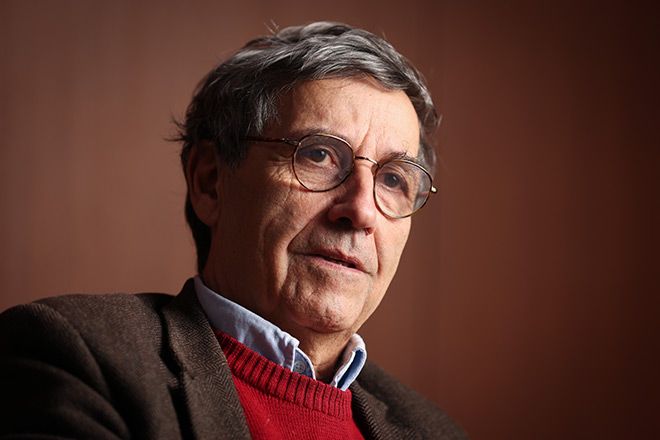
Emmanuel Todd, a French historian, anthropologist, sociologist, and political scientist at the National Institute of Demographic Studies in Paris, stated during a live broadcast on Le Figaro television that the Western world has entered a phase of major collapse and disintegration.
Stating that global balances have been overturned, Todd noted that conflicts in the Ukrainian and Iranian theatres have laid bare the structural weaknesses of the Western system.
Appearing in the studio alongside strategic analyst François Heisbourg, Todd offered assessments drawn from his new book, The Rupture, a sequel to his earlier work, The Defeat of the West.
Discussing the work, which comprises extensive interviews conducted with journalist Diane Lagrange, the French thinker shared the global ramifications of institutional erosion across the European and US axis.
“European leaders live in an absolute kingdom of illusions”
Expressing that the Russian threat articulated in European capitals lacks an objective basis, Todd stated that continental politicians have succumbed to a psychological illusion. The French anthropologist remarked that Europe is generating artificial fears by projecting its own internal crises outward.
Todd offered the following assessment regarding the posture of decision-makers in Europe: “European leaders appear to harbour a desire for open war with Russia. To put it bluntly, the picture before us shows that Europe has turned into a veritable kingdom of illusions. This entire narrative suggesting that Russia wants to invade Europe is nothing more than a fantasy detached from reality.”
Emphasising that the military objectives of the Moscow administration remain limited, the historian clearly delineated Russia’s strategic boundaries. Recalling that Russia seeks to advance as far as the Dnieper river and secure control over the port of Odesa, Todd noted that it lacks the demographic and logistical power to push beyond.
Todd used the following phrases regarding Russia’s intentions: “I defined Russia’s war objectives very clearly in my book. They want to reach the Dnieper line, take Odesa, and perhaps turn the remainder of Ukraine into a satellite state. However, they will stop there because they have no intention of going further. They possess neither the demographic resources to achieve that nor such a strategic objective.”
“Russia is a target onto which our deep internal pain is projected”
Emphasising that the dominant discourse in Europe must be analysed, Todd stated that the mindset of decision-makers reflects a societal anxiety. He expressed that Europe and the US have lost their internal cohesion, a condition that has poisoned their perception of the external world.
Noting that the disintegration of Western civilisation lies at the root of the problem, Todd spoke as follows: “It is possible to explain this threat rhetoric partly in psychiatric terms, because a significant proportion of those who articulate it are entirely sincere. Yes, there is a serious paranoia that has seized the mechanisms of control. The real issue is the internal disintegration not only of Europe, but of Germany, France, the general Western system, and the US. This process of disintegration produces an outlook that views the world paranoically. Russia is therefore merely a target onto which our deep internal pain and unease are projected.”
Referring to topics to which he dedicated substantial space in his book, Todd stated that the reality of the West losing its own identity lies at the centre of the global system. He stressed that xenophobia and security paranoia are the direct consequence of the internal loss of values.
“Trump is the defeated party in this war, not the victor”
Stating that the conflict in Ukraine has reached a point of no return for the West, Todd noted that the reality on the ground cannot be obscured through propaganda. Expressing that the course of the conflict will become definitive within this year, the thinker drew attention to the acceleration along the frontline in Russia’s favour.
Reporting that European leaders have grown anxious over the fear of accountability as the end of the war nears, Todd said: “This year will be the period when the picture in Ukraine becomes clear. Balances on the frontlines are shifting rapidly, and the gap is closing. This conflict is taking on an increasingly dirty character. This is precisely why European leaders are acting with such panic. Everyone will have to confront their own record once the war ends. History will write what we actually did for the Ukrainians: whether we drove them to suicide or genuinely helped them.”
Entirely rejecting claims of a covert partnership between US President Donald Trump and Vladimir Putin, Todd pointed to Washington’s failure on the ground. He emphasised that the American military industry has failed to produce the ammunition required to sustain Kyiv’s army, which is why the conflict has been lost.
Todd conveyed the condition of the White House in the following words: “The narrative that the US and Europe are divided into two opposing camps, and that the US and Russia are friends seeking to fleece the Europeans, is an utter illusion. Donald Trump is a president of defeat. The Americans lost this war because they could not provide sufficient weapons to the Ukrainian army. The American military-industrial complex is in an extremely dire state. The Trump administration is attempting to make people forget this American defeat; that is why it browbeats Europeans, stages political theatre, and embarks on diversionary operations.”
“Germany has entered a rearmament process in the Merz era”
Stressing that the most fundamental rupture within the Western alliance has occurred in Germany, Todd expressed that Berlin has abandoned its cautious foreign policy line to adopt a confrontational stance. He stated that the government led by Christian Democrat Friedrich Merz has focused on armament policies.
Noting that German industry was mobilised to close the American military shortfall, Todd spoke as follows: “The primary development on the scene since my previous book, The Defeat of the West, has been Germany’s mobilisation for war. Following the cautious line of the Social Democrats, the accession to power of the Christian Democrats led by Merz directly propelled Germany, the continent’s leading industrial power, into a process of rearmament. When American industry proved inadequate, German industry stepped in, and this gave Trump renewed hope. Since Merz came to power, Trump has authorised the Central Intelligence Agency to direct Ukrainian missiles directly at Russian targets. Therefore, the notion that Trump and Putin are walking hand in hand is complete nonsense.”
“Russians are strategic realists who do not impose values”
Expressing that Russia acts out of motives of state security and sovereignty rather than expansionist ambitions, Todd said Moscow does not recognise a Western-centric hierarchy of values. Arguing that Russia’s strategic approach coincides with American realism, the thinker noted that moral sermons in international relations have lost their validity.
Stating that Russian statecraft is based on the vision of a multipolar world, Todd offered the following assessment: “Russia’s strategic theory runs in almost the exact same direction as the approach of the American John Mearsheimer. They are strategic realists thinking through national sovereignty and raison d’etat. Their most distinctive characteristic is the principle of not imposing their own moral or cultural values on their partners. When the Russians speak of a multipolar world, they mean not only a balance of power, but also diversity in the sphere of values. They even explicitly state that Westerners may live as they wish, and that this does not concern them.”
Emphasising in particular that he is no sympathiser of Russia while offering these observations, Todd said: “I feel almost uncomfortable falling into this strange position of appearing to defend Russia. Yet I have no such intention. In my book, I openly confess that I harbour a deep sympathy for the Iranian people, but I have never felt such an affinity towards the Russians.”
“The Iran war is a kind of Vietnam disaster for Washington”
Stating that the Iranian intervention launched by Donald Trump in February 2025 has led to a global economic impasse, Todd expressed that the surge in natural gas and oil prices has choked Western economies. Expressing that Washington acted with strategic blindness, the author stated that this decision has culminated in a major failure.
Relating that the Iran operation was a diversionary manoeuvre designed to cover up the debacle in Ukraine, Todd continued his remarks: “A dynamic of systematic failure exists here. Following the American defeat experienced in Ukraine, the Washington administration continually resorted to diversionary moves. First they dreamt of acquiring Greenland, applied pressure to Europeans, tried to bring Venezuela to its knees, and sought to encircle Cuba and Iran. Relative success in Venezuela pulled the wool over the eyes of the Americans. They turned towards Iran to make people forget the Ukraine defeat, yet Iran is an entirely different country. It is a society packed with engineers, undergoing extremely rapid cultural change.”
Emphasising that the resistance the American administration encountered in Iran has transformed global balances, Todd said: “For the Americans, this war is a first-order strategic disaster. It resembles a Vietnam War, which was lost over five or six years, lost this time within a few days. This is a complete fiasco, and in truth everyone except Trump is aware of it.”
“Ukraine and Iran have now turned into a single war”
Expressing that a deep chasm has opened between the discourse constructed by the media and the material balance of power on the front, Todd noted that the Western industrial base has eroded. He stated that the Ukrainian and Iranian fronts have practically merged, turning anti-Western forces into a unified bloc.
Todd explained the military reality on the ground with these words: “The most striking element in the process we are experiencing is the profound divergence between the debates in the media and the concrete reality of the war on the ground. There is a demographic in the West that speaks and comments constantly, yet war is conducted through military-industrial capacity on the ground. At this stage, the Ukraine War and the Iran War have effectively turned into a single war. On both fronts, the inadequacy of the West’s military-industrial capacity has been exposed. While a missile shortage is experienced on one side, ammunition is running out on the other. These acts of aggression, which initially appeared disconnected, have bonded a tripartite power comprising Russia, Iran, and China. These countries are conducting extraordinarily close cooperation. While the Americans direct Ukrainian missiles, the Russians designate the targets of Iranian missiles.”
Recalling that the exhaustion of American arsenals is not limited to the Iran war, Todd added that reports by the Pentagon and the think tank Rand Corporation documented the air defence crisis long before the attack on Iran.
“Our constant aggression hardened the conservative line in Iran”
Examining from an anthropological perspective the form assumed by the Iranian political system in the face of Western pressure, Todd expressed that external interventions played a decisive role in the hardening of the Tehran regime. Conveying his own observations, the thinker recounted the contacts he has maintained with Iranian diplomats since the early 2000s.
Sharing an assessment conveyed to him during the era of Mahmoud Ahmadinejad by a diplomat, Todd said: “At that time, a young Iranian embassy counsellor spoke these words to me: ‘Every irrational step taken by the Americans strengthens Iran’s strategic hand in the region. On the other hand, however, American attacks unite Iranian national consciousness around conservatism, consolidating the position of hardliners in the administration.’ The situation I describe in the book is precisely this long-term dynamic.”
Explaining the differences in societal structure between Russia and Iran through anthropological family models, Todd said: “In my capacity as an anthropologist, I examine the links between family systems, political ideology, and political temperament. Russian and Iranian political temperaments are fundamentally different from one another. Russia possesses an authoritarian culture where power is organised vertically. Putin did not create the system; this communitarian Russian family culture created Putin. In contrast, the Iranian family possesses a nuclear and individualistic structure. Individualism raises individuals open to debate and negotiation, as seen in the tradition of Shia thought. Had it not been for the unending aggression of the West, this dynamic could have evolved along its natural course. Our interventions reversed the process.”
Expressing that he is a Westerner of the older generation, the thinker offered the following evaluation: “I am an old Westerner who believes in an environment of free debate and pluralism. I am a researcher trained in Cambridge and living in Paris. Yet what we call the West today has severed itself entirely from the values of the past, turning into a mechanism that generates intolerance towards the world. A historian does not look at issues through who is at fault; he analyses historical dynamics.”
“The rise of the far right in Germany is a historic danger”
Expressing that nation states have returned to their ancient reflexes during the disintegration of the Western alliance, Todd stated that the political transformation in Germany has reached alarming proportions. Criticising the radicalisation and war rhetoric in German politics, the historian stressed that memory is being targeted for erasure.
Evaluating electoral dynamics in Germany, Todd said: “I devoted a very detailed chapter to Germany in my book. Truly bizarre developments are taking place there. A far-right party, an extension of the National Socialist heritage, has reached levels of 45%. No one can say that I am the only person concerned by this. On the other side is a Chancellor who is losing ground yet rapidly dragging his country into direct conflict with Russia. In his speeches, he characterises the Russians as barbarians. Yet they forget the fact that the force which slaughtered 25 to 27 million Soviet citizens in the past was the German military. We are witnessing the return of historical dynamics, and we must manage to see ourselves as we truly are.”
“Gross domestic product figures are an empty universe of signs”
Finding the growth narrative driven by US economic supremacy and leadership in artificial intelligence misleading, Todd noted that economic indicators do not reflect genuine societal prosperity. He argued that despite American gross domestic product rising on paper, decay is occurring across fundamental indicators.
Emphasising that economic indicators do not match reality on the ground, Todd shared the following observations: “A large proportion of the minds working in the field of artificial intelligence in the US are not of American origin; they are reliant on highly skilled labour coming from outside. American gross domestic product appears to be growing constantly, yet these measurement methods do not reflect reality. Life expectancy in the US has fallen behind Europe. We saw that Ukrainian refugee children arriving in France surpassed local pupils in mathematics classes in French secondary schools. We live in a universe of signs that has entirely no substance behind it. The awakening from this illusion will be quite shocking, alongside the impending energy crisis and the collapse of the European economy.”
Expressing that the American economy remains afloat through its trade deficit, the thinker used these phrases: “The most concrete proof of the unreality of the American economy is the incessantly growing trade deficit. America can no longer produce what it consumes. It has even begun to run a trade deficit in agriculture. They are dependent on their allies in Europe and Asia for food products; in other words, it is we who feed the Americans. Through irresponsible energy policies, Washington is also crashing the peripheral economies that it needs in order to survive.”
“Elderly electoral dominance has produced a gerontocracy in France”
Expressing that population ageing in Western societies represents an indicator of strategic collapse, Todd drew attention to demographic rupture in France. He stated that infant mortality rates in France have begun to climb again, resembling the final era of the Soviet Union.
Emphasising that France’s political structure has been shaped according to the interests of the elderly population, the author said: “While preparing for my discussions with Diane Lagrange, I examined demographic statistics in depth. Infant mortality rates in France have begun to rise again. This datum recalls the collapse process of the Soviet Union. On the other hand, while Europe is retreating in births and child numbers, it reaches high figures in life expectancy for individuals aged over 60. The metabolism of society is slowing, and the values of the elderly are becoming dominant.”
Reporting that political power has been held hostage by older generations, Todd concluded his words as follows: “When France does not have a population as old as Italy or Germany, how did it surrender to such an elderly-oriented system? Because the primary power of the elderly is the ballot box, the votes they cast. If you remove democracy and the voting mechanism, you would see that the elderly would not pour into the streets to protect their privileges. A strong liberal democratic tradition allowed the older generation to make maximum use of its ballot power, and France drifted into a gerontocratic regime.”
Expressing that market capitalism and the individualistic concept of economic man have destroyed the family, the French thinker stated that the global decline in birth rates stems from economic selfishness. He added that having children demands self-sacrifice and devotion, whereas market values destroy this instinct.
Stating that artificial intelligence represents one of the greatest ruptures in human history, Todd warned that this technology carries existential risks that threaten the continuity of the species, much like nuclear weapons.


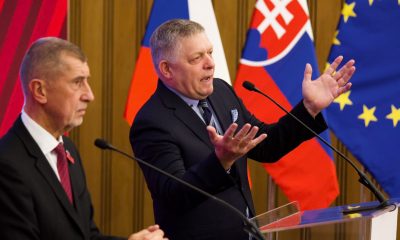


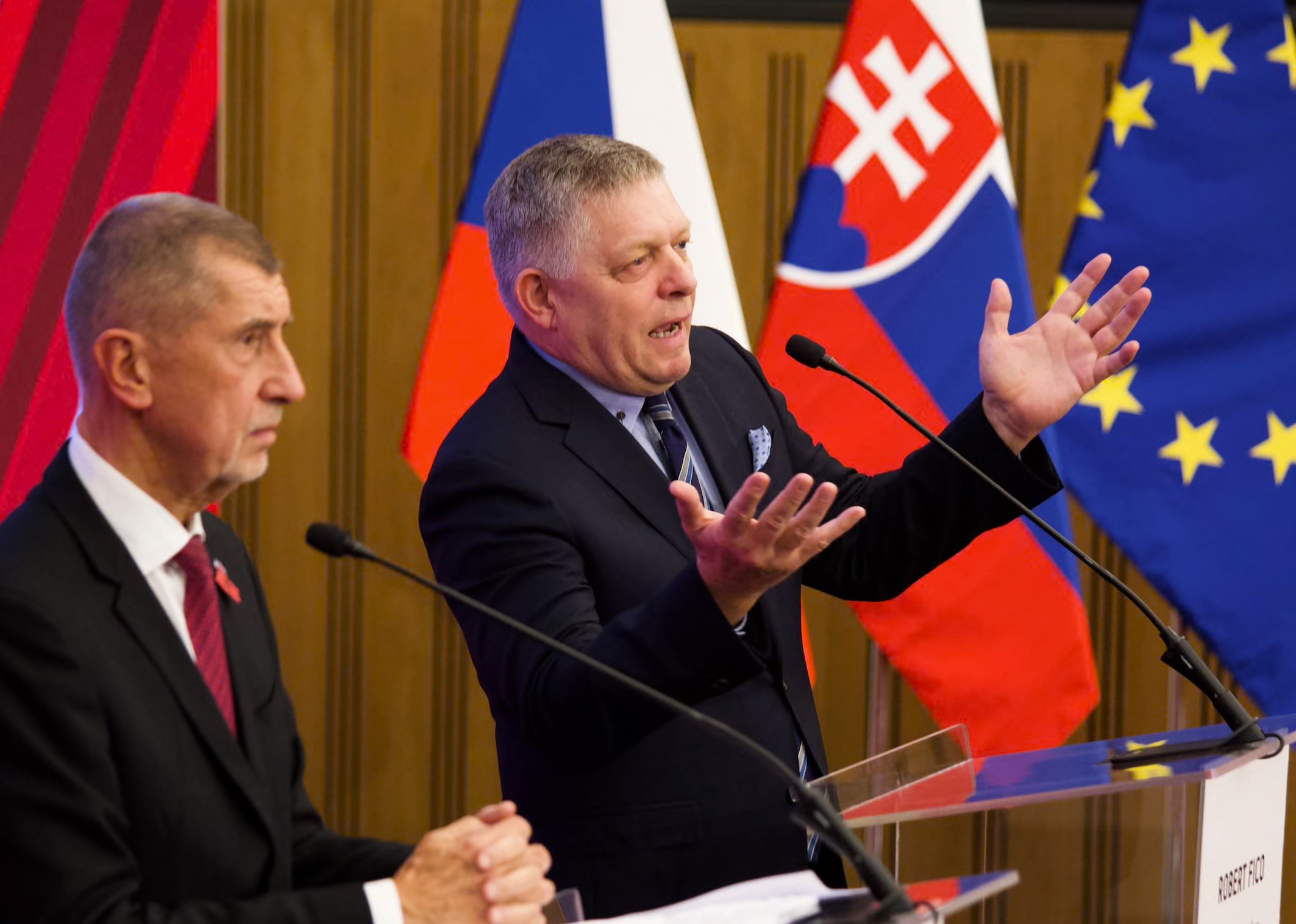
Slovak Prime Minister Robert Fico has hit back after German Chancellor Friedrich Merz threatened to veto the EU budget unless funding for Ukraine is secured.
Merz said he would block the EU’s seven-year budget if no agreement is reached on financial assistance for Ukraine.
The chancellor’s intervention has angered Central European leaders who are net beneficiaries of EU funds but do not want to take part in the next round of funding to support Ukraine’s war effort.
“What the chancellor is doing is typical blackmail, and I will not bow to it,” Fico told reporters in Bratislava.
Fico spoke alongside his Czech counterpart, Andrej Babiš, whose government has refused to participate in a future loan to Ukraine.
“I do not know why he said this,” Babiš said, referring to Merz’s stance.
Merz wants EU leaders to discuss Ukraine’s financing needs at a summit in Dublin on Friday.
In a letter to European Council President António Costa, who will chair the meeting, obtained by The Guardian, Merz wrote:
“We must maintain our support for Ukraine in its struggle to defend itself. This is our shared vital interest. Yet bilateral aid provided to Ukraine is distributed unevenly, with the burden shouldered mostly by only a few member states.”
The EU agreed last year to provide a €90 billion loan to Ukraine, intended to cover two-thirds of its military and civilian spending for 2026 and 2027.
Since then, however, Russia’s relentless bombardment has placed a heavier financial burden on Kyiv, prompting President Volodymyr Zelenskyy to ask for €70 billion to plug the budget deficit.
The EU has endorsed Zelenskyy’s figures and pledged to find €45 billion. Ukraine’s other allies, such as Britain and Canada, are expected to cover the rest.
Last year, Merz launched an initiative to tap €210 billion in frozen Russian state assets held in the EU, but the plan fell through due to opposition led by Belgium, which holds most of the funds in Brussels.
The €90 billion loan was the backup plan. Having opted out of that loan, Hungary, Slovakia, and Czechia indicated that they would not take part in the next round either.
Bulgaria joined these three member states following the election of Prime Minister Rumen Radev last April.
The question of funding for Ukraine is now spilling over into the fraught negotiations on the 2028-34 EU budget.
Germany, the largest net contributor, wants substantial cuts to the proposed budget and opposes the EU providing generous funding to member states that refuse to contribute to Ukraine’s financial needs.
Merz states in his letter that a “collective commitment without exceptions” is a “fundamental prerequisite” for closing Ukraine’s financing gap and for “discussing other matters, particularly those with financial implications.”
He also notes that, in the context of the EU’s next seven-year budget, known as the Multiannual Financial Framework, all member states must contribute to a “robust” financial perspective for Ukraine from 2028 onwards.
A German government official said:
“For the Multiannual Financial Framework (MFF) to be successfully concluded, it is vital that all EU member states provide financial support to Ukraine.”
Berlin is also aiming to shift decision-making on funding for Ukraine from unanimity to qualified majority voting, in an effort to prevent a single government from blocking EU decisions.
The letter reflects mounting frustration among the EU’s northern member states, Ukraine’s most generous backers, over lower contributions from other EU countries in Central and Southern Europe.
The task of brokering an agreement on the budget falls to Costa, the former Portuguese prime minister.
Costa wants a deal by the end of the year, ahead of elections in France, Poland, and Italy in 2027 that could complicate the process.
A spokesperson for Costa confirmed receipt of the letter without elaborating on details. “President Costa will dedicate time to the Ukraine issue at the informal European Council meeting in Dublin this week,” the spokesperson said, adding that funding for Ukraine would be addressed at a dedicated summit on the EU budget scheduled for 26-27 November.
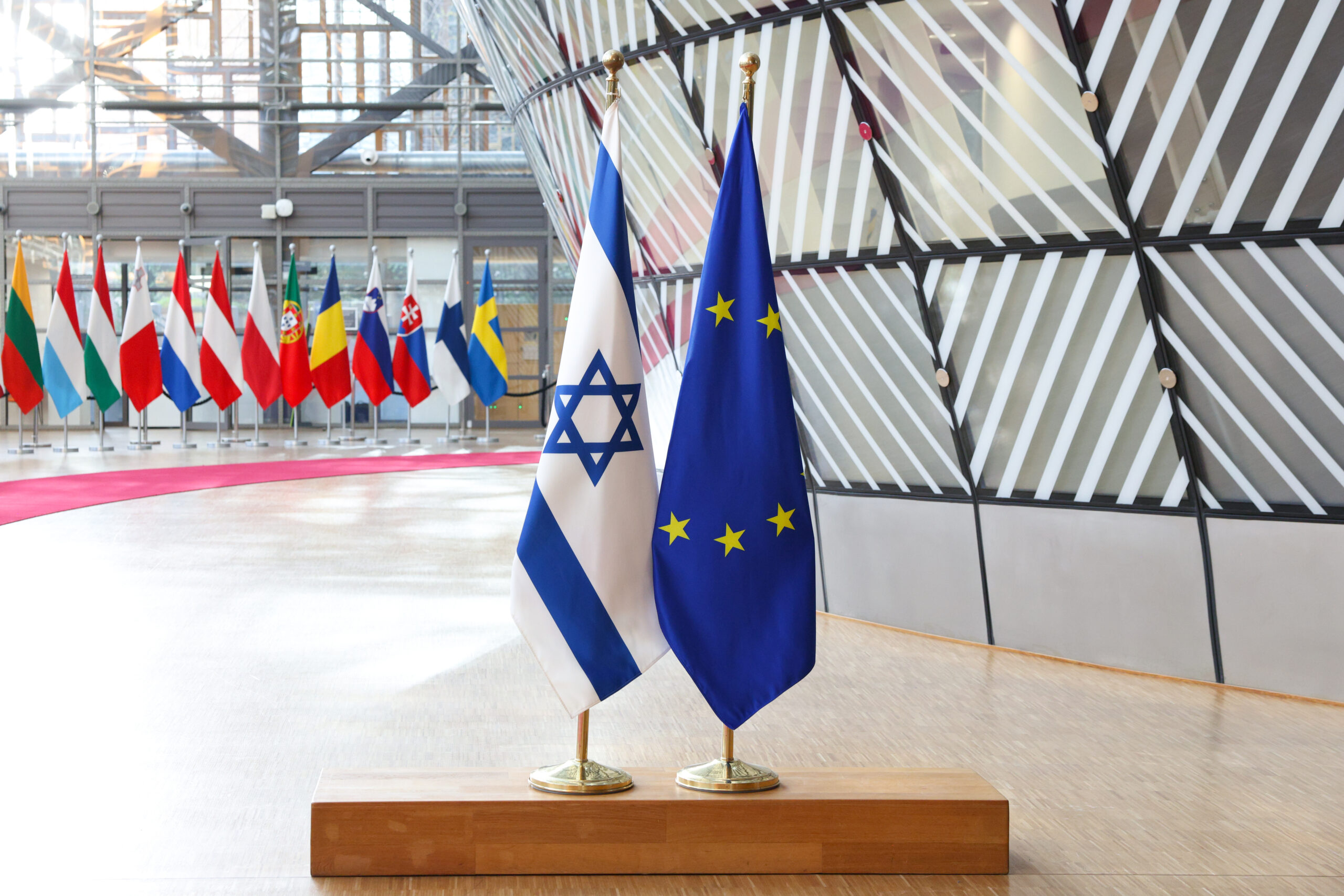
The EU expects the next Israeli government to mend its “difficult relationship” with Brussels and adopt a more constructive approach toward Gaza and illegal settlements.
Israeli President Isaac Herzog tasked Gadi Eisenkot, the leader of the anti-Netanyahu bloc, on Sunday with forming a government.
Eisenkot stated that the country faces a “catastrophic diplomatic crisis” as traditional allies begin to reassess their relations with Israel.
Speaking to Rapporteur, several European diplomats stationed in Tel Aviv said they expect ties to get back on track.
“Whatever government comes in, we can try to revitalize relations because Israel is clearly a very important partner,” one European diplomat said, adding that Brussels expects the next administration to be “less aggressive”.
The diplomat noted that relations with Europe are currently “not very good”.
Israel cut off communication with Kaja Kallas, the EU high representative for foreign affairs and security policy, after Rapporteur revealed in June that she had compared Israel to apartheid-era South Africa during a visit to Mexico.
The diplomat stated that this decision, taken ahead of elections, was political in nature. A second European diplomat based in Brussels explained that the announcement came only a few days before an official visit by Dubravka Šuica, the European commissioner for the Mediterranean.
“This could have been interpreted as a tactic to divide Europe, but Israel had asked Kallas to deny the report; she did not do so,” the second diplomat said.
Brussels has repeatedly voiced its frustration with Israel over the humanitarian crisis in Gaza and the expansion of West Bank settlements.
However, EU governments blocked almost all sanctions proposed by the European Commission.
A third diplomat said opposition parties would “almost certainly take the issue more seriously” when it comes to tackling violence by West Bank settlers:
“We see Palestinians being expelled from their homes and new illegal settlements being built in the West Bank. There is a reluctance on the part of the current government to address this issue, which causes problems in our relations.”
The new government is expected to ease pressure on Palestinians and halt construction of the E1 settlement project, a controversial plan to build settler housing in the West Bank east of Jerusalem.
“They will probably try to deal with the problem of extremist settlers in the West Bank,” the diplomat added.
On Gaza, the diplomat described the situation as “a complete nightmare”, with two million Palestinians crowded into an area that accounts for roughly 35% of the territory.
“There are not enough tents for the winter, and not enough vaccines are reaching the area despite an increase in diseases,” the diplomat said.
The European official argued that Donald Trump’s peace plan met all the conditions for Europe. Although the EU had much to offer, neither the US nor Israel appeared interested in EU involvement in the process.
“We are currently training Palestinian police in the West Bank, and if permitted, we could do the same in Gaza,” the diplomat said.
The diplomat disclosed that Israel had agreed with Šuica that Europe would finance two projects aimed at improving sewage and water infrastructure in Gaza, continuing:
“However, none of these projects has started yet because there is a serious problem with dual-use goods. Getting materials into Gaza is very difficult because the Israelis say they could be misused if they fall into the wrong hands of Hamas.”
Israel insists that Hamas must be disarmed before subsequent phases of Trump’s plan can proceed.
With disarmament unlikely to happen in the near term, the EU argues that certain measures can be carried out in parallel.
“We can begin rebuilding sanitation systems in Gaza. We can start building desalination plants. We can begin providing energy and water to Gaza,” one diplomat said.
While Brussels hopes for progress on Gaza and the West Bank, it maintains that expectations regarding the establishment of a Palestinian state need to be “managed”.
The EU continues to advocate a two-state solution, yet most leading Jewish parties oppose the creation of a Palestinian state.
The diplomat noted that the next Israeli government will likely have “a very slim majority and not much room for manoeuvre”.
There is also a “major misunderstanding” between the EU and Israel that must be addressed. According to the diplomat, Europeans fail to recognize the “psychological impact” of 7 October on Israelis.
“This event changed the country and made the two-state solution even more distant than before,” the diplomat said.
In return, some Israeli politicians believe Europe has betrayed Israel despite what they view as a fight against “Islamist terrorism”.
“Their argument is that European politicians are somewhat afraid of the Muslim population in Europe,” the European diplomat said.
Europe strongly opposes Iran and the possibility of Tehran acquiring nuclear weapons, imposing sanctions in response.
However, the diplomat argued that the EU would not participate in a war because it lacks a common army:
“We are a diplomatic and economic power, which is why we resort to sanctions and diplomacy. The expectation that we would take part in a military operation is unrealistic.”
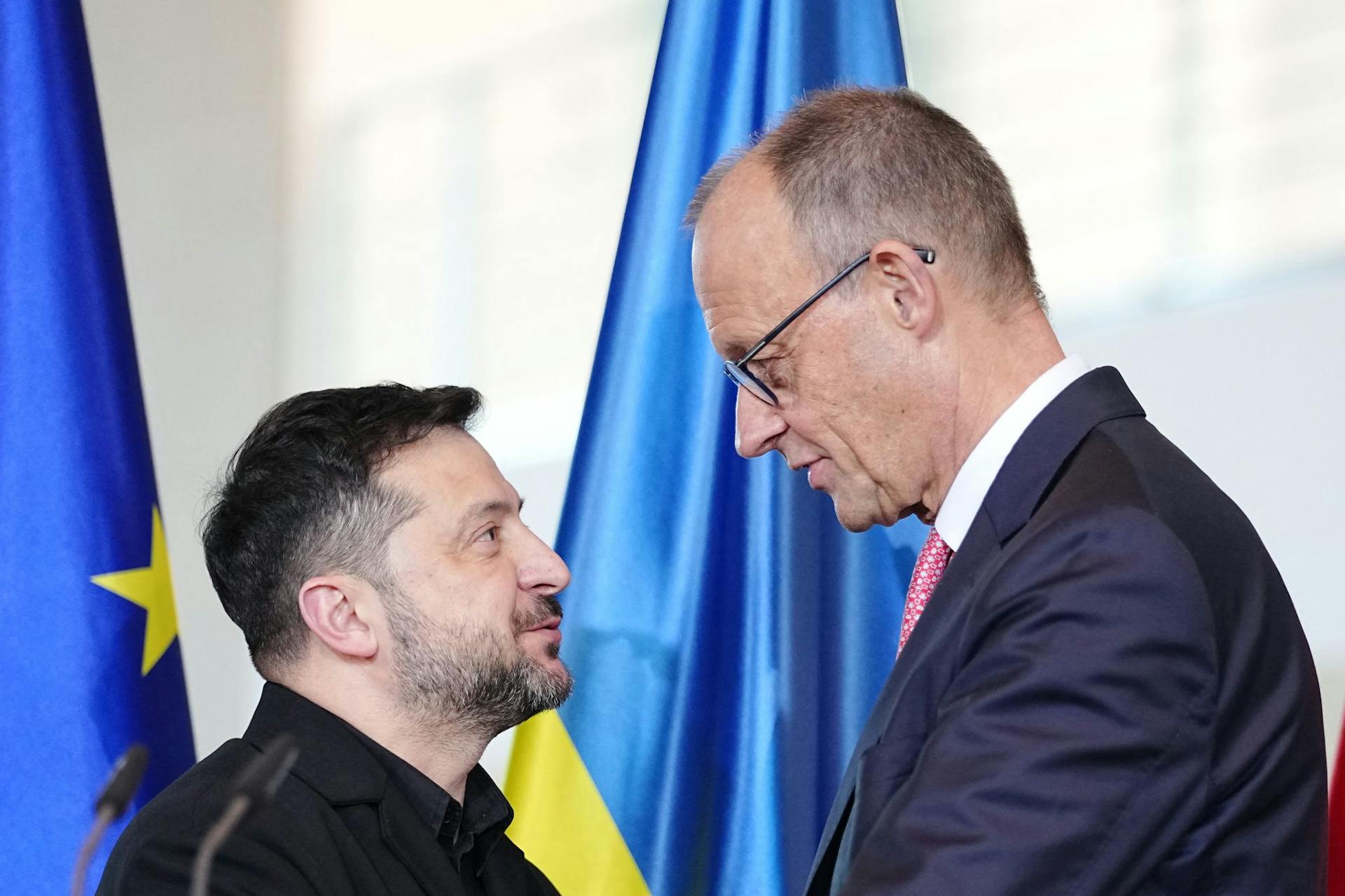
Germany has threatened to veto the European Union’s joint budget for the 2028-2034 period, which is currently under negotiation, unless every member state commits to providing financial support to Ukraine in 2027 and subsequent years, German Chancellor Friedrich Merz warned.
According to a report by the Financial Times (FT), Chancellor Merz set out Berlin’s condition for the budget talks in a letter addressed to European Council President António Costa.
In his letter, Merz wrote: “A collective commitment that every single one of us, without exception, will make a fair contribution to closing Ukraine’s budget deficit is an indispensable prerequisite for resolving this budget issue and, in particular, for addressing subsequent matters that carry financial implications.”
The German Chancellor stressed that a formula backed by all member states must be established to provide Ukraine with a reliable, multi-year financial perspective starting from 2028.
Merz also insisted that any agreed solution must cover the interest payments on debts incurred to finance the assistance provided to Kyiv.
Conversely, several countries within the bloc have cut financial aid to Ukraine, and the number of capitals adopting this stance is projected to rise next year.
In December 2025, Hungary, Slovakia, and the Czech Republic approved the EU’s 90 billion euro loan package for Kyiv only on the condition that they would not contribute to its costs themselves.
Alongside these three countries, Bulgaria has also stated that it does not plan to participate in subsequent financial assistance packages for Ukraine.
In France, far-right leader Marine Le Pen, who could potentially win the presidential election scheduled for spring 2027, recently told the FT that Paris has run out of funds.
Le Pen assessed: “The honest approach is to tell Mr Zelensky clearly, and even warn him: ‘Look, we cannot do more. We have already allocated the 90 billion euro EU loan, in which France’s share amounts to 18 billion euros. 18 billion euros is genuinely a huge amount of money.'”
The EU’s 90 billion euro loan, covering the 2026-2027 period, aims to meet two-thirds of Ukraine’s financing requirements.
Brussels expects the remaining 45 billion euros to be covered by other partners, including Canada, the UK, Norway, Japan, South Korea, and Australia.
Germany remains the largest net contributor to the EU budget.
In contrast, the four Eastern European countries seeking to avoid financing Ukraine rank among the largest net beneficiaries of the bloc’s budget.
Leveraging this balance, Chancellor Merz aims to use his influence in the EU budget negotiations to secure uninterrupted support for Kyiv in 2027 and the years beyond.
According to the FT, Berlin is also demanding that future aid packages be decided by qualified majority voting rather than unanimity, which is required under the current system.
A German government spokesperson told the newspaper:
“The issue of Ukraine’s financial needs must be resolved within the framework of the next EU budget. Financial support for Ukraine from all EU members is decisive for the successful conclusion of the budget talks.”

IRAM expert Oral Toğa assesses Middle East shifts after US vote

Netanyahu Arab party attack triggers crisis over coalition

Fico accuses Merz of blackmail over threat to veto EU budget

US Senate panel seeks records in Trump-linked crypto investigation

Europe ready for arms and missile control talks with Russia, FT says
-

 Diplomacy1 week ago
Secular dress code dispute exposes deeper Türkiye-Azerbaijan strains
-
 Russia2 weeks ago
US and Russia weigh energy deals and corporate return in peace talks
-
 Europe6 days ago
EU urges citizens to prepare 72-hour survival kits for crises
-
 Middle East2 weeks ago
US warns Gulf allies of possible Iran strikes after midterms
-

 America2 weeks ago
Bolsonaro reportedly leaves Brazil on jet linked to scandal-hit firm
-
 Asia1 week ago
China expands Africa arms sales, displacing France and Western rivals
-
 Europe2 weeks ago
EU prepares Ukraine peace mission to Abu Dhabi led by Björn Seibert
-
 Diplomacy2 weeks ago
Steinmeier seeks to de-escalate German-Chinese tensions on visit
