
Interview
‘The assassination of Arouri is not going to change anything in the battlefield against the Israeli occupation forces’

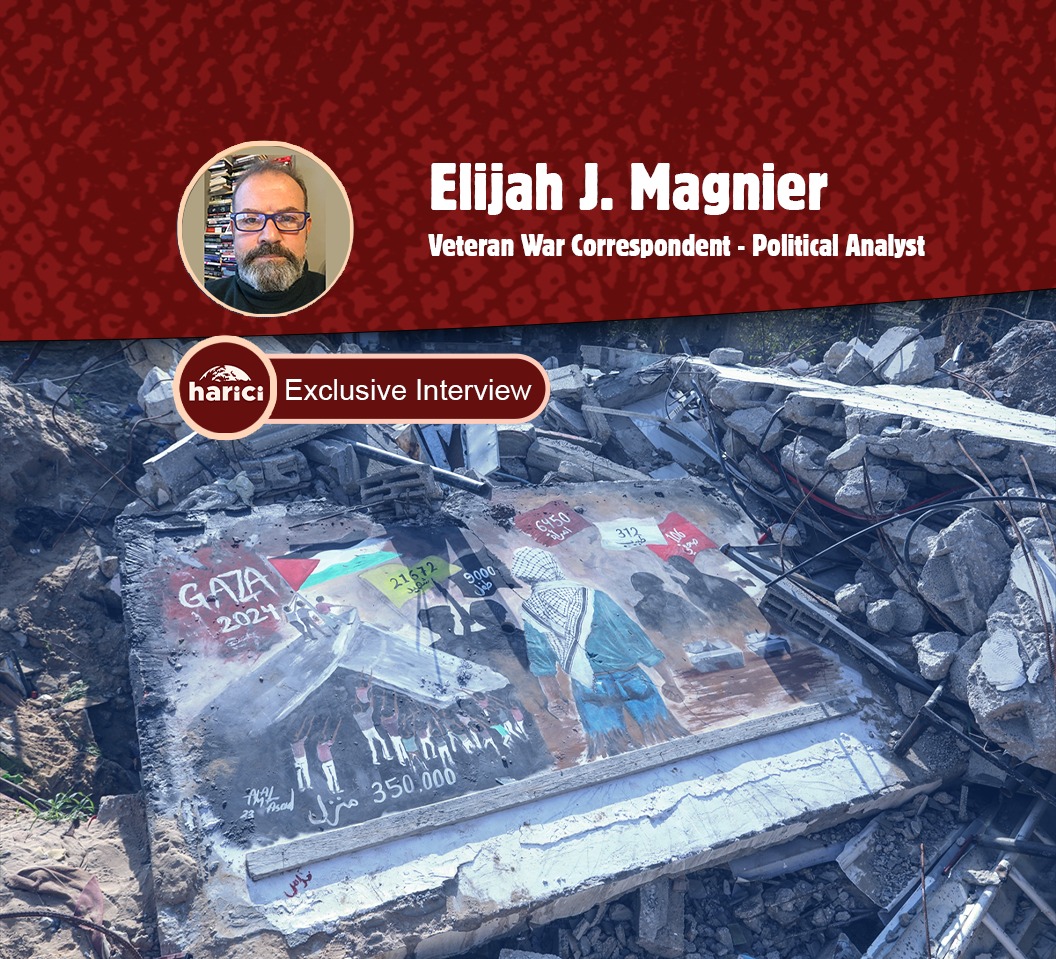
Elijah J. Magnier, a Brussels-based veteran war correspondent and political analyst who has worked in many countries in the Middle East for many years, spoke to Harici. “It is impossible to eliminate Hamas,” Magnier told Harici, adding that Israel will not achieve its stated goals in Gaza. Magnier also emphasized that Hezbollah would retaliate after Aruri’s assassination.
Magnier is a veteran war correspondent and political analyst with more than 35 years of experience in the Middle East and North Africa, having lived in Iran, Iraq, Lebanon, Libya, Sudan and Syria. Specializing in Middle East politics, strategic planning and non-state actors, Magnier has an extensive knowledge of political networks in the region.
Elijah studied Terrorism and Counter-Terrorism at St. Andrews University and London University, holds a Masters Degree in Terrorism and Counter-Terrorism and a PhD in policing and political science from John Moores Liverpool University, UK.
He has covered many major wars and military conflicts in the region, including the Israeli invasion of Lebanon in 1982, the Iraq-Iran War, the Lebanese Civil War, the 1991 Gulf War, the 1992-1996 war in the former Yugoslavia, the 2003 US invasion of Iraq and the subsequent war and occupation, the second Lebanon War in 2006, and the recent wars in Libya and Syria.
We talk with Elijah J. Magnier about the implications of the killing of Hamas deputy leader Saleh al-Arouri in an Israeli drone strike in Beirut, Lebanon, and the future of Gaza.
‘Eliminating Hamas is an impossible task’
The first question is, do Israel goals in Gaza match the reality on the ground? I mean, do you believe that Israel can achieve its goal of completely eliminating Hamas?
Eliminating Hamas is an impossible task. The former Israeli Prime Minister Ehud Barack said that Hamas is an ideology, therefore it is impossible to be defeated. These were his own words. Therefore, many Israeli officials in power today or still outside the power but are influential in Israel, understands that it is impossible to defeat Hamas because Hamas is a resistance group. In the history, in the world history never resistance group has been defeated by an occupation force. It takes time. It may take one or two or three or five generations. But as long as the people of the land, the owners of the land, continue fighting and opt for an armed fight, it means that there is no solution but for them to reach either a compromise or to recover the territory. Know the objective that Israel announced is impossible to achieve.
‘Hezbollah will retaliate very soon’
Israel announced at the beginning of the war that it would target Hamas leaders abroad. And yesterday, Israel killed Arouri, a senior Hamas official. Considering especially Hezbollah’s efforts not to escalate the war, how can it respond to Israel now?
This is a folkloric tactical victory because every single non state actor, organization like Hamas, Hezbollah, Hashd al-Shaabi in Iraq, the Houthis in Yemen… All these groups have horizontal leadership. It is not vertical when the head of the pyramid is killed then the whole pyramid is in crisis. No, it is horizontal when one leader is killed, another one or maybe 10 can replace him. Or even if Israel manages to kill 10 other leaders within Hamas, by the way they killed Arouri and another two leaders of Al Qassam and who were on the target list of Israel at the same time. But that is not going to alter the capability of Hamas. And with the proof is that Saleh al-Arouri was in Lebanon and he was not guiding the battle. Those who are guiding the battle are in Gaza and the assassination of Arouri is not going to change anything in the battlefield against the Israeli occupation forces in Gaza.
Also, the Israelis have killed in assassinated so many Palestinian leaders in the past that nothing has changed. On the contrary, the Palestinian leadership increased in its strengths and its objective to fight Israel.
Now how Hezbollah is going to react, that’s something completely different because the attack was inside Beirut, in the suburb of Beirut. That is a clear attempt to break the rules of engagement and to attack Hezbollah and the Lebanese in the place where they live. They have killed also three Lebanese in this attack. So Hezbollah has to retaliate and will retaliate very soon because failure of retaliating will encourage the Israeli to carry out more attacks.
‘The assassination will not affect Hamas’
Could you be a little more specific? How will Arouri’s assassination affect Hamas?
It will not affect Hamas at all because the Arouri was not guiding the battle and there are many people who can replace him. Because Hamas is an ideology is made of many leaders, many people look at how they have killed Sheikh Ahmed Yasin, the founder of Hamas in the past and nothing has changed. They killed the Rantisi and nothing has changed. They killed Mabhouh in Dubai and Hamas continued develop itself and managed to lead the Palestinian resistance to the 7th of October. So being having one of the leaders assassinated or as I said another 10 leaders, it will change nothing in the equation.
‘Because of his failure, Netanyahu is running away from his objectives, going towards Lebanon’
Is the assassination of Arouri is a sign of victory for Netanyahu or does it have a strategic significance? Do you expect these assassinations to continue?
Well, this is the policy of Israel to violate international law and go and attack in any sovereign country thinking that it can get away with it because it has the support of the Americans and the international community. This is why Israel is always getting away with it without impunity, because it has discover. However, this is again a tactical victory, because Benjamin Netanyahu is in deep trouble.
He has not achieved any of the two main declared objectives to defeat Hamas and free all the prisoners. And he is under pressure from the government and the coalition by the two ministers of security, Itamar Ben-Gvir and finance Bezalel Smotrich, who threatened him to resign if he stops the war on Gaza. Now continuing the war on Gaza is increasing the casualties. INS published more than 10,500 Israeli soldiers wounded in this battle, of which many hundreds that are severely wounded and others really totally crippled. So the level of casualty is so high that is unjustified in the light of the failure to achieve any objective. This is why Netanyahu is running away from his objectives, going toward Lebanon and perhaps thinking that this would enlarge the war, bring other actors like the United States to calm down everybody and find a solution, even for him in Israel, and say, OK, it’s enough, you all stop now. He will look like he’s not the one who stopped the war, but all the Israeli, the Americans who are imposing on him to stop the war. This is his hope.
‘There is no post war Gaza, because Israel hasn’t achieved anything’
I would like to ask you about the future scenarios in Gaza. We know Israel objects the US plan, but even Israel does not have an agreement on plan yet. How do you think stable governance can be achieved in let’s say in post war Gaza?
There is no post war Gaza, because Israel hasn’t achieved anything to dictate the law in Gaza and what’s going to happen next. On the contrary, we have seen the Israeli army declaring that it has occupied and controlled the north. And then the next day the Israeli are bombing Jabalia, Beit Hanoun, Cuhr ed-Dik or all the area in the north. So they really not in control. And then we see the Israel is saying we broke into this area, Khan Younis or other area or Tuffah. And then the next day they pull out because they can’t stay. So if you can’t stay in the place and you are harassed by the resistance all the time, you can’t say this is my plan for after the war and you haven’t finished the job and you know you will not be able to finish the job. So all this bravado is, really has no sense of reality in it.
‘If Israel loses the war, regional countries will turn their backs on it’
A question about the region and about the, let’s say, geopolitics. The the normalization process with Israel and the Gulf countries, especially the UAE, Qatar and Saudi Arabia continue despite the war in Gaza. And these countries are also developing relations with especially China and of course also Russia, and now Saudi Arabia and UAE recently becoming an official member of BRICS. What do you think? How related is the ongoing war in Gaza to this global shift?
It is unrelated because Russia was one of the first countries to recognize the state of Israel in 1948. Moreover, China has always maintained good relationship with Israel, and the Arab states recently have increased the relationship with Israel. They also declared the normalisations and other did not declare normalisation but still continue to receive Israeli ministers like Saudi Arabia. Nevertheless, these countries do not have borders with Israel and other countries like Saudi Arabia consider Hamas as a terrorist organization. And Saudi Arabia has imprisoned and still hold in its presence more than 63 members of Hamas.
Therefore, for them it is really not an issue to see Israel bombarding Gaza and the result of this bombardment is killing 21 to 22,000, mainly civilians, and wounding 55 to 65,000 so far and so many other thousand under the rebels. For them, this is not an issue. This is not going to change the course of the relationship unless Israel come out defeated and this is what the Israeli Defense Minister Yaov Gallant said yesterday when he said we have no longer a place in the Middle East if we do not win this war. It means if Israel comes out defeated, this will set an example for the future generation that Israel can be defeated. There is no point in having a good relationship with Israel when it is weak. The invincible army showed that is invincible and it’s weak and has been defeated on the 7th of October surprised with all the technology and the intelligence that it brags about and the support of all the Western intelligence supporting the Israelis all the time. So all these indication lead to a conclusion that at the end of the day what is the benefit of having good relationship with Israel?
‘Donald Trump may bring with him more potentiality of aggression towards Iran’
Last question is about the US elections, because it is also an important aspect this year.
What do you think? How will the US elections at the end of this year and maybe Donald Trump’s possible victory, changed the balance in the Middle East, particularly US, Iran relations?
If Joe Biden remains in power, Joe Biden presented himself as a non-aggressive president. However, he has changed nothing of what Donald Trump has said before he leaves office. So he kept the presence of the US forces in Syria, his support to the Kurds in northern Syria, he continues to steal the oil there. He kept the presence in Iraq, and he unconditionally supported Israel.
Exactly what Donald Trump did, with one difference, that Donald Trump’s approach toward Russia is different. Trump doesn’t want the war with Russia and Joe Biden has failed with his war against Russia in Ukraine. Therefore, to stand down on Ukraine is not going to change a lot and the policy of the next president because the Ukrainian capability has been depleted.
Now in relation to the Middle East, there was a difference between Biden’s approach to Saudi Arabia and Donald Trump has a different approach. However, the support of Israel is always unconditional. On the contrary, Donald Trump may bring with him more potentiality of aggression towards Iran more than Joe Biden.










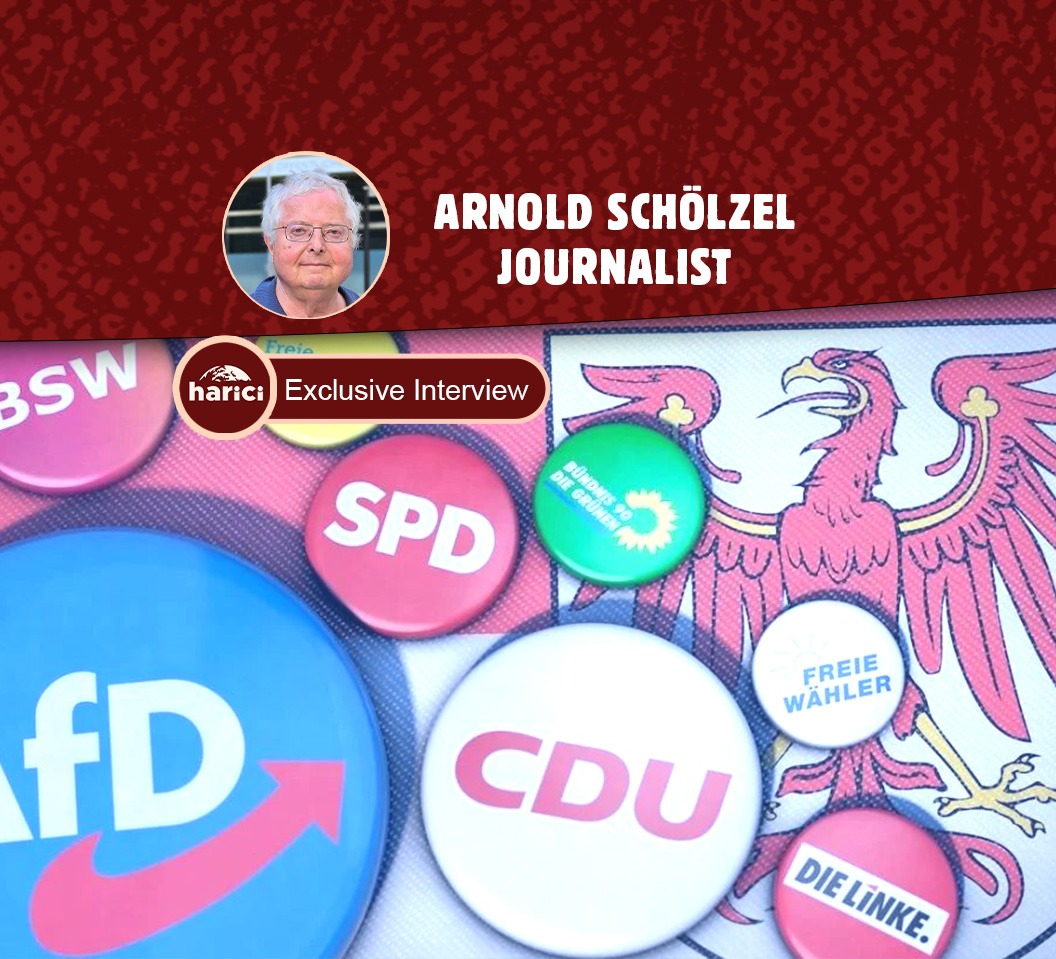
Following the Alternative for Germany (AfD)’s major victory in the Saxony-Anhalt state elections, significant uncertainty regarding Germany’s future has emerged. Subsequently, in Berlin, Die Linke (The Left) pulled off a major surprise by becoming the leading party, after which a massive counter-campaign began in the mainstream media and the political establishment.
The future is uncertain, but certain signs are evident: the political center, represented by the CDU/CSU, SPD, and the Greens, has crumbled with a loud crack and is on the verge of collapse. We are moving toward a model in which the U.S. will scale back its role in the war in Ukraine, allowing Europe’s “Big Three” (Germany, Britain, and France) to take a more prominent role. While German capital, reliant on cheap Russian gas and despite alarm bells ringing in its industrial sector, is trying to strain relations with China, pessimism and war mongering are on the rise in Berlin.
We discussed all of this with journalist Arnold Schölzel at the Berlin office of Germany’s only left-wing daily newspaper, junge Welt. Schölzel’s biography is quite interesting and deserves a more detailed account; but for now, let’s just say this much: As a young man, he was among those who fled from West Germany to East Germany (the German Democratic Republic—GDR) in 1967. He made this decision because he could no longer tolerate the “old” Nazi influence while serving in the German Armed Forces (Bundeswehr). Schölzel says that throughout the entire history of the GDR, nearly one million people crossed from the West into the country. In a world where escapes from “behind the Wall” to the West are constantly recounted, this issue deserves closer scrutiny.
We spoke with Schölzel on a wide range of topics, from the rise of the AfD to the war in Ukraine, and from German mainstream politics to the “transatlantic right.” The journalist, who emphasizes the prevailing uncertainty, believes that within German big business, there is a segment more inclined toward cooperation with Russia alongside those who favor a more aggressive stance against it. Nevertheless, Schölzel believes that a significant segment of the German business and political class sincerely believes it can bring Russia to its knees and reduce the Russian Federation to a sort of colonial position. In his view, the AfD serves as a “reserve force” kept in reserve precisely for this climate of uncertainty, and it is possible for the party to radicalize even further to the right under different circumstances.
Let’s start with current German politics. What are your thoughts, in particular, on the Russia-Ukraine war and the U.S.’s recent “peace” initiative? Does the U.S. truly want peace, or is it trying to buy time and push its European allies forward?
This is definitely one of Trump’s goals—namely, getting Western Europeans to foot the bill for the war. I believe he reiterated this yesterday [October 18]; it has always been his goal. Western Europeans have also accepted this with great enthusiasm.
I, however, have serious concerns about this for two reasons. One is the long-standing geopolitical tradition of the U.S. and the United Kingdom opposing cooperation between Russia and Western Europe—particularly Germany—on the continent; this has been the case for 120 years. This is a very clear policy. The interests of the U.S. and the entire Anglo-Saxon world are clear. So this relates to the “Heartland” theory outlined by [Zbigniew] Brzezinski in his book The Grand Chessboard, doesn’t it? Whoever plays the Eurasia card poses a threat to U.S. global power. This is understandable.
Here’s what I think: If they aim to create discord between Russia and Western Europe—and especially Germany—they might miscalculate, just as I believe they did during the First and Second World Wars. I firmly believe this: I call it German imperialism; German imperialism still wants a place in the sun. Everything starts with that. In 1897, [Bernhard] von Bülow—then Foreign Minister and later Chancellor—made this declaration. It was a declaration that Germany was challenging Great Britain at the time—and, of course, the United States as well—and asserting its own claims to the status of a world power, a great power.
My counterparts in Russia do not believe me, but I suspect that there are still factions within German big business who hold this view: We must secure a position as a great power here on our own. As far as I know, the debate once again revolves around the following question: Will we achieve this through cooperation with Russia, or through an anti-Russian policy that will ultimately weaken Russia to the point of collapse?
In my view, this constellation stems from geography, economics, and—in my eyes—a denial of reality: namely, German foreign policy’s refusal to acknowledge the actual balance of power on the continent.
The prevailing belief in Germany—and I think this is the dominant policy right now—is that Russia can be brought to heel. We hear this over and over again. There are people like Kiesewetter, who are constantly featured on German public television; Roderich Kiesewetter, the foreign policy expert. Morning and night, it’s Kiesewetter, Ms. [Claudia] Major, and many others whose names I’ve forgotten.¹
So within the circle of German foreign policy and security experts, there is a group—behind which, I believe, lie rigid interests—and they believe that Germany, as the leading nation of the EU, is still so powerful that this leader can finally bring Russia to heel.
[German Foreign Minister Johann] Wadephul actually drew a comparison on faz to the collapse of the Soviet Union. This is actually a template: just as we diminished the Soviet Union, we will now diminish the Russian Federation. I see this as madness. I’ll say it again: my Russian counterparts—for example, Fyodor Lukyanov, whom I speak with from time to time—can’t believe that I think German politicians are this crazy, but to be honest, I’m afraid. I’m afraid they actually believe this. As I said, Wadephul repeated this in faz. And this is, of course, a very, very dangerous game—everyone knows that, right? Because this war between Ukraine and Russia could escalate into a larger war at any moment, and there are people who are clearly willing to take that risk.
The U.S., in its current form, seems to be standing somewhat on the sidelines, I suppose. Last week, Der Spiegel published an interview with NATO Supreme Commander General Alexus Grynkewich and the Inspector General of the German Armed Forces (Bundeswehr). You read different things there. There, contrary to the rhetoric of these war hawks in German foreign policy, it states that Russia is not planning a war. Russia is not planning a war. Grynkewich said that we are far superior militarily. That’s precisely why Russia shouldn’t be allowed to take the initiative. But what isn’t clear from this interview is that we want to corner and weaken Russia. You hear this from the Germans—and, of course, from the coalition of the willing that is effectively led by Germany now that Joe Biden is gone—don’t you?
We’ve heard many reports that the U.S. will withdraw from Europe and that the U.S. is trying to dismantle NATO. But at the same time, they’re somehow forcing Germany to take on NATO’s leadership; the Trump administration, it seems, is saying we want Germany to lead Europe. And this process of rearmament—and perhaps the militarization of German culture—is steadily increasing, because every time I come to Berlin, it feels like there’s more and more war mongering in the air—much more. But it’s hard to understand what German big capital, the big bourgeoisie, is trying to do in Ukraine. Of course, they have some major investments, particularly in the arms and defense industries. I suppose this also serves as a kind of laboratory for war efforts, digitalization, or things like that, but still, Germany—or at least some German bourgeois circles—is also facing some difficulties due to the war in Ukraine. How can we reconcile these conflicting interests of the German bourgeoisie and what they plan to do in Ukraine? Why are they doing this?
I truly believe the real target is Russia—the collapse of Russia, just as it was with the Soviet Union. Russia is made up of more than 80 different nations and ethnic groups. There are also many, many different nationalities within the Russian Federation itself. I think they tried this in the 1990s and 2000s in Chechnya, the Caucasus, and generally in places like Tatarstan by playing the “national card” against the Muslim population. This failed, just as efforts to play the “national card” and foment national division in China—through Tibet or Xinjiang, that is, the Uyghurs—have failed.
Now, the openly declared goal in Russia—which possesses immense natural resource wealth—is to weaken Russia politically to such an extent that it regresses to a semi-dependent or colonial status.
I always recall a pioneer of German foreign policy from the era of the German Empire. His name was Paul Rohrbach. In 1916, he uttered this memorable phrase: Whoever controls Kiev can bring Moscow to its knees. This actually comes from Brzezinski—and yes, from 70 to 80 years ago. I get the impression that a large portion of German capital has abandoned the idea that it could achieve its own goals through cooperation with Russia. I view even the fact that Siemens has almost completely withdrawn from Russia as a very, very serious warning sign. Siemens had been operating in Russia since around 1860. Lenin’s plan—communism, Soviet rule, plus electrification—was largely carried out by Siemens.
Therefore, abandoning this trade and withdrawing is, in my view, a very serious warning sign that German big business has other plans regarding cooperation with Russia. In addition, I believe Donald Trump—though this began under Biden—told the Western Europeans: “What you do with Russia is now your story; we have our own issues with China.” I believe this is the backdrop to what is happening right now.
So the question is: What will the future of U.S.-China relations look like? This situation, of course, is affecting these alignments in Europe. Frankly, I’m not sure about this issue. German big business is clearly split on the matter of China. On the one hand, they argue that if we don’t cooperate with China, we’ll fall behind technologically and economically. On the other hand, I think they’re trying by any means necessary to break away from this close bond with China, this economic integration, and—though I don’t yet have a clear idea of how it will play out—they’re trying to gain independence through a policy that forces China to make concessions that will weaken Russia.
This seems a bit contradictory, because, of course, the cooperation between China and Russia is on such a scale that there’s no sign China is abandoning Russia. I don’t believe that. But China will likely take its own position there as well. I don’t know which one, but this is very, very complex.
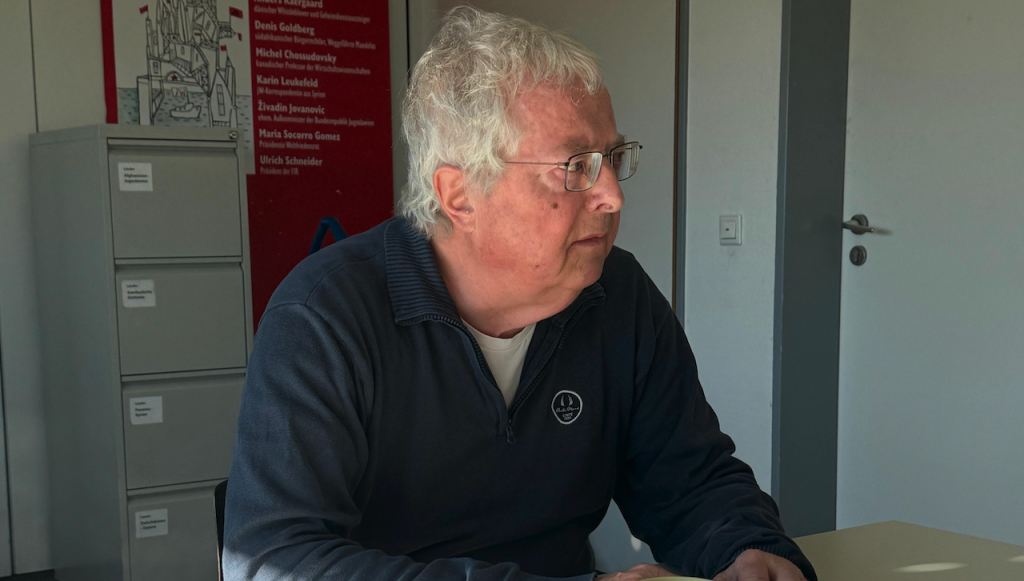
Arnold Schölzel
Where does the AfD fit into this picture, and what position does it hold? This party is polling at 30 percent—could you explain how the AfD positions itself regarding the war and in relation to German big business?
I think this is also an expression of the internal contradictions within German big business. They are not in agreement on policies regarding the war and relations with Russia, and fortunately, nothing has been decided yet. As I said, there is an aggressive faction; but alongside that, of course, there is also a sufficient number of companies and segments of capital that favor a reasonable policy toward Russia—one that seeks cooperation. There were many German companies at the recent International Economic Forum in St. Petersburg. Gerhard Schröder has now taken on this role at Globus. Other major German companies are also still operating in Russia. For example, Metro and the automakers haven’t shut all their doors. At least they haven’t completely abandoned their factories.
As for the AfD, in my view, it serves as a political reserve in the broader political landscape. In other words, I believe that in a situation where the economic crisis may be deepening and a political crisis is unfolding in the Federal Republic, the AfD acts as a “transatlantic right-wing” reserve—particularly, of course, to support the CDU.
Magdeburg [the capital of the state of Saxony-Anhalt] is perhaps a laboratory where such a scenario is being tested. There are also influential forces that have finally forced Friedrich Merz to tear down this so-called “firewall” (Brandmauer) against the AfD.
So far, it has been said that this is merely a rumor, but it is reported, for example, that Axel Springer CEO Mathias Döpfner has twice asked Merz to pursue a more cooperative policy toward the AfD. This is just a rumor, but it has never actually been denied either.
And Döpfner has very good relationships with Peter Thiel and Elon Musk.
He recently presented Peter Thiel with the Axel Springer Award and had a long conversation with him. And the truly interesting thing here—which reinforces the argument that Sevim Dağdelen and I have made regarding the AfD’s ties to the transatlantic right— —is Peter Thiel’s remarks, his lengthy conversation with Matthias Döpfner at the award ceremony, and now his connections with various figures from U.S. big business. For example, Jamie Dimon, CEO of JP Morgan Chase—the largest bank in the U.S.—says that what Trump is doing here is threatening our allies, presenting the withdrawal of NATO from Western Europe not as an actual policy but as a threat… Dimon said this is going in the wrong direction, that it’s the wrong policy, and that we need to “win back the old West.” This means reestablishing sensible cooperation not only with Western Europe but also with Japan, the Philippines, and South Korea—in other words, rebuilding the old West. He didn’t say what this means politically in terms of China policy, but I’m skeptical that it will be a good thing. Therefore, this will likely be more in line with the Democrats’ traditional policy: pursuing a more liberal stance domestically compared to Trump and the entire MAGA movement, but adopting a tougher stance abroad toward China and Russia.
And to me, it makes a lot of sense for them to ally with the AfD to reestablish the “old West.” For U.S. capital, this is probably more appealing than the U.S.’s confrontational policy toward Western Europe. But all of this is in such flux right now that it’s hard to say what kind of realistic policy will emerge from it. I have to admit that. In other words, things are at a stage where it’s difficult to say where they’re really headed. I’ll say it again: interests in Germany—within German big business—appear to be divided. There are at least two: an aggressive variant and a cooperative variant. The AfD likely serves both of them—it makes no difference to them. They are, as we might say, a “reserve force”—a recreational reserve for big politics. Whether this will actually materialize is another matter, depending on the CDU’s election results. There, Friedrich Merz is consistently dragging down the CDU’s vote share; so much so that the necessity of bringing the AfD on board is increasing rather than decreasing.
Of course, decisions are primarily made at the economic level, and these are later reflected in politics—including policy toward Russia and China. But as I said, it’s very hard to say which faction will prevail there.
Do you think the AfD will turn into a new CDU—or a “CDU 2.0”—once it grows large enough?
Absolutely. The AfD was a breakaway from the CDU. It was founded by CDU members. In East Germany—for example, in Saxony—its leadership consists primarily of former CDU members who came of age under Kurt Biedenkopf’s leadership in the 1990s. The AfD, which is particularly strong in Saxony, is, in my view, a product of the CDU.
Of course, it could always return. A shift toward radicalization could also occur; the AfD has brought together elements that were banned in the old CDU of the Federal Republic—namely, anti-Semites, racists, and supporters of the U.S. Open fascists are welcomed with open arms in the AfD. My view is this: The AfD is not a fascist party, but it is a party for fascists. Of course, radicalization could also occur in this context.
This also depends on developments within the EU. Take Italy, for example—things are going a bit differently there than expected; that is, there is no radicalization under Meloni. But if Marine Le Pen becomes president in France next year, we will likely have to reassess where things are headed here in Germany as well. Right now, so many things are up in the air.
Does the same apply to Die Linke (The Left)? Because I think I read an article in your newspaper, *Junge Welt*, suggesting that Die Linke is increasingly becoming the party of the urban, trendy crowd—in other words, sort of like a new SPD. Is that true?
Yes. Even though it won the election in Berlin, it’s constantly losing ground, especially in East Germany. Up until 10 years ago, its voter base across all of East Germany was around 20 percent; now it’s mostly below 10 percent, and here in Berlin there’s a notable exception where the vote largely comes from the immigrant population—or people of immigrant origin. Elif Eralp, the lead candidate, played a major role in this.
It’s also worth noting that there were 2.5 million eligible voters in Berlin, and because voting was permitted for the first time starting at age 16, there were a large number of young people. However, there was also a record number of people—1.4 million—who have lived in Berlin for years but lack the right to vote. These are, of course—I think nearly 1 million of them—people without German passports, which had never been seen before.
The Left’s entire platform, in my opinion, is indeed a social democratic one. I think it will be very difficult for the Left to repeat this election victory. They won’t be able to repeat this victory in future elections.
However, mainstream parties like the CDU, SPD, and the Greens seem to be trying to normalize the AfD by portraying Die Linke in Berlin as anti-Semitic or something similar. Because I’ve read some news articles or watched videos in publications like *Die Welt* where it’s claimed that the AfD is already more “normal” than Die Linke. Is it possible to use Die Linke to normalize the AfD?
Yes. When the AfD won the election in Saxony-Anhalt, [CSU leader and Bavarian State Premier] Markus Söder said this was democracy. But when the Left Party won in Berlin, he said, “We’ll cut off all the money we give them; we’ll do this, we’ll do that.” I can say that for the CSU and Markus Söder, the question is also about how to deal with the AfD, and I think they’ve already decided how to manage their policies regarding the AfD.
But there’s still a kind of division within the CDU regarding how to deal with the AfD. Because one part of the party wants to ban this party, while the other part says, “No, don’t do that.” Is it possible to ban this party?
The “C” in the names of the Union parties stands for “Christian.” There are major Christian churches—Catholics, Roman Catholics, and Lutherans—and they are very powerful within the CDU/CSU. And there are also Jews. Take Karin Prien, for example, the minister of youth and social affairs. Prien comes from a Jewish family, and I don’t think there would be any cooperation between her and the AfD, for instance. So you’re right, the CDU is also divided internally, and this will lead to major problems.
You mentioned China, but there have been many debates in Germany recently that are critical of China. I think for the past few years, both German government officials and major sectors like the automotive industry have been taking a cautious stance toward China. For example, they didn’t want any tariffs imposed on China. But recently, they’ve changed their stance and adopted a harsh rhetoric similar to that used against Russia.
No, the situation is more complex. Do you remember Annalena Baerbock, that famous foreign minister? She presented a China strategy, didn’t she? In that strategy, China was defined as a “partner, competitor, and systemic adversary.” The result was supposed to be “decoupling” [economic separation].
Looking at it today, I can say that this has failed. No one is talking about this China strategy anymore, and I think the strategy is only three years old. No one is talking about it anymore. Furthermore, “decoupling” later evolved into a cautious—very cautious—process of “risk reduction” [derisking]. These are the famous supply chain issues. In other words, you want to avoid putting all your eggs in one basket; you don’t want to remain dependent on shipments from China in the event of a crisis.
On the other hand, I visited China for the first time last year, and the Chinese press is writing things about German executives that are completely different from what you read here in the business section of the *Handelsblatt* or in the *Süddeutsche Zeitung*. German executives in China—especially in the automotive sector—are saying that we shouldn’t just manufacture here; we actually need to conduct research and development activities here as well.
BMW established its own research and development facility in China last year. The situation is the same for VW. The reasoning is this: They are, so to speak, at the forefront of the world—at the forefront of global technology—and if we aren’t part of that, we’ll miss out on opportunities in the global market.
For German companies, the issues at stake are now entirely different and strategic—not just in this sector, but in sectors like artificial intelligence as well. They’re stating this quite clearly: Germany has fallen so far behind in certain technical fields that it can only keep up by collaborating with China.
As for the tone in German politics… If I were in their shoes, I’d be cautious. Politicians have become more cautious in their stance, but the German media has not. Even in the business newspapers here, you don’t hear about what’s really happening technologically in China.
Of course, there are exceptions. Today’s economic section of *faz* reports that China has almost caught up with Nvidia in the software sector. Even just a short time ago, it was being said that China lagged months, even years, behind Nvidia and major U.S. tech companies in the field of AI software. Today’s *Faz* notes that the two are now very close and, above all, emphasizes that China’s strategy is to make everything open-source. This means it’s incredibly cheap and accessible to everyone. Consequently, *Faz* describes this, so to speak, as massive competition: The Germans will join this competition too; naturally, they’ll gravitate toward what’s cheaper, won’t they?
At the investment forum that began today (October 19) in Berlin, the Chancellor is expected to meet with Nvidia CEO Jensen Huang. In an interview he gave to the Bild newspaper in London just before heading to Berlin, he said it broke his heart to see how far behind Germany has fallen in the technology sector. According to him, Germany (after all, they’re always polite) has very talented people, but now they really need to get down to business.
To be honest, I was in China merely as a sort of political tourist, but when I read about what’s been happening in Germany, I learned this: an economic stagnation that’s been ongoing since 2019. We’ve been in a recession since 2019, and wages have been affected as well—which, of course, is a major source of discontent among the public. This is precisely the ground on which the AfD has actually grown.
The issue isn’t just peace with Russia; first and foremost, of course, it’s the loss of industry and blue-collar jobs. We’re talking about hundreds of thousands of jobs; in the automotive electronics sector alone, 10,000 jobs are being lost every month right now. The problem is that there has been a decline in investment. Foreign investment in Germany has not yet returned to 2019 levels.
That is precisely why we are organizing an investment summit like the one taking place here today. When I returned from China as a political tourist, I said, “One gets the impression—perhaps a bit exaggerated and not entirely accurate—that Germany resembles an industrial museum compared to China and what is on display there.”
This is a clear strategy, and the Federal Republic must confront it: I believe it is precisely this situation—this weakness and decline—that is the reason we are holding an investment conference here today. In other words, the aggressiveness in politics stems in part from this weakness. As we can see, we are losing ground, and that is a problem.
In France and other European countries, many groups—especially young people—are taking to the streets, but there’s no similar trend in Germany. For example, if we compare the number of participants at the peace rally we witnessed in Berlin three years ago with those at this year’s events, there’s a clear drop in attendance. What do you make of that?
That’s true. However, there has also been a “School Strike” ongoing in Germany for over a year now. In these protests, young people are mounting significant resistance against mandatory military service. Even though there isn’t the same level of street activism as in France, the School Strikes appear to be quite significant for a country like Germany.
¹ Roderich Kiesewetter: A CDU member of parliament and the party’s foreign policy spokesperson. He is known for his hardline stance toward Russia. Claudia Major: A German expert on security and defense policy born in East Berlin. While she argues that striking Russia’s interior regions is legitimate, her recent meeting with Chechen separatists also made headlines in Germany. (Editor’s note)
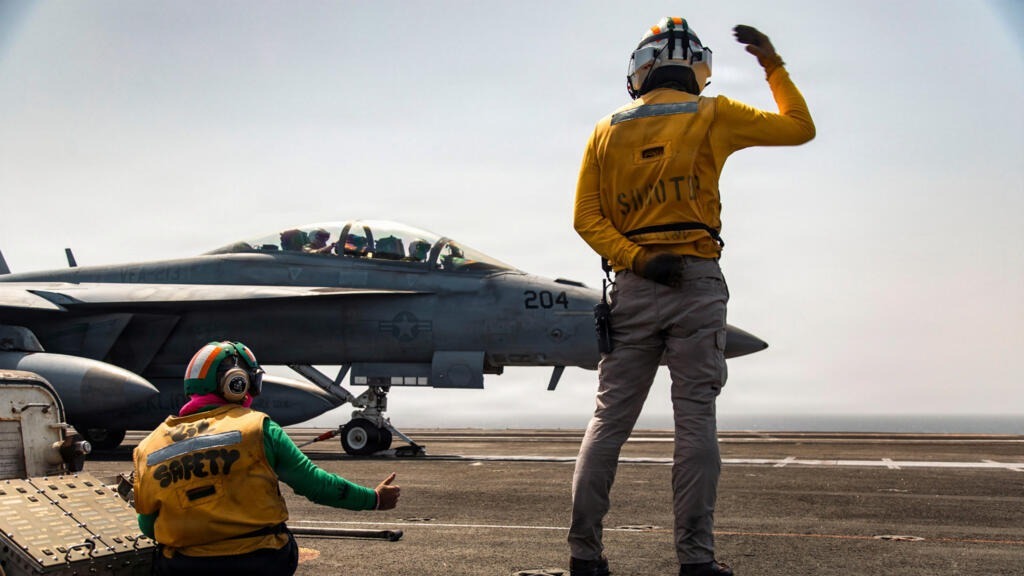
Retired US Army Lieutenant Colonel and military analyst Daniel Davis discussed the US military operation against Iran, decision-making mechanisms in Washington, US-Israel relations, transformations in modern warfare doctrine, and the global balance of power in an interview with Harici Media.
Answering questions of Harici Editor-in-Chief Tunç Akkoç regarding the Iran war, retired Lieutenant Colonel Daniel Davis stated that the US administration lacks an achievable military strategy on the ground. Davis said: “I would say the US has a desire, not a strategy. It wants to subjugate the Iranian side, corner them, seize control of the Strait of Hormuz, prove they pose no threat to anyone in the region, and ensure they never possess nuclear weapons. That is our desire. But there is no strategy to achieve any of these goals.”
Drawing on his past military experience, Davis detailed the geographical and technical challenges on the ground: “As a soldier with direct combat experience, having gained combat experience in some of these mountains between Afghanistan and Pakistan, for example, I know that many of the mountains inside Iran belong to the same mountain category. I knew what a difficult military task it would be to conquer a country as large as most of Western Europe, where such mountain ranges cover the entire western front. Therefore, I knew you could do nothing on the ground. However, I also knew that you could not subjugate a country with this kind of defense capacity and of this nature through air power alone.”
Pointing out that Iran’s defense infrastructure spans many years, Davis continued: “You cannot do this, especially when they have anticipated this for twenty years and made all kinds of preparations by constructing underground caves, production facilities, and storage facilities, and developing production capabilities for their unmanned aerial vehicles and missiles. There is no way you can defeat them. Because such facilities were designed not only to withstand all our strike missiles, such as Tomahawk, Jasmine cruise missiles, PSM, or ATAC, but also to survive. Most are capable of surviving nuclear explosions as well. I have been inside some of these here in the US. I have been in some physically located beneath a mountain. I know they were specifically designed when constructed to withstand the largest nuclear weapons the Soviet Union might possess. The ones there are of the same kind. If you know before embarking on an act of starting a war that the enemy is this large, possesses these types of defenses, and everyone knows these are resistant to our non-nuclear conventional munitions, why would you start a war to force them into something you clearly cannot achieve?”
Addressing the assumptions behind the war decision, Davis said: “I think this is a fantasy stoked by Benjamin Netanyahu. It was said, ‘If we assassinate their leaders, the same thing will happen as happened to Maduro in Venezuela. You went there, captured him, and disabled him; when you did that, you took control of the entire government, they basically handed the country over to you, and the same will happen here.’ Anyone who thinks Venezuela is like Iran has paid attention to nothing. The culture, history, religion, experiences, and everything that has transpired over the last 47 years are radically different from those in Venezuela, and you do not have an insider to facilitate the process as we had in Venezuela. But President Trump appears to have thought this way.”
“When he started the war on February 28, he sealed our fate; we lost this war”
Pointing to inconsistencies in US President Donald Trump’s decisions and the trajectory of the operation, Davis stated: “This situation is proof that he is stuck. Because, in my view, when he started the war on February 28, he sealed our fate. We lost this war. Even if it is ongoing right now, there is no logical way for us to win it. Because we cannot eliminate the trump card held by the Iranian side.”
Stating that military pressure mechanisms are insufficient, Davis explained: “We still have our missiles, aircraft, aircraft carriers, and all such elements. That is why it appears feasible. It is thought, ‘Maybe if we make a good enough deal, or put enough pressure on them, or impose a blockade and leave the public in a dire enough position to change the government’s mind.’ This is a fantasy. This is the only thing President Trump has. Because if he were acting based solely on military reality, strategic reality, and cultural and religious reality, he would know this was an unwise move, but he does not know.”
Describing Trump’s negotiation approach and the breakdown of the reached agreement, Davis used the following expressions: “He is a transactional individual who wants relationships resolved overnight. For example, during the memorandum of understanding period, this duration was to be 60 days. After starting the war, no achievable military objectives remained. Whatever your desires were, you can no longer reach them because you have confronted reality. Now he is trying to find an exit route, but even within this understanding, he cannot arrive at a rational and consistent perspective. Any rational person would think that when the memorandum of understanding was signed on June 17, it provided him with an exit route. You implement the terms of this memorandum, the crisis is resolved, the dual blockade is lifted, and the Strait of Hormuz could reopen.”
Addressing the clauses of the agreement text and subsequent developments, Davis said: “The terms Trump signed stated that Iran had administrative control of the Strait of Hormuz but could not demand any transit fees for 60 days. Iran accepted this, but accepted only one condition: the ‘for 60 days only’ stipulation. Subsequently, they publicly announced that they would collect fees later, but not during these 60 days. The US was not mentioned in the text in any way. We had no say. The authority to decide how operations would run was left to Iran together with Oman. We gave them 30 of the 60 days to prepare their plan for this. But after four or five days passed, the US suddenly declared a new southern corridor together with Oman.”
Detailing the process of reversing the decision, Davis noted: “While a step to reopen the strait had been agreed upon, traffic had risen to approximately one-third of pre-war levels, and many shipments had passed directly on the first day, Trump personally turned back this development toward finding a reasonable exit route from the unfolding disaster. According to reports from some sources in Washington, he came under intense pressure from pro-war figures in his inner circle and those on the Israeli side. He backed down under this pressure and modified the terms by inserting himself into the fifth paragraph. He never made Israel implement the first paragraph, which covered Lebanon and envisioned a ceasefire on all fronts. We did not even give them 30 days; we intervened before five days had passed. Trump has a goal, fails to reach it, puts forward another condition, and then withdraws that as well. He is very easily manipulated; he reaches a decision, then someone speaks with him, and he changes his mind.”
Recalling that a similar situation occurred in relations with Saudi Arabia, Davis said: “He said he made a great deal with Saudi Arabia, and the next day he changed the condition by saying, ‘as long as they sign the Abraham Accords.’ Saudi Arabia, on the other hand, announced that this was not part of the agreement and had never been discussed. This situation shows that President Trump constantly makes concessions when pressured. On this basis, how can any agreement be reached with the US? This situation means that no military or diplomatic exit point remains because he does not permit it.”
“Control is no longer an economic matter; it is a national security imperative”
In response to a question about whether a mutual exit opportunity remains from the current impasse, Davis said: “We had the memorandum of understanding; we had secured this agreement. However, President Trump and his Secretary, Scott Bessent, said, ‘as long as it is a deal we like, we want a new deal.’ You already had a deal; what deal are you talking about now? Why would the Iranian side negotiate a new deal that differs from an agreement made two months ago? This is completely illogical. The Iranian side holds military superiority through its missile cities and half a dozen alternative methods to control the strait. As their official authorities stated on social media, control of the strait is no longer merely an economic matter; it is a national security imperative because it is the only tool with which they can balance their American adversary, who is far stronger militarily.”
Evaluating the impact of the oil crisis, Davis stated: “Strategic Petroleum Reserves are declining. This situation has prevented a crisis so far, but it cannot cover products like jet fuel, diesel, and fertilizer. If it continues this way and the problem is postponed, the reserves will be depleted one day, and economic activity cannot be sustained without oil. Pressure is on President Trump, and the Iranian side is aware of this. They know the blockade will harm them, but they have calculated that they can endure much longer and deeper pain than our side. This is an existential matter; they know that if they surrender their only trump card to an unpredictable president, they will be attacked again later.”
“Reflexive support for Israel in society has been broken”
Touching upon relations between the US and Israel, Davis said a clear divergence has begun in American society. Davis noted: “In the past, across all segments of society and all generations, it was reflexively said, ‘Of course we are pro-Israel, they are our democratic ally.’ This situation continued until the Gaza process following October 7. Israel was attacked on October 7, and no one found it strange that it responded. However, what happened afterward created problems. Israel used this opportunity to destroy the Gaza Strip, increase pressure in the West Bank, bring in new settlers, and discuss annexation.”
Describing the rift between political elites and the public, Davis explained: “There is a major divide in America. Elites are unaffected by genocide or the killing of women and children in the West Bank and Gaza; they close their eyes, arguing that Israel is an ally. However, the eyes of the American public are not closed. They see human suffering on social media and do not carry the memorized assumptions of the past. These elites are not merely bought with money; for decades, they genuinely believed that our interests and Israel’s interests were one and the same. In their minds, saying something negative about Israel is equivalent to saying something negative about the US. Younger generations in particular, and a growing portion of all generations, recognize that our interests are not the same.”
Drawing attention to the cost of the war to the US, Davis noted: “We elected President Trump to apply the America First principle, not Israel first, Britain first, or Germany first. There is anger against those who sacrificed America’s needs by entering the war. According to figures reflected in the public domain, at least 600 Americans were injured; according to what I have heard, this number is over a thousand. Money has been spent, our facilities have been damaged, and our aircraft destroyed; around 40 to 50 of our aircraft were damaged or destroyed. Our bases were ruined and will likely never be rebuilt. We have also lost our geopolitical influence in the region. I doubt that relations with Saudi Arabia, Qatar, the United Arab Emirates, and Kuwait can return to their former state. Because the foundational assumption of this entire structure was that we could protect them; we could not even protect ourselves.”
“We are still living as if it were 1992”
Evaluating the shift in military technology, Davis stated that the US has lost its traditional military superiority. Davis said: “A large number of people in America are still living as if it were 1992. The Soviet Union had just collapsed, China was a peasant army developing militarily and economically, and we held absolute dominance following Operation Desert Storm. We are no longer in 1992. The Russians corrected their mistakes after the initial phase of the Ukraine war in 2022; they became a much stronger land force, missile, and drone force. China, meanwhile, reached immense technological and industrial capacity.”
Explaining the current situation through the example of Iran, Davis said: “We thought we could crush Iran like a fly, but we could not do so due to their missile cities and technologies. If we cannot eliminate Iran, what can we do against China or Russia, which possess power far beyond that? We have fallen behind in categories such as hypersonic missiles and the new Oreshnik missile. When I saw the Bayraktar TB2 vehicles used by the Turks in the 2020 Armenia-Azerbaijan war, as someone with an armored unit background, I understood that the nature of war had changed. The US, meanwhile, talks about producing 300,000 drones by 2030. In an environment where tactics change every six weeks on the Ukrainian and Russian battlefield, our systems remain extremely slow. Ukrainian soldiers mocked the tank platoon manual published last year, saying that with these methods, one could not survive on the battlefield for even ten minutes.”
“The idea of containing China is a fantasy”
Criticizing the US military approach toward China, Davis evaluated: “There is talk of a strategy to militarily contain China. Will you prevent their activities within their own borders, their technological developments, or the expansion of their military? You cannot stop a country with a strong economy and a massive population. We can achieve no result other than entering a war with China in the Asia-Pacific region and losing it. China’s shipbuilding capacity is approximately 200 times ours; they are vastly superior to us in artillery ammunition, aircraft, and missile production. Our methods left over from the Cold War no longer work. What we need to do is keep our own defense strong and ensure deterrence, not spend billions of dollars in the region to establish forward bases that will be hit.”
Touching upon the potential for diplomatic relations between the two countries, Davis said: “I think President Trump personally knows that going to war with China is unwise. However, the Pentagon and the military-industrial complex view China as a constant enemy, demanding more budget, more bases, and more missiles every year. No one considers diplomacy. Yet we can develop peaceful, stable relations with China based on mutual benefit, even if not friendly. Regarding Taiwan as well, I think leaders realize after seeing what occurred in the Middle East and Ukraine that help will not come, and they will adopt a more cooperative stance by withdrawing independence rhetoric. China does not want to start a war; it desires a model similar to Hong Kong. Even if a conflict breaks out in the worst-case scenario, it is between China and Taiwan; the US should not choose to join the war and lose.”
Emphasizing that the arms lobby inside the US maintains its power, Davis stated: “The military-industrial complex remains extremely powerful and holds all levers of power. They maintain control through members of Congress, the media, and public relations networks; I see no sign that this structure is weakening.”
“They did not want someone who would tell the truth about Israel”
Providing information about the process surrounding the cancellation of his appointment within the Office of the Director of National Intelligence, Davis recounted the issue in these words: “When Tulsi Gabbard came to me and asked me to become the number three executive in the Office of the Director of National Intelligence, I said I would be honored to serve my country. However, I stated that I had openly opposed the policies pursued by Israel since October 7 and the war in Gaza and Lebanon, and that these views might not be welcomed within the administration. She thought my accurate past analyses would compensate for this situation. One of my duties was to present the daily intelligence briefing to the president.”
Describing the stage at which his candidacy was withdrawn, Davis said: “Articles against me appeared in the Israeli press and American media. I never hid my views; I said Benjamin Netanyahu’s policies were harming Israel and dragging us down as well. I advocate the ‘America First’ principle, but there are many people within the administration who say ‘Israel First’ and have zero tolerance for any criticism directed at Netanyahu. They did not want someone who would tell the truth regarding Israel. The process expanded following posts by figures like Laura Loomer. On the day I passed the CIA polygraph test and was set to begin duty, Susie Wiles was informed that I had put the president in a difficult position regarding the Russia-Ukraine war. While Trump was saying there would be a ceasefire, I stated on my program that Vladimir Putin would not agree to a ceasefire given his current advantage. Although I stated that I supported a ceasefire, this was made a pretext, and my appointment offer was withdrawn,” completing the interview.

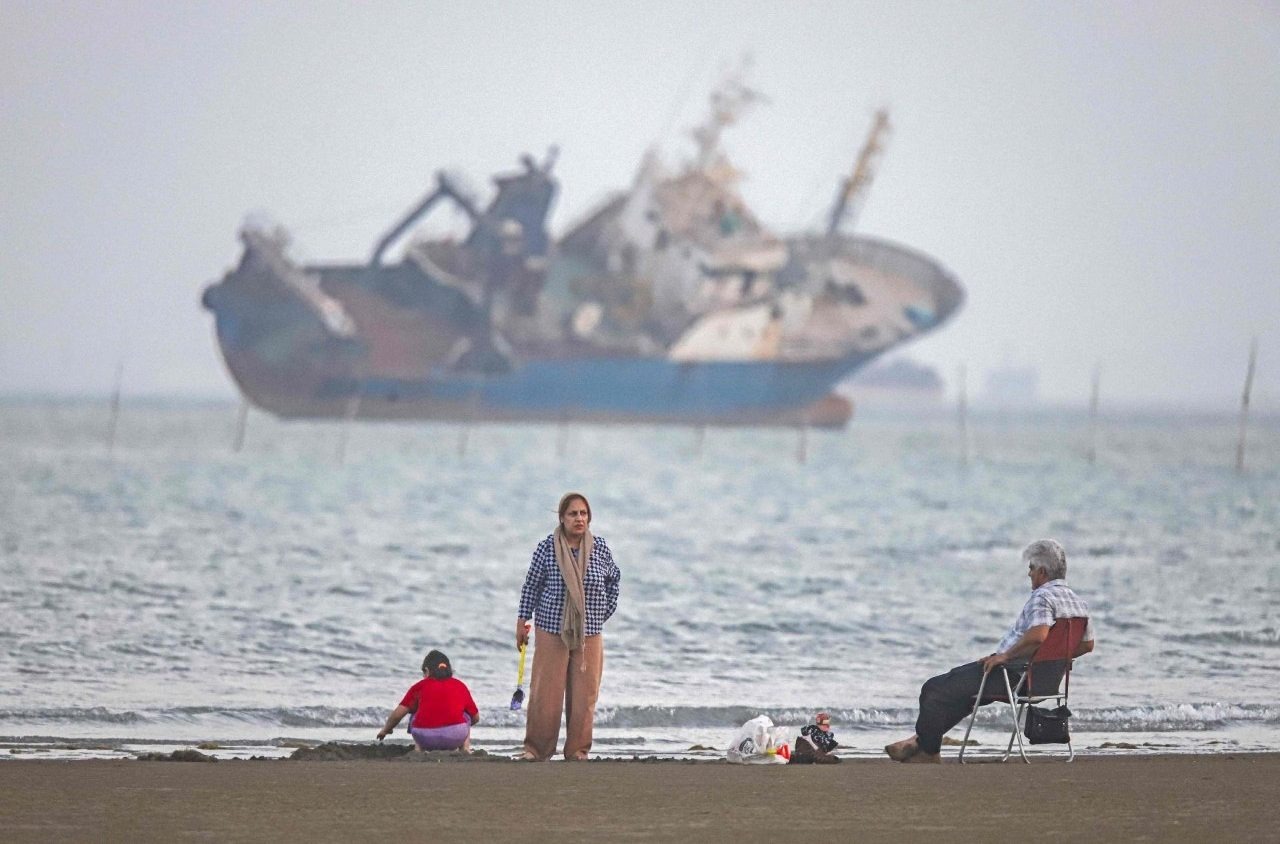
In an interview with Harici Media, Trita Parsi, Executive Vice President of the Quincy Institute for Responsible Statecraft, stated that global unipolarity is coming to an end, transitioning into an increasingly multipolar order.
Parsi addressed shifting global power dynamics, US foreign policy toward China, structural domestic pressures in Washington, and the strategic miscalculations surrounding the ongoing US conflict with Iran.
Parsi noted that while many analysts declare the arrival of a post-American world, the transition will not be an abrupt moment. Instead, he described a phased emergence where it becomes clear that no single superpower possesses deterministic influence over global affairs.
Parsi observed that many governments have been slow to internalize this reality or adjust their policies accordingly, creating the superficial illusion that a unipolar system remains intact. “Whether it’s fully multipolar or other configurations, we can be debated. What I think is clear is that the unipolarity is coming to an end,” Parsi said.
“Unipolarity is an aberration, an abnormality”
Regarding Washington’s readiness for a multipolar world, Parsi asserted that the US political establishment remains unprepared and has historically denied the shift. He recalled that during the first two years of the Biden administration, describing the world as multipolar was dismissed as a Russian propaganda narrative.
However, Parsi highlighted a shift under US Secretary of State Marco Rubio, who stated in a February 2025 interview that unipolarity was an anomaly. Parsi explained, “He actually went further. He said that unipolarity is an aberration, an abnormality, a historical accident. If you believe that it’s a historical accident, if you believe that it’s an abnormality, then I think it comes from that, that any effort to try to restore unipolarity should be rejected.”
Addressing US policy toward China, Parsi noted that despite the summit between US President Donald Trump and Chinese President Xi Jinping in Beijing, there is no structural indication that Washington views Beijing as a potential partner rather than a rival.
He contrasted the Biden administration’s aggressive posture—which assumed an existential struggle for dominance—with the Trump administration’s softer but poorly planned approach.
Parsi argued that neither power can decisively defeat the other, making mutual coexistence and co-governance essential to avoid a catastrophic zero-sum confrontation.
“An effort to indefinitely contain China is a recipe for disaster”
Parsi rejected the feasibility of military containment against Beijing, warning of severe consequences. “I think an effort to indefinitely contain China is a recipe that will bring about great power competition and a confrontation between the US and China that is going to be completely disastrous,” Parsi stated.
He observed that despite significant US strategic errors, such as the conflict with Iran, China has exercised restraint rather than exploiting American vulnerabilities. Parsi argued that if Beijing were dead-set on aggressive power competition, it would have acted differently.
Economically, Parsi argued that containing China through tariffs or Soviet-era containment models is a losing proposition.
Unlike the Soviet Union, which maintained an isolated economic model, China is deeply integrated into global trade and serves as the primary trading partner for most nations, including those in Latin America such as Brazil. Parsi emphasized that economic containment is unviable against a state with such vast global integration.
“This confrontation will be the deadliest conflict in human history”
Evaluating the risk of the “Thucydides Trap,” Parsi criticized the Washington foreign policy establishment for its structural inability to envision peaceful coexistence.
He noted that the political culture in Washington is built around zero-sum competition and conflict rather than diplomatic management.
Parsi emphasized that while historical precedents exist, humanity is not bound to repeat them, particularly when the stakes involve existential risks. Parsi warned that an unmanaged confrontation between the US and China “would be the deadliest conflict in human history if it is allowed to happen,” threatening human survival itself.
Parsi attributed this narrow strategic focus to structural domestic forces, particularly the US military-industrial complex and influential lobbying groups. Working alongside the grand strategy of liberal hegemony, these forces require US military dominance worldwide, especially in Asia.
Parsi explained that institutional inertia makes it extraordinarily difficult for Washington to alter its strategic trajectory.
“The US had an unrealistic plan A and no plan B”
Turning to the conflict with Iran, Parsi asserted that Washington lacks a coherent strategy, having relied on an unrealistic plan that failed within the first three days.
He stated that the US expected a swift regime collapse or surrender within four days, but faced horizontal escalation from Iran, including threats to the Strait of Hormuz and regional strikes.
“The United States had a very unrealistic plan A and no plan B, and it’s been stuck in that situation ever since,” Parsi said, adding that Washington has been improvising and executing tactical operations without strategic success.
Parsi attributed President Trump’s shifting decisions on Iran to this absence of strategy and his personal demand for immediate results. When military action failed to yield swift progress, Trump turned to diplomacy, only to lose patience within three weeks and resume military strikes. Parsi questioned whether the global community could afford a superpower acting in such an erratic manner.
“Without Israel’s push, there would not have been a war with Iran”
Addressing Israel’s role, Parsi stated that Israeli pressure was a decisive factor in driving US policy toward confrontation with Iran.
“Without Israel’s push, there would not have been a war with Iran. Without Trump agreeing to the Israelis, there would not have been a war with Iran. Both of them were needed,” Parsi remarked, noting that Israeli efforts since 1995 elevated Iran into a primary US national security concern disproportionate to actual US interests in the region.
Parsi identified a growing divergence between US and Israeli interests in the Middle East. While the US benefits from reducing its regional military footprint of 50,000 troops, Israel requires continuous US military presence and intervention to maintain a favorable regional balance of power.
Parsi noted that this divergence has created a visible rift between Washington and Tel Aviv following the poor execution of the war and subsequent diplomatic maneuvers.
“Israel’s standing amongst the American public has plummeted”
Parsi highlighted a major shift in American public opinion regarding Israel, noting that sympathy for Palestinians has surpassed sympathy for Israel across almost every demographic category, except Republicans over the age of 65.
He attributed this decline directly to Israel’s military actions in Gaza and its perceived role in drawing the US into a disastrous war with Iran, which mirrored earlier public grievances over the Iraq War.
Regarding a resolution to the conflict, Parsi stated that a dignified exit for both the US and Iran remains possible, though the window is narrowing due to personal hostility and political miscalculations.
Finally, addressing Trump’s political image, Parsi clarified that Trump was never strictly anti-war, but rather anti-risk.
He explained that Trump entered the conflict because Israeli officials convinced him that war with Iran posed little risk and would be concluded within 100 hours. Parsi concluded that had Trump not been misled into believing the operation would be a swift success, he would not have initiated it.

“The AfD is not a fascist party, but a party for fascists”

Nokia and ICEYE sign deal to build sovereign Ukraine satellite network

Mélenchon’s “new France” vision triggers fierce cross-party debate

US envoy says Syria interim leader Sharaa seeks Israel normalization

Unauthorised AI agents access customer accounts at major US banks
-

 Europe2 weeks ago
Berlin Left Party backs Israel’s right to exist for coalition pact
-

 America2 weeks ago
Trump weighs presidential memorandum to cut surging US diesel prices
-
 Diplomacy2 weeks ago
SWP urges backing for Gulf trade routes bypassing Strait of Hormuz
-
 Diplomacy2 weeks ago
EU and China reach preliminary deal to curb hybrid car imports
-

 America2 weeks ago
Thiel targets Pope and Obama over AI in new ‘Antichrist’ lectures
-

 Europe2 weeks ago
LSE study finds post-bailout Greece turned into a cafe economy
-

 Russia2 weeks ago
Russia relaxes diesel export curbs after talks with Trump
-

 America2 weeks ago
Energy firms enlist ex-US officials to tap Venezuelan oil
