
Opinion
The Triangular Nuclear Game and Dilemma Between Iran, Israel and the U.S.

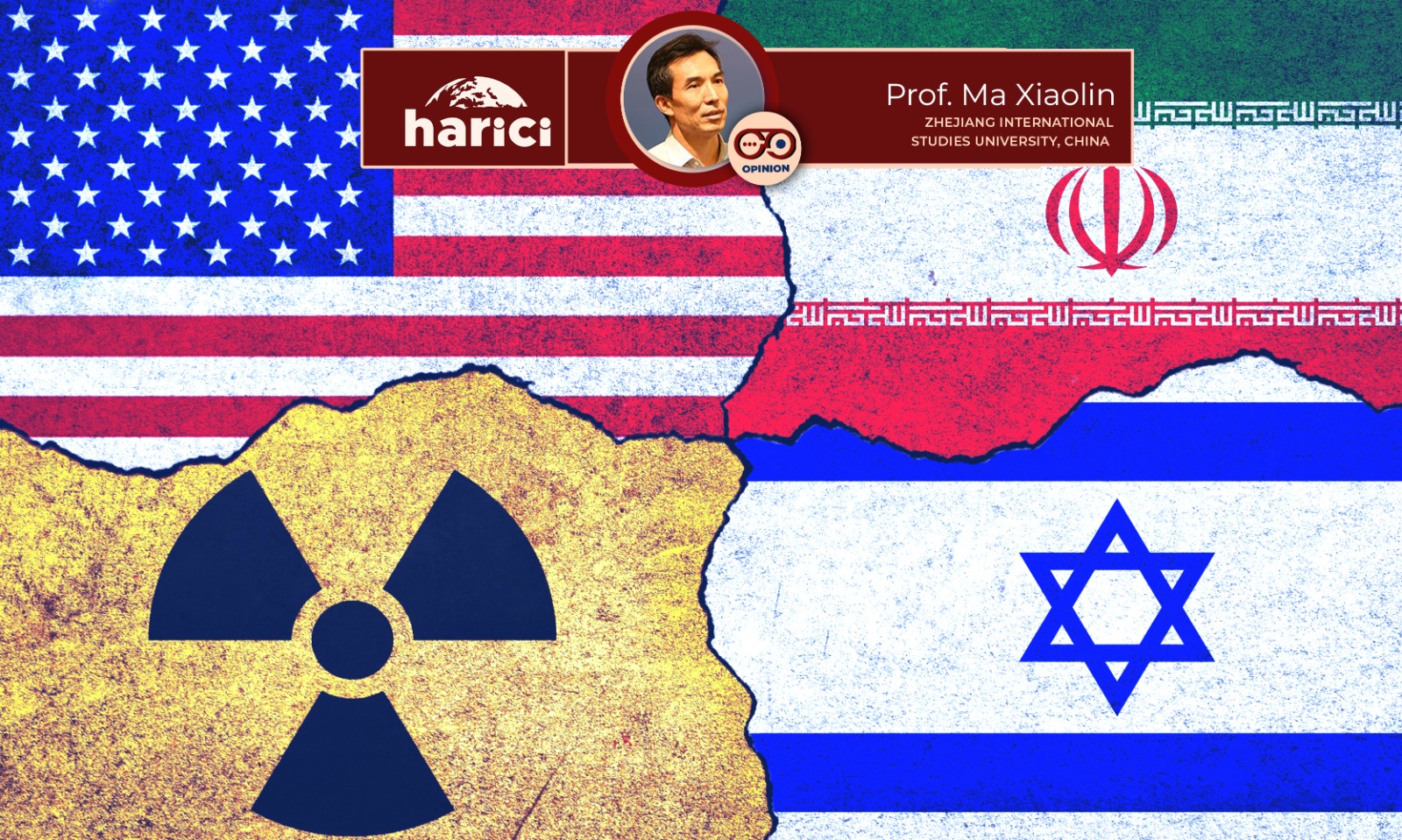
According to U.S. media reports, White House envoy Steve Witkoff is planning to meet Iranian Foreign Minister Abbas Araghchi in Oslo next week to restart nuclear talks. Despite approving the decision to suspend cooperation with the International Atomic Energy Agency (IAEA), Iran affirmed its commitment to the Nuclear Non-Proliferation Treaty (NPT) and the Safeguards Agreement on 3 July. On the same day, the U.S. Treasury Department announced sanctions on multiple commercial networks that assist in Iran’s oil trade. As for Israel, it had already made it clear that it could launch further attacks on Iran at any time if it attempted to cross the nuclear threshold.
The smoke of the “Twelve-Day War” has not yet fully dissipated, yet the triangular nuclear game among Iran, the United States, and Israel has resumed, returning to the long-standing path of geopolitical maneuvering familiar to the international community, as if nothing major had just happened in the Middle East. In essence, all three countries continue to follow the same entrenched logic in addressing the Iranian nuclear issue, leaving this dangerous geopolitical game mired in stalemate.
The fundamental issue behind Iran’s nuclear dilemma lies in its missed opportunity to actually possess nuclear weapons, thus leaving it trapped in a “strategic prison” where it cannot cross the nuclear threshold. On June 17, renowned American realist theorist John Mearsheimer stated, “I’ve always believed that if I were Iran’s national security advisor, they would already have nuclear weapons.” Mearsheimer cited North Korea and Israel as examples of achieving national security through actual nuclear possession, while Libya and Iraq, which lacked nuclear weapons, had their regimes overthrown by the United States and others—thus calling Iran “extremely foolish.”
Objectively speaking, Iran began nuclear research in the 1950s under the Pahlavi dynasty with U.S. assistance but missed the best opportunity to enter the nuclear club alongside its quasi-ally Israel. Since the establishment of the Islamic Republic in 1979, Iran has faced unprecedented international isolation and engaged in an eight-year war with Iraq, lacking the capacity and conditions to advance nuclear research or accelerate nuclear armament—even while repeatedly suffering from chemical weapons attacks by Iraq.
Subjectively, the new Iranian regime repeatedly emphasized that Islamic teachings forbid weapons of mass destruction, becoming entangled in a moral or procedural justice dilemma amid the complex Middle Eastern power game—repeating the strategic blunder of China’s ancient ruler Duke Xiang of Song, who famously refused to “attack the enemy mid-river.” Ultimately, Iran—while dreaming of exporting the Islamic Revolution and asserting Persian nationalist dominance in the Middle East—underestimated the strategic value of nuclear weapons as “a poor nation’s deterrent,” missing yet another strategic opportunity to cross the nuclear threshold at the end of the Cold War. Even when India and Pakistan successively became nuclear powers in 1998, Iran still hesitated at the gates of the nuclear club. In 2002, George W. Bush introduced the “Axis of Evil” theory and openly declared a plan to overthrow Iran’s government, while launching wars in Afghanistan and Iraq. Iran’s nuclear ambitions were exposed and a nuclear crisis ensued. But with the timing, geography, and international consensus no longer in Iran’s favor, it was too late to turn back.
Of course, the concurrent North Korean nuclear crisis in East Asia and the resulting persistent tensions may have further paralyzed Iran into strategic hesitation. It continued to adopt a vague nuclear policy—reluctant or afraid to take the critical step toward actual nuclear capability, while simultaneously obstructing IAEA inspections. This indecisive stance has subjected Iran to round after round of collective international sanctions and unilateral U.S. sanctions, while also revealing to nuclear-armed Israel Iran’s strategic timidity—prompting Israel to reinforce its “zero tolerance” stance toward an Iranian nuclear capability. The Arab states’ collective anxiety over a potential Iranian bomb has also intensified, making Iran’s nuclear trajectory one of the region’s top concerns.
In 2015, the Obama administration tacitly accepted Iran’s sphere of influence in Iraq, Syria, and Lebanon in exchange for Iran’s agreement to sign the Joint Comprehensive Plan of Action (JCPOA), also known as the Iran nuclear deal. This legally weak document merely delayed Iran’s nuclear development or made it more difficult. However, Iran still failed to recognize the strategic importance of nuclear capability for its national security. Moreover, unwilling to resolve its structural contradictions with Israel or even the United States, Iran ultimately sowed the seeds of its own tragic fate—exposing itself to military strikes from both Israel and the U.S.
After the outbreak of the Sixth Middle East War, the long-standing asymmetric conflict or proxy war between Iran and Israel gradually escalated into direct confrontation. In the two clashes with Israel in April and October last year, Iran, unwilling to escalate tensions, responded with “symbolic counterattacks,” fully exposing its nature as a “paper tiger.” This, in turn, stimulated Israel’s adventurous tendencies and ultimately led to the outbreak of the “Twelve-Day War.” Once Israel extended its air superiority over the Eastern Mediterranean to reach Iranian territory, the Trump administration—initially uninterested in being drawn into another Middle East war—took advantage of the chaos and joined the military campaign against Iran. Iran’s “negotiated retaliation” against U.S. military targets once again demonstrated its typical style of bluffing but faltering at the critical moment.
If Mearsheimer’s warnings and sarcasm are considered mere theoretical musings, the sudden outbreak and rapid de-escalation of the India-Pakistan conflict right before the “Twelve-Day War” clearly showed the world the fundamental security value of nuclear weapons for national survival—and their effectiveness in preventing the escalation and expansion of conflicts. Had Iran possessed nuclear capabilities equivalent to Israel’s in deterrence and destruction, Israel would likely have reconsidered the heavy price of a large-scale attack on Iran, and the U.S. might not have dared to exploit the situation.
Iran has missed multiple real opportunities to become a nuclear-armed state. Its semi-transparent nuclear policy created a gray zone that allowed Israel, the U.S., and even Iran itself to extract strategic benefits from brinkmanship, ultimately turning the nuclear crisis into a bizarre chess game in which all three players have their own agendas, justifications, and gains.
Israel is clearly determined to prevent any neighboring country—especially Iran, which refuses to recognize Israel, seeks regional hegemony, and constantly uses the Palestinian issue to exert pressure—from acquiring nuclear weapons. If Iran were to become nuclear-armed, it would inevitably break Israel’s absolute monopoly on nuclear power in the Middle East, resulting in a state of mutual nuclear deterrence—Israel’s worst nightmare. Worse, if Iran’s nuclearization prompted frightened Arab states to follow suit, Israel would find itself surrounded by nuclear-armed neighbors, creating an even greater and longer-lasting nightmare.
This is a binary, existential decision: 0 or 1, life or death. Therefore, Israel is willing to go to war to permanently block Iran at the gate of the nuclear club, relying on U.S. backing and firefighting. Israel has effectively hijacked American national security and Middle East diplomacy, and cleverly leveraged Iran’s ethnic, sectarian, and status-based conflicts with Arab countries. By continuously amplifying the narrative of an Iranian nuclear threat, Israel gradually built a unified front to prevent Iran from going nuclear. This ultimately led to the signing of the Abraham Accords, further isolating Iran in the regional power game, leaving it aligned only with a few non-state actors.
The United States, meanwhile, driven by its interest in preserving Israel’s strategic security, controlling the Persian Gulf oil lifeline, establishing air and naval bases in Arab states, and treating oil-rich Arab countries as a kind of “ATM,” has intermittently released conflicting messages—sometimes warning that Iran is “about to become nuclear,” sometimes suggesting it is “still not there.” By tightening and loosening U.S.-Iran relations at will, Washington has kept Iran sleepwalking in a state of nuclear ambiguity. Iran, in turn, has grown complacent over temporary U.S. concessions, investing the resulting petrodollars into regional expansion and proxy wars—only to ultimately become deeply entangled in a nuclear crisis web of its own making, from which it can no longer free itself.
Iran is clearly the “victim” of long-term pressure from Israel and the United States. However, in over 40 years of foreign policy struggle, Iran also seems to have benefited from its nuclear ambiguity policy: by publicly emphasizing its sovereign right to peacefully use nuclear energy, projecting a strong image of defending national and ethnic dignity, evoking the tragic consciousness and martyrdom complex of the Persian nation and the Shiite “dual minority” identity, cleverly binding the regime’s legitimacy with the rationality of state behavior, and linking public resentment against foreign oppression and interference with an aggressive foreign policy. Through its long-standing nuclear ambiguity and brinkmanship strategy, Iran has not only used external pressure and hostility to maintain the political base and legitimacy of the Islamic regime, but also skillfully avoided repeated waves of public pressure for domestic reform, external openness, livelihood improvements, and a better international image—using it even as a pressure-release valve to divert and mitigate the internal political and social contradictions that continue to intensify.
By this point, the Iranian nuclear crisis has become a tool that all three parties—Iran, Israel, and the United States—need. It has turned into a geopolitical bargaining chip that anyone can exploit for advantage or avoid for protection, and a deadlocked game that no one seems able to escape from in the short term.
For Israel and the United States, the Iranian nuclear crisis and the current Iranian regime are two sides of the same coin—offering a paradox that provokes both old and new questions: Is changing Iran’s current regime truly something Israel and the U.S. want to see happen? Wouldn’t a relatively isolated Iran, one that maintains its current ideological mindset, political system, and worldview, be more beneficial to Israel’s regional maneuvering in the Middle East, to America’s dominance and interference, and to the joint use of a seemingly powerful Iranian “scarecrow” to intimidate the many “little sparrows” of the Arab world?
Now let’s imagine the opposite scenario: if Iran gave up exporting the Islamic Revolution, abandoned the Palestine card and made peace with Israel, dissolved the “Shiite Crescent” and the “Axis of Resistance,” normalized relations with the U.S., and respected the political systems and foreign policies of neighboring Arab monarchies—would Israel still have any justification to continue occupying the territories of Palestine, Lebanon, and Syria? Could it still maintain its aggressively expansionist “Greater Israel” policy? Could it continue to violate neighboring airspaces with impunity? And would the U.S. still be able to persuade Arab countries to host numerous military bases, lavishly buy American weapons, and huddle beneath the protective wings of American power?
Prof. Ma is the Dean of the Institute of Mediterranean Studies (ISMR) at Zhejiang International Studies University in Hangzhou. He specializes in international politics, particularly Islam and Middle Eastern affairs. He previously worked as a senior Xinhua correspondent in Kuwait, Palestine, and Iraq.









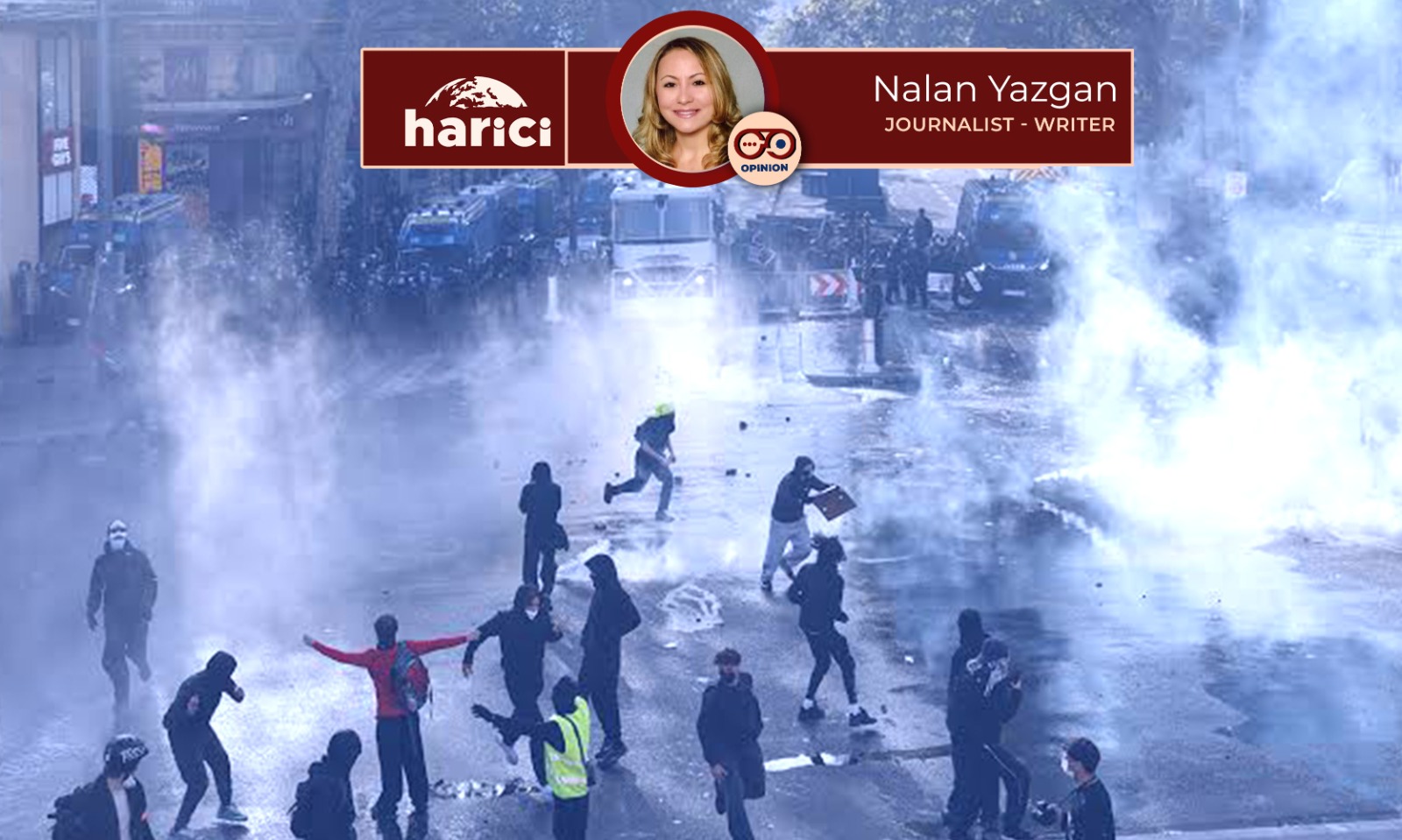
The streets of France have turned into a stage not merely for anger against the government, but for a deep-seated mistrust of the state’s approach to security. The blurring of the line between peaceful demonstrators and looters, lingering questions over police conduct, and the media’s refocusing on the immigration debate are bringing the country to the brink of a political reckoning far deeper than a routine public-order crisis.
In France, a government does not have to wait for an electoral defeat to lose its legitimacy. Sometimes, slogans chanted in a public square, tear gas fired down a boulevard, crowds penned in at the exit of a cordoned-off street, and testimonies of unhindered looting in shops only hundreds of metres away suffice to expose just how fragile the bond of trust between state and society has become.
Events in Paris on Saturday, 17 October point to precisely such a political fracture. Planned demonstrations with the participation of student unions, trade unions, and the Yellow Vests were marked throughout the day by police crackdowns, disputes over march routes, looting in the city centre, and widespread criticism of the government’s perceived inadequacy. The scene that emerged by evening suggested that France was grappling not merely with an issue of public order, but with a burgeoning crisis of confidence regarding the state’s impartiality and political motives.
Whom does the state permit to take to the streets, whom does it obstruct, and which forms of violence does it intervene against, and to what degree? The answer to this question may prove decisive in understanding France’s current political impasse.
The shadow of 17 October 1961
It is impossible to view the date of these demonstrations as a mere coincidence on the calendar. On 17 October 1961, a peaceful demonstration in Paris supporting Algerian independence was brutally crushed by the French police. Scores of people were killed, with some demonstrators drowned after being thrown into the River Seine. The event remains etched in memory as one of the darkest chapters in France’s colonial history and state-sponsored violence.
Sixty-five years later, as police interventions, youth rage, and the state’s stance on the right to protest are debated once again on the streets of Paris on 17 October, the resurgence of this historical memory was inevitable.
This memory may hold a distinct meaning, especially for French citizens of North African descent. Yet it would also be a mistake to reduce all the young people taking part in the demonstrations to a single identity, immigrant origin, or political motivation.
To what extent has the French Republic truly reckoned with the legacy of its colonial past and the relationship its security apparatus maintains with diverse segments of society?
Looters on the streets, where are the police?
Individuals dressed in black and associated in the public eye with the Black Bloc broke into shops at various locations, damaged businesses, and engaged in looting.
While peaceful demonstrators marched under a heavy police presence, fierce criticism arose that looting in certain areas had been allowed to unfold unchecked.
It is striking that while 14,000 police officers were deployed across the capital during the Pope’s visit to Paris, only 10,000 officers in total were assigned across the whole of France for the demonstrations of 17 October.
To which areas were police resources allocated? Had intelligence services assessed the risk of looting beforehand? While a robust security presence flanked the routes of peaceful marches, why was the same effectiveness not demonstrated in safeguarding commercial districts?
The deployment of elite units trained to quell urban unrest, such as CRS 8, does not resolve these questions. On the contrary, the failure to contain the incidents despite the presence of specialized units calls the quality of planning and coordination into question.
A political reckoning extending from Marseille to Limoges
The debate in Paris soon reverberated across the country’s other cities. In a televised address, the socialist mayor of Marseille stated that he had requested police reinforcements from the government, yet the units dispatched fell short given the scale and requirements of the city.
The mayor’s most striking allegation was that while looters stormed Marseille City Hall, the Hôtel de Ville, police officers stood roughly 200 metres away and failed to intervene. Stating that he possessed security camera footage, the mayor affirmed that he would await the scrutiny of a Parliamentary Commission of Inquiry and demand an explanation from the government.
The mayor of Limoges likewise issued what amounted to an ultimatum to the government, demanding the reconstruction of the torched town hall and the full reimbursement of costs. According to the mayor, the government had failed to protect a public building and neglected to provide the police with the necessary resources and backing.
These statements emerging from two distinct cities demonstrate that a new confrontation over security policy has arisen between local authorities and the central government. How security resources are allocated, which risks are prioritized, and whether the warnings of local administrations are heeded must all be brought to light.
The deepening scrutiny over the administration’s stance was compounded by President Emmanuel Macron’s refusal to accept the resignation tendered by Interior Minister Laurent Nuñez. The rejection of the resignation raises the question of whether the executive aims to preserve the chain of accountability, or fears that a political reshuffle would only exacerbate the crisis.
In either case, the government faces a crisis of trust.
An eight-minute speech and unanswered demands
Macron’s roughly eight-minute televised address failed to meet expectations regarding the political dimensions of the crisis. The president announced that he would meet with student unions and that the prime minister would engage with political parties, yet he presented neither tangible decisions nor a comprehensive political roadmap.
Education spending, police violence, the Palestinian cause, anti-fascism, and backlash against the Macron administration appear to have ceased being disparate issues in the eyes of the youth.
To be sure, the true strength of a state lies not in silencing its people and streets, but in addressing legitimate demands. It must not be forgotten that institutions unable to adapt and change are destined to break.


By its very nature, foreign policy feeds into and draws nourishment from numerous, disparate, and varied fields. It is a domain with manifold and diverse inputs. For foreign policy is examined alongside a broad array of subjects, ranging from geography to history, economics to intelligence, and military might to public diplomacy, commonly termed soft power elements.
The capacity of the state, that is, the scale of the state, or in other words the aggregate of its elements of power (namely political, economic, military, and soft power components), is decisive in foreign policy. Geography is decisive in foreign policy. Commercial relations are decisive in foreign policy. Energy dependence on another country or countries, if present, is decisive in foreign policy. Foreign policy cannot be conducted in spite of these four factors.
There is more. A country’s capacity, its scale, does not increase overnight, from one day to the next. It requires planning. It requires national consensus. It requires time. It requires preparation. Nor are these enough. The regional and global environment, the conjuncture, and the international plane must also allow for it. The stance of allies and adversaries is, of course, also important.
For the international environment is, by its nature, complex. It is an environment rife with contradiction, turmoil, conflict, and tension. To draw an analogy, the person in the driver’s seat of foreign policy is not a motorist speeding along the road as they please. There are things they must not forget, rules they must obey, red lights, vehicles speeding up from behind, a truck moving ahead, and a heavy vehicle hurtling toward them from the opposite direction.
Success in foreign policy does not arrive simply because a politician we like has become foreign minister. For a foreign minister is only as effective as the power, capacity, and weight of their country. One must accept this plain truth.
Moreover, there are simple, straightforward questions that reveal whether foreign policy, which some find deeply complex and inscrutable, is successful or not.
There are undoubtedly ways to measure the effectiveness, prestige, influence, and success of foreign policy.
For instance, the number of countries that respect a passport, how many countries can be visited visa-free, and how many countries impose visa requirements and grant those visas only with great difficulty are important indicators of a country’s standing.
Let us take ourselves as an example. Which countries require a visa for the Turkish passport? Which ones do not? Is it easy for our citizens to obtain visas for the countries they primarily wish to visit?
Let us give another example from the Turkic world.
On the Cyprus issue, which we regard as a national cause across government and opposition, right and left, Kemalist and Milli Görüş adherents alike, how many countries have we succeeded in having recognize the TRNC? Why do the Turkic states (Azerbaijan, Kazakhstan, Kyrgyzstan, Turkmenistan, Uzbekistan) not recognize the TRNC? Far from recognizing the TRNC, how do the Turkic states in Central Asia (Turkistan) explain to Ankara their developing relations with the Greek Cypriot Administration of Southern Cyprus, which Türkiye does not recognize, their appointment of ambassadors, and their recognition of Southern Cyprus as the island’s sole legitimate government?
We must also ask this question, of course: What is the state of Türkiye’s bilateral trade with the Turkic states?
Let us give an example of the relationship between foreign policy and big capital.
In which countries are big capital circles, among the greatest supporters of the ruling bloc, winning major tenders?
In our country, across both ruling and opposition ranks, there is a political party order that supports Türkiye’s EU membership. Yet how much progress has been made on EU membership?
Why is US President Trump not keeping the promises he made to Türkiye at the NATO summit held in Ankara a few months ago?
How many contracts has the new regime in Syria, the al-Sharaa administration, awarded to Turkish companies for the reconstruction of its country?
Has the government in Libya that Türkiye supports paid the money owed to Turkish construction firms, outstanding for years?
How does Qatar, with whom our relations are very good, explain its developing ties, energy agreements, and joint military drills with Greece and the Greek Cypriot Administration, disregarding our sensitivities?
Who is the addressee of the harsh statements used in recent weeks by Azerbaijan, which we view as “two states, one nation”? To what extent does Azerbaijan share Türkiye’s policy on Israel? What does Türkiye think about the scale, depth, and intimacy of Azerbaijan-Israel relations?
These questions can certainly be multiplied.
Yet without taking into account the scale of the state and observing the criteria for measuring foreign policy, no sound assessment can be made.
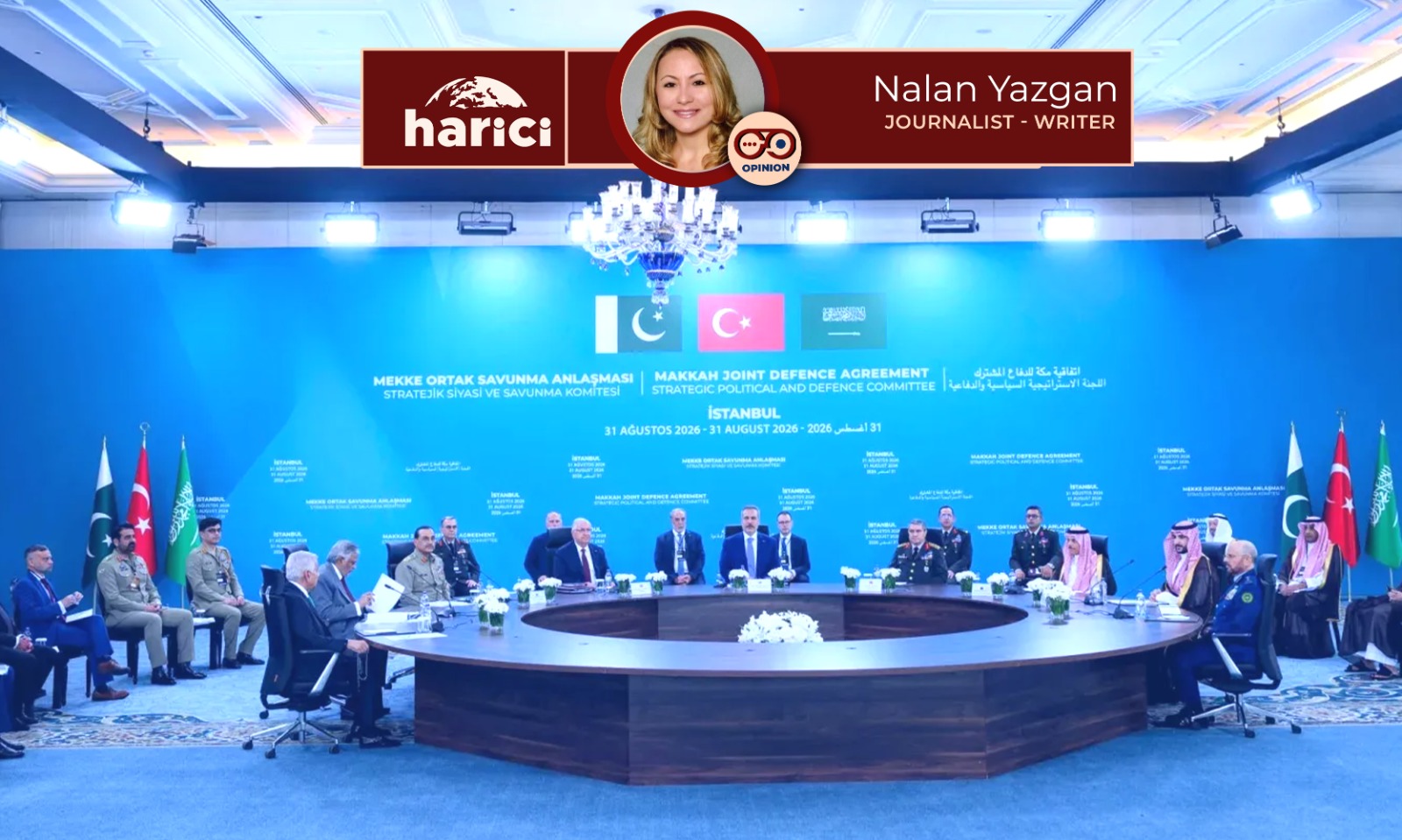
In the Middle East, war is no longer waged merely to seize territory. The true contest turns on who will control the energy pipelines, trade routes, ports, and railways of tomorrow. Missiles may strike cities today, but the maps of the future are being drawn through transport and energy corridors.
In this context, interpreting Türkiye’s presence in the Mecca Alliance solely as military support for Saudi Arabian security remains incomplete; it fails to explain why two states that viewed each other with mutual suspicion until recently would take steps toward a cooperation close enough to constitute a shared destiny.
Alongside Saudi Arabia’s existential motives, Ankara’s participation in this alliance is anchored in a profound geopolitical foundation: to position itself within, and if possible at the very centre of, the Middle East’s reconfigured energy and transport corridors.
Today, it cannot be said that Riyadh and Ankara see eye to eye on every regional issue. The threat perceptions and priorities of the two countries do not, quite naturally, entirely coincide. On the geopolitical chessboard, partnerships do not always arise from identical agendas. When reasons are sufficiently compelling, particularly existential ones, they can override political differences and enable common ground along the same strategic path.
A new war of corridors unfolds in the Middle East
On one side lies IMEC (India-Middle East-Europe Economic Corridor), planned to extend from India through the United Arab Emirates, Saudi Arabia, Jordan, and Israel to Europe. On the other stands the Development Road, which aims to link the Persian Gulf across Iraq to Türkiye, and onward to Europe.
These two undertakings are, of course, far more than mere transport projects. They represent two divergent geopolitical answers to where the future flow of trade and energy between Asia and Europe will traverse; for Türkiye, this issue is of vital importance.
If a corridor system taking shape to Türkiye’s south, beyond Ankara’s orbit, becomes permanent, Türkiye could forfeit not only an economic opportunity but also a substantial portion of its strategic centrality in the Middle East. It is through this prism that the Mecca Alliance must be evaluated.
Türkiye’s seat at the same table with Saudi Arabia signifies more than military solidarity. Riyadh and Ankara must sit together to avoid exclusion from the region’s emergent security and economic architecture, for the security of a corridor and the corridor itself are no longer separate matters.
The Strait of Hormuz, the Red Sea, the Bab al-Mandab, and the Suez Canal are links in the very same chain. A security crisis in one directly impacts the others. While the vulnerability of Hormuz makes alternative export routes for Gulf oil indispensable, instability across the Red Sea heightens the strategic cost of Suez.
Saudi Arabia’s alternative pipelines connecting its eastern oil fields to Red Sea terminals are therefore not merely energy infrastructure; they are strategic bypasses mitigating dependence on Hormuz.
For Türkiye, the Development Road fulfills the same function across a broader geography. Stretching from the Persian Gulf through Iraq to Türkiye, and from Türkiye into Europe, this artery possesses the potential to forge a new overland backbone connecting the Gulf to the Mediterranean and Europe. As security concerns in the Red Sea mount and the vulnerability of Suez deepens, the value of this route rises accordingly.
The Hejaz Railway: Revived once again
The return of the Hejaz Railway to the regional agenda signifies far more than mere nostalgia. Once linking Istanbul to Damascus, Amman, and the Hejaz, the railway served as one of the primary transport and logistical arteries of the Ottoman geography.
Reviving the idea of the Hejaz Railway could become the emblem of Türkiye’s drive to reimagine its historical transport connections between the Gulf, the Hejaz, and the Levant through modern rail, energy, and logistics networks.
The objective here is not to restore the past, but to transpose the strategic logic of that historical geographical linkage into the twenty-first century. For this reason, Türkiye’s role in the Mecca Alliance and the resurgence of the Hejaz Railway project must be viewed as components of the same overarching picture.
Corridors do not consist solely of energy pipelines. Railways, ports, highways, electrical interconnectors, logistical hubs, and security architectures are all facets of the same geopolitical grid, and safeguarding these networks requires political alliances.
Herein lies the strategic significance of Saudi Arabia and Türkiye sitting at the same table in Mecca, even at a juncture when their views on Syria diverge.
Ankara and Riyadh do not need to agree on every subject. Yet neither wishes to see the new map of the Middle East drawn to its detriment. Türkiye’s aim is not to build an anti-bloc against any specific country alongside Saudi Arabia; rather, the goal is to avoid exclusion from the future energy and trade systems of the Middle East, while securing a decisive voice in establishing their security architecture.
Hence, for Türkiye, the Mecca Alliance is far more than a simple defence pact. Securing the Development Road, shielding Gulf energy corridors, stabilising the Red Sea, rethinking connections across the Hejaz and the Levant, and bolstering trade corridors reaching Europe all intersect within this single strategic equation.
In this equation, Türkiye’s foremost advantage remains its geography. Ankara sits at the northern terminus of the overland routes linking the Gulf to Europe; within NATO; and at the crossroads connecting the Black Sea, the Caucasus, the Eastern Mediterranean, and the Middle East.
Will Türkiye become one of the powers shaping the Middle East’s energy and trade architecture over the coming decades, or will it be reduced to a mere transit state traversed by routes designed by others? That question defines the true strategic significance of the Mecca Alliance for Ankara.
In the Middle East of tomorrow, it will be impossible to separate the corridor carrying energy, the security framework protecting that corridor, and the alliance constructing that security framework.
Whoever controls the corridor shapes commerce. Whoever guarantees the routes through which trade flows holds sway over the regional balance of power. This is the true dimension of the contest currently underway in the Middle East.
A succession of distinct and largely mutually exclusive ambitions are competing for dominance in the current climate: India’s linkage to Europe, the Gulf’s new economic horizons, Saudi Arabia’s alternative energy routes, the security crisis in the Red Sea, the strategic weight of Hormuz, and Türkiye’s aspiration to open outward to Europe via the Development Road. Ironically, perhaps, the conflict that will decide which corridor underpins global stability has already begun, and it will likely continue spreading to new fronts. Regrettably, the fires in our region appear poised to intensify long before they abate.

Nokia and ICEYE sign deal to build sovereign Ukraine satellite network

Mélenchon’s “new France” vision triggers fierce cross-party debate

US envoy says Syria interim leader Sharaa seeks Israel normalization

Unauthorised AI agents access customer accounts at major US banks

US drafts Ukraine plan with Nord Stream restart and sanctions relief
-
 America2 weeks ago
How will Brazil’s presidential runoff work?
-

 Europe2 weeks ago
Berlin Left Party backs Israel’s right to exist for coalition pact
-

 Russia2 weeks ago
71 EU lawmakers demand closure of Russian Houses in 15 member states
-

 Russia2 weeks ago
US and Russian figures discuss American stake in Nord Stream lines
-

 Europe2 weeks ago
MI6 investigates potential leaks after former BND chief is detained
-
 Russia2 weeks ago
Drone strike shuts down Yandex data centre in Russia’s Ryazan region
-

 America2 weeks ago
Trump weighs presidential memorandum to cut surging US diesel prices
-

 Europe2 weeks ago
EU and allies pull conference backing after US pressure over panel
