
America
Trump financial disclosures show millions invested in major defense contractors, analysis reveals

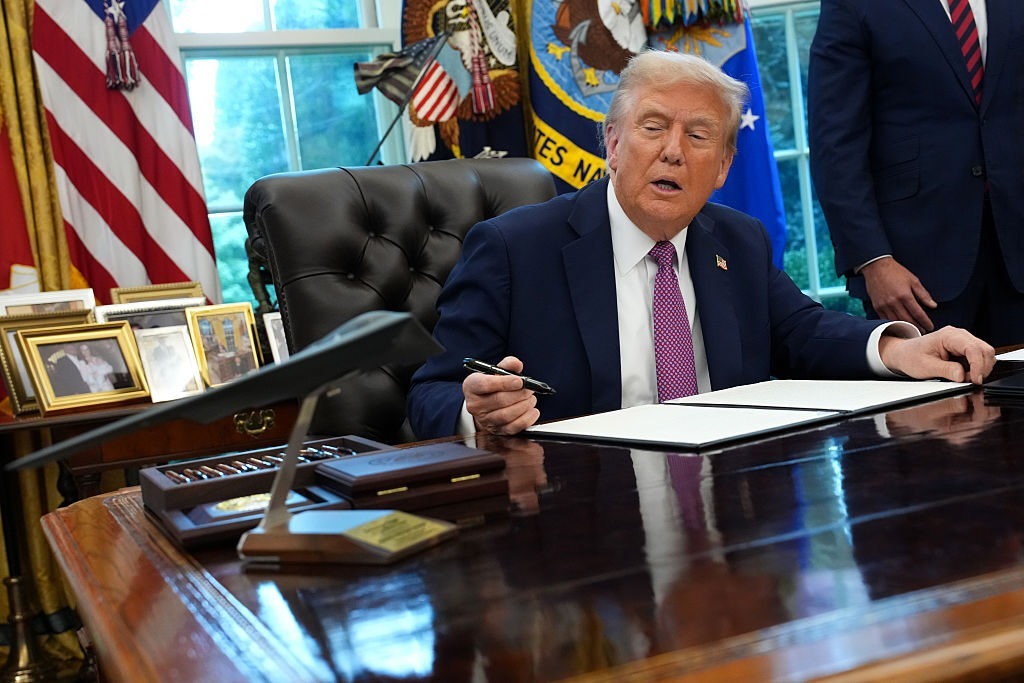
US President Donald Trump’s financial disclosures released last week reveal that he has invested millions of dollars in approximately a dozen companies, including weapons manufacturers and defense contractors, according to a news analysis by Responsible Statecraft. The analysis shows that Trump, through investment firms representing him, acquired shares in defense sector companies valued at a total of between $9.7 million and $24.3 million.
The companies receiving investment included Palantir, Lockheed Martin, and General Dynamics.
According to the financial disclosures, the investment firms managing Trump’s assets invested between $1.6 million and $3.9 million in the data analytics and artificial intelligence company Palantir.
The analysis noted that Palantir developed the AI-powered Maven Smart System, which is utilized in US military operations in the war with Iran. The same analysis also claimed that the company contributed to the development of software named “Big Daddy,” which is used in Israeli military operations in Gaza.
Trump’s portfolio also includes shares in Boeing. The analysis stated that Boeing sold F-15 fighter jets valued at $8.6 billion to Israel less than three months before Trump and Israeli Prime Minister Benjamin Netanyahu initiated their joint war against Iran.
According to the financial disclosures, Trump also invested in GE Aerospace, Lockheed Martin, General Dynamics, and RTX, the manufacturer of Tomahawk missiles.
The analysis wrote that weapons produced by these companies were heavily used in the war with Iran, including Tomahawk missiles used in a US Air Force strike on a primary school in the Iranian city of Minab. The report stated that at least 168 children lost their lives in this attack.
According to Responsible Statecraft, the majority of these companies received new contracts from the Pentagon aimed at replenishing US missile stockpiles depleted during the war with Iran.
RTX signed a $373 million contract for 23 Standard Missile-3 IB interceptor missiles, while Lockheed Martin was reported to have secured a $35 billion contract intended to quadruple its production of the THAAD missile defense system.
The financial disclosures showed that Trump’s investment firms also invested in shares of Kratos Defense, Honeywell, Howmet Aerospace, L3Harris, and TransDigm.
Responsible Statecraft noted that the shares of these companies gained significant value within a year of Trump returning to office. According to the analysis, in 2025, Palantir shares rose by 135%, Kratos shares by 188%, GE Aerospace shares by 84%, and RTX shares by 61%.
In April, Trump posted on Truth Social, stating: “Palantir Technologies has proven to have very powerful capabilities and equipment on the battlefield. Ask our enemies!” Following the post, the company’s shares reportedly rose by approximately 3% within a few minutes.
Financial records showed that Trump generated more than $2 billion in income in 2025. Responsible Statecraft wrote that this amount is “unprecedented” for a sitting US president.
According to the report, the majority of this income was derived from investments linked to cryptocurrency companies such as World Liberty Financial and Binance. Trump reportedly earned hundreds of millions of dollars from “memecoins” launched through these companies, though these crypto assets later suffered sharp declines in value, resulting in losses for numerous investors.
The analysis stated that Tahnoun bin Zayed al-Nahyan, the UAE National Security Advisor and brother of the UAE President and Foreign Minister, invested $500 million in World Liberty Financial and $2 billion in Binance. Trump subsequently approved the export of advanced AI chips to the UAE, a decision that the analysis indicated created the impression of being linked to the crypto investments.
According to the analysis, Donald Trump Jr. is also connected to companies operating in the unmanned aerial vehicle and defense technology sectors. Trump Jr. is a major shareholder and advisory board member at Unusual Machines, which manufactures drone components, while his investment firm also holds stakes in Powerus and Vulcan Elements, both of which hold Pentagon contracts.
Trump Jr. serves on the board of Powerus, which markets drone systems used to intercept Iranian missiles to Gulf countries, and Eric Trump is reported to hold a financial interest in the same company.
Richard Painter, who served as the chief White House ethics lawyer during the George W. Bush administration, evaluated the situation, saying: “These countries are under great pressure to buy from the president’s sons. In this way, the president will do what they want.”
When asked last year about potential conflicts of interest arising from Trump’s business activities, White House Spokesperson Anna Kelly responded: “There are no conflicts of interest.” Trump also acknowledged the existence of conflicts of interest in an interview with the New York Times earlier this year, but argued they were not important, saying: “I realized that nobody cares.”












America
US Democrats split over proposed data center moratoriums amid rising energy and climate concerns

Democrats in the United States increasingly view the rapid expansion of data centers as a critical challenge, yet the party remains deeply divided over how to address the issue.
For many Democrats, the immense energy consumption of these facilities—which drives up household electricity bills and exacerbates climate change—makes some form of restriction an inevitable policy option. The growing public unpopularity of these centers raises the political stakes for Democrats, who are seeking solutions to protect their prospects in this year’s midterm elections on promises of lowering the cost of living.
Last month, Representative Frank Pallone Jr., the top Democrat on the House Energy and Commerce Committee, called for a moratorium on data center construction. However, senior party leadership has shown little enthusiasm for the proposal.
These internal divisions are also playing out at the state level, where at least two Democratic-controlled legislatures have passed data center moratoriums. One of those measures was vetoed, while the other is currently awaiting the governor’s signature.
Support for restricting data centers does not align strictly along traditional ideological lines. A faction of anti-establishment Republicans has backed such efforts, while other members of the Republican Party continue to debate how, or even if, to regulate the massive server farms powering the artificial intelligence boom.
In Congress, Democratic leaders have repeatedly argued that data centers must pay their fair share of rising energy costs.
Earlier this year, Senate Majority Leader Chuck Schumer stated that Democrats would push for “strong, enforceable consumer protections.”
Similarly, House Minority Leader Hakeem Jeffries expressed support for technological innovation while emphasizing, “We must ensure we are protecting the American consumer.”
However, neither leader has endorsed a specific legislative proposal to achieve these objectives. Requests for comment sent to the offices of Schumer and Jeffries went unanswered.
Jeffries also told Politico that halting data center development is “certainly not a position I am articulating at this time.”
In contrast, influential progressive figures, including Senator Bernie Sanders and Representative Alexandria Ocasio-Cortez, argue that a total moratorium on data center construction is necessary.
In March, these lawmakers introduced legislation that would ban the construction of new data centers until Congress enacts a suite of AI safety measures, ranging from government audits of AI models to protections against mass layoffs.
Pallone voiced strong support for the concept last month during a subcommittee hearing on a separate data center bill, stating he favored “a national AI data center moratorium until we can figure out a way that this is not going to harm our nation’s air, water, and utility bills.”
Following his remarks, Pallone added: “The reality is that everything with these data centers is moving so quickly, and I am concerned about the impact on electricity consumers and the environment.”
The Data Center Coalition, an industry group backed by several major technology companies, argued that a national moratorium would deter investment in the US, damage the economy, and “send the wrong message to other industries.”
“A federal mandate to halt data center construction risks restricting access to cloud and digital services, undermines our global competitiveness, and would have significant consequences for Americans’ daily lives,” the group said in a statement in late June.
Maxwell Shulman, a policy research analyst at Beacon Policy Advisors, suggested that the primary force driving the recent push for moratoriums is a “general hostility toward AI and Big Tech.”
“People see many of these changes. They are worried about AI. They are worried about the economy and their jobs, and they feel there is very little they can do about it,” Shulman said. “They view data centers not only as the physical embodiment of AI, but also as one of the rare areas where they can actually have a say or fight back.”
Shulman added: “I think moratoriums are a blunt but effective tool to demonstrate this opposition or concern toward AI in general, not just data centers.”
Meanwhile, a narrower, bipartisan bill has been gaining momentum in Congress.
The Electricity Consumers Protection Act, led by Representative Kathy Castor, a Democrat, and Representative Gabe Evans, a Republican, would require state utility regulators to establish rules ensuring that ordinary Americans do not foot the bill for new power generation and transmission lines built to support high-load consumers like data centers.
The bill passed the House Energy and Commerce subcommittee in late June and is scheduled for consideration by the full committee.
Castor said Congress should begin by establishing regulatory safeguards, though she did not rule out supporting a construction halt in the future.
“People want guardrails. They do not want their electricity bills to go up, and they are worried about water,” Castor said last month.
When asked about her stance on a moratorium, Castor added: “If we reach a point where these guardrails are not put in place and companies simply ignore them, we will have to move to that stage.”
At the state level, Democratic governors have blocked or slowed legislative efforts to limit data center expansion. In Maine, the legislature passed a bill to ban new data center construction for 18 months, but Governor Janet Mills vetoed the measure because it did not exempt an ongoing $550 million project.
New York lawmakers passed a one-year data center moratorium in June, which is currently awaiting action from Governor Kathy Hochul. According to a report by Politico, Hochul is instead considering an executive order for a shorter, six-month halt.
Other Democratic governors have actively opposed data center moratoriums.
“Walking away from a technology that will continue to propagate is leaving the table,” Representative Abigail Spanberger, a Democrat from Virginia, told Politico this week.
In California, Democratic Governor Gavin Newsom vetoed a bill that would have required planned data centers to estimate their water usage.
As broad moratoriums encounter resistance, state-level Democratic leaders are turning to more targeted solutions, such as reassessing data center tax credits. In Illinois, Democratic Governor JB Pritzker announced in June that the state would suspend its tax incentives for data centers due to energy and water concerns.
Some Republicans have adopted a similar approach. In May, Ohio’s Republican Governor Mike DeWine instructed state officials to temporarily halt the evaluation of new tax exemption requests while lawmakers review data center growth in the state.
In Virginia, lawmakers kept data center tax incentives intact after prolonged budget debates that forced a special legislative session. Spanberger instead supported the introduction of a new tax on electricity consumption.
Meanwhile, in New Jersey, Governor Mikie Sherrill signed legislation this week that places data centers into a separate category of electricity consumers. The governor’s office stated that the measure will ensure data centers pay for their own energy use and the associated infrastructure.
Commenting on the dynamics facing state leaders, Shulman said: “There is a massive amount of investment potential and a lot of potential jobs at stake. And I really think these Democratic governors do not want to shoot their own states in the foot in the race to capture these jobs.”
Shulman added: “The goal for a Democratic governor is to send a policy signal strong enough to make voters feel they are taking a tough stance on AI, or addressing its potential negative consequences, while still trying to attract as much investment and as many jobs as possible.”
America
Trump intervention prompts FIFA to lift suspension of US striker Balogun ahead of Belgium clash

US President Donald Trump intervened with FIFA to request a review of a red card suspension handed to US footballer Folarin Balogun, leading the global governing body to unexpectedly lift the ban, it has emerged.
Belgian football authorities have reportedly been granted the right to appeal the FIFA decision, which overturned a one-match suspension given to Balogun, a striker for the US Men’s National Team.
The two teams are scheduled to face each other tonight at 03:00 Turkish time (TRT) in a Round of 16 fixture. The winner of the match will advance to the quarterfinals to play either Portugal or Spain.
Trump welcomed the decision by FIFA, which enables the 25-year-old Balogun to play in tonight’s match against Belgium in Seattle despite receiving a red card during Wednesday’s 2-0 victory over Bosnia and Herzegovina.
“Thank you to FIFA for doing the right thing and correcting a major injustice!” Trump wrote on his Truth Social account.
According to a report by The Athletic, the Royal Belgian Football Association (RBFA) has been granted the right to formally appeal the decision.
Sources told the publication that to avoid any conflict of interest, Belgium’s appeal will be evaluated by a member of the FIFA Appeal Committee who does not represent any federation from Europe or the Americas.
UEFA, the governing body of European football, is expected to issue a statement on the matter later today.
On Wednesday, Balogun received a controversial red card for a foul, resulting in the top US goalscorer being sent off during his team’s 2-0 victory against Bosnia and Herzegovina.
The red card carried an automatic, immediate one-match suspension, which traditionally allowed no right of appeal.
However, for the first time in more than 60 years of World Cup match history, FIFA announced it would allow Balogun to play in the subsequent fixture.
“The automatic match suspension imposed on the US player Folarin Balogun is suspended for a probationary period of one (1) year,” FIFA said in a statement on Sunday.
Citing Article 27 of its disciplinary code, FIFA stated: “The judicial body may decide to suspend the implementation of a disciplinary measure fully or closely.”
The New York Times, citing three people familiar with the conversation, reported that Trump called FIFA President Gianni Infantino on Wednesday to request a review of Balogun’s suspension.
Sports broadcaster Ben Jacobs first reported that the White House had contacted Infantino for this purpose.
MS NOW confirmed that Trump called the FIFA president. Citing a US official, MS NOW reported that during the call, Trump sought to better understand why Balogun was shown the red card and why it resulted in a suspension.
The official said the US government submitted “additional evidence” to FIFA, and the federation’s Disciplinary Committee utilized this information in the process that led to the lifting of Balogun’s suspension.
According to officials, the government focused on the fact that referees reviewed slow-motion replays before the red card was shown.
“Ultimately, a correct and appropriate result was achieved,” the official told MS NOW.
The Royal Belgian Football Association stated it was “astonished” by FIFA’s change of stance regarding Balogun’s suspension and argued that the move violated FIFA’s written regulations.
The federation said it was “exploring all possible options.”
Trump has been heavily involved in the tournament, which the US is co-hosting alongside Mexico and Canada. The president maintains a close relationship with FIFA President Infantino.
Trump’s 2025 financial disclosure, made public last week, revealed that Infantino gifted Trump 10 tickets worth $15,000 for the FIFA Club World Cup final held last July at MetLife Stadium in New Jersey.
Trump attended the match, in which Chelsea defeated Paris Saint-Germain 3-0, and appeared on the pitch alongside Infantino to present the trophy.

The US military has begun taking delivery of F-35 fighter jets without radar systems after Northrop Grumman was unable to manufacture the aircraft’s new AN/APG-85 radar quickly enough for installation on upgraded Lockheed Martin jets leaving the production line.
The aircraft are being delivered without the radars, each valued at about $9 million, which are considered essential for combat operations and battlefield effectiveness.
According to The Bunker, six US Marine Corps F-35s have already been delivered without radar systems.
An unspecified number of F-35s destined for the US Air Force and US Navy will also be delivered without radars. The new radar systems are not expected to be available before 2028.
The current radar cannot be fitted into the upgraded F-35 configuration.
One reason the approximately $196 million F-35 carries such a high price tag is its complex shape, stealth coating and integrated electronic architecture, all designed to reduce its radar signature.
According to The Bunker, the situation is comparable to “carbines without bullets, tanks without armor, ships without oceans, or nuclear weapons without the nuclear.”
The issue has become emblematic of the broader F-35 program. The $2 trillion project continues to struggle with readiness problems, in part because the Pentagon has not purchased enough spare parts to keep its fleet operational.
The radar shortfall is particularly notable because it marks a second instance in which perceived future threats have contributed to procurement complications.
A decade after the program began, then-Pentagon acquisition chief Frank Kendall said in 2012 that the initial rush to put the F-35 into production while its design was still evolving had been “acquisition malpractice.”
This time, the Pentagon says it deliberately accepted the risks of a “highly concurrent development and production program” to upgrade the F-35 so it could “maintain air superiority against future threats.”
In simple terms, “highly concurrent” means manufacturing components before the aircraft’s design has been finalized.
That approach ultimately left the aircraft without their new radar systems, repeating the same practice that Kendall criticized 14 years ago.
The radar-less F-35s will not remain grounded while awaiting the new electronic equipment.
Instead, the Pentagon now possesses a growing fleet of what has effectively become some of the world’s most expensive jet trainers.

EIB to unveil 15 billion euro tech initiative to scale European startups

Germany to purchase US Tomahawk missiles to build own long-range strike capability

France explores Syrian transit routes as alternative oil corridor to bypass Strait of Hormuz

Trump financial disclosures show millions invested in major defense contractors, analysis reveals

US Democrats split over proposed data center moratoriums amid rising energy and climate concerns
-

 Middle East2 weeks ago
Qatar and Saudi Arabia acquire hundreds of millions of dollars in Israeli defense technology, report says
-

 Europe2 weeks ago
Buckingham Palace updates King’s official role to focus on securing faith in multi-faith Britain
-

 Diplomacy2 weeks ago
NATO draft declaration pledges €70 billion to Ukraine ahead of Ankara summit
-

 Interview2 weeks ago
“Capitalism does not require a free social order”
-

 Asia2 weeks ago
South Korea unveils $518 billion plan for new southwestern semiconductor cluster
-

 Europe2 weeks ago
Billionaire Peter Thiel deepens ties with German and Austrian right-wing political elite
-

 Europe2 weeks ago
Europe faces 15-year low in winter gas reserves as June storage targets fall short
-

 America2 weeks ago
US begins development of first new nuclear warhead in four decades for submarine fleet
