
Europe
Germany’s welfare overhaul could leave millions facing benefit cuts

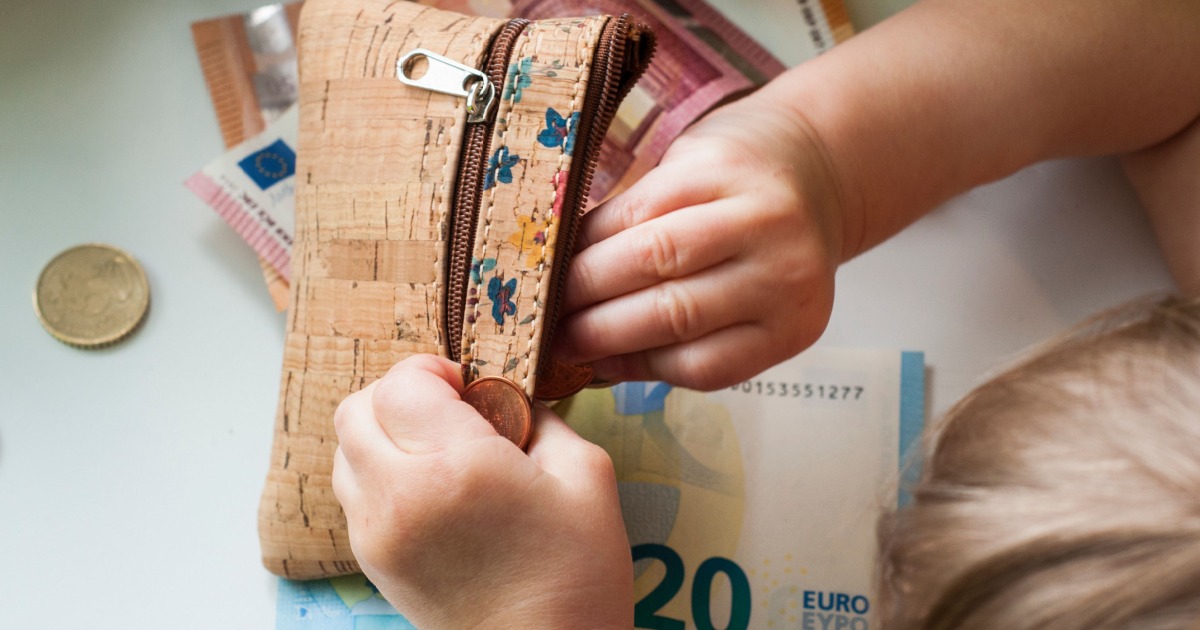
Germany’s new government has replaced the Bürgergeld citizens’ income benefit with a new basic income support scheme as part of a broader overhaul of the country’s welfare system.
The Bürgergeld benefit had been in force since 2023, replacing the previous Unemployment Benefit II. According to junge Welt (jW), the latest changes effectively mark the return of the “Hartz IV regime” introduced under former Chancellor Gerhard Schröder in 2005.
Federal Labour Minister Bärbel Bas of the SPD on Wednesday described the reforms as “a strong signal against the abuse of social benefits.”
Steffen Kampeter, head of the Confederation of German Employers’ Associations, backed the move and called for the “consistent enforcement of stricter cooperation obligations.”
Officials at Bas’s ministry are currently drafting legislation governing how the new basic income support will be calculated. The process is referred to as the “standard needs assessment.”
The shift from Bürgergeld to the new basic income support represents more than a change in name. The central principle is that securing employment takes priority. If low-paid jobs are available and deemed “reasonable,” job seekers registered with employment agencies will be required to accept them. Failure to do so will result in benefit reductions.
According to the Federal Employment Agency (BA), the reform’s primary objective remains placing people into long-term employment, while vocational training and continuing education are given secondary importance.
Bas has likewise described the policy as one that “promotes employment rather than benefit dependency,” adding: “Everyone who is able to work must make an effort to find a job.”
According to a statement published on Wednesday by the organization Sanktionsfrei, that characterization does not reflect reality. Of the roughly 5.5 million people receiving basic income support, nearly two million are children and young people. At least 800,000 recipients are already working but must supplement their income because of low wages.
In addition, more than one million benefit recipients are unable to participate in the labor market because they care for relatives, look after children, are in education or are ill.
The share of recipients who “completely refuse” to seek work is negligible. Even the Federal Employment Agency’s Institute for Employment Research identified only around 100 such cases last year.
The federal government also plans to reduce housing benefits. Joachim Rock, managing director of the Paritätischer Gesamtverband, said on Wednesday that the move would push recipients of both basic income support and housing assistance further into poverty.
Older people and families would be particularly affected. At the same time, the governing coalition has pledged to eliminate homelessness by 2030.
Ines Schwerdtner, co-chair of Germany’s Left Party, argues that abolishing the standard benefit entirely would violate fundamental rights and is considering filing a constitutional complaint against the reforms with the Federal Constitutional Court.







The mounting diplomatic and political friction between Germany and the Russian Federation has reached a critical juncture following allegations concerning a drone incident at Leipzig airport, exposing acute institutional fractures within Berlin and broader European divisions. In an extensive interview on the Strategic Compass programme broadcast by the Turkish digital outlet Harici, Dr Ulrike Guérot, a prominent German political scientist, international relations specialist, and director of the European Transcontinental Initiative, joined host Professor Hasan Unal to assess Berlin’s aggressive diplomatic posture, impending state and national elections, and parallel political volatility in France.
Professor Unal opened the exchange by questioning the strategic logic behind the German government’s escalation, drawing a direct comparison with regional military posturing elsewhere: “The Turkish planes and the Greek planes harass each other over the Aegean on a daily basis, and sometimes they do not even get to the news. So why did the Russians, or why might they have, attacked Germany with one single drone in Leipzig?”
Dr Guérot framed the incident within a calculated chronology of escalation orchestrated by German authorities. Recasting the events that began on 1 September, she noted that the German government asserted an immediate Russian threat without offering substantiating evidence to the public. In swift retaliation, authorities moved to shutter the Russian Consulate in Bonn by 18 September and ordered the closure of the Russian House, the major cultural centre situated on Friedrichstrasse in Berlin.
“It is a little bit repeating history”
“First, just to notice, it all happened and then was notified on the first of September,” Guérot stated. “That was the day when the government basically said that we are threatened by Russia, that the drone has been coming. The drone in the Leipzig airport came from Russia, without any proofs, by the way. And then they ordered to close the Russian consulate in Bonn for the 18th of September and also to close the Russian House, which is in Friedrichstrasse in Berlin.”
Emphasising the symbolic resonance of the calendar, Guérot recalled: “The first of September, as everybody knows, is the day that World War II started. It was this famous sentence from 5:45 am onwards: ‘We are going to shoot back.’ And that was the Polish beginning of World War II. So there is a lot of despair from the critical community in Germany to just notify that it is a little bit repeating history when you scale up a war and you take, by coincidence, the date of the first of September.”
Turning to the physical reality of the Leipzig occurrence, Guérot highlighted the absence of tangible casualties or infrastructural devastation. “There was no one killed, no one injured, no nothing. It was just, say, a harmless drone on the airport of Leipzig, no proofs whatsoever that it really came from Russia.” She recalled that Peter Gauweiler, a veteran Bavarian politician and former Christian Social Union (CSU) Bundestag deputy, had proposed that “the most intelligent thing to do would be to have a common commission, a Russian and German commission, to pursue and go for the reasons where this drone really came from.” However, Guérot observed that “this neutral undertaking to really clarify the origin is not taken up by the German government.”
Professor Unal concurred, noting that Moscow has routinely tendered similar joint investigative proposals: “The Russians keep offering that joint committee to investigate what has actually happened.”
Guérot contextualised Berlin’s intransigence within a broader three-year diplomatic pattern, pointing to earlier sabotaged negotiations. She recalled that in April 2022, potential peace talks were derailed following interventions associated with then-British Prime Minister Boris Johnson, who reportedly expressed that the West was not yet ready for peace. She also cited subsequent diplomatic dialogues, including discussions involving Donald Trump and Russian President Vladimir Putin in Alaska, along with mediation efforts initiated by former German Chancellor Gerhard Schroeder, all of which were marginalised or rebuffed by European capitals. “You can say that for three years at least, any attempt to go for negotiation or peaceful settlement has not been taken on by the European side,” she said.
Tracing the immediate escalation cycle back to March, Guérot referenced cross-border drone strikes deep inside Russian territory, including attacks on domestic oil refineries in Perm. She specifically cited bellicose rhetoric from Christian Democratic Union (CDU) Bundestag deputy and foreign policy hardliner Roderich Kiesewetter, who asserted that Germany needed to carry the war towards Russia.
“The backdrop is obviously that everybody who is closely observing what is happening at the Ukrainian-Russian frontline knows that the war is lost for Ukraine, and that there is no possibility to win it,” Guérot argued. “And so the only possibility to basically prolong it, to not settle peace, to really push further, was to do drone attacks.”
“Stand pretty alone when he wants to escalate this”
Evaluating the geopolitical reception of Berlin’s rhetoric, Guérot stressed the striking absence of broad European solidarity behind CDU leader Friedrich Merz and the federal establishment. Statements of support following the Leipzig announcements were confined to a narrow geographic and institutional band: European Commission President Ursula von der Leyen, incoming EU foreign policy chief Kaja Kallas, and Finnish Prime Minister Alexander Stubb.
“Solidarity statements for Friedrich Merz interestingly only came from Kaja Kallas, not surprisingly, came from Ursula von der Leyen, came from Alexander Stubb, the Finnish Prime Minister, but not much more,” Guérot observed. “Germany, in basically scaling up this more or less ridiculous drone towards a super serious NATO conflict vis-a-vis Russia, is not apparently currently supported by many of the other EU countries. We had no solidarity statements from Giorgia Meloni, or from France, or from Ireland, or from Greece. So you see that there is a Finnish, Estonian, German alignment here, and it is important to realise that Mr Merz is standing pretty alone when he wants to escalate this.”
Addressing the notable restraint displayed by Warsaw, Professor Unal highlighted the tactical distance Poland has maintained despite its proximity to the conflict theatre: “Poland seems to be basically keeping away from the conflict for a while, particularly over the last year or so when the Russians kept talking about retaliation against countries supplying Ukraine with weapons. There is also tension between Ukraine and Poland, and as a result, the Poles actually keep a low profile.”
Guérot pointed to profound historical and cultural grievances driving the Polish reticence, specifically controversies surrounding World War II commemorations and the glorification of nationalist figures associated with Stepan Bandera. “Around 9 May, when the Ukrainians tried to push away Soviet war memorials commemorating soldiers who fought the Wehrmacht and redeclared memorials celebrating the heroes of Bandera, the Poles made a direct connection between Bandera and elements such as the Azov formations,” she explained. “You take a look at the internet and you see many pictures that point to proto-fascism in the Ukrainian troops. The Poles, having had intense historical trauma in the Second World War with Ukrainian nationalists, shied away from this. In reaction to the redeclaration of war memorials, the Poles even threatened the EU accession process, taking a tough stance that without historical clarification, Warsaw will not support Ukrainian entry.”
This lack of collective European enthusiasm was mirrored at the institutional level within the North Atlantic alliance. When Kiesewetter publicly urged invoking Article 4 of the NATO Treaty to convene emergency alliance consultations following the Leipzig drone incident, the appeal fell on deaf ears in Brussels. Alliance leaders, including Mark Rutte, offered no substantive mobilisation. “What we see is escalation on the German side, very little solidarity, and most European and NATO countries declining to react in the manner the government perhaps planned,” Guérot stated. “This shows the isolation of the German government.”
“An interference into the Russian elections”
Guérot subsequently turned to what she identified as a critical yet largely suppressed domestic objective behind Berlin’s diplomatic confrontation: the Russian presidential election scheduled for 20 September. Germany is home to an estimated 4 million Russian citizens and dual German-Russian passport holders who possess voting rights in Russian federal ballots.
“Consular affairs were overwhelmingly dealt with in Bonn,” Guérot pointed out. “The consulate in Bonn was a huge building handling marriages, legal affairs, passports, and voting. What is done in essence when you close the consulate of the Russian Federation on 18 September, two days before the Russian elections, is that you keep 4 million Russians from voting. I think this is behind the closure of the consulate and behind the deadline of the 18th of September.”
Guérot disclosed that she had spoken directly with the Russian Consul in Bonn following the eviction directive: “He is very shocked. He and the entire consular staff will be leaving the country on 18 September. They are being pushed out.”
Drawing an explicit contrast with Germany’s domestic democratic scrutiny, Guérot noted an ongoing legal challenge before the Federal Constitutional Court in Karlsruhe regarding the February 2025 Bundestag election. Sahra Wagenknecht’s party, the BSW, has alleged electoral irregularities involving 9,400 miscounted or uncounted votes that kept the party beneath representation thresholds and artificially preserved a parliamentary path for a Merz-led majority.
“At the same time, the German government, by closing the Russian consulate, is preventing 4 million Russians from voting,” Guérot remarked. “What they wanted to prevent in Germany is headlines in the newspapers reporting that majorities of Russians in Germany voted for Putin. In Germany, Putin is entirely demonised. If you had polling showing that out of 4 million Russians in a free election, a majority voted for Putin, the German government did not want to see those headlines. In an era where everyone systematically talks about Russian interference in Western elections, one can say that the closure of the Russian consulate in Germany was a sublimated interference into the Russian presidential elections.”
Professor Unal observed that narratives of external Russian subversion have proliferated across European and American political landscapes, often serving domestic political ends. He noted allegations of subversion surrounding Western ballots, the political pressure exerted against right-wing parties, and efforts in France to target figures such as Marine Le Pen.
Guérot underscored the broader cultural dismantling accompanying this geopolitical posture. She condemned Berlin’s parallel decision to terminate the operations of Germany’s premier cultural outposts in Russia: the Goethe Institutes in Moscow and St Petersburg.
“Goethe would turn around in his grave,” Guérot said. “Johann Wolfgang von Goethe was always for the peaceful understanding of peoples, for enlightenment. The Moscow institute had already been reduced to digital online courses and library services. The Goethe Institutes were holding German culture together, running academic conferences. Seeing that most Russians I meet speak fluent, flawless German, while almost nobody in Germany speaks Russian, severing cultural relations is entirely counterproductive. Germany would have done better to invest in cultural relations and Russian language learning.”
“We need to carry the war towards Russia”
Turning to diplomatic initiatives originating across the Atlantic, Guérot noted reports from German national broadcaster Deutschlandfunk indicating that US interlocutors, including figures such as Jared Kushner and designated negotiators, were engaging in diplomatic missions to Kyiv to explore settlement frameworks.
“The US appears alerted, which again confirms that NATO is not following Friedrich Merz’s Article 4 trajectory,” she noted. “However, Ukrainian voices interviewed on German radio insisted they do not want these negotiations, claiming nothing will emerge because Washington will not apply sufficient pressure on Moscow, and Russia will not surrender its core territorial positions in Russian-speaking areas. The visit of a US delegation to settle peace is not welcomed by Ukraine.”
Guérot added that Moscow, anticipating Vladimir Putin’s re-election on 20 September, may adopt a calculated holding pattern: “Russia may try to buy time, watching the forthcoming US midterm elections in November and speculating on the next American presidential administration in 2028, creating another prolonged phase without a formal settlement.”
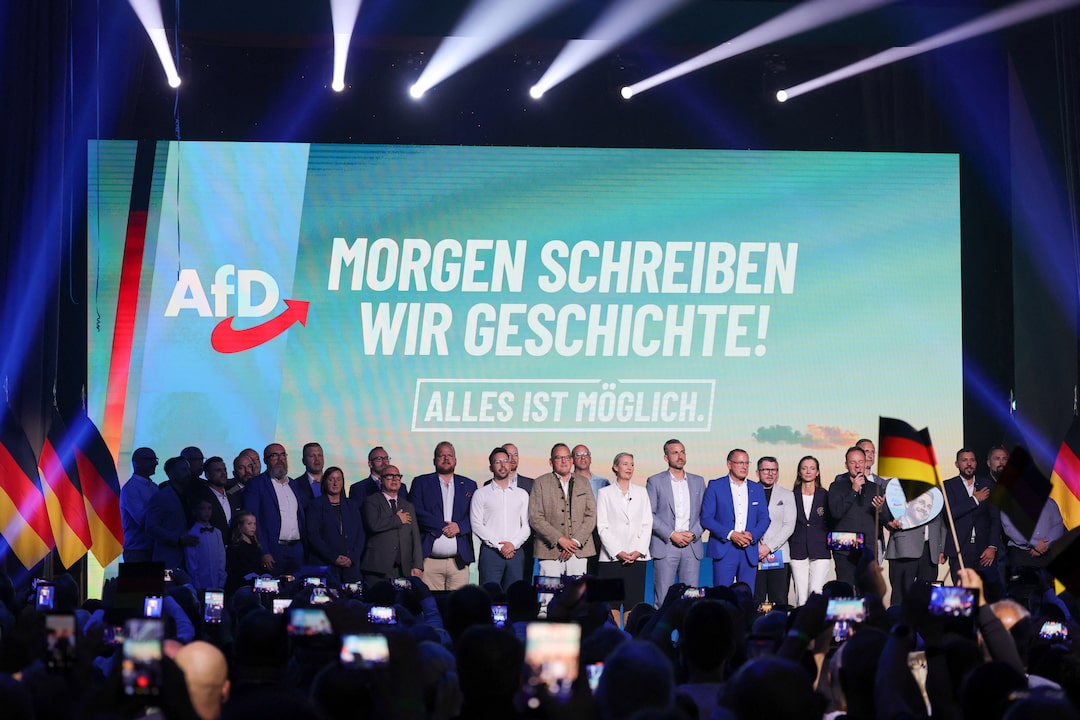
This international impasse is intimately tethered to acute domestic instability within Germany, particularly the state parliamentary elections in Saxony-Anhalt, where Alternative for Germany (AfD) was tracking between 40% and 43% in polling. Guérot referenced President Putin’s public address reacting to Berlin’s escalation, noting that the Russian leader openly linked Germany’s foreign policy hostility to the Saxony-Anhalt vote.
“Putin spoke with a degree of British humour, acknowledging: ‘Dear Germans, we know that you are in a critical time and that you have forthcoming elections in Saxony-Anhalt where the AfD is between 40% and 43%,'” Guérot observed. “Putin basically indicated: ‘We understand that your escalation of the war is designed to deter attention from these elections and prevent the AfD from scoring an overwhelming victory.’ The world has understood this.”
Addressing internal speculation in Berlin, Guérot revealed that political circles had actively discussed whether federal authorities might consider invoking an emergency decree (Notstand). Under the Basic Law, a formal state of emergency could technically lead to the suspension or postponement of scheduled elections. “The war emergency has not been decreed because that would create an absolute domestic crisis,” Guérot explained. “Instead, escalating towards NATO and Article 4 was a mechanism to generate an international emergency atmosphere without declaring a formal domestic emergency that would explicitly torpedo the vote.”
The regional ballot in Saxony-Anhalt carries symbolic and structural implications far exceeding the state’s population of roughly two million. Magdeburg, the state capital, represents a historic centre of European statehood, serving as the seat of Emperor Otto the Great, the tenth-century architect of the Holy Roman Empire.
“Otto the Great returns to his grave in Magdeburg Cathedral this very Sunday,” Guérot noted. “At the exact same moment, all German, European, and global eyes are focused on Magdeburg. It is like Asterix and Obelix fighting back the Roman Empire. A decisive victory by the AfD could produce a massive domino effect across the republic.”
Guérot expressed severe alarm over the domestic pre-election mobilisation, citing street actions by radical left groups in the state capital: “The German Antifa is mobilising, setting up protest camps and tents on the streets of Magdeburg. May it remain peaceful. We are conducting democratic elections. The AfD may win 40% to 43%. The sheer fact that protest tents are being built to challenge the vote is a sign that German democracy is under immense strain.”
“The dissolution of Germany”
Beyond the immediate ballot count, the structural issue is whether the AfD, led in Saxony-Anhalt by Ulrich Siegmund, can translate a plurality into an executive mandate. Guérot outlined the severe institutional stakes involved, specifically the interstate broadcasting treaty (Rundfunkstaatsvertrag) binding all 16 federal states to fund and maintain Germany’s public media apparatus, including ARD, ZDF, and regional outlets such as Mitteldeutscher Rundfunk (MDR).
“One Bundesland stepping out of that treaty would cause the entire public service media system to collapse,” Guérot explained. “Ulrich Siegmund has announced that an AfD administration would seek to terminate that contract. For the political establishment, preventing an AfD-led regional government is considered existential.”
Parliamentary seat arithmetic remains exceedingly precarious due to Germany’s 5% electoral threshold. “If the SPD, the Greens, and the BSW all fall beneath the 5% threshold, Siegmund could capture an absolute majority of seats with roughly 43% of the vote,” Guérot stated. “Conversely, if the Greens, the SPD, and the BSW narrowly clear 5%, Siegmund’s 43% will not yield a legislative majority. Counting will stretch late into the night. Just as in the federal election where 9,400 votes proved decisive, a razor-thin margin of voters will determine the entire outcome.”
Widespread public anxiety regarding postal voting (Briefwahl) has further heightened distrust. Guérot cited legal scholarship by constitutional expert Ulrich Vosgerau, who has examined the transparency vulnerabilities inherent in unmonitored mail-in ballots: “Postal ballots are not publicly counted at polling stations at 8:00 pm in the presence of citizen observers. Professor Vosgerau has conducted numerous presentations analysing the distortion risks and irregularities associated with mail-in systems.”
Should the AfD fall short of a solo majority, the establishment parties face severe coalition paralysis. CDU state leader Sven Schulze has hinted at attempting a minority administration. Alternatively, the CDU would be compelled either to break its long-standing party resolution forbidding cooperation with the left-wing Die Linke to form an anti-AfD popular front, or reconsider its firewall (Brandmauer) against the AfD. Guérot noted that figures such as former Health Minister Jens Spahn are increasingly attuned to shifting political realities, subtly reconsidering party strategy.
“German nerves are black. Everything is completely open,” Guérot said. “It is like a billiard ball striking three or four others, setting off a chain reaction. I was raised in the spirit that Germany is a solid, exemplary democracy founded on the rule of law. We used to look with immense arrogance upon Greece, Italy, and southern Europe as unstable systems. Now, many Germans feel our own system is breaking apart. I listened to a satirical commentary this week describing ‘the dissolution of Germany’. That commentary captures a widespread national sentiment that the prevailing political order no longer holds.”
“Deeply divided between the western and eastern branches”
Turning to internal AfD dynamics, Guérot rejected homogenous caricatures, detailing severe philosophical, geopolitical, and regional fractures dividing the party. “The AfD is deeply divided between its western and eastern branches,” she stated. “The western wing, represented by figures like Alice Weidel and Beatrix von Storch, is fundamentally pro-Atlanticist, pro-capitalist, libertarian, supportive of Elon Musk, and explicitly pro-Zionist. The eastern wing, led by Ulrich Siegmund in Saxony-Anhalt and Bjoern Hoecke in Thuringia, represents an entirely different social base.”
“Hoecke and Siegmund routinely generate online videos attracting seven million views, a reach no establishment politician can match,” Guérot observed. “The eastern wing is far more critical of American hegemony and NATO, prioritises peaceful security architecture with Russia, and embraces social-national economic views. This east-west party divide mirrors the geographic electoral map of Germany. The former East Germany, with its distinct historical socialization regarding socialism, capitalism, and the West, is demanding a fundamental reconsideration of the 1990 reunification, questioning whether it was an equal union or an economic and political annexation (Anschluss).”
Guérot noted that institutional co-optation is simultaneously eroding the party’s anti-war core, drawing parallels to the historical evolution of the Green Party: “The Greens entered the Bundestag in 1983 with Petra Kelly as committed pacifists opposing nuclear weapons and militarism. Forty years later, under Annalena Baerbock and Anton Hofreiter, the Greens have become olive-green warmongers. A similar subversive dynamic is visible inside the AfD. In the Bundestag Defence Committee, several AfD deputies who strongly advocated peace with Russia ten months ago have quietly shifted towards mainstream NATO positions. Deputies who remain committed to a revised European security architecture with Moscow are facing an increasingly hostile climate.”
“Burn the French debt”
Assessing the parallel volatility in France, Guérot analysed the complex landscape shaping the May 2027 presidential race following the judiciary’s decision to allow Marine Le Pen to stand for election despite facing public fund embezzlement charges, while imposing an electronic monitoring tag.
Guérot traced Le Pen’s tactical political transformations: “Between 2012 and 2017, Marine Le Pen modified roughly 80% of her political platform to achieve mainstream acceptability. She abandoned the traditional Front National posture of Jean-Marie Le Pen, which was anti-American, anti-capitalist, anti-EU, and pro-peace with Russia. She travelled to New York, visited Tel Aviv, embraced pro-NATO and pro-EU rhetoric, and presented herself as a defender of the Jewish community against Islamist threats in southern France. Yet this normalisation strategy failed to deliver the presidency.”
The sudden emergence of Jordan Bardella, the 30-year-old president of the Rassemblement National, has accentuated programmatic confusion within French nationalist ranks. “Bardella is an MEP who is explicitly pro-NATO, pro-armament, pro-Kyiv, strongly anti-Russia, and pro-Israel,” Guérot said. “He represents a clean break from historic Gaullist and sovereignist principles. Now that the courts have permitted Le Pen to run, the central question is whether she will realign with authentic sovereignist traditions or continue along Bardella’s Atlanticist trajectory, much like Giorgia Meloni’s alignment in Rome.”
On the political centre, persistent rumours suggest European Central Bank President Christine Lagarde could be parachuted in as an establishment candidate to succeed Emmanuel Macron. Guérot noted the glaring institutional double standard governing French political scrutiny: “It would be remarkable to witness two women running for the presidency where one faced scrutiny over 50,000 euros while the other carries questions regarding 400 million euros from past arbitrations, yet one is declared clean while the other is branded far-right.”
With the French Socialist Party historically collapsed at 6% of the national vote and forced to sell its iconic Rue de Solferino headquarters, and the Greens lacking viable national figures following Anne Hidalgo’s divisive urban tenure in Paris, former Prime Minister and current Le Havre Mayor Edouard Philippe stands as the most viable moderate conservative challenger against right and left populism.
Guérot pointed to radical initiatives advanced by Jean-Luc Melenchon, leader of La France Insoumise, as evidence of deepening polarisation. Launching his campaign in the immigrant-dense northern Paris suburb of Saint-Denis, Melenchon addressed both demographic transformation and historic symbolism: “Saint-Denis is the burial site of the Kings of France in the historic basilica, now situated within an overwhelming migrant community. Melenchon framed himself as their exclusive defender, declaring they would face expulsion under Le Pen.”
Melenchon sparked broader financial panic by explicitly advocating a radical debt jubilee. “A few days ago, Melenchon declared: ‘Il faut bruler la dette’—we must burn the French debt, arguing sovereign debt is merely an accounting fiction,” Guérot stated. “This produced outrage across French ministries and financial markets, with officials warning that France’s creditworthiness was being destroyed. In semantic terms, it represents a revolutionary posture evoking 1789 and Marie Antoinette. It underscores the extreme fragility of the Fifth Republic.”
Concluding her strategic overview, Guérot warned that the core engine of European stability has broken down entirely: “For sixty years, the Franco-German tandem guaranteed European stability and institutional compromise. Today, that tandem is completely broken. Both Germany and France are simultaneously gripped by profound internal dissolution. Between the Saxony-Anhalt vote and the French presidential elections in 2027, anything can happen. As a German citizen whose two sons live in Paris, I am deeply alarmed. No one benefits from state collapse and political turmoil in the two foundational powers of Europe.”
Following the discussion, Dr Guérot and Professor Unal announced that they will convene the East-West Forum in Istanbul on 26 September, an international conference organised by Harici and the European Transcontinental Initiative to examine the fundamental shifts destabilising the global architecture.
Russia has quietly withdrawn approximately 20 diplomats from Brussels in line with European Union demands, without resorting to any retaliatory measures against the EU mission in Moscow.
According to a report by the EUobserver portal, EU foreign affairs spokesperson Christian Wigand said the previous day: “The Permanent Mission of the Russian Federation to the EU has complied within the deadline with our decision to cap the maximum number of staff at 40 people, excluding the head of mission.”
Kaja Kallas, the EU High Representative for Foreign Affairs and Security Policy, had set a deadline of 1 September for Russian Chargé d’Affaires Karen Malayan to complete the staff reduction. She cited Russia’s “abuse of diplomatic power” and the necessity of establishing a balanced staffing presence with her mission in Moscow.
The stated rationale of “abuse” rests on allegations that Russia has deployed hundreds of spies to Europe under the cover of diplomatic immunity.
Germany decides to close consulate
In an announcement on 1 September, Germany directly blamed Russia for an attack carried out at Leipzig Airport in early August and announced countermeasures.
Under these measures, it was announced that Russia’s Consulate General in Bonn as well as the Russian House in Berlin would be closed. Following the developments, Foreign Minister Johann Wadephul also summoned the Russian Ambassador to the ministry.
The crisis in question began on 4 August with the detection of an explosives-laden unmanned aerial vehicle (UAV) near a Ukrainian Antonov cargo aircraft at Leipzig/Halle Airport.
Russian ambassadors summoned across Europe
Following Germany’s attribution of the Leipzig attack to Moscow, numerous EU member states summoned Russian embassy representatives to their foreign ministries.
Condemning Russia’s “dangerous and irresponsible” actions, the Finnish Foreign Ministry summoned the Russian Ambassador. In its statement, the ministry said: “Russia’s actions will receive a resolute and clear response.”
Czech Foreign Minister Petr Macinka stated that Germany’s findings regarding the UAV attack at Leipzig/Halle Airport were alarming and had to be taken seriously.
Emphasising that he planned to discuss the issue with the Czech intelligence services in the coming days, Macinka announced that he had summoned Russia’s Ambassador to the Czech Republic, Anna Ponomaryova, to the ministry.
Sweden, Portugal, and Denmark were also among the countries that summoned Russian ambassadors. In his assessment of the matter, Danish Foreign Minister Lars Lokke Rasmussen said: “The Russian Ambassador has been summoned to the Ministry of Foreign Affairs for a meeting. Germany has reported that Russia was behind the failed hybrid attack in Leipzig. We stand shoulder to shoulder within NATO and the EU. We remain steadfast in our support for Ukraine and in strengthening our collective defence capabilities.”
On the same day, alongside the European Union, France, Belgium, and the Netherlands also summoned Russian representatives to their foreign ministries.
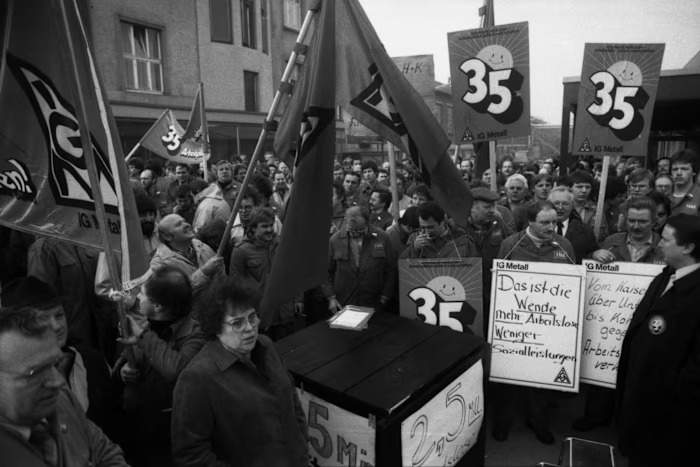
Some of Germany’s biggest industrial bosses are reigniting the debate over longer working hours.
Nearly 40 years ago, German metalworkers secured a 35-hour working week by winning one of the most contentious disputes in the country’s post-war history.
According to a report in the Financial Times (FT), prominent companies, including Mercedes-Benz and toolmaker Stihl, have demanded that employees work 40 hours a week without additional pay, arguing that high labour costs are undermining the country’s competitiveness.
Speaking to the Handelsblatt newspaper earlier this summer, Martin Brudermuller, chairman of the supervisory board of Mercedes-Benz Group, said, “By international standards, labour here has become too expensive,” arguing that the country had lost its “productivity advantage over key competitors.”
“We must seriously consider returning to a 40-hour working week,” Brudermuller said.
Labour costs in Germany are among the highest in the EU. Hourly labour costs in the manufacturing sector stand at 49.50 euros, which is 47% above the EU average of 33.70 euros and triple the cost of 15.60 euros in Hungary.
Although German employees are more productive than their Eastern European counterparts, unit labour costs, which measure worker productivity, have risen significantly faster since 2023 compared with previous years, according to a study by the IMK, a think-tank funded by German trade unions.
The calls to return to a 40-hour week have come ahead of industrial unions starting their latest wage negotiations in October.
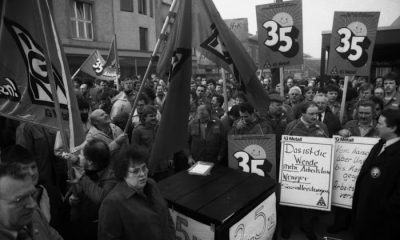
The 35-hour working week was phased in over more than a decade following a dispute in 1984.
In that dispute, tens of thousands of metalworkers in former West Germany staged a seven-week strike to secure shorter working hours.
Today, the 35-hour working week is the collectively agreed standard for approximately one-fifth of German employees, concentrated in sectors such as automotive, engineering, iron, and steel. Across all sectors, the average weekly working time is 37.8 hours.
Germans work fewer average annual hours than employees in almost all other OECD economies. However, this comparison is heavily skewed by the country’s high rate of part-time employment.
What has turned a decades-long debate into an urgent issue of competitiveness is the deepening crisis in the German manufacturing sector.
Having peaked in late 2017, German industrial production has fallen by more than 15% as manufacturers have been hit by back-to-back energy price shocks stemming from anti-Russia sanctions, intensifying competition from China, US tariffs, and the profound shift towards electric vehicles.
According to Marcus Berret, global managing director of the consultancy Roland Berger, high labour costs were once offset by Germany’s other attractive features for employers, such as political stability, strong infrastructure, a skilled workforce, and dense industrial clusters.
However, these advantages have begun to erode as the cost gap with countries in Eastern Europe and beyond has widened:
“When it comes to labour costs, we are not talking about a 10% or 20% gap [with rival economies]. In some cases, we are talking about a three- or fourfold difference.”
So far, manufacturing employment in Germany has declined at a much slower pace; despite the sharp drop in output, approximately 6.5 million people continue to work in the sector.
However, Berret predicts further job losses:
“If I piece together the information I have from individual companies, I estimate that the number of people employed in manufacturing will drop to below 5 million.”
Currently, around 12,000 to 15,000 manufacturing jobs are being lost each month, and major employers such as Volkswagen have already indicated that many more positions in Germany will need to be eliminated.
Economists argue that longer working hours may become inevitable for employees who manage to keep their jobs.
Martin Werding, a member of the German Council of Economic Experts, says that the mechanisms manufacturers once used to compensate for high labour costs, such as relying on temporary agency workers who could be laid off during periods of weak demand, are no longer sufficient.
“Today’s challenges have grown so large that this flexibility is no longer enough,” Werding said.
A shift from 35 to 40 hours without additional pay would increase working time by 14% without changing weekly wage costs. Werding added that the debate over working hours is “far beyond symbolic politics.”
With more than 2.2 million members, IG Metall, Germany’s largest and most powerful trade union, rejects the claim that factories are bound by a rigid 35-hour working week constraint.
Nadine Boguslawski, head of collective bargaining at IG Metall and a member of the Mercedes supervisory board, stated that agreements with employers already provide companies with significant flexibility to increase or reduce working hours.
“A rigid 35-hour working week, as is sometimes portrayed, simply does not exist in the companies I know,” Boguslawski said.
She added that IG Metall remains open to finding tailored solutions for struggling companies.
At the heart of the debate lies a fundamental disagreement between unions and employers over whether longer working hours destroy jobs by distributing a fixed amount of work among fewer people, or protect jobs by making German factories more competitive.
Boguslawski argued that one of the main reasons IG Metall fought hard for the 35-hour working week in the 1980s was to “bring more people into employment” by sharing available work among more people:
“If you reverse this and increase weekly working hours to 40, you generally need fewer workers, regardless of whether those additional hours are paid or unpaid.”
However, economists such as Werding argue that the volume of available work is not guaranteed and depends on the competitiveness of firms.
They suggest that if lower labour costs per unit of output make German factories more competitive, companies can retain production and jobs that would otherwise move abroad or disappear.
It remains unclear whether the push for longer working hours will make it onto the negotiating agenda between unions and employers this autumn.
Gesamtmetall, the metal industry employers’ association, declined to comment on calls to abandon the 35-hour working week, citing “internal deliberations.”
Berret worries that the political and public debate has not yet caught up with the scale of the crisis facing German industry.
“Many people are living in a different reality regarding what lies ahead of us,” Berret said.

Guérot warns German and French instability threatens European order

The caption and the guest list: What the West’s SCO coverage cannot explain about Türkiye

US expands military footprint in Somalia with new Bosaso base

Milei hardens Falklands stance with oil sanctions and defence push

Pope Francis accused Opus Dei of mafia tactics over Spanish shrine
-
 Diplomacy2 weeks ago
US strikes fail to break Iran as regional anchors rise, Dr. Moeini says
-

 Diplomacy2 weeks ago
Blackwater founder Erik Prince creates air defence venture with Kyiv
-
 Europe2 weeks ago
UK and Russia edge closer to conflict over long-range drone supply
-
 Diplomacy2 weeks ago
South Korea begins first commercial voyage via Northern Sea Route
-

 Opinion2 weeks ago
What did the Israeli attack in Syria reveal?
-

 Asia2 weeks ago
China and Arab states launch 5-year anti-desertification plan
-
 Asia2 weeks ago
India intel push on China risks dangerous miscalculation, study says
-
 Russia1 week ago
Putin circle weighs tactical nuclear risk as Ukraine talks stall
