
Europe
The AfD as battering ram

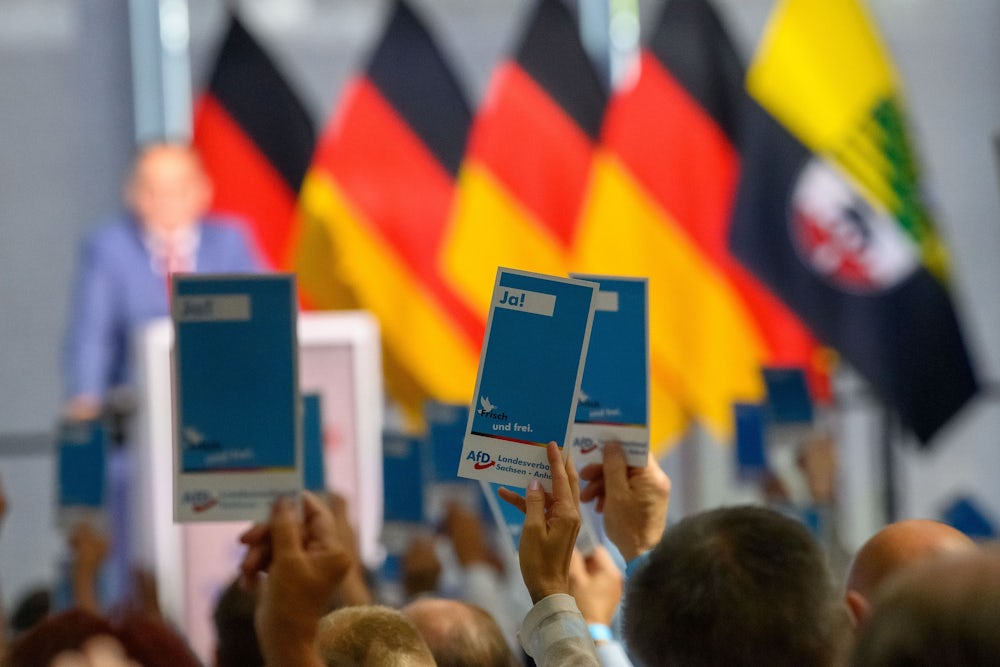
In the Bundestag office of Bernd Baumann, parliamentary manager of the AfD, two portraits reportedly hang on the wall: Karl Popper and Friedrich Hayek.
Or so reports Maurice Höfgen in Surplus. Even so, figures one might readily christen the “children of Mont Pèlerin” have always occupied a prominent place within the AfD: Beatrix von Storch, one of the party’s co-founders; Alice Weidel, its co-leader; and AfD-aligned academics such as Charles B. Blankart were all once fixtures of the Hayek-Gesellschaft (Hayek Society).
Höfgen rightly asks: How does Baumann, who claims his party has evolved into a “workers’ party,” come to venerate these quintessential architects of neoliberalism, thinkers whose creed rests upon the rollback of the state, radical deregulation, and faith in the redemptive power of the free market? Posed differently: how can workers bring themselves to vote for the AfD, an outfit whose economic platform is arch-liberal to its core?
Part of the answer is already being furnished across the Atlantic, where the “Silicon Valley populism” of Trumpism proffers precisely this bargain. Decades of crisis marked by protracted economic stagnation have run their course by selectively boosting productivity while depressing real wages across advanced capitalist economies, chief among them Germany (a subject to be explored elsewhere). Yet what remains resembles a zero-sum game that fractures the working class itself: the credentialed and the uncredentialed oscillate toward opposing poles of capital’s response to secular stagnation. What triggers this broader dynamic -all too lazily dubbed “the rise of the right,” a phrase that explains very little- is the collapse of neoliberal globalization’s promises under recurring cycles of crisis and austerity, coupled with a restless search for a new order.
In this “post-neoliberal” dispensation, a battering ram is required to arrest the decline of German and European “competitiveness” -relative, of course, to the United States and China. In this context, the AfD embodies a proto-fascist reaction all too eager to play the part. One must underline that the planks explicitly championed in the AfD’s Saxony-Anhalt state election platform- deregulation, tax cuts, virulent anti-bureaucratism, digitalization, and the bolstering of the household economy, represent the collective demand of the entire bourgeoisie in a final sortie against the “welfare state” that German capital has never quite managed to dismantle. The reigning grievance asserts that Continental Europe, Germany and France foremost, cannot compete because it never underwent an Anglo-American wave of deregulation, financial services expansion, and the gutting of the social state. That is the thesis, and the remedies prescribed are virtually indistinguishable from the AfD’s own. Tellingly, the party’s campaign slogan in Saxony-Anhalt was “Everything is possible!”, the very motto Ronald Reagan brandished in his “more, more, more” presidential bid against Jimmy Carter’s morose, flailing “degrowth capitalism.” Here lie the contours of a social vision that jealously guards national borders while submitting unreservedly to the borderless supremacy of the market.
Indeed, nestled within the hundreds of pages penned on how to contain the AfD, one finds, astonishingly, proposals virtually identical to the party’s own economic blueprint. Case in point: Andreas Rödder -forced to resign in 2023 as head of the CDU’s basic values commission after suggesting that CDU-led minority governments could replace the “firewall” and that the AfD should not be overdramatized- could write in The Economist that one viable path before a Chancellor Merz is to “embark on the sweeping reforms he promised before taking office and tackle issues such as high labor costs, bloated public spending, and excessive regulation.” While conceding this would be a high-stakes gamble that might bring down the government or force snap elections, Rödder insists: “Yet this is precisely the kind of strong leadership Germany urgently needs.”
The migration question, I contend, is mere window dressing. Schemes to terminate social assistance to immigrants advance hand in glove with retrenchments aimed at impoverished German citizens. The grievance directed downward (and outward) against redistribution never extends upward to challenge the windfall redistribution engineered through tax cuts. The “aristocratic populism” emanating from the United States and Silicon Valley embodies an ephemeral alliance in this zero-sum game.
State enterprises sold for a song in the 1990s following the German Democratic Republic’s annexation by the Federal Republic; scores of factories shuttered on the pretext of uncompetitiveness; Saxony-Anhalt, trailing only Bremen with the highest poverty rate; Saxony-Anhalt, sinking beneath the national wage average of every other state; Saxony-Anhalt, burdened with the highest unemployment and the lowest life expectancy… And the remedy they devise? More deregulation, less bureaucracy, longer weekly working hours.
Precisely at this juncture, Bloomberg traced the funds that the German state began deploying in a purported bid to revitalize the economy. Berlin’s €500-billion spending proposal, on the strength of the pledge alone, triggered a 20% surge in the mid-cap MDAX index for 2025, while a defense-focused UBS Group stock basket (excluding broader defense outlays) leaped by 65%. Yet this year, the moment of reckoning has arrived: the MDAX’s meager 5.7% advance lags even the modest 6.4% gain of the DAX, home to Germany’s corporate titans. While German mid-caps remain comparatively cheap on paper, the direct beneficiaries of fiscal largesse have failed to deliver outperformance. Germany’s catch-up trajectory relative to higher-valued economies and foreign bourses has ground to a virtual halt.
There is more: the initial reality check concerns where all this capital actually flowed. The Ifo Institute estimates that 95% of the newly incurred debt earmarked for spending last year went not toward capital investment, but to plug gaping holes in the general budget. The city of Berlin alone plans to allocate over €2 billion of its share to plant 700,000 trees, even as police precincts and clinics languish in disrepair. Economists sounded the alarm early last year that this mammoth €500-billion fund was subsidizing consumption rather than productive investment… And so it goes. Debt financing and militarization, heralded as the catalysts of reindustrialization, serve at least to afforest Germany.
Lest one imagine the AfD has devised a genuine solution: the penchant among the aforementioned neoliberal forebears to pair state retrenchment with non-state communitarian structures (ethno-nationalist ties, the family, religion) corresponds precisely to the plaudits they receive from the likes of Elon Musk, bent on gutting the “administrative state” through DOGE. In its Saxony-Anhalt manifesto, the AfD advocates prioritizing domestic, home-based care over institutional nursing facilities in the healthcare and caregiving sectors. Aspiring to govern the state, the party declares that, to render home care “more attractive and financially viable,” the state administration will lobby federally to ensure that care provided by family members is factored much more heavily into statutory pension entitlements. The battering ram deployed against the “welfare state” hides in the fine print.
Nor does it end there. While much has been made of the AfD’s electoral sweep among the state’s workers, more than 50% of the self-employed cast their ballots for the party as well. This indicates that, alongside its posturing as champion of the Mittelstand; the export-oriented family enterprises that form the backbone of the German economy, the AfD has also emerged as a gravitational pole for traditional small businesses and agrarian strata.
The AfD was born out of a faction of the German establishment, specifically those who opposed the euro on economic grounds in the wake of the Eurozone crisis. Initially, the party cannibalized the business-friendly FDP: prominent corporate figures, including former Federation of German Industries (BDI) president Hans-Olaf Henkel, deserted the FDP for the AfD, seeking to position it as a de facto successor to the Free Democrats, one committed to abandoning the common currency in its current form and pivoting toward a Europe with a distinctly “national” imprint. This nascent AfD was defined by co-founder Konrad Adam’s grievance that “the welfare state subsidizes society’s passive cohorts at the expense of its productive strata,” and by advisory council economist Ronald Vaubel’s proposal to skew suffrage by assigning greater weight to the votes of higher earners and taxpayers.
Now, it seems, they have mastered the rules of the game. Having hollowed out the FDP, they have set their sights on the CDU. To become a true “people’s party” (Volkspartei), they required something more than sluggish neoliberal and libertarian ideologues. The paramount threat here is a coalescence between the AfD and the CDU. In my view, that is the singular mechanism capable of rendering a fascist dictatorship genuinely viable. Indeed, Rödder, whom I cited earlier, outlines another scenario: the CDU fracturing under the shockwaves of state elections. The outcome, as he envisions it, is nothing less than a complete realignment of the German party system:
“This could give rise to a new center-right movement comprising Christian Democrats, liberal Free Democrats [FDP], and disillusioned AfD voters, committed to reforming the areas that matter most to Germans.”
A convergence uniting the nuclear saber-rattlers of the AfD, the CDU at the vanguard of militarism and anti-Russian belligerence, and the FDP, the last paladin of neoliberal orthodoxy… Of one thing I am certain: this nightmare scenario will be anything but “center-right.”





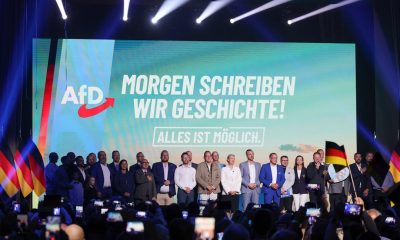




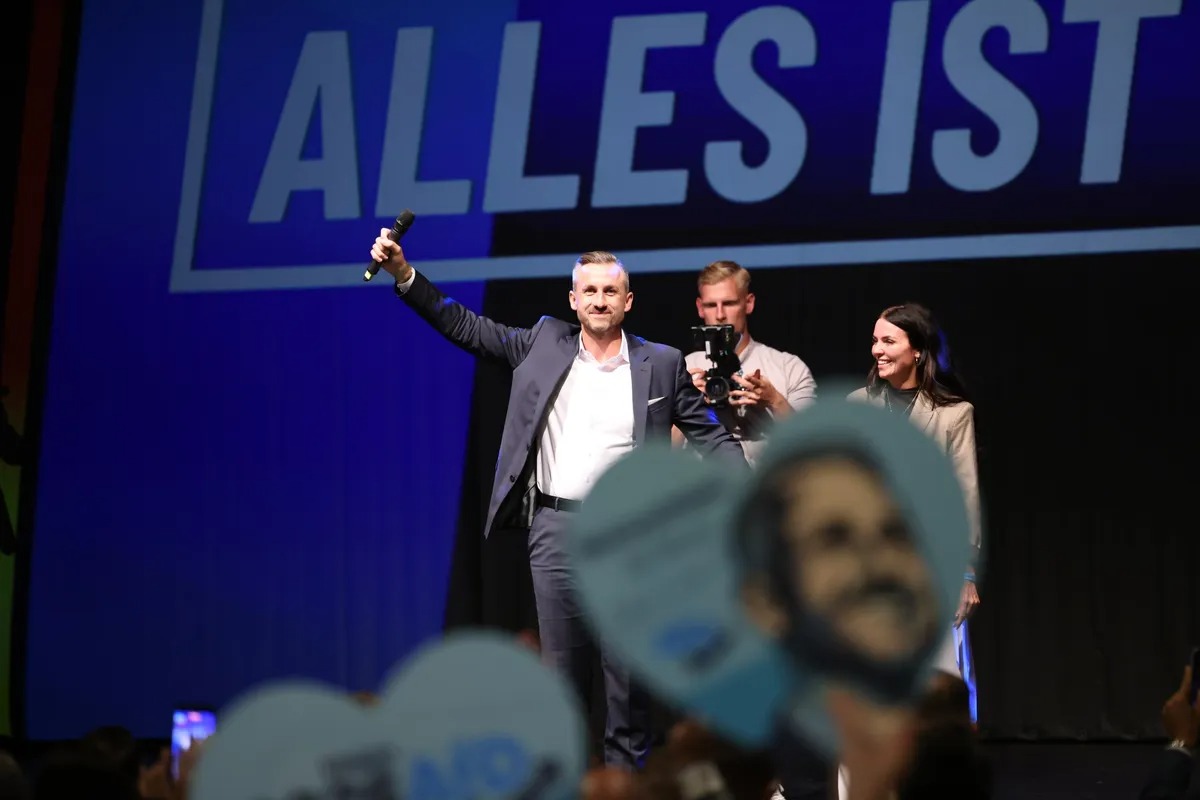
Germany’s small and medium-sized enterprise sector, known as the “Mittelstand”, has urged the federal government to implement “reform” following the Alternative for Germany’s (AfD) clear victory in Saxony-Anhalt.
Representing the group that forms the backbone of Europe’s largest economy, Christoph Ahlhaus, head of the German Federal Association of the Mittelstand, told Bloomberg that an urgent change in policy is needed to restore confidence in Germany’s economic future and to curb support for “populist” parties.
In an interview on Monday, Ahlhaus stated that the AfD’s victory in Saxony-Anhalt was “a clear signal for all people in Berlin and for Chancellor Merz,” adding, “The disappointment is very, very big.”
Germany’s traditional industrial sectors, ranging from automotive to chemicals and engineering manufacturers, are under intense pressure to adapt to a rapidly shifting competitive landscape.
High energy prices, bloated bureaucracy, and fierce price competition from Chinese rivals are eroding profits and triggering sweeping restructurings, fuelling anxieties over the economic future among industrial workers.
Ahlhaus noted that the vast majority of companies do not support the AfD’s policy aimed at reducing economic integration in Europe, arguing that crackdowns on immigrants could become a “major problem” for small and medium-sized enterprises.
Martin Lück, chief capital markets strategist at Franklin Templeton, said in a note: “The extremely strong performance of the AfD is, above all, an important political signal, but not yet an acute development for the capital market.” He continued:
“From an investor’s perspective, this creates problems if doubts arise regarding the state’s European integration, fiscal reliability, openness to international skilled labour, or the continuity of its energy and industrial policies.”
Lück added: “Saxony-Anhalt, which is particularly reliant on fresh investment and skilled labour, can hardly afford such doubts.”
Speaking to Bloomberg ahead of Sunday’s elections, the AfD’s lead candidate, Ulrich Siegmund, rejected the criticism and insisted that the party’s policies would actually help attract investment.
“Many companies want to invest in Saxony-Anhalt because they view it as a competitive edge, and having an administration that provides planning certainty once again is seen as an asset for the region,” Siegmund said.
According to Siegmund, the business community wants “to eliminate ideology entirely from economic development support and, in general, grant freedom back to companies.”
Saxony-Anhalt has the lowest per-capita GDP among Germany’s 16 federal states.
Since national reunification, Saxony-Anhalt has suffered a sharper demographic decline than any other region; between 1990 and 2024, its population fell by more than a quarter.
Marcel Fratzscher, president of the Berlin-based German Institute for Economic Research (DIW), contended that the election result was “an economic disaster as well,” saying: “Whoever forms the next government will struggle to implement reforms. Yet Germany needs very tough reforms.”
Speaking to Bloomberg, the former European Central Bank official warned that the “far-right” party’s platform could lead to catastrophe:
“If you look at the consequences of what the AfD wants, there will be a massive drop in GDP and a massive rise in unemployment. Germany is very export-dependent. Almost half of Germany’s GDP comes from exports, and the AfD will ruin [its] economic model; that will have terrible, as well as economic, repercussions.”
Major cutbacks across core sectors such as the chemical and automotive industries have heightened anxiety among workers regarding their economic future.
Far-reaching reorganisations, such as Volkswagen’s restructuring programme approved late on Thursday, will generate a domino effect across various regions of Germany, including Saxony-Anhalt.

Doubts are growing within the European Union leadership over whether Ukraine’s urgent military requirements on the frontline can be met.
Speaking to the Euractiv news website, a European Commission official working in close contact with the Ukrainian defence sector warned that Brussels’ cumbersome defence mechanisms are failing to keep pace with rapid shifts on the ground.
The government in Kyiv aims to establish joint weapons production with European countries.
However, bringing defence projects to fruition within the EU often takes between five and 10 years. Due to these lengthy timescales, weapon systems run the risk of becoming technologically obsolete against frontline realities by the time they reach Ukraine.
It is also reported that projects funded under the European Defence Fund (EDF), the European Commission’s primary financing instrument for collaborative defence research and technology development, could conclude without answering tangible frontline needs.
Drawing attention to the system’s lack of flexibility, the Commission official stressed that weapons manufacturers are accustomed to selling the same product for years, whereas battlefield conditions now transform far more rapidly. The official also stated that Ukrainian companies have outpaced their European counterparts in specific sectors.
Riho Terras, vice-chair of the European Parliament Subcommittee on Security and Defence, recalled that Ukrainian military equipment entering the European market must comply with EU standards and regulations.
Arguing that the European defence sector lacks the ability to transform rapidly, Terras said the existing industrial infrastructure produces systems that are overly complex and excessively expensive for the modern battlefield.
Stating that the current production model is unsustainable in the long run, Terras noted that the issue also carries a political dimension, offering the following assessment: “European citizens do not yet feel that this war is their war.”
Ukrainian President Volodymyr Zelenskyy had stated that they require an additional 27 billion euros to cover defence expenditures, requesting that a portion of the two-year, 90-billion-euro loan package planned by the EU for 2027 be brought forward to this year.
Irish Minister for Defence Helen McEntee, speaking after an informal meeting of EU defence ministers, said Brussels is broadly receptive to Kyiv’s appeal to front-load the funds.
Stating that next year’s financing has been approved, McEntee said the general trend at the meeting pointed towards a consensus in favour of releasing the resources ahead of the planned schedule.
The 90-billion-euro loan package, agreed last December, is intended to cover two thirds of Ukraine’s total financing needs for 2026 and 2027.
Under the current plan, half of this amount is slated for transfer this year, with the remaining 45 billion euros scheduled for next year.
However, according to data cited by Euractiv, only 11.7 billion euros, intended primarily for military spending, has been delivered to Ukraine to date.
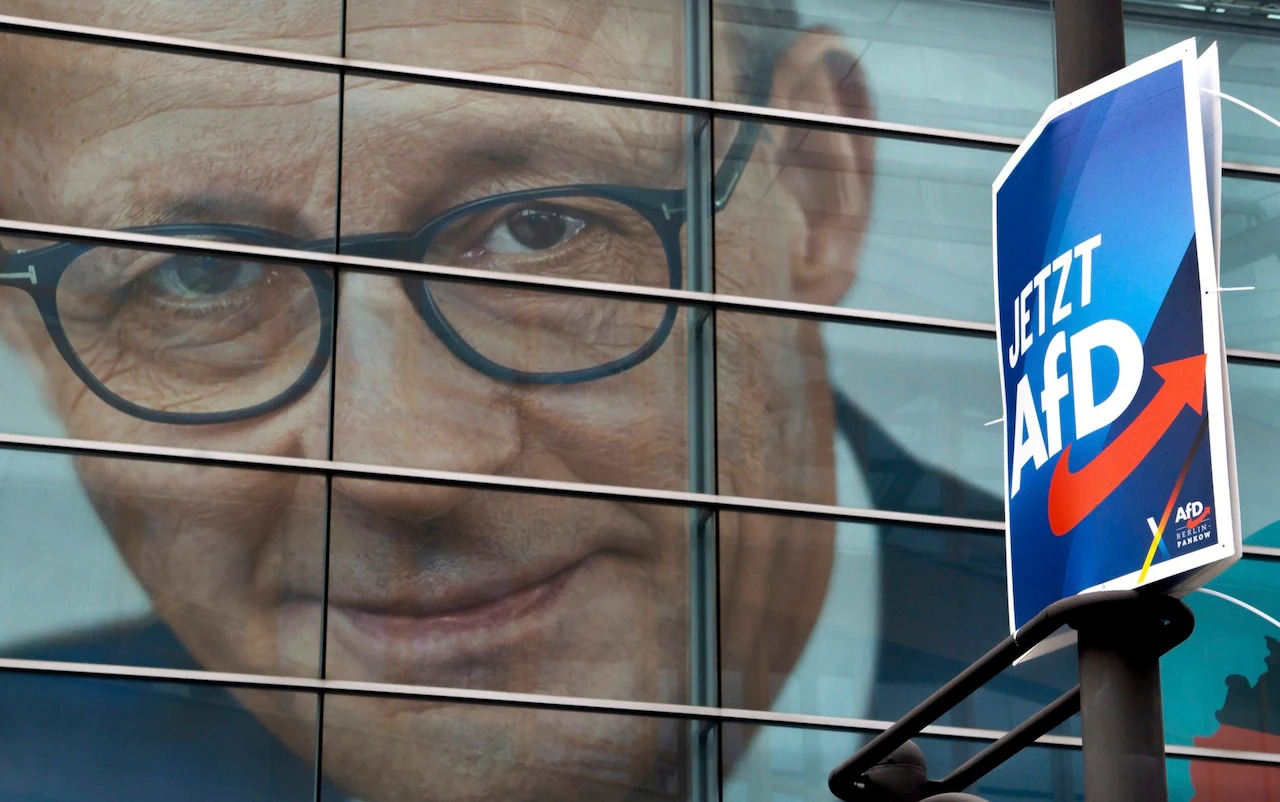
Chancellor Friedrich Merz and his party, the CDU, are set to fundamentally overhaul the country’s citizenship laws in a bid to counter Alternative for Germany (AfD).
Senior figures in the CDU (Christian Democrats) are debating a ban on dual citizenship and the tightening of language requirements to retain their own voters who are turning towards the AfD.
In an interview with The Telegraph newspaper, senior CDU lawmaker Gunter Krings argued that previous governments had made the process of acquiring German citizenship “too fast and too easy”:
“Naturalisation should be seen as the final stage of integration into our workforce, our society, and the constitutional order. We cannot accept people wanting to become German citizens whilst living in a parallel society.”
Under the proposals, those seeking to become German citizens would have to pass a more demanding language proficiency examination demonstrating that they can discuss highly complex subjects, rather than a simple “B1” level test of everyday spoken German.
They will also be required to renounce the citizenship of their home countries, prove complete financial independence, and renounce “all forms of anti-Semitism”.
Krings spoke to The Telegraph ahead of the Saxony-Anhalt elections, in which the CDU suffered a heavy defeat at the hands of the AfD.
Krings, a deputy leader of the CDU parliamentary group in the German parliament, the Bundestag, pointed to the new citizenship laws as one way to achieve this goal.
These reforms would make financial independence and fluent spoken German mandatory for those applying for citizenship after five years of residence in Germany.
Krings said:
“One of these areas is definitely language skills. Currently, we only require the B1 level, which allows you to participate in only very simple conversations. But if you truly want to participate in the political process, as we expect of German citizens, you need to know German better; therefore, the B1 level is not enough.”
Arguing that the current system, which allows migrants to acquire German citizenship even if they receive social assistance, is “not fair to German taxpayers”, the CDU politician said: “Under current rules, it is sufficient to cover most of your livelihood [from your own income]; therefore, according to many court decisions, 51% is considered enough, but I do not think this is right.”
Krings argued that if nearly half of a person’s income comes from the German welfare state, “this cannot be proof of economic integration when applying for citizenship.”
Another key element of the reform would be the repeal of the legislation enacted in 2024 by the previous government, led by Olaf Scholz, which permitted dual citizenship in Germany.
Speaking on this matter, Krings said:
“I think the rule should be: when you receive German citizenship, you must give up your previous citizenship. If you move from one country to another and plan to live here permanently, I do not understand why keeping the citizenship of your former country should be so important to you.”
Krings argued that the lax citizenship requirements in Germany were primarily a result of reforms carried out by the Scholz government.
However, he also cited decisions taken by previous CDU leaders, such as former German Chancellor Angela Merkel.
Speculation is mounting that Merz could be forced to step down from the chancellorship as he struggles to quell discontent within his own party and from his coalition partner, the Social Democrats (SPD).
The citizenship reforms will require the approval of the SPD, which has previously sought to soften some of the CDU’s core policies.
The SPD is losing support not only to the AfD, but also to Die Linke (The Left Party) and the BSW.
In addition to losing the upcoming elections in Saxony-Anhalt, where it is in power, the CDU is also expected to lose the state elections to be held later this month in Berlin and in another eastern state, Mecklenburg-Western Pomerania.
Hendrik Wust, a regional CDU leader who has been compared to Andy Burnham, is widely discussed in CDU circles as a potential successor.
Wust, for his part, sought to damp down these rumours throughout the summer by publicly backing Merz.

German business urges swift reform after AfD win in Saxony-Anhalt

Netanyahu ignored MBZ warning on Hamas 7 October plan, report says

UK reassures US that new Israeli settlement sanctions are symbolic

EU defence industry struggles to meet Ukraine frontline requirements

The AfD as battering ram
-

 Diplomacy2 weeks ago
US strikes fail to break Iran as regional anchors rise, Dr. Moeini says
-

 Diplomacy2 weeks ago
Blackwater founder Erik Prince creates air defence venture with Kyiv
-

 Europe2 weeks ago
UK and Russia edge closer to conflict over long-range drone supply
-

 Diplomacy2 weeks ago
South Korea begins first commercial voyage via Northern Sea Route
-

 Europe23 hours ago
Germany’s CDU drafts tougher citizenship rules to counter AfD
-

 Opinion2 weeks ago
What did the Israeli attack in Syria reveal?
-

 Asia2 weeks ago
China and Arab states launch 5-year anti-desertification plan
-

 Asia2 weeks ago
India intel push on China risks dangerous miscalculation, study says
