
Europe
AfD secures sweeping victory in Saxony-Anhalt state election


Alternative for Germany (AfD) secured a sweeping victory in the Saxony-Anhalt state election on Sunday.
On the other hand, with 43.8%, the party fell just short of an outright majority in its bid to form the country’s first “far-right” state government since the Second World War. The state has a population of 2.1 million people.
German Chancellor Friedrich Merz’s party, the CDU, suffered a poor result in the eastern state, securing 17.2%. The CDU was followed by its coalition partner, the SPD, on 9.3%. The Greens won 8.9%, Die Linke (The Left Party) 8.6%, and the Sahra Wagenknecht Alliance (BSW) 5.3%, all managing to enter the state parliament.
Voter turnout was notably high at 77.8%. AfD appears to have won over many individuals who did not vote at all five years ago.
Among all voters, the issue of social security played the largest role at 25%. Internal security and migration issues reached a combined total of only 22%.
At the same time, AfD reached 65% among those who assessed their financial circumstances as poor.
In Saxony-Anhalt, GDP per capita stands at 38,452 euros compared with a federal average of 53,516 euros. The unemployment rate is 8.0% in Saxony-Anhalt, whereas the federal average is 6.3%. The pension for men is 1,676 euros in Saxony-Anhalt against a national average of 1,892 euros.
In the pensioner category, the CDU (27%) and AfD (38%) secured relatively close levels of support, whereas AfD led by a wide margin among workers, civil servants, and the self-employed, winning 61%, 46%, and 52% respectively.
AfD’s candidate for state premier said “we made history” and stated that the party received a clear mandate to govern.
Speaking to public broadcaster ARD, 35-year-old Ulrich Siegmund said that voters sent the message that “things cannot continue this way.”
“Friedrich Merz was a very good campaigner for us in this election campaign,” Siegmund said.
AfD federal co-leader Alice Weidel described the result as “sensational” and said her party “extends its hand to anyone who wants to make Saxony-Anhalt better and move Germany forward.”
AfD was seeking an absolute majority in the state parliament to govern alone and breach the “firewall” created by mainstream parties’ refusal to cooperate with AfD.
Final results revealed that AfD fell three seats short, securing 39 lawmakers in the 83-seat parliament.
Siegmund said they would not enter into “games” such as a minority government, but it remains unclear how the divided opposition could form a stable government without AfD.
BSW, which announced that it would support neither Siegmund nor incumbent CDU leader Sven Schulze as state premier, nevertheless criticises the “firewall” erected against AfD. BSW took five seats in the state parliament.
Schulze congratulated AfD on becoming the state’s strongest political force and said, “As the CDU, we will also have to face this result.”
The federal general secretary of Merz’s party, Franziska Hoppermann, refused to back down from the commitment not to engage with AfD.
Hopermann said:
“AfD is a far-right party. It wants to exit the euro; this means economic collapse… It works in close cooperation with Russia and wants a completely different social model. We will not cooperate with them.”
AfD’s regional branch in Saxony-Anhalt is one of several classified as a “far-right group” by the domestic intelligence agency.
In its election programme, the party refers to “remigration”, meaning the deportation of immigrants.
AfD previously won the Thuringia state election but was unable to assume power. There, a CDU leader formed a minority government to take office.
Schulze’s attempt to form an alliance against AfD will be a sensitive issue, as it will require at least some tacit support from the “far-left” Left Party, with which the CDU refuses to form a coalition.
Germany’s 16 states hold broad powers in areas such as supervising security matters and managing the education system.
Siegmund had listed a “deportation drive” and the elimination of incentives for people to come to Germany and “exploit our social system” among his top priorities. Citing concerns over “disinformation”, he wants to launch a lengthy process to withdraw Saxony-Anhalt from the regional public broadcaster.
AfD in Saxony-Anhalt also wants to legalise homeschooling, which has not been permitted in Germany thus far.
The party pledges to ban the official flying of the rainbow flag at schools, claiming it “devalues the family”, and to ensure schools fly the national flag.
The party opposes taxpayer money being “gifted” to Ukraine and states it will push for the lifting of sanctions on Russia. However, this is not a matter state governments can decide.
The 16 state governments are also represented in Germany’s upper house (Bundesrat), where certain government bills must be approved. As one of the smallest states in a nation of 83.5 million, Saxony-Anhalt’s influence there is limited: it holds four of 69 votes.












The European Commission has rejected a peace plan proposal from the US administration that entails resuming Russian natural gas purchases via Ukraine.
Commission spokesperson Paula Pinho stressed that Brussels has not changed its stance.
Pinho recalled that European Commission President Ursula von der Leyen had previously stated clearly that no restrictions on Russia would be lifted until the conflict comes to an absolute end.
The New York Times reported that the US president’s new peace proposal includes Europe returning to large-scale Russian gas purchases through Ukraine.
According to the report, Special Envoy Steve Witkoff and Jared Kushner raised the matter during talks in Kyiv last month with Ukrainian and European officials, including Ukrainian President Volodymyr Zelenskyy.
Sources contacted by the newspaper noted that some European and Ukrainian officials believe Washington would seek to secure a share of Russian gas exports.
Under this plan, the objective is to channel a share of the profits to American companies or the US government.
Russian President Vladimir Putin had said Moscow was ready to work on supplying fuel to European nations, but noted that a signal must come from the other side.
Putin stated that Moscow must evaluate the feasibility and necessity of fuel flows to the Western market, adding that they would not wait for Europe to shut the door ostentatiously on energy supplies.
Kremlin spokesperson Dmitry Peskov remarked that European nations rejecting Russian gas would make them dependent on the US and deprive them of the ability to diversify their supply sources.
Peskov noted that the US sells gas at very high prices and that if European nations pay more for energy, their industries will suffer.
The EU plans to halt liquefied natural gas imports from Russia entirely by 1 January 2027 and pipeline gas by 30 September 2027.
Von der Leyen had previously announced that the bloc would reduce Russian gas imports to zero by the end of 2027.
Russia halted gas flows to Europe via Ukraine as of 1 January 2025, when the five-year contract between Gazprom and Naftogaz of Ukraine expired.
Putin had stated that Kyiv refused to extend the transit agreement. Following the closure of the Ukrainian route, the TurkStream pipeline remained the only operational corridor carrying Russian pipeline gas to Europe.

A prosecutor investigating corruption allegations surrounding a real estate project linked to US President Donald Trump in Serbia was targeted with spyware, a new investigation has revealed.
The findings, published by the University of Toronto’s Citizen Lab alongside the Serbia-based digital rights group SHARE Foundation, showed that Rade Bajić, who served at the Prosecutor’s Office for Organized Crime, was selected as a target.
Bajić became a target of the Pegasus spyware developed by Israel-based NSO Group after he publicly spoke out about political interference and abuses of power.
The prosecutor stated that on 13 August, he received a warning alert from Apple cautioning him against state-sponsored or mercenary spyware attacks.
Project cancelled, but investigation and pressure continue
The probe centres on a plan to transform the historic complex in Belgrade that housed the former Yugoslav Ministry of Defence headquarters into a luxury Trump Tower skyscraper.
Linked to US President Trump’s son-in-law Jared Kushner, the real estate development drew fierce backlash amid political pressure disputes and allegations that the site’s protected heritage status had been unlawfully revoked.
The investment firm founded by Kushner announced late last year that it was pulling out of the project, citing respect for the Serbian public and the city of Belgrade.
Recalling his investigation into claims that senior government officials had improperly lifted the historic military complex’s protected status, former prosecutor Bajić said: “In my opinion, my role in this case was the sole reason for the illegal spyware attack.”
Target list widens to university and judicial figures
The spyware scandal in Serbia has widened, sweeping in political opposition figures, civil society, and academic circles.
It was also confirmed that an iPhone belonging to University of Belgrade Rector Vladan Đokić was infiltrated by Pegasus spyware.
Đokić, who refused to back the government’s crackdowns on student demonstrations, has become one of the prominent figures of the protest movement.
Police raided his office on 31 March, seizing his computers and servers. Đokić had also been touted as a likely leader for a student-backed opposition list ahead of early general elections scheduled for Sunday.
Shortly before the report was published, a pro-government tabloid released audio recordings allegedly capturing Đokić discussing his political ambitions, putting him directly in the crosshairs.
While the source of the recordings remained undisclosed, Đokić stressed that the breach of his phone represented a grave assault on his personal privacy, safety, and the dignity of the rector’s office, demanding that those responsible be punished.
State institutions silent on allegations
Speaking to Politico, SHARE Foundation policy advisor Andrijana Ristić noted that surveillance operations had spread from civil society and journalists to student activists, politicians, and finally to members of academia and the judiciary.
Ristić stated that the lack of state action despite formal criminal complaints has fuelled this escalation.
Citizen Lab senior researcher John Scott-Railton emphasized that technology from NSO Group, which claims to turn over a new leaf every time an abuse is uncovered, is being deployed directly for repression.
Scott-Railton pointed out that targeting individuals who defend freedom against corruption was no coincidence.
The Serbian Ministry of Internal Affairs left questions unanswered, though officials had previously denied allegations of cyber espionage.
NSO Group, which maintains that it sells its products exclusively to governments and was blacklisted by the US government in 2021 over human rights abuses, also made no comment.
Apple confirmed that it had sent mass threat notifications to users on 13 August, but provided no specific details regarding the cases of Bajić or Đokić.
In September, Citizen Lab and the SHARE Foundation disclosed that at least 14 individuals, including student activists and opposition figures, had received similar spyware alerts.
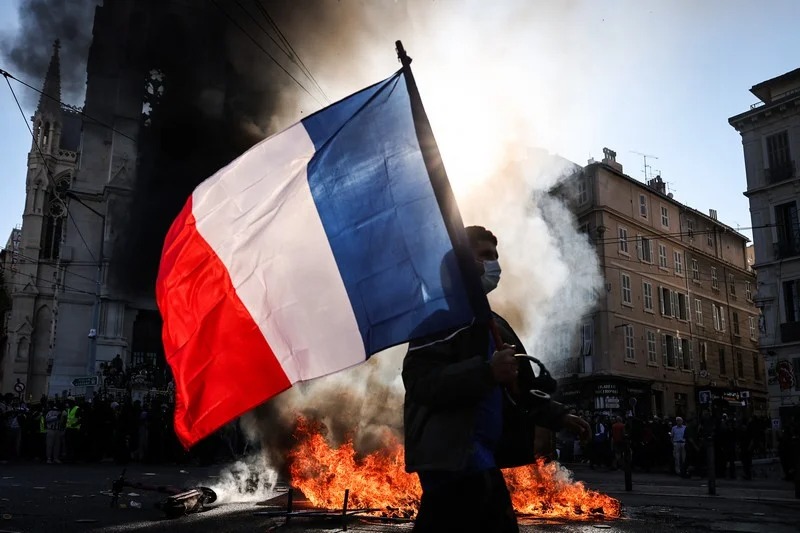
French Interior Minister Laurent Nuñez tendered his resignation amid some of the country’s most violent street unrest in recent years. President Emmanuel Macron rejected the resignation.
According to a statement from the Elysée Palace, Macron made the decision because law enforcement required uninterrupted command under current conditions. Macron instructed Nuñez to roll out new methods on the ground as quickly as possible.
The president also demanded that all necessary measures be taken to ensure transparency regarding the lapses in intelligence and foresight that led to the violence.
How many people were on the streets during Saturday’s protests?
The demonstrations were organised on 17 October over the rising cost of living and discontent with the government’s social policies. According to the Interior Ministry, approximately 550,000 people took part, while trade unions put the figure at 800,000.
Hundreds of thousands marched peacefully on Saturday. However, clashes with law enforcement broke out in Paris, Lyon, Marseille, and other cities, where shops were looted and buildings set on fire.
In Marseille, protesters stormed the city hall. As they forced their way in, they shouted, “This is a revolution, we are taking the Bastille!”, and went on to loot numerous stores.
In Lyon, the office of a tourism company housed in a 19th-century building was vandalised and torched. In Limoges, a 19th-century city hall was set ablaze.
Damage incurred by French businesses is reportedly estimated in the hundreds of millions of euros.
Citing Nuñez reported approximately 1,800 detentions and more than 500 injuries among police officers, gendarmes, and firefighters. Reuters reported that Nuñez stated 2,400 people had been detained nationwide and around 1,000 security personnel injured.
During the demonstrations in Paris, one person suffered a fatal heart attack while being detained.
Macron: We feel anger and shame
In a televised address, Macron said that nothing could justify the events. “There is nothing that can justify, explain, or excuse this. Tonight, we all feel anger and shame,” he said.
In the same speech, he stressed that peaceful demonstrators had legitimate grievances and should not be equated with those resorting to violence. He also noted that the protesters’ voices must be heard and that the government had already begun efforts to address them.
Macron said that legitimate demands must not be conflated with violence, and that violence should not prevent those demands from being heard.
Right demands state of emergency, Macron holds off
Right-wing politicians demanded the declaration of a state of emergency.
Macron declined to do so, stating that the government could allow local authorities to ban protests if necessary to protect public buildings and businesses.
Marine Le Pen, who is expected to run as the candidate for the far-right National Rally in next year’s presidential election, called for restraint. Le Pen said the situation in the country must not be treated as normal.
Meanwhile, Jean-Luc Mélenchon, leader of the far-left France Unbowed, stated that Macron must meet the demands of high school students staging demonstrations.
Macron’s term in office ends in 2027.
Throughout his nearly decade-long presidency, the country has frequently witnessed widespread protests, alongside persistent criticism over economic weakness and mounting public debt.

South Korea pulls part of embassy staff from Ukraine amid POW dispute

Netanyahu unveils security doctrine and regional alliance map

At least 47 major US data centre projects halted or cancelled

EU rejects US proposal to resume Russian gas flows through Ukraine

Serbian prosecutor in Trump Tower inquiry targeted by Israeli spyware
-

 Europe2 weeks ago
France and Germany urge EU market kill switch against trade threats
-
 Europe2 weeks ago
Bill to drop NATO membership goal submitted to Ukrainian parliament
-

 Europe2 weeks ago
Marine Le Pen unveils fiscal programme pledging French budget cuts
-

 Middle East2 weeks ago
CIA report warns Israel faces growing risk of civil conflict
-

 Europe2 weeks ago
Berlin Left Party backs Israel’s right to exist for coalition pact
-
 America2 weeks ago
How will Brazil’s presidential runoff work?
-
 Diplomacy2 weeks ago
The West is preparing for war not with Russia, but with its own people, French analyst Georges Kuzmanovic insists
-

 Diplomacy2 weeks ago
Türkiye delivers Korkut air defence systems to Ukraine, report says
