
Opinion
Ankara’s Second Summit: Twenty-Two Years On, NATO Returns to a Türkiye That Has Changed the Rules

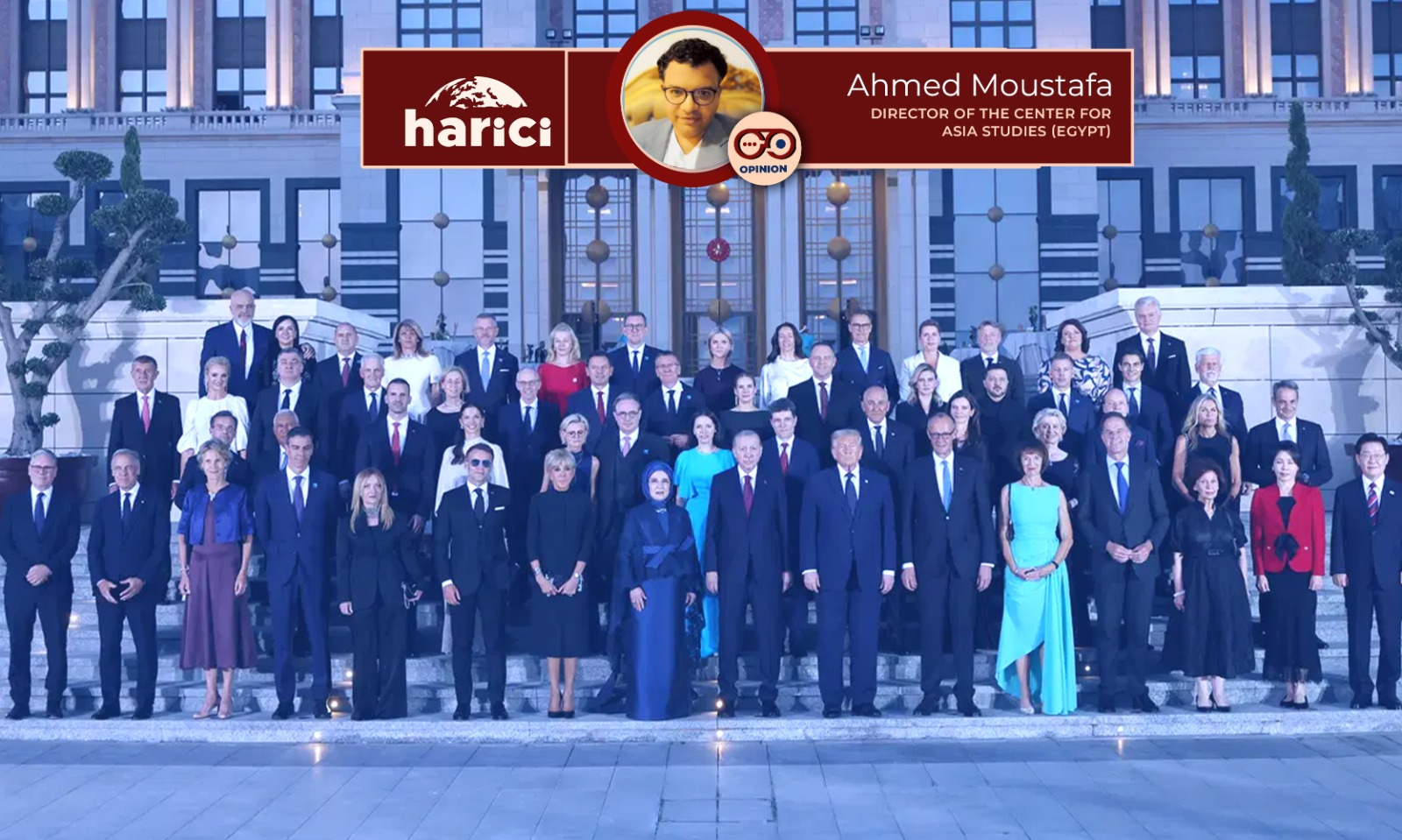
Dr. Ahmed Moustafa Director & Founder, Asia Center for Studies & Translation, Egypt
Twenty-two years after Istanbul hosted NATO’s leaders in 2004, the Alliance has returned to Turkish soil, this time to the Beştepe Presidential Complex in Ankara, for a summit that arrives not as ceremony but as reckoning. The 36th NATO Summit, convened July 7–8, unfolds against a backdrop few of its architects in 2004 could have imagined: a Ukraine war grinding into its fifth year, a Middle East still smoldering from a direct US-Israel war with Iran, an American president openly questioning the value of the Alliance he is attending, and a host nation, Türkiye, that has quietly become indispensable to almost every crisis on NATO’s agenda.
Türkiye’s Moment: From Junior Partner to Power Broker
Hosting a NATO summit has always been a statement of strategic weight. But Ankara 2026 is different in kind. Türkiye arrives not merely as host but as leverage. Its defense-industrial base — anchored by companies like ASELSAN, which has attracted reported interest from global capital including BlackRock, with US Ambassador Tom Barrack said to be facilitating contacts and BlackRock’s Larry Fink having met President Erdoğan earlier this year — has positioned Türkiye as a rising node in NATO’s push for defense-industrial self-sufficiency. The Ankara Summit’s dedicated Defence Industry Forum, held alongside the political summit, underscores this: Türkiye is no longer simply a NATO member on the alliance’s southeastern flank but a manufacturing and innovation hub the Alliance now needs.
This is Erdoğan’s leverage point. As European allies scramble to meet the 5% GDP defense-spending pledge agreed last year, with 3.5% earmarked for core defense and 1.5% for resilience and infrastructure, Türkiye has positioned Ankara as a “delivery checkpoint” — a moment to translate commitments into contracts, and contracts into Turkish industrial gain. Analysts covering the summit have openly asked whether the gathering represents collective security or, in effect, the largest commercial handshake in Turkish defense history.
The Russia-China Question: Hedging in Plain Sight
Türkiye’s balancing act is not new, but it has rarely been more visible. Even as Ankara hosts NATO’s leaders, Foreign Minister Hakan Fidan met his Russian counterpart in Moscow only weeks earlier, part of a pattern of parallel engagement that Ankara has never fully abandoned since the Ukraine war began. Türkiye continues to occupy a unique lane inside NATO: a member state that supplies Kyiv with Bayraktar drones while keeping Black Sea diplomatic channels to Moscow open, and one that has deepened economic and energy ties with both Russia and China without triggering the kind of alliance discipline applied to smaller members. For Ankara, NATO membership and multi-alignment with Moscow and Beijing are not contradictions to be resolved but assets to be managed simultaneously — a posture that gives Turkish diplomats outsized room to maneuver at exactly the summit meant to reaffirm collective unity.
Ukraine: Sustaining a War Without an End
The degraded state of the Ukraine war looms over every session in Ankara. NATO is expected to affirm a pledge of roughly €70 billion in military equipment, assistance, and training for Ukraine in 2026, with allies committing to sustain at least equivalent levels into 2027. Yet the summit convenes amid reports that Italy has been resisting parts of the Ukraine funding language in the draft communiqué, exposing cracks in what NATO officials insist remains a “unity summit.” President Trump is scheduled to meet Ukrainian President Volodymyr Zelenskyy on the sidelines, following recent phone calls in which Trump suggested renewed prospects for a negotiated peace — even as fighting continues largely unabated and Zelenskyy has publicly flagged what he considers European inaction.
Ankara’s Trade-Off Amid the US-NATO Rift Over Iran
The most consequential subtext of this summit may be the still-raw rupture between Washington and its allies over the Strait of Hormuz. Since the US-Israel war against Iran erupted in late February — triggered by the killing of Supreme Leader Ali Khamenei — Iran’s closure and periodic re-closure of Hormuz has convulsed global energy markets. When Trump called on NATO, China, Japan and South Korea to help secure the strait militarily in March, every ally declined; Germany’s defense minister flatly stated it was not Europe’s war. Trump responded by calling NATO’s refusal a “very foolish mistake” and describing the Alliance, without American backing, as a “paper tiger.”
That rift has not healed; it has merely gone quiet enough to allow a summit to proceed. A ceasefire and blockade-lifting memorandum signed in June eased the crisis, but Iran has since signaled it will impose transit fees on Hormuz shipping, with “special treatment” reportedly reserved for friendlier states — a policy Washington rejects as unworkable for any lasting deal. Strait security is now formally on this week’s NATO agenda, even though the underlying disagreement over burden-sharing on Iran was never resolved, only overtaken by events. This is the trade-off Turkish politicians are positioned to exploit: Ankara can offer itself as an indispensable interlocutor — bridging Washington’s frustration with European reluctance — while extracting defense-procurement access and diplomatic capital in return, precisely the kind of transactional leverage Erdoğan has cultivated throughout the crisis.
The Middle East Overhang: Syria, Lebanon, and a Widening Israel Rift
Türkiye’s regional posture will shape the summit’s Middle East undertone as much as any formal session. President Trump is set to hold a separate bilateral meeting in Ankara with Syrian President Ahmed al-Sharaa, the former rebel commander now leading Damascus. The meeting follows Trump’s repeated suggestion — first floated at the G7 — that Syrian forces could take on Hezbollah in Lebanon more effectively than Israel, a proposal al-Sharaa has consistently declined, insisting Damascus seeks only economic channels with Beirut, not a military role reminiscent of Syria’s decades-long occupation of Lebanon. The subtext is unmistakable: Washington is testing whether it can redirect regional security burdens away from an Israeli campaign in Lebanon that has produced significant civilian casualties, toward a Syrian government still consolidating power after Assad’s fall — a maneuver that would simultaneously ease pressure on Israel and open a new channel of US engagement with post-Assad Syria, independent of Iran.
Layered atop this is an open diplomatic rupture between Ankara and Jerusalem. Foreign Minister Hakan Fidan, in a CNN Türk interview days before the summit, described Israel’s policies and mindset as “a burden that humanity can no longer bear” and called for international sanctions, accusing Israel of perpetrating mass killing in Gaza. Israeli Foreign Minister Gideon Sa’ar branded the remarks “textbook incitement to genocide,” a charge Germany’s foreign minister also distanced himself from as unacceptable rhetoric, while President Isaac Herzog denounced the comments as antisemitic. Erdoğan, for his part, dismissed Israeli criticism as an attempt to deflect from its own conduct in Gaza. That this exchange erupted just as NATO’s Israeli-aligned members prepare to sit alongside Türkiye’s delegation adds a genuinely awkward undercurrent to an Alliance summit ostensibly focused on Russia and defense spending — and gives Ankara another card to play: positioning itself as the Muslim world’s most vocal NATO-member critic of Israel, a role with real currency across the Arab and Islamic world even as it strains Türkiye’s Western alliances.
The Palestinian Case and Arab Coordination
For Cairo, Islamabad, Doha, and Riyadh, the Ankara summit is being watched less for its Ukraine communiqué than for what it signals about regional alignment on Gaza and the Palestinian file. Egypt, Qatar, Pakistan, and Saudi Arabia have each played mediating or coordinating roles throughout the Iran crisis and its regional spillover — Islamabad brokered ceasefire talks during the Hormuz confrontation, while Qatar helped facilitate a Lebanon ceasefire alongside the United States and Iran. That same quartet’s coordination on Gaza reconstruction, Palestinian statehood diplomacy, and pressure against further escalation in Lebanon is likely to intensify in the summit’s aftermath, particularly if Fidan’s confrontational posture toward Israel hardens into a broader Turkish push to rally Muslim-majority states — inside and outside NATO — around a unified Palestinian position. Whether Ankara’s rhetoric translates into coordinated Arab-Turkish diplomatic action, or remains a unilateral Turkish gesture aimed at domestic and regional audiences, will be one of the more consequential open questions to emerge from a summit meant, on paper, to be about Russia and the Atlantic alliance — and that has become, in practice, a referendum on how far Türkiye’s ambitions now extend.
This analysis draws on reporting from NATO’s official summit documentation, Reuters, the Congressional Research Service, The National, The Jerusalem Post, Al Arabiya, and other outlets covering the Ankara Summit as of July 7, 2026.







Thomas Karat, behavioral analyst
The photograph that Western agencies distributed from Bishkek arrived with its meaning already fixed. Above an image of the Kyrgyz president escorting China’s Xi Jinping past an honor guard, the caption read COUNTER US POWER. The image itself showed a familiar diplomatic ritual, two heads of state walking a red carpet. The caption supplied what the image did not: an adversary, a purpose, and the direction in which a Western audience was meant to orient its concern. The gap between the neutral picture and the loaded words is a useful place to begin, because it is where the framing of the entire summit was decided before a single line of analysis was written.
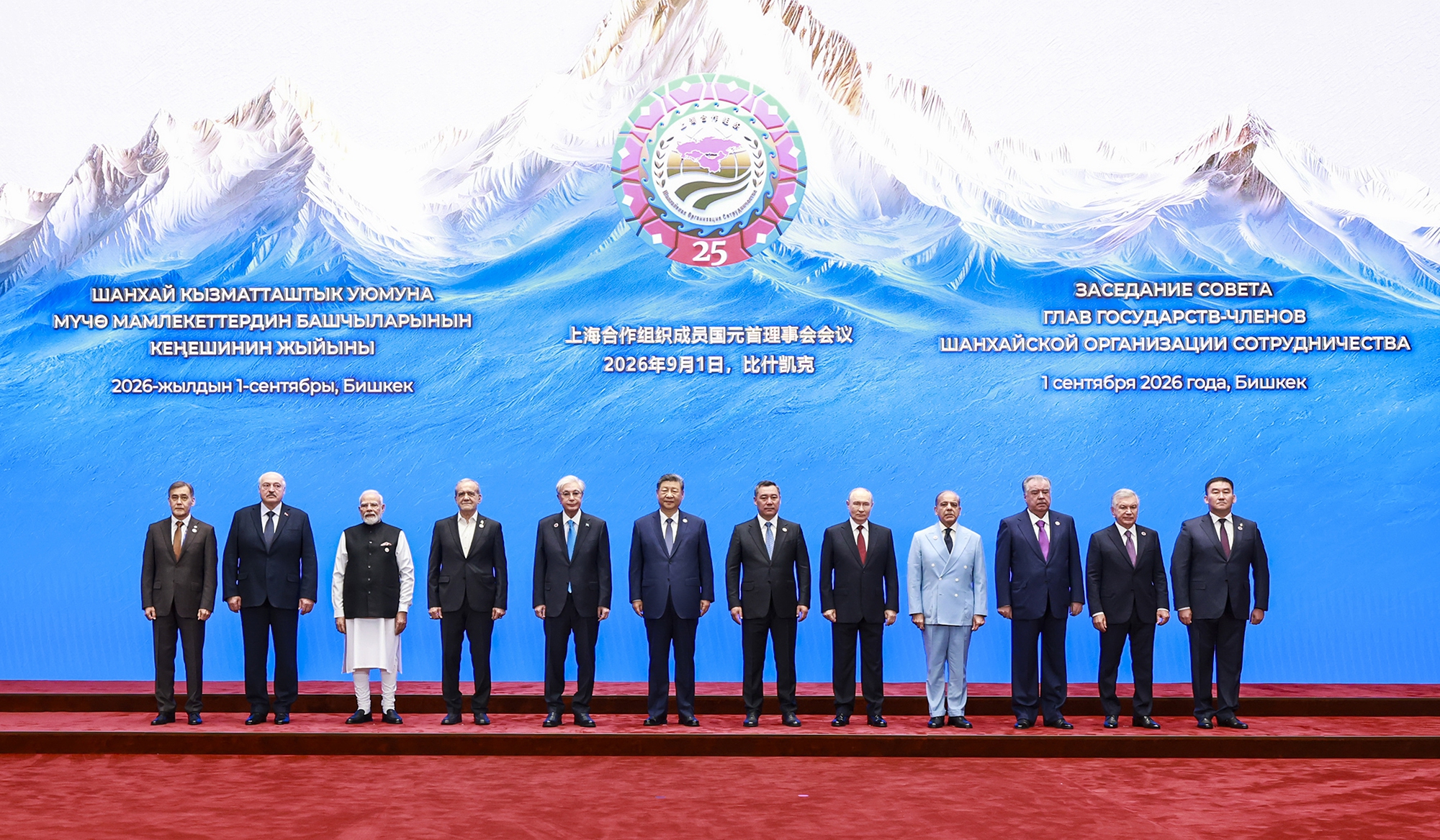
On Sept. 1 the Shanghai Cooperation Organization marked its twenty-fifth anniversary in the Kyrgyz capital, with ten member states, more than a dozen heads of government, and the secretary-general of the United Nations among the guests. Most European and North American outlets carried a single Agence France-Presse dispatch, which described the bloc as one that seeks to be a counterinfluence to the West. France 24 reported that the Russian and Chinese leaders had traveled to Central Asia to counter Western influence. British coverage of an earlier session of the same body called it a secretive summit of an “axis of upheaval.” In each formulation the West occupies the grammatical center of a meeting it did not attend. The organization is assigned no purpose that can be stated without reference to Washington and Brussels. It is defined entirely as a reaction to them.
Türkiye is the hole in the caption
The framing meets its first and largest obstacle in the guest list, and specifically in the presence of a NATO member at the table. Türkiye holds the status of dialogue partner in the organization, and President Recep Tayyip Erdogan has attended its summits in person. A Western reader told that the SCO is an axis assembled against his alliance is not encouraged to ask why a founding member of that alliance keeps a seat in it. The same AFP dispatch that calls the bloc a counterinfluence to the West records, several paragraphs below its lead, that the organization now counts fifteen dialogue partners including Türkiye, Saudi Arabia and Qatar. Türkiye belongs to NATO. Saudi Arabia and Qatar host the forward headquarters of United States Central Command and the largest American air base in the region. An organization built to oppose the West does not assemble this membership, and a caption that calls it one survives only for readers who do not reach the paragraph that contradicts it.
Türkiye’s position is the part of the picture that Western coverage is least equipped to interpret, because the prevailing map allows for only two teams. Ankara is not choosing the SCO over NATO. It is doing something the two-team model cannot represent, treating the organization as a venue to be worked, neither joining it nor shunning it. A state that keeps its treaty commitments in the Atlantic while cultivating standing in a Eurasian security forum is hedging against a future in which the Atlantic order no longer sets the terms alone. That behavior is legible from Istanbul and largely illegible from the outlets that produced the Bishkek caption, which is why their account of the summit reads, from this vantage, as a description of a world that has already begun to pass.
The vocabulary and its tell
The language of the coverage repays close attention. The recurring terms are “counter,” “against,” “anti-Western,” and “axis,” a vocabulary of opposition that grants the bloc no content of its own. The word “axis” carries the heaviest freight. It imports the moral architecture of the Second World War, and more recently of the “axis of evil,” and lays it over a trade-and-security forum whose membership includes a NATO government. The transfer is performed a few lines from the facts that make it untenable, and the proximity is the tell.
There is a structural habit worth naming as well. The AFP copy notes that the organization’s founding declaration describes it as not an alliance directed against other states, and then, in the following sentence, observes that the Russian and Chinese leaders have delivered anti-Western speeches at past summits. The self-description is admitted and immediately withdrawn. The skepticism applied here is selective. When a NATO communiqué describes the alliance as defensive, the same wire services do not append a reminder of its record of offensive operations. The doubt switches on for adversaries and off for partners, a selection that rests on assumption and not on evidence. Coverage outside the Western agency system handles the same material with a cooler hand. Al Jazeera quoted a regional analyst describing the SCO simply as not a coherent anti-Western alliance, a plain and accurate line that appears in no Western headline, because it does not fit the caption.
A bloc that grew in proportion to the pressure
The organization’s history explains more than its rhetoric does. It began in 1996 as a border-demarcation arrangement among China, Russia and three Central Asian republics, a technical body concerned with the settlement of frontier lines. It gained momentum in close proportion to the pressure applied to its members from the West. India and Pakistan acceded in 2017. Iran was admitted after years of sanctions had made membership useful to Tehran and to the bloc alike. The roster of dialogue partners expanded toward fifteen as American secondary sanctions and tariffs demonstrated to a widening circle of governments the value of a forum beyond Washington’s reach. At Bishkek the rotating chairmanship passed to Pakistan, another long-standing American security partner. The pattern is consistent: the organization has grown less by recruitment than by the steady conversion of states that Western policy has pressed toward the exits.
Iran offers the sharpest illustration. President Masoud Pezeshkian took his seat in Bishkek six months into a war with the United States. A week before the summit, the U.S. Treasury announced a sanctions campaign it named Operation Economic Outcast, extending secondary sanctions to five further sectors of the Iranian economy, aviation, digital assets, gold, shipping and technology, and warning in a separate alert that any party of any nationality paying Iran for passage through the Strait of Hormuz risked U.S. penalty. Secondary sanctions do not fall on the target alone. They fall on any government or firm that trades with the target, which makes them an instruction directed at the sovereign decisions of other states, enforced by the threat of exclusion from the dollar system. China, the largest purchaser of Iranian oil, responded that it would firmly defend its interests. A measure aimed at Tehran functions as a demand issued to Beijing, and Beijing traveled to Bishkek. India provides a second instance. Prime Minister Narendra Modi held a scheduled bilateral with President Vladimir Putin days after Washington imposed a 50 percent tariff on Indian goods over New Delhi’s purchases of Russian oil. The instrument intended to discipline India accompanied it to the very table it was meant to keep it from.
The divisions are real, and they are the point
An accurate account of the summit requires equal candor about the organization’s limits, and candor here is what separates analysis from a mirror image of the framing under examination. The SCO is not a unified bloc. Russia and China compete for influence across the same Central Asian ground. India and China share a contested and periodically violent border, which is why Modi and Xi appeared on the same platform but arranged no formal bilateral. India and Pakistan hold membership in the same body while remaining adversaries. A proposed development bank has been discussed for years without becoming a functioning institution. The 40 percent of humanity the organization claims to encompass is a measure of scale, not of common purpose.
These divisions do not rescue the Western frame. They sharpen the judgment it obscures. Agreement among these governments does not exist, and it is not what makes the summit notable. What makes it notable is the preference of states that distrust one another to manage their disputes inside a structure the United States does not control. The arbitration of one it does control is the option they declined. That preference is a heavier comment on the standing of the American-led order than any declaration could produce. It requires no alliance and no shared ideology. It requires only that a critical mass of states has concluded that the Western order is something to work around, and that the working-around now proceeds openly, at the level of heads of state, beneath a caption instructing Western readers to see a hostile axis where a hedging one stands.
The shrinking center
The phrase that recurs whenever Western officials describe global opinion is “the international community.” Bishkek is a reminder of how much that phrase conceals. The community it invokes is a specific and diminishing set of capitals that grew accustomed, during the brief period of unchallenged American primacy after 1991, to mistaking its own consensus for the consensus of humanity. The summit in the Kyrgyz capital assembled a NATO member, a Western-courted partner in India, the Gulf security clients of the United States, and the two most heavily sanctioned states on earth, and it did so under the observation of the United Nations secretary-general. No description of that room as an anti-Western axis can be reconciled with its composition. The description persists because it serves the audience it is written for, offering a shrinking center the reassurance that it remains the fixed point around which the world still turns.
From Ankara, and from the wider vantage of states that have watched the post-1991 order lose its monopoly, the reassurance reads as a lagging indicator. The two men in the photograph were walking to lunch. The power that could not prevent the lunch, could not hold its Indian partner at a distance from Moscow, could not isolate the state it is fighting, and could not keep the head of the United Nations from attending, is nonetheless assured by its own press that the summit was organized around opposition to it. The more accurate reading is the one Türkiye’s own conduct already reflects. The world is not arranging itself against the West so much as arranging itself without waiting for it, and the caption over the photograph is the last place that development will be admitted.
Dr. Ahmed Moustafa, Director & Founder, Asia Center for Studies & Translation, Egypt
Ten heads of states and governments, a cast of partners spanning half of Eurasia meet in the Kyrgyz capital promising a world beyond Western dominance. The summit’s quiet battles over money, media and the club’s own contradictions will matter more than its communiqué.
BISHKEK, Kyrgyzstan: This is a city that understands great powers. Soviet engineers drew its street grid. Its economy runs substantially on money earned by Kyrgyz workers in Russia. And when the Shanghai Cooperation Organization holds its annual summit here Aug. 31st to Sept. 1st 2026 the mountain-ringed capital will become, for 48 hours, the seat of this era’s most consequential open question: What does the world look like after Western dominance?
What will the world look like beyond Western dominance?
The participant list alone is enough to illustrate the scale of the stakes. Chinese President Xi Jinping, Russian President Vladimir Putin, and Iranian President Masoud Pezeshkian will lead the SCO’s ten full members, representing roughly 40 percent of humanity. They include India and Pakistan, Belarus, and the four Central Asian republics, led by Kazakhstan and its President Kassym-Jomart Tokayev, alongside dialogue partners whose presence stretches from Cairo to the Gulf and all the way to Ankara.
No Western institution has ever had to accommodate such a company under one roof. No American administration has had to watch it from the outside.
On paper, the agenda is deliberately unremarkable: counterterrorism cooperation through the organization’s Tashkent-based coordinating body, Afghanistan’s instability, trade facilitation, energy, digital development and the ritual invocation of the “Shanghai Spirit” mutual trust, mutual benefit, respect among civilizations. The organizing principle, as ever, is consensus, which is another way of saying nothing said in the plenary hall will offend anyone.
The real summit will happen in the margins, in three conversations the final declaration will not be recorded.
The first is about money and how to move it where Washington cannot reach it
No communiqué will use the word “sanctions.” Yet diplomats from three member states, speaking on the condition of anonymity to describe preparatory talks, said the financial file has consumed more negotiating time than any other: the long-delayed SCO Development Bank, given fresh impetus at last year’s Tianjin summit; the expansion of local-currency trade; the stitching together of national payment systems that would let members settle accounts without touching the Belgium-based SWIFT network and therefore without touching U.S. financial law.
The urgency is not abstract. Russia’s central bank operates under sweeping penalties. Iran has been locked out of the dollar system for a generation. Even India, a Western partner, buys Russian oil in non-dollar currencies to keep its options open. Tariffs and secondary sanctions have turned “financial inclusiveness,” in the organization’s diplomatese, into the summer’s quiet rallying cry.
The obstacles are equally concrete. The development bank has been discussed for more than a decade without being built, partly because every founding member wants it capitalized, headquartered and denominated on its own terms. “Nobody in that room is against de-dollarization,” said one economist who advises a member-state government. “Everybody in that room is against a bank China controls.”
The second conversation is about the United States absent, and everywhere
The months before the summit have seen a burst of American diplomacy conducted largely through intermediaries: reported contacts between the CIA director and Russian intelligence; a Pakistani army chief’s travels to Tehran; Gulf foreign ministers, and on one reading the Jordanian monarch, carrying messages to Beijing. Washington describes the traffic as routine management of a complicated world. In the capitals gathering in Bishkek, it is read as something more evidence that the superpower wants deals.
“Diplomacy by intermediary is either sophistication or exhaustion,” said a European ambassador in Beijing, who like others spoke on the condition of anonymity. “The Americans say the first. This summit will spend two days staging the second.”
The calendar sharpens the drama. U.S. midterm elections fall ten weeks after the leaders leave Bishkek, and a president who has staked his brand on ending wars and winning trade disputes has delivered a durable settlement of neither. Advisors openly worry that losing the House would hand the opposition subpoena power and the machinery of impeachment. Analysts expect the summit’s choreography to be calibrated accordingly: handshakes and family photos projecting an alternative order, measured carefully enough not to hand Washington an enemy at the worst possible moment.
Yet the “declining America” narrative has limits that the summit’s own design reveals. India attends in large part to ensure the organization does not become a Chinese-Russian instrument; it has blocked anti-Western language before and is expected to again. The Central Asian states hedge between Russian security, Chinese financing and Western markets. And every member’s sanctions-resistance project is, in the end, a measure of how much the dollar world still matters.
The third conversation is the one an Egyptian started
Among the more concrete proposals at Tianjin came not from a head of state but from Dr Ahmed Moustafa, an Egyptian scholar and specialist in Asian and Eurasian Affairs, who directs the Cairo-based Asia Center for Studies and Translation, attending as his country an SCO dialogue partner continues testing the club’s outer circle. His argument: the organization’s deepest deficit is neither military nor financial but informational.
The West’s real advantage runs through its media platforms and professional networks, which shape the aspirations of the very youth the organization claims to speak for. His proposal, a standing, professionally sponsored mechanism binding member-state think tanks and media, and a professional social platform for the region’s young people, “similar to or stronger than LinkedIn” circulated this summer in summit working groups.
The idea matters less as a business plan than as a diagnosis that Beijing and Moscow have reached by harder roads. For all its demographic weight, the information environment in which the organization’s citizens actually live is dominated by Western platforms and Western languages. Member states have answered with firewalls, copycat apps and an annual media forum. What they have not produced is a digital ecosystem anyone would choose.
Skeptics see a structural reason: professional networks create value through the free flow of information precisely what several member governments are professionally committed to restricting. “You can build a LinkedIn for the Shanghai Spirit,” one diplomat joked. “Good luck making anyone network in it.”
The last conversation is with itself
The family photo will not show the feuds beneath it: India and China, India and Pakistan, Iran which left Tianjin with expressions of sympathy and no security guarantees after its war with Israel and a host government whose national strategy is to be courted by all sides at once. A quarter-century after the organization’s founding, its signature achievement remains the summit itself: proof that rivals can meet, not yet proof that they can build.
“Bishkek will be perfectly staged,” said a veteran analyst of Eurasian institutions. “The question is whether anything survives the motorcades.”
When the leaders fly home over Bishkek on the first of September, they will leave behind banners, a communiqué and a claim: that a new order is not merely desired but operational.
The quieter truth of this summit is that an order cannot be declared into existence. It has to be built payment system by payment system, platform by platform, in the unphotographed rooms where the Shanghai Spirit is tested against arithmetic.

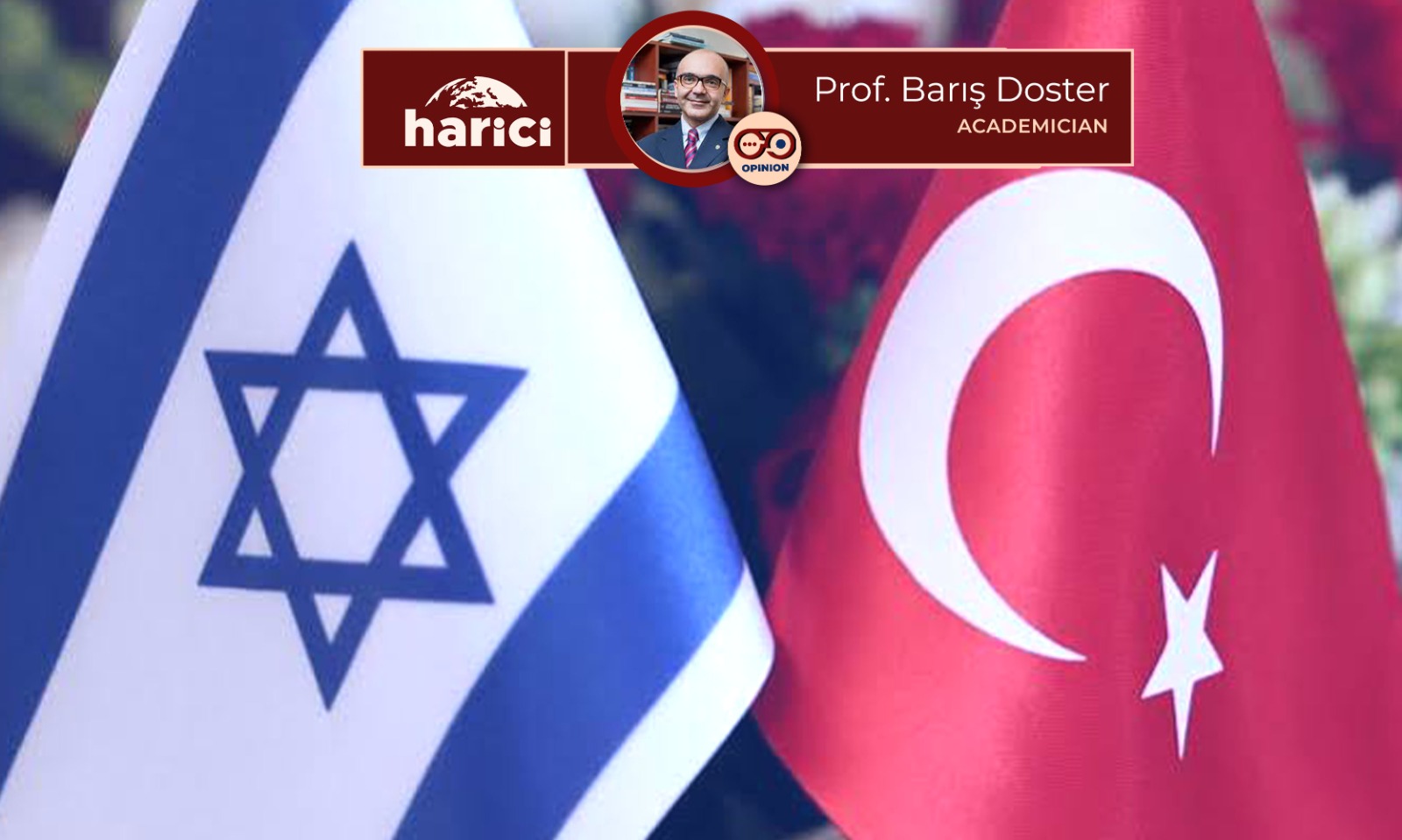
Following Israel’s strike on the Abu al-Duhur Airbase in Syria on August 18, relations between Damascus and Tel Aviv have reportedly broken down. Syrian Foreign Minister Asaad Hassan Sheybani announced in the wake of the attack that all communication with Israel had been severed. “We anticipate that talks regarding a security agreement with Israel will resume in the near future. At present, we do not trust Israel. Our priority is the cessation of attacks against our sovereign territory,” he stated.
The minister’s utter helplessness reverberates through his words.
The post-Assad regime in Damascus ascended to power on the back of American and Israeli support. Consequently, the United States and Israel stand as the primary arbiters of Syria’s destiny. It is precisely for this reason that the Damascus administration has abandoned all claims to its rights over the Israeli-occupied Golan Heights—virtually resigning itself to the occupation and striking it from the agenda. Upon seizing power, it pledged immediate fealty to Washington: “We will pose no security threat to Israel, and we shall thwart anyone who attempts to do so.” It operated under the delusion that it could forge a functional relationship with Israel—led by Netanyahu, a perpetrator of genocide and a convicted war criminal—by appeasing it through concessions. It was gravely mistaken.
For Israel currently holds sway over a substantial portion of Syrian territory. It establishes military outposts across the country, carries out airstrikes at will, and deploys its armor unimpeded.
Similarly, the Israeli-backed PYD-YPG terrorist organization exercises control over an expanse of land vastly disproportionate to its actual strength—territory exceptionally rich in energy resources—solely through the patronage of the US and Israel. Leveraging that very support, it wrenches outsized political, military, and administrative concessions from the Damascus government.
Evidently, the displacement of Iranian and Russian influence in Syria by that of the United States and Israel has brought profound satisfaction to certain circles in our country. Yet what these quarters fail to see, refuse to see, or cannot bring themselves to acknowledge even when confronted with it, is this fundamental reality: Washington envisions a Middle Eastern order wherein Israel commands supremacy, projects expanding power, and dictates terms, while Türkiye raises no objection whatsoever and instead accommodates itself to this architecture. To compel Türkiye’s acquiescence, the US is actively deploying its vast and varied arsenal of leverage.
Lest we forget, the United States had already brought several Arab states to the desired threshold through the Abraham Accords. That process was ultimately intended to culminate in the open, formal consecration of the de facto rapprochement between Saudi Arabia and Israel. That trajectory has not been abandoned; it has merely been placed on ice for the time being. Behind the scenes, Washington maintains an intense flurry of diplomacy with Saudi Arabia, Qatar, Egypt, the United Arab Emirates, and Jordan. Once the wider Middle East, the Islamic world, and the Arab sphere have been fully conditioned to accept the ongoing reality in Gaza—and once the oppressed, grieving, and beleaguered Palestinian people have been driven entirely from their ancestral homeland—this shelved agenda will be revived.
We know that the Zionist establishment in Israel, aligned with American imperialism, chose not to strike Iran first before confronting the Iranian-backed Axis of Resistance, the Shia Crescent, and Tehran’s proxy forces. It executed the exact inverse: it struck first at Syria, at Hamas in Palestine, and at Hezbollah in Lebanon. Only after eroding their efficacy did it turn its sights directly upon Iran. In Syria, the previous regime held out far longer than anticipated—enduring for 13 years and 8 months. As a consequence of the civil war that erupted in March 2011, Assad was ultimately overthrown, finding refuge in Moscow.
When 61 years of Baathist rule, including 53 years of the Assad dynasty, came to a close in December 2024, the emergent regime in Damascus wasted no time in pledging its allegiance to the United States, to Israel, and to the Arab states that backed it, chief among them Saudi Arabia. It proclaimed that it would erect a bulwark against Iran, raise not the slightest objection to Israel, and execute Washington’s directives to the letter.
A broad demographic in Türkiye that welcomed this turn of events swiftly began asserting—under the banner of religious and sectarian fraternity—that this transition worked entirely in Türkiye’s favor. The sheer fallacy of this premise was exposed in short order.
And how was it exposed?
It was exposed by Israel immediately laying the groundwork for a Syria partitioned into four enclaves (Druze, Kurdish, Alawite, and Arab). It was exposed by the renewed revelation that the US-Israel axis intends, sooner or later, to carve up Syria along sectarian and ethnic fault lines—mirroring the precedents of Lebanon and Iraq—in a country roughly composed of 70 percent Sunni Arabs, 10 percent Alawites, 10 percent Kurds, 5 percent Christians, and 5 percent Druze and Turkmens.
It was exposed by the fact that the PYD-YPG terrorist organization, even if denied the entirety of its territorial ambitions, has managed to secure a portion of its political, military, and administrative demands through US–Israeli patronage, thereby being permitted to preserve its existence by settling for a reduced perimeter.
And it was exposed by the resilience of Iran, which, despite suffering immense exhaustion and attrition in the face of American and Israeli aggression, refused to capitulate and maintained its resistance. It was exposed by the failure of the US-Israel tandem to achieve its overarching political and military objectives in Iran, bringing to the fore once again the undeniable truth that Iran possesses an institutionalized state tradition, a national consciousness, and an armed force of a depth and resilience that defy any comparison to Libya, Iraq, or Syria.

Germany’s CDU drafts tougher citizenship rules to counter AfD

BSW rules out AfD coalition but weighs issue-by-issue cooperation

Netanyahu orders dismantling of illegal West Bank settler outposts

China leads $54bn capital injection into state banks and insurers

US drafts post-war Middle East strategy focused on Iran
-
 Diplomacy2 weeks ago
US strikes fail to break Iran as regional anchors rise, Dr. Moeini says
-
 Diplomacy2 weeks ago
Blackwater founder Erik Prince creates air defence venture with Kyiv
-
 Europe2 weeks ago
UK and Russia edge closer to conflict over long-range drone supply
-
 Diplomacy2 weeks ago
South Korea begins first commercial voyage via Northern Sea Route
-
 Opinion2 weeks ago
What did the Israeli attack in Syria reveal?
-
 Asia2 weeks ago
China and Arab states launch 5-year anti-desertification plan
-
 Asia2 weeks ago
India intel push on China risks dangerous miscalculation, study says
-

 America2 weeks ago
Pentagon to fully purge Anthropic AI from systems by end of September
