
Opinion
The caption and the guest list: What the West’s SCO coverage cannot explain about Türkiye

Thomas Karat, behavioral analyst
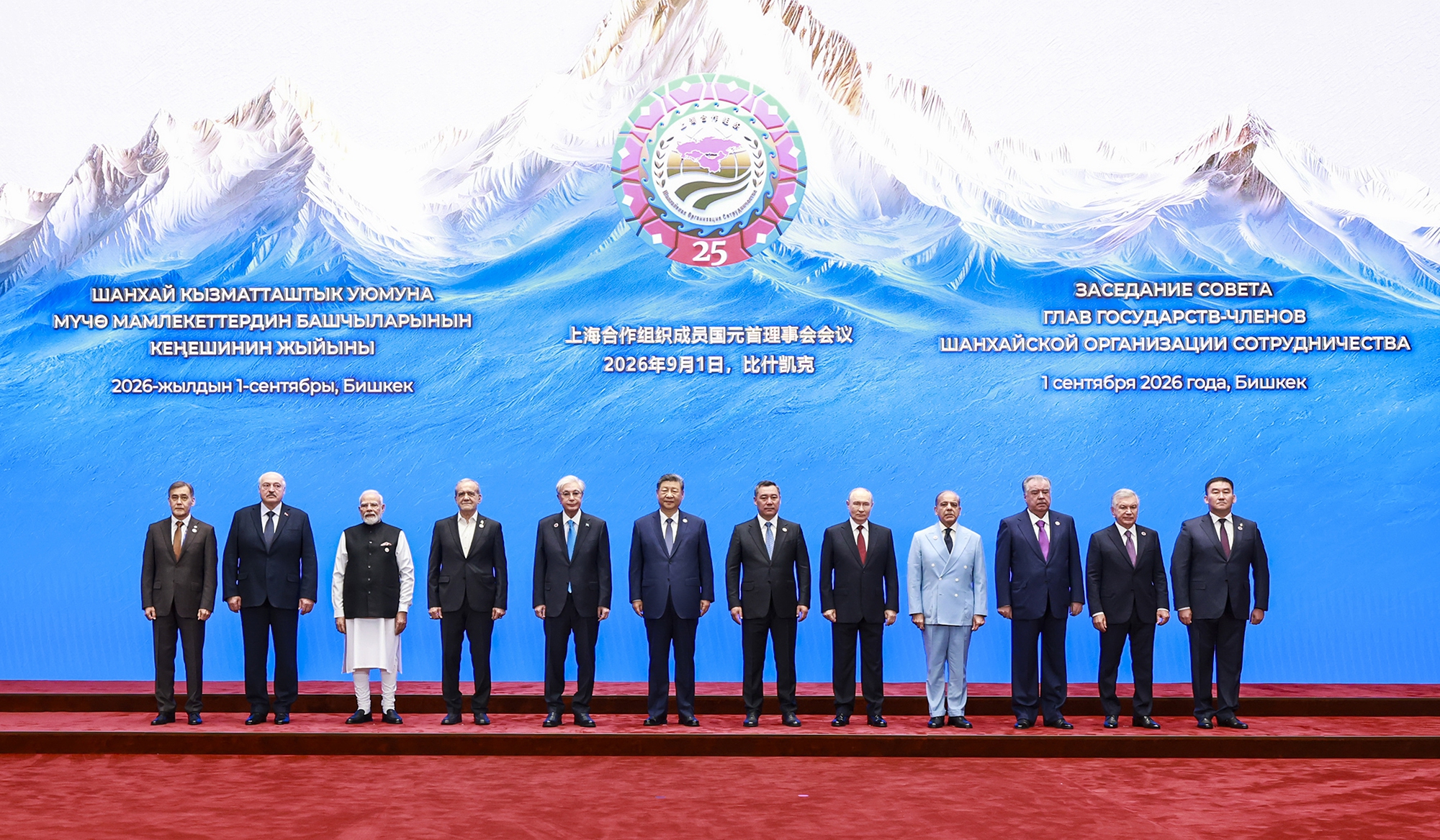
The photograph that Western agencies distributed from Bishkek arrived with its meaning already fixed. Above an image of the Kyrgyz president escorting China’s Xi Jinping past an honor guard, the caption read COUNTER US POWER. The image itself showed a familiar diplomatic ritual, two heads of state walking a red carpet. The caption supplied what the image did not: an adversary, a purpose, and the direction in which a Western audience was meant to orient its concern. The gap between the neutral picture and the loaded words is a useful place to begin, because it is where the framing of the entire summit was decided before a single line of analysis was written.
On Sept. 1 the Shanghai Cooperation Organization marked its twenty-fifth anniversary in the Kyrgyz capital, with ten member states, more than a dozen heads of government, and the secretary-general of the United Nations among the guests. Most European and North American outlets carried a single Agence France-Presse dispatch, which described the bloc as one that seeks to be a counterinfluence to the West. France 24 reported that the Russian and Chinese leaders had traveled to Central Asia to counter Western influence. British coverage of an earlier session of the same body called it a secretive summit of an “axis of upheaval.” In each formulation the West occupies the grammatical center of a meeting it did not attend. The organization is assigned no purpose that can be stated without reference to Washington and Brussels. It is defined entirely as a reaction to them.
Türkiye is the hole in the caption
The framing meets its first and largest obstacle in the guest list, and specifically in the presence of a NATO member at the table. Türkiye holds the status of dialogue partner in the organization, and President Recep Tayyip Erdogan has attended its summits in person. A Western reader told that the SCO is an axis assembled against his alliance is not encouraged to ask why a founding member of that alliance keeps a seat in it. The same AFP dispatch that calls the bloc a counterinfluence to the West records, several paragraphs below its lead, that the organization now counts fifteen dialogue partners including Türkiye, Saudi Arabia and Qatar. Türkiye belongs to NATO. Saudi Arabia and Qatar host the forward headquarters of United States Central Command and the largest American air base in the region. An organization built to oppose the West does not assemble this membership, and a caption that calls it one survives only for readers who do not reach the paragraph that contradicts it.
Türkiye’s position is the part of the picture that Western coverage is least equipped to interpret, because the prevailing map allows for only two teams. Ankara is not choosing the SCO over NATO. It is doing something the two-team model cannot represent, treating the organization as a venue to be worked, neither joining it nor shunning it. A state that keeps its treaty commitments in the Atlantic while cultivating standing in a Eurasian security forum is hedging against a future in which the Atlantic order no longer sets the terms alone. That behavior is legible from Istanbul and largely illegible from the outlets that produced the Bishkek caption, which is why their account of the summit reads, from this vantage, as a description of a world that has already begun to pass.
The vocabulary and its tell
The language of the coverage repays close attention. The recurring terms are “counter,” “against,” “anti-Western,” and “axis,” a vocabulary of opposition that grants the bloc no content of its own. The word “axis” carries the heaviest freight. It imports the moral architecture of the Second World War, and more recently of the “axis of evil,” and lays it over a trade-and-security forum whose membership includes a NATO government. The transfer is performed a few lines from the facts that make it untenable, and the proximity is the tell.
There is a structural habit worth naming as well. The AFP copy notes that the organization’s founding declaration describes it as not an alliance directed against other states, and then, in the following sentence, observes that the Russian and Chinese leaders have delivered anti-Western speeches at past summits. The self-description is admitted and immediately withdrawn. The skepticism applied here is selective. When a NATO communiqué describes the alliance as defensive, the same wire services do not append a reminder of its record of offensive operations. The doubt switches on for adversaries and off for partners, a selection that rests on assumption and not on evidence. Coverage outside the Western agency system handles the same material with a cooler hand. Al Jazeera quoted a regional analyst describing the SCO simply as not a coherent anti-Western alliance, a plain and accurate line that appears in no Western headline, because it does not fit the caption.
A bloc that grew in proportion to the pressure
The organization’s history explains more than its rhetoric does. It began in 1996 as a border-demarcation arrangement among China, Russia and three Central Asian republics, a technical body concerned with the settlement of frontier lines. It gained momentum in close proportion to the pressure applied to its members from the West. India and Pakistan acceded in 2017. Iran was admitted after years of sanctions had made membership useful to Tehran and to the bloc alike. The roster of dialogue partners expanded toward fifteen as American secondary sanctions and tariffs demonstrated to a widening circle of governments the value of a forum beyond Washington’s reach. At Bishkek the rotating chairmanship passed to Pakistan, another long-standing American security partner. The pattern is consistent: the organization has grown less by recruitment than by the steady conversion of states that Western policy has pressed toward the exits.
Iran offers the sharpest illustration. President Masoud Pezeshkian took his seat in Bishkek six months into a war with the United States. A week before the summit, the U.S. Treasury announced a sanctions campaign it named Operation Economic Outcast, extending secondary sanctions to five further sectors of the Iranian economy, aviation, digital assets, gold, shipping and technology, and warning in a separate alert that any party of any nationality paying Iran for passage through the Strait of Hormuz risked U.S. penalty. Secondary sanctions do not fall on the target alone. They fall on any government or firm that trades with the target, which makes them an instruction directed at the sovereign decisions of other states, enforced by the threat of exclusion from the dollar system. China, the largest purchaser of Iranian oil, responded that it would firmly defend its interests. A measure aimed at Tehran functions as a demand issued to Beijing, and Beijing traveled to Bishkek. India provides a second instance. Prime Minister Narendra Modi held a scheduled bilateral with President Vladimir Putin days after Washington imposed a 50 percent tariff on Indian goods over New Delhi’s purchases of Russian oil. The instrument intended to discipline India accompanied it to the very table it was meant to keep it from.
The divisions are real, and they are the point
An accurate account of the summit requires equal candor about the organization’s limits, and candor here is what separates analysis from a mirror image of the framing under examination. The SCO is not a unified bloc. Russia and China compete for influence across the same Central Asian ground. India and China share a contested and periodically violent border, which is why Modi and Xi appeared on the same platform but arranged no formal bilateral. India and Pakistan hold membership in the same body while remaining adversaries. A proposed development bank has been discussed for years without becoming a functioning institution. The 40 percent of humanity the organization claims to encompass is a measure of scale, not of common purpose.
These divisions do not rescue the Western frame. They sharpen the judgment it obscures. Agreement among these governments does not exist, and it is not what makes the summit notable. What makes it notable is the preference of states that distrust one another to manage their disputes inside a structure the United States does not control. The arbitration of one it does control is the option they declined. That preference is a heavier comment on the standing of the American-led order than any declaration could produce. It requires no alliance and no shared ideology. It requires only that a critical mass of states has concluded that the Western order is something to work around, and that the working-around now proceeds openly, at the level of heads of state, beneath a caption instructing Western readers to see a hostile axis where a hedging one stands.
The shrinking center
The phrase that recurs whenever Western officials describe global opinion is “the international community.” Bishkek is a reminder of how much that phrase conceals. The community it invokes is a specific and diminishing set of capitals that grew accustomed, during the brief period of unchallenged American primacy after 1991, to mistaking its own consensus for the consensus of humanity. The summit in the Kyrgyz capital assembled a NATO member, a Western-courted partner in India, the Gulf security clients of the United States, and the two most heavily sanctioned states on earth, and it did so under the observation of the United Nations secretary-general. No description of that room as an anti-Western axis can be reconciled with its composition. The description persists because it serves the audience it is written for, offering a shrinking center the reassurance that it remains the fixed point around which the world still turns.
From Ankara, and from the wider vantage of states that have watched the post-1991 order lose its monopoly, the reassurance reads as a lagging indicator. The two men in the photograph were walking to lunch. The power that could not prevent the lunch, could not hold its Indian partner at a distance from Moscow, could not isolate the state it is fighting, and could not keep the head of the United Nations from attending, is nonetheless assured by its own press that the summit was organized around opposition to it. The more accurate reading is the one Türkiye’s own conduct already reflects. The world is not arranging itself against the West so much as arranging itself without waiting for it, and the caption over the photograph is the last place that development will be admitted.










By its very nature, foreign policy feeds into and draws nourishment from numerous, disparate, and varied fields. It is a domain with manifold and diverse inputs. For foreign policy is examined alongside a broad array of subjects, ranging from geography to history, economics to intelligence, and military might to public diplomacy, commonly termed soft power elements.
The capacity of the state, that is, the scale of the state, or in other words the aggregate of its elements of power (namely political, economic, military, and soft power components), is decisive in foreign policy. Geography is decisive in foreign policy. Commercial relations are decisive in foreign policy. Energy dependence on another country or countries, if present, is decisive in foreign policy. Foreign policy cannot be conducted in spite of these four factors.
There is more. A country’s capacity, its scale, does not increase overnight, from one day to the next. It requires planning. It requires national consensus. It requires time. It requires preparation. Nor are these enough. The regional and global environment, the conjuncture, and the international plane must also allow for it. The stance of allies and adversaries is, of course, also important.
For the international environment is, by its nature, complex. It is an environment rife with contradiction, turmoil, conflict, and tension. To draw an analogy, the person in the driver’s seat of foreign policy is not a motorist speeding along the road as they please. There are things they must not forget, rules they must obey, red lights, vehicles speeding up from behind, a truck moving ahead, and a heavy vehicle hurtling toward them from the opposite direction.
Success in foreign policy does not arrive simply because a politician we like has become foreign minister. For a foreign minister is only as effective as the power, capacity, and weight of their country. One must accept this plain truth.
Moreover, there are simple, straightforward questions that reveal whether foreign policy, which some find deeply complex and inscrutable, is successful or not.
There are undoubtedly ways to measure the effectiveness, prestige, influence, and success of foreign policy.
For instance, the number of countries that respect a passport, how many countries can be visited visa-free, and how many countries impose visa requirements and grant those visas only with great difficulty are important indicators of a country’s standing.
Let us take ourselves as an example. Which countries require a visa for the Turkish passport? Which ones do not? Is it easy for our citizens to obtain visas for the countries they primarily wish to visit?
Let us give another example from the Turkic world.
On the Cyprus issue, which we regard as a national cause across government and opposition, right and left, Kemalist and Milli Görüş adherents alike, how many countries have we succeeded in having recognize the TRNC? Why do the Turkic states (Azerbaijan, Kazakhstan, Kyrgyzstan, Turkmenistan, Uzbekistan) not recognize the TRNC? Far from recognizing the TRNC, how do the Turkic states in Central Asia (Turkistan) explain to Ankara their developing relations with the Greek Cypriot Administration of Southern Cyprus, which Türkiye does not recognize, their appointment of ambassadors, and their recognition of Southern Cyprus as the island’s sole legitimate government?
We must also ask this question, of course: What is the state of Türkiye’s bilateral trade with the Turkic states?
Let us give an example of the relationship between foreign policy and big capital.
In which countries are big capital circles, among the greatest supporters of the ruling bloc, winning major tenders?
In our country, across both ruling and opposition ranks, there is a political party order that supports Türkiye’s EU membership. Yet how much progress has been made on EU membership?
Why is US President Trump not keeping the promises he made to Türkiye at the NATO summit held in Ankara a few months ago?
How many contracts has the new regime in Syria, the al-Sharaa administration, awarded to Turkish companies for the reconstruction of its country?
Has the government in Libya that Türkiye supports paid the money owed to Turkish construction firms, outstanding for years?
How does Qatar, with whom our relations are very good, explain its developing ties, energy agreements, and joint military drills with Greece and the Greek Cypriot Administration, disregarding our sensitivities?
Who is the addressee of the harsh statements used in recent weeks by Azerbaijan, which we view as “two states, one nation”? To what extent does Azerbaijan share Türkiye’s policy on Israel? What does Türkiye think about the scale, depth, and intimacy of Azerbaijan-Israel relations?
These questions can certainly be multiplied.
Yet without taking into account the scale of the state and observing the criteria for measuring foreign policy, no sound assessment can be made.

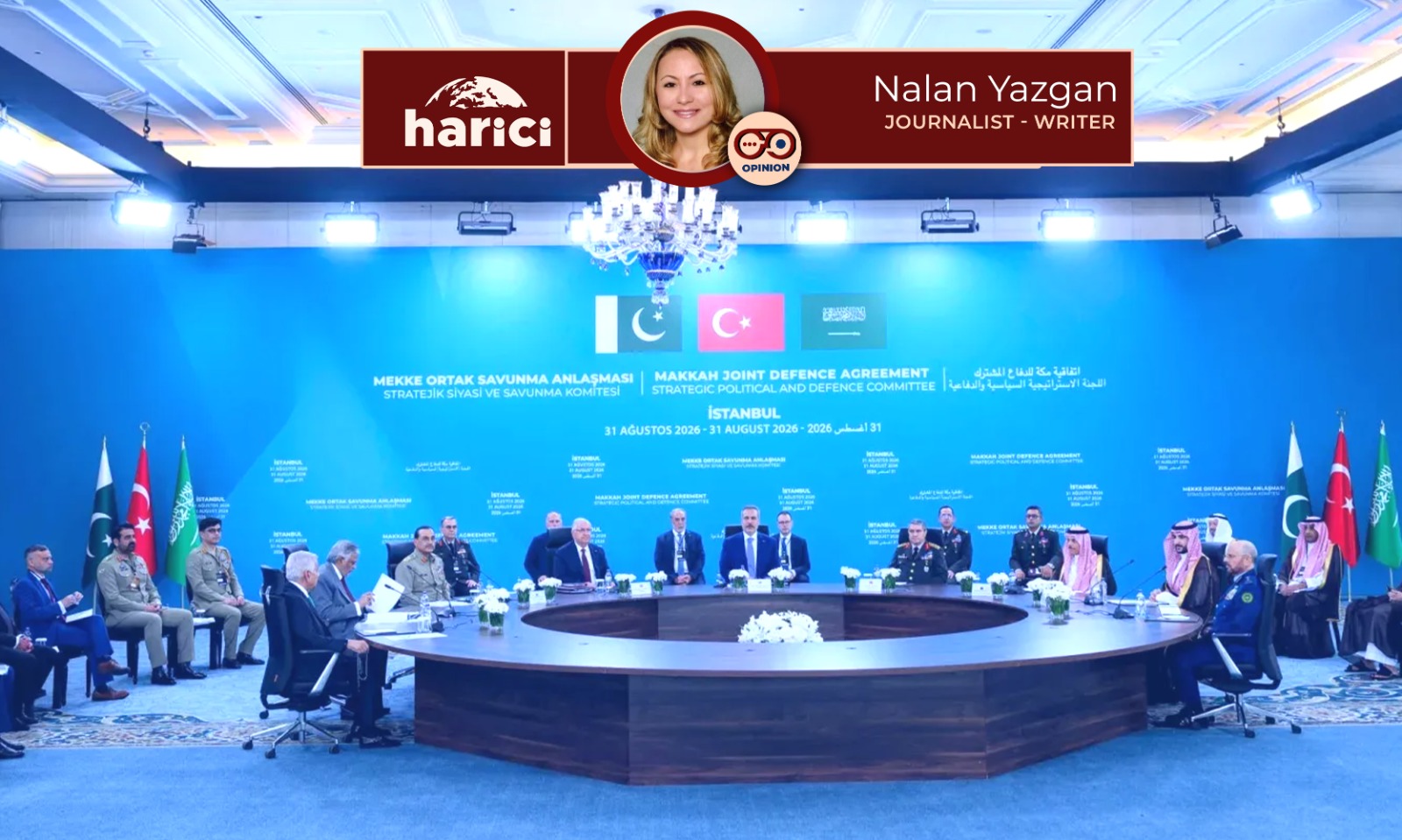
In the Middle East, war is no longer waged merely to seize territory. The true contest turns on who will control the energy pipelines, trade routes, ports, and railways of tomorrow. Missiles may strike cities today, but the maps of the future are being drawn through transport and energy corridors.
In this context, interpreting Türkiye’s presence in the Mecca Alliance solely as military support for Saudi Arabian security remains incomplete; it fails to explain why two states that viewed each other with mutual suspicion until recently would take steps toward a cooperation close enough to constitute a shared destiny.
Alongside Saudi Arabia’s existential motives, Ankara’s participation in this alliance is anchored in a profound geopolitical foundation: to position itself within, and if possible at the very centre of, the Middle East’s reconfigured energy and transport corridors.
Today, it cannot be said that Riyadh and Ankara see eye to eye on every regional issue. The threat perceptions and priorities of the two countries do not, quite naturally, entirely coincide. On the geopolitical chessboard, partnerships do not always arise from identical agendas. When reasons are sufficiently compelling, particularly existential ones, they can override political differences and enable common ground along the same strategic path.
A new war of corridors unfolds in the Middle East
On one side lies IMEC (India-Middle East-Europe Economic Corridor), planned to extend from India through the United Arab Emirates, Saudi Arabia, Jordan, and Israel to Europe. On the other stands the Development Road, which aims to link the Persian Gulf across Iraq to Türkiye, and onward to Europe.
These two undertakings are, of course, far more than mere transport projects. They represent two divergent geopolitical answers to where the future flow of trade and energy between Asia and Europe will traverse; for Türkiye, this issue is of vital importance.
If a corridor system taking shape to Türkiye’s south, beyond Ankara’s orbit, becomes permanent, Türkiye could forfeit not only an economic opportunity but also a substantial portion of its strategic centrality in the Middle East. It is through this prism that the Mecca Alliance must be evaluated.
Türkiye’s seat at the same table with Saudi Arabia signifies more than military solidarity. Riyadh and Ankara must sit together to avoid exclusion from the region’s emergent security and economic architecture, for the security of a corridor and the corridor itself are no longer separate matters.
The Strait of Hormuz, the Red Sea, the Bab al-Mandab, and the Suez Canal are links in the very same chain. A security crisis in one directly impacts the others. While the vulnerability of Hormuz makes alternative export routes for Gulf oil indispensable, instability across the Red Sea heightens the strategic cost of Suez.
Saudi Arabia’s alternative pipelines connecting its eastern oil fields to Red Sea terminals are therefore not merely energy infrastructure; they are strategic bypasses mitigating dependence on Hormuz.
For Türkiye, the Development Road fulfills the same function across a broader geography. Stretching from the Persian Gulf through Iraq to Türkiye, and from Türkiye into Europe, this artery possesses the potential to forge a new overland backbone connecting the Gulf to the Mediterranean and Europe. As security concerns in the Red Sea mount and the vulnerability of Suez deepens, the value of this route rises accordingly.
The Hejaz Railway: Revived once again
The return of the Hejaz Railway to the regional agenda signifies far more than mere nostalgia. Once linking Istanbul to Damascus, Amman, and the Hejaz, the railway served as one of the primary transport and logistical arteries of the Ottoman geography.
Reviving the idea of the Hejaz Railway could become the emblem of Türkiye’s drive to reimagine its historical transport connections between the Gulf, the Hejaz, and the Levant through modern rail, energy, and logistics networks.
The objective here is not to restore the past, but to transpose the strategic logic of that historical geographical linkage into the twenty-first century. For this reason, Türkiye’s role in the Mecca Alliance and the resurgence of the Hejaz Railway project must be viewed as components of the same overarching picture.
Corridors do not consist solely of energy pipelines. Railways, ports, highways, electrical interconnectors, logistical hubs, and security architectures are all facets of the same geopolitical grid, and safeguarding these networks requires political alliances.
Herein lies the strategic significance of Saudi Arabia and Türkiye sitting at the same table in Mecca, even at a juncture when their views on Syria diverge.
Ankara and Riyadh do not need to agree on every subject. Yet neither wishes to see the new map of the Middle East drawn to its detriment. Türkiye’s aim is not to build an anti-bloc against any specific country alongside Saudi Arabia; rather, the goal is to avoid exclusion from the future energy and trade systems of the Middle East, while securing a decisive voice in establishing their security architecture.
Hence, for Türkiye, the Mecca Alliance is far more than a simple defence pact. Securing the Development Road, shielding Gulf energy corridors, stabilising the Red Sea, rethinking connections across the Hejaz and the Levant, and bolstering trade corridors reaching Europe all intersect within this single strategic equation.
In this equation, Türkiye’s foremost advantage remains its geography. Ankara sits at the northern terminus of the overland routes linking the Gulf to Europe; within NATO; and at the crossroads connecting the Black Sea, the Caucasus, the Eastern Mediterranean, and the Middle East.
Will Türkiye become one of the powers shaping the Middle East’s energy and trade architecture over the coming decades, or will it be reduced to a mere transit state traversed by routes designed by others? That question defines the true strategic significance of the Mecca Alliance for Ankara.
In the Middle East of tomorrow, it will be impossible to separate the corridor carrying energy, the security framework protecting that corridor, and the alliance constructing that security framework.
Whoever controls the corridor shapes commerce. Whoever guarantees the routes through which trade flows holds sway over the regional balance of power. This is the true dimension of the contest currently underway in the Middle East.
A succession of distinct and largely mutually exclusive ambitions are competing for dominance in the current climate: India’s linkage to Europe, the Gulf’s new economic horizons, Saudi Arabia’s alternative energy routes, the security crisis in the Red Sea, the strategic weight of Hormuz, and Türkiye’s aspiration to open outward to Europe via the Development Road. Ironically, perhaps, the conflict that will decide which corridor underpins global stability has already begun, and it will likely continue spreading to new fronts. Regrettably, the fires in our region appear poised to intensify long before they abate.

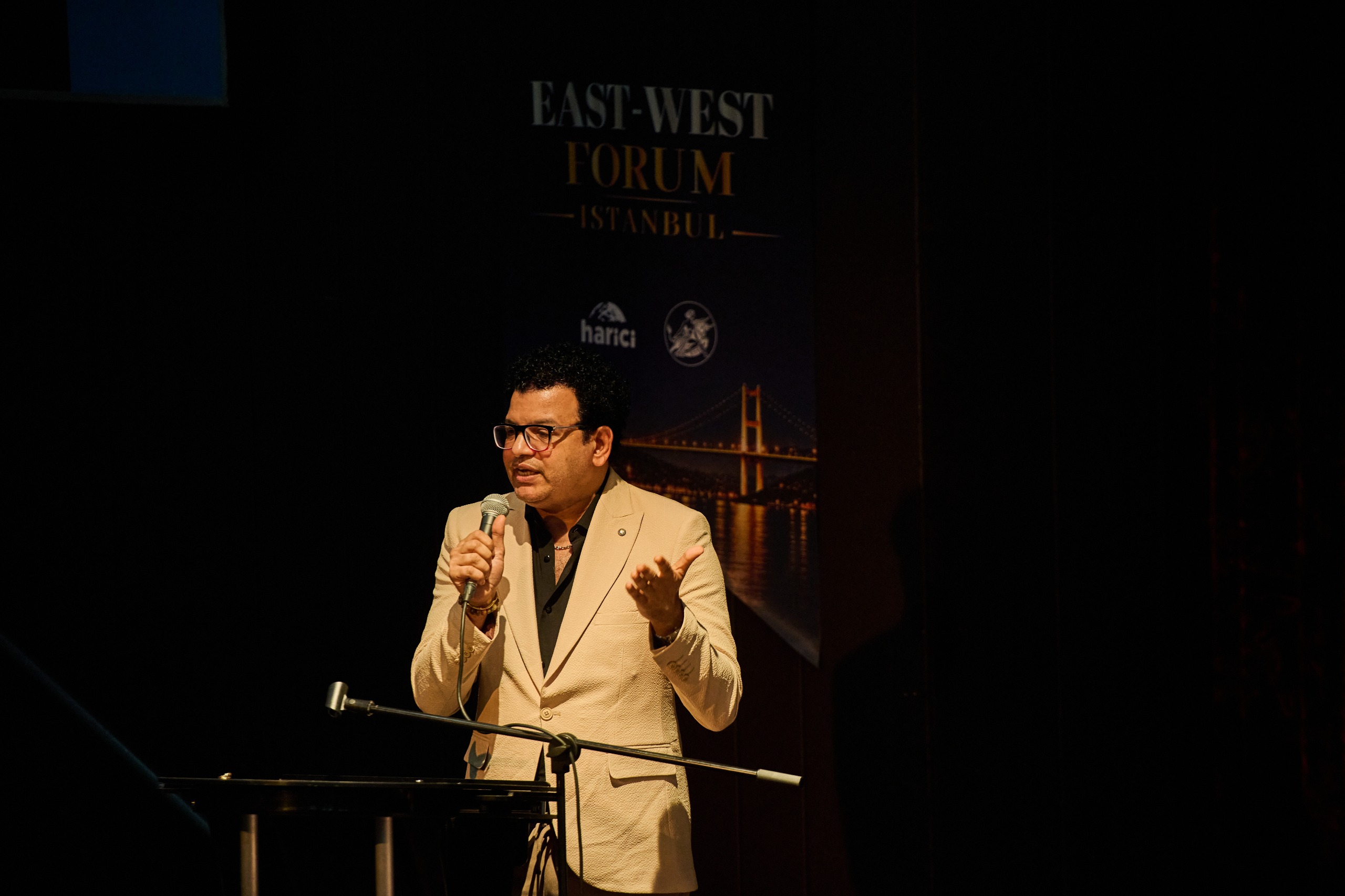
Dr. Ahmed Moustafa, Director & Founder, Asia Center for Studies & Translation, Egypt
In a city that has spent centuries translating the language of one civilization to another, the first East-West Forum arrived at a moment when the world itself seemed to have lost the vocabulary for talking across its divisions.
Held in Istanbul on Sept. 26–27 and preceded by meetings around the event, the forum brought together diplomats, academics, journalists, strategists and political thinkers from a wide range of countries. Hosted by Harici Media in partnership with the Berlin-based European Transcontinental Initiative, the gathering was conceived as an attempt to examine a world increasingly defined by competing power centers, regional wars, economic fragmentation, artificial intelligence and the erosion of confidence in institutions created after the Second World War. Harici reported that participants came from roughly 30 countries.
For us, the significance of Istanbul was not simply a matter of the speakers on the panel or the structure of the programme. Its deeper importance lay in the willingness to put difficult — and sometimes uncomfortable — questions on the table.
We would like to extend our sincere thanks and appreciation to my friend and brother, Mr. Tunç Akkoç, Founder and Editor-in-Chief of Harici Media, for his gracious invitation to a representative of the Asia Center for Studies & Translation, Egypt, to participate in the Forum as a speaker and commentator. His initiative in creating a platform where competing geopolitical narratives could meet directly deserves recognition.
In his opening remarks, Akkos stressed that the initiative was intended to establish a permanent platform where people representing different political and intellectual traditions and perspectives could meet and engage in direct dialogue.
This vision is particularly significant because the traditional language used in international relations has increasingly struggled to explain the realities of a rapidly changing world.
The Problem of Proxy Wars
During the session that discussed proxy wars in the region and ways to reach solutions to their crises, the Center put forward the view that the Middle East cannot simply be understood through the traditional map that divides the parties into “good” and “evil,” or into “responsible states” and “rogue states.”
Such terms, in our assessment, often reflect the perspective of powers that possess extensive influence over international media and financial and security institutions.
The Center particularly criticised what we see as political bias within important sectors of the Western media and some non-governmental organisations that receive Western funding. From our perspective, these institutions can, in some cases, move from being mere observers of geopolitical conflicts to becoming influential parties in the battle over the narrative and the story.
However, this view should remain open to debate and should not automatically be accepted as an absolute truth.
The more important question is not whether every Western journalist, every NGO, or every Western institution works to serve a single geopolitical agenda clearly, this is not the case, but whether the information environment itself has become so highly polarised that the public is now receiving radically different interpretations of the very same war.
In our assessment, the answer is increasingly approaching “yes.”
The problem becomes particularly clear when searching for the term “proxy wars” in the Middle East. Some of the first results focus on groups associated with Iran, including Hezbollah and the Houthis, as well as Hamas, whereas the history of regional conflicts is far more complex.
Al-Qaeda and ISIS emerged through different historical trajectories, with Anglo-Saxon support that was “created by Britain and the United States.” In environments dominated by the United States and Britain, Al-Qaeda emerged from the environment associated with Osama bin Laden and the Afghan jihad, while ISIS developed largely from Al-Qaeda in Iraq, under American sponsorship, to pursue a certain agenda in the region and advance the scenario of “creative chaos” promoted by Condoleezza Rice, the radical US Secretary of State.
At the same time, US policy toward Afghanistan during the Cold War contributed to shaping the broader environment from which some militant jihadist movements later emerged.
These distinctions matter.
Because propaganda often begins where complex historical details end.
Who Has the Right to Define a “Rogue State”?
The same problem appears in the vocabulary used to describe states.
Countries such as China, Russia, Iran and North Korea are frequently portrayed in Western strategic discourse as states challenging the existing international order.
Egypt, despite the different nature of its relationship with Washington, can also become the subject of criticism when its foreign policy does not conform to certain Western expectations.
The question is not whether these governments should be exempt from criticism. Of course not.
The deeper question is this: can the international system remain sustainable when one geopolitical camp increasingly assumes the authority to define which governments are legitimate, which movements are terrorist, which wars are defensive and which forms of resistance are acceptable?
That was one of the central questions behind our intervention in Istanbul.
The Middle East has repeatedly been presented through the lens of the “Iranian threat” as the principal strategic danger.
There is no question that Iran possesses significant military and regional capabilities, and that its policies are deeply contested by many neighbouring states. At the same time, reducing virtually every regional security problem to Tehran can obscure the interests and roles of other actors, including Israel, the United States, Gulf states, armed groups and local political forces.
The region has repeatedly paid a heavy price for simplistic interpretations of complex conflicts.
The Economics of Fear
The discussions in Istanbul also led us to a broader American question: to what extent can fear itself become a source of political and economic power?
Historically, the United States has experienced intense political campaigns shaped by perceived racial, ideological and security threats.
One does not need to accept every interpretation of this history to recognise that fear can become a factor with tangible economic consequences.
A 2020 study by Citi estimated that racial discrimination against Black Americans had cost the US economy approximately $16 trillion in lost economic output since 2000, based on an analysis of disparities in wages, education, housing and investment.
This figure demonstrates the extent of the economic losses associated with racial discrimination and exclusion. It also raises questions about the relationship between fear-based narratives concerning Black Americans, media influence, the political power of the gun lobby and the broader economic consequences of insecurity.
More importantly, however, the study highlights a fundamental point: bias and insecurity carry substantial and measurable economic costs.
The broader lesson has direct relevance to foreign policy.
When societies are continually presented with existential enemies, military spending and the expansion of security institutions become politically easier to justify.
America After Iran
In Istanbul, we also advanced the view that the United States after its confrontation with Iran in 2026 should not simply be understood through the traditional image of unlimited American power.
The conflict exposed economic and strategic vulnerabilities.
The Strait of Hormuz emerged as a major strategic pressure point for global energy markets, amid disruptions to international trade that forced governments and companies to search for alternative routes and supplies.
The consequences were reflected in oil prices and energy costs in Europe and elsewhere.
This does not mean that American power has disappeared. Rather, it suggests that military power is no longer synonymous with strategic control.
The rise of China, Russia, ASEAN, Iran and other centres of economic and diplomatic influence has made the international order increasingly complex and dispersed.
The East-West Forum itself reflected this reality, bringing together voices from Europe, Asia, the Middle East and North America while explicitly addressing multipolarity and the ongoing transformation of the global order.
America Is Changing From Within
The domestic dimension of American politics also deserves attention.
The emergence of figures such as Zohran Mamdani in New York and Abdul El-Sayed in Michigan reflects changes in the American political debate over inequality, foreign policy, healthcare, identity and the influence of established political and economic interests.
Their political trajectories should not be treated as evidence of a predetermined future for the United States.
They do, however, illustrate how issues that were once treated as peripheral including the costs of war, US policy toward Israel, economic inequality and the political influence of younger and more diverse generations have moved closer to the centre of American political debate.
This is another reason why East-West dialogue cannot remain confined to foreign ministries and military institutions.
A Dinner for Dialogue
One of the most memorable moments on the margins of the Forum was the private dinner held on the evening of Friday, September 25, hosted by H.E. Mr. Hasan Capan, Chairman of the Turkish-Chinese Friendship Foundation, and H.E. Ambassador Ersin Erçin, Vice Chairman of the Foundation, in honour of the speakers and participants.
We extend our sincere thanks and appreciation to both of them for their generosity, friendship and support.
The gathering was more than simply a dinner. It provided an opportunity for personal interaction, an exchange of ideas and the building of relationships among participants — precisely the kind of human diplomacy that formal conferences sometimes lack.
Real dialogue does not always begin behind conference podiums.
Very often, it begins around a single table.
Istanbul’s Larger Message
The first East-West Forum should be regarded as the beginning of a dialogue, not the end of a debate.
The organisers have already articulated a vision of transforming the initiative into an annual gathering in Istanbul, developing expert working groups, establishing an East-West Forum network and potentially creating a business council capable of connecting intellectual dialogue with economic cooperation.
This may ultimately prove to be one of its most important contributions.
The world that emerges from the current conflicts including the crisis surrounding the Strait of Hormuz will require more than ceasefire agreements.
It will require a new conversation about security, energy, sovereignty, development, technology and coexistence.
Istanbul is an exceptional setting for such a dialogue. One participant even proposed moving the headquarters of international organisations, including the United Nations, to Istanbul.
For centuries, the city has stood between two continents without belonging exclusively to either.
The East-West Forum can follow the same principle: not choosing one civilisation against another, but creating a space in which East and West can confront their differences without turning disagreement into permanent conflict.
For this reason, we see the Istanbul gathering as an announcement of intent.
It was not an attempt to erase differences.
It was an attempt to make dialogue possible despite them.
At a time when proxy conflicts increasingly risk evolving into direct confrontations, this may be among the most important political conversations the world can undertake today.

Ex-BND head Hanning tied to former Mossad chief amid spy inquiry

Iran war costs US economy $265 billion as household burden mounts

Trump dismisses US envoy to Greece Kimberly Guilfoyle

Most EU citizens reject fast-track Ukraine accession, poll finds

Ex-US official says air defences fail against Yemeni airport strike
-

 Europe2 weeks ago
German interior ministers drop unanimity rule to counter AfD veto
-
 Europe2 weeks ago
Key European allies excluded from US-led NATO meeting in Poland
-
 Diplomacy2 weeks ago
While the West breeds crises, Eurasia weaves peace and development, says Prof. Zhang Weiwei
-
 Middle East2 weeks ago
Netanyahu holds secret UAE talks with Saudi Arabia and Arab officials
-

 Diplomacy2 weeks ago
The European Union’s peace project has collapsed, MEP von der Schulenburg says
-
 America2 weeks ago
Musk appointed co-director of Pentagon future warfare initiative
-
 Opinion2 weeks ago
A new world in the East, old dogmas in the West
-
 Asia2 weeks ago
South Korea plans $120B spend on eight US nuclear power plants
