
Diplomacy
Trump meets regional leaders as tensions over Iran and Gaza mount

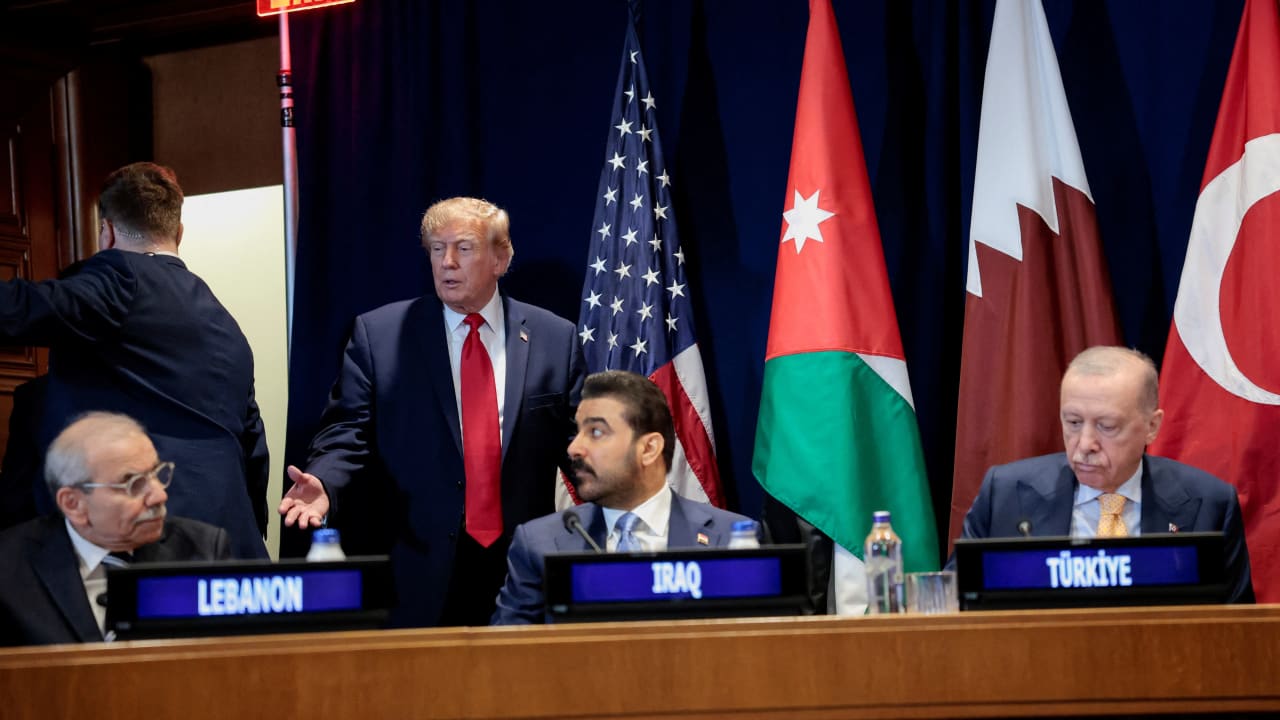
US President Donald Trump met leaders from Egypt, the Gulf, Jordan, Lebanon, Syria, and Türkiye on the sidelines of the UN General Assembly.
Trump described the countries represented as “friends, allies, and partners of the United States.” Speaking about peace and prosperity in the Middle East, Trump said:
“It is an honour for me to be here with some of America’s greatest and closest friends, allies, and partners, to continue our efforts towards a safer and more prosperous Middle East. This is a special place, and it has become even more special in the time since I entered politics… I have many great friends sitting at this table. They are all magnificent people, and we are ensuring that their lives go well.”
Adding that every country around the table was “extraordinary”, Trump thanked them for US investments originating from these nations totalling approximately $21 trillion since he took office in January 2025.
In particular, he spoke of his close relationship with President Recep Tayyip Erdoğan, with whom he has forged a close friendship since his first term in office. Thanking Erdoğan, he described him as a “great man” and a “tough cookie”.
The US president also noted that a recent meeting held between US and Iranian representatives had been productive.
Trump observed humorously that the region was filled with high energy, though he noted this sometimes meant “too high energy.”
Trump said there was “great momentum” towards reaching an agreement with Iran. A few hours before this statement, speaking from the rostrum of the UN General Assembly, he had asserted that the US could either make a deal with Tehran or “destroy” it.
In his address of approximately 35 minutes to world leaders earlier on Tuesday, Trump said: “I have a big decision to make. Will a deal be made with Iran that will allow them to rebuild the country and make it much greater than before, perhaps one of the greatest countries in the Middle East or even the world? Or will I destroy the Islamic Republic, and do it quickly, without ever giving them the chance to kill and destroy people and countries again?”
Stating that the US aims “to completely isolate Iran financially”, Trump added: “I hope they do the right thing quickly before it is too late; you know that one day it will be too late, and we will have no chance left to allow their survival as a nation.”
Trump also addressed Iran’s nuclear programme, stating that preventing Tehran from acquiring a nuclear weapon remains one of the primary objectives of the US campaign.
Trump continued:
“A large part of what we did, perhaps 99%, was to ensure Iran did not obtain a nuclear weapon; those facilities were blown up. We might have to blow up one more, Mount Kazma. We do not see much activity there, but if we do, we will blow it up immediately.”
Asked by Al-Monitor whether there was a consensus on a roadmap forward, the US Ambassador to Türkiye and Special Envoy for Syria and Iraq, Tom Barrack, said: “There is a consensus that we need a roadmap forward; that is the only consensus.”
In a separate development, King Abdullah of Jordan told Al-Monitor that the meeting went “very well”.
Asked by a reporter about the meeting with Iran, Witkoff replied: “I feel very good right now.”
Gulf states are attempting to keep diplomatic channels with Iran open while the conflict continues. On Sunday, UAE presidential adviser Anwar Gargash told Al-Monitor that talks between Washington and Tehran must be accompanied by a parallel regional dialogue.
Gargash said: “We need a new mindset that these kinds of discussions about what kind of region we all want, what kind of stability we pray for, and what core elements of development we need: which are very closely linked to stability: can take place at an Iran-US level, but must also take place at an Iran-Arab level.”
At the UN General Assembly, regional leaders took a sharp line against Israel. King Abdullah II of Jordan highlighted the Palestinian issue during his address at the 81st UN General Assembly in New York, stating that Israel was a “regional threat” acting with “frightening impunity”.
On the opening day of the event, he delivered a passionate speech referencing a “unique moment in history” where “the scale of information and the speed of change are unprecedented.”
The King added: “Every day, a new crisis, a new tragedy, a new emergency arises demanding our attention. Every generation believes that the challenges it faces are unique; perhaps for us, this is true.”
Hussein continued:
“If anyone has any doubt that a crisis in this part of our world will remain confined solely to this region, let them look at the energy and grocery bills of ordinary families from Mumbai to Madrid and Minnesota. The Iran war has demonstrated how quickly instability can disrupt trade, investment, and the lives of people outside the region.”
Recalling that he has warned at the UN for years about the dangers of leaving the Palestinian-Israeli conflict unresolved, the King argued that the international community has chosen to “manage” the conflict rather than confront and resolve it, questioning the value and legitimacy of international law in light of “one of the longest-running occupations in the world.”
The King of Jordan continued:
“If international law can be ignored for decades, then what exactly is the value of this law? And how can we enforce it if we do not even name its violations? In Gaza, the evidence is stark: at least 300 Palestinian children were killed in the first 300 days of the so-called ceasefire.”
The King condemned the Israeli government for “changing the rules”, continuing attacks and the destruction of civilian infrastructure in Gaza, and refusing to withdraw from the war-torn Palestinian territory.
Stating that Israeli actions in the West Bank must be regarded as a policy of forced displacement, Hussein called on the international community to treat Gaza and the West Bank as integral parts of a single whole belonging to the Palestinian people.














British magazine The Economist reported that mobilization, conflict casualties, and pervasive uncertainty have left Ukraine confronting the threat of demographic collapse.
According to data cited by the magazine, Ukraine’s fertility rate has declined from 1.2 children per woman in 2020 to between 0.8 and 0.9.
This rate marks a lower level than that of any major nation except South Korea.
In the first half of 2026, the number of deaths in Ukraine surpassed the number of newborn babies threefold.
The report noted that ever since independence was gained in 1991, the number of births in the country has lagged behind the number of deaths every year.
The Economist emphasized that the demographic collapse driven by the ongoing fighting constitutes an “existential threat.”
The magazine identified mass refugee migration as the principal driver of the population loss.
More than 5 million Ukrainians reside abroad, predominantly in Europe.
The proportion of those wishing to return among those who left the country is also steadily shrinking.
According to data from the Centre for Economic Strategy (CES), the share of those seeking to return dropped from 74% in 2022 to 43%.
The fact that the majority of refugees consist of Ukrainian children and women under the age of 44 further aggravates the demographic picture.
The Kyiv government decided to exempt men under the age of 25 from mobilization to alleviate the demographic decline.
The magazine reported, however, that many young people have fled the country, while those who remain do not plan to start families.
Projections cited in the report indicate that even if hostilities cease in the coming years, Ukraine can, at best, expect merely a deceleration of depopulation.
Olga Duhnich, an expert at the Ukraine-based think tank Frontier Institute, stated that the generation born in the 1990s and 2000s is the least populous in Ukraine’s modern history, meaning the country cannot expect a post-conflict baby boom.
The United Nations (UN) projects that Ukraine’s population will decline by 0.7% to 0.9% each year over the next two decades.
Under this projection, Ukraine’s population will fall to approximately 25 million by 2040.
If hostilities drag on, people are expected to abandon plans to have children, deepening the crisis even further.
Beyond exempting men under 25 from mobilization, the Kyiv government is rolling out various support packages to boost birth rates.
Under legislation enacted in the country, parents who have children receive a direct payment of 50,000 hryvnias (around $1,100).
Parents are also paid 7,000 hryvnias each month during the first year.
Other state programmes subsidize childcare costs, while Ukrainian soldiers are granted free freezing of egg and sperm cells.
Ukrainian Minister of Social Policy Denis Ulyutin said in May to the Livyi Bereh media outlet that roughly 22 to 25 million people lived in government-controlled territories.
Ulyutin characterized the prevailing picture by saying: “This is a catastrophe.”
Ella Libanova, Director of the Institute for Demography and Quality of Life Research, estimated the population at 29 million during the same period.
Libanova attributed the steep fall from a population of 30 million in 2025 to high death rates and the demographic crisis.
In a statement in October, Libanova announced that Ukraine’s population had slipped to 28.5 million.
Institute Director Libanova said: “The population is already at 28.5 million; we lost half a million people. We lost them, but thankfully this was still caused by migration rather than casualties.”
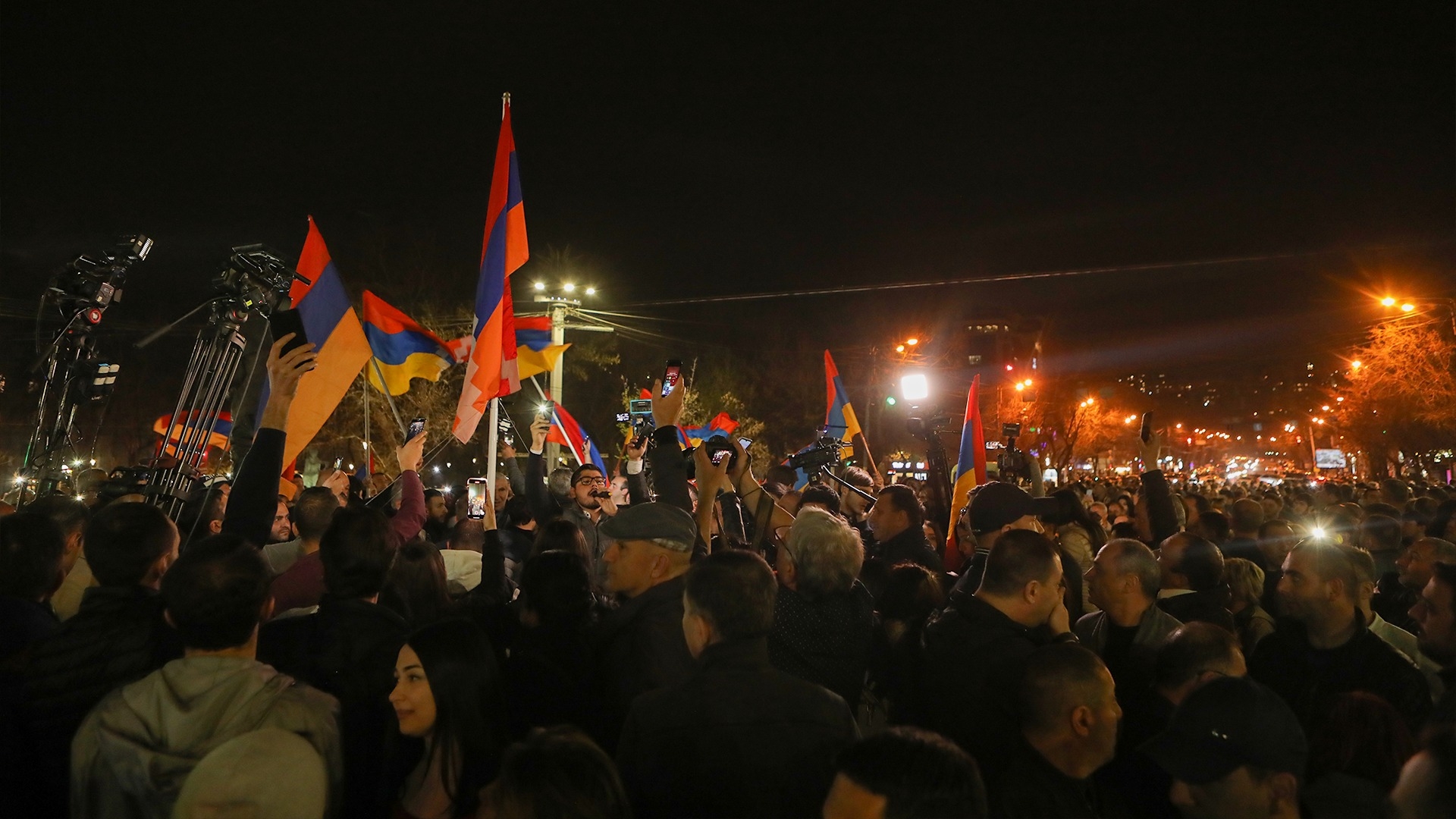
Narek Karapetyan, a lawmaker and head of the Strong Armenia faction in the Armenian parliament, has urged opposition parties to unite around four core principles set out in a joint declaration.
The key points of the declaration include resisting territorial concessions and blocking the adoption of a new constitution, which the opposition has termed the “Aliyev constitution”.
According to a report by Aysor.am, Narek Karapetyan stated that the opposition meeting was originally planned to be led by his uncle, businessman and Strong Armenia movement leader Samvel Karapetyan.
“We initiated the meeting, but the authorities took preemptive steps to prevent Samvel Karapetyan from launching the national unification process,” Narek Karapetyan said.
Noting that, despite these events, opposition representatives convened and signed a joint declaration based on four agreed articles, Narek Karapetyan invited other opposition forces and members of the public to join the alliance.
“We will not allow them to implement the Aliyev constitution in Armenia. We must unite,” Karapetyan said.
Ahead of these developments, Armenian National Security Service personnel detained Strong Armenia Party leader Samvel Karapetyan following a search of his home.
The party’s press secretary, Agavni Sukiasyan, announced that on the morning of the same day, the Investigative Committee of Armenia searched the homes of both Samvel Karapetyan and Narek Karapetyan.
In a report citing the Investigative Committee, Armenpress stated that Samvel Karapetyan was detained as part of a case involving allegations of causing large-scale financial damage to the Electric Networks of Armenia (ENA) company, embezzling entrusted property, and money laundering.
According to committee figures, the total damage inflicted on the company exceeds $179 million.
Narek Karapetyan’s home was also searched at the end of July as part of a criminal case.
On 22 July, Armenia’s Central Electoral Commission approved the Prosecutor General’s request to strip Narek Karapetyan of his parliamentary immunity, and Karapetyan was charged with large-scale money laundering.
According to information reported by Sputnik Armenia, the investigation is linked to charges brought against Strong Armenia supporter Aleksan Aleksanyan.
Investigative authorities allege that Aleksanyan received approximately $4.4 million and €230,000 from the Karapetyan-owned Tashir Foundation under the guise of gifts and loans.
Several criminal cases had previously been opened against Samvel Karapetyan.
In 2025, Karapetyan was charged with publicly calling for the violent seizure of power after backing the Armenian Apostolic Church, which had been criticized by Armenian Prime Minister Nikol Pashinyan.
In January, legal proceedings were also launched against Karapetyan on charges of large-scale tax evasion and money laundering.
Separately, in early July 2025, the Armenian parliament approved a bill enabling the nationalization of the Electric Networks of Armenia company.
In March, Armenia’s Constitutional Court ruled that the nationalization process in question complied with the law.
According to analysts, the use of the same standard track gauge as China on the new railway line demonstrates Moscow’s ‘pragmatic’ approach toward strengthening ties with Beijing.
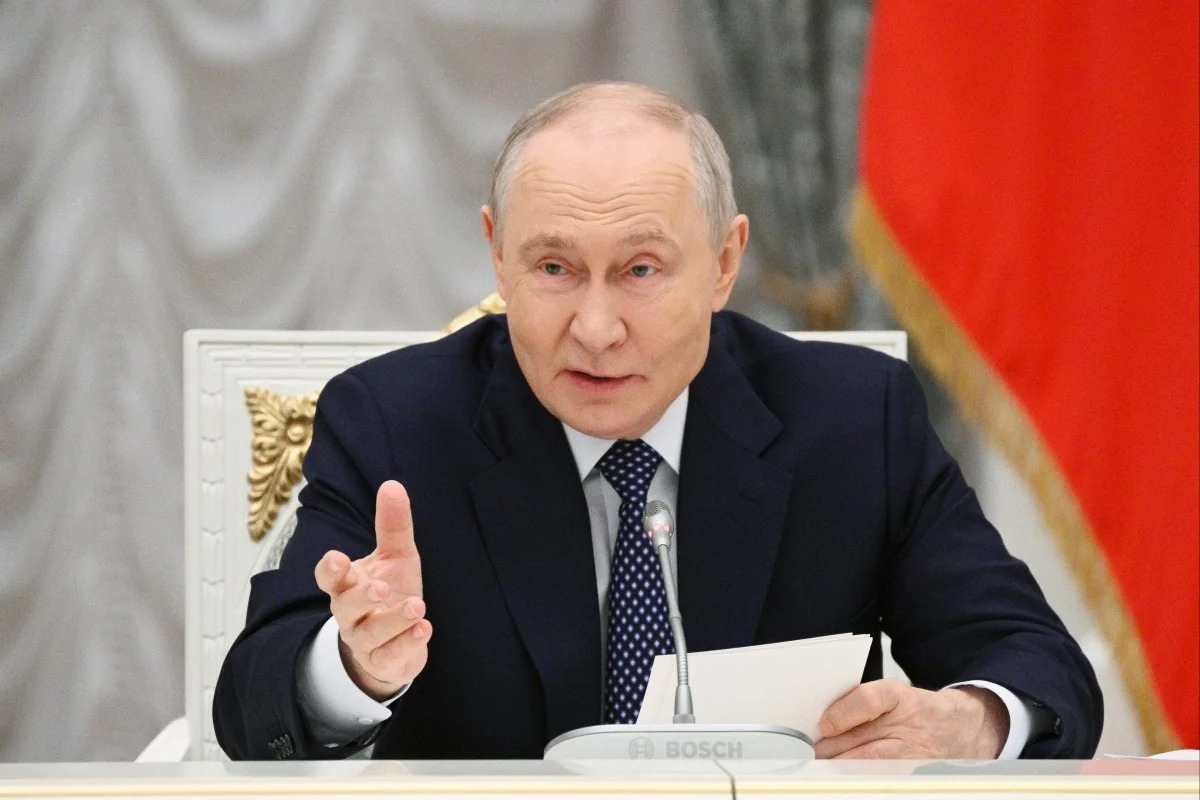
Russian President Vladimir Putin has signed into law an agreement providing for the construction of a second standard-gauge railway line at a key border crossing with China. Moscow aims with this move to accelerate its eastward pivot and bolster relations with Beijing ahead of the Asia-Pacific Economic Cooperation (APEC) Summit.
According to a document published on Monday on Russia’s official legal information portal, Putin signed the law ratifying the railway agreement reached with Beijing during his visit to China in May.
The two sides agreed to jointly construct a new line along the cross-border railway connecting Zabaykalsk in southeastern Russia with the city of Manzhouli in northern China.
The defining feature of the new line is that it will use the 1,435-millimetre standard gauge, the most widely used track gauge globally and the one adopted by China, rather than the 1,520-millimetre broad gauge predominantly employed across Russia’s national rail network.
Speaking to the South China Morning Post, Li Lifan, a specialist in Russian and Central Asian affairs at the Shanghai Academy of Social Sciences, said the second standard-gauge line will help ease freight transit capacity constraints at the border crossing. This will reduce waiting times for cargo trains and enhance the speed and reliability of transport services along the eastern corridor.
Freight trains running from China to Russia currently rely on a single 1,435-millimetre gauge track at the Manzhouli-Zabaykalsk border crossing. This transit point handles more than 60% of rail freight trade between China and Russia, as well as a significant share of Europe-bound cargo traffic.
Because trains travelling in opposite directions must take turns using the same track to cross the border, bottlenecks occur periodically.
Zoey Wang, a director covering corporate, infrastructure, and project finance ratings at international credit rating agency Fitch Ratings, said the project is expected to provide more stable transport conditions for two-way shipments of commodities, machinery and electrical goods, consumer products, and cross-border e-commerce cargo.
According to Wang, the project will make corporate shipping schedules more predictable and help reduce costs arising from delays, cargo detention, and supply chain disruptions.
According to Russian media reports, Moscow expects the second line to increase annual transport capacity at the Zabaykalsk border crossing to 39 million tonnes by 2030, an increase of 11 million tonnes over current levels.
With Western sanctions curtailing its access to European markets, Russia has increasingly redirected its trade toward Asia in recent years.
However, experts caution that putting the new line into operation does not necessarily ensure a substantial increase in trade volume. In the view of analysts, the true significance of the decision lies in the strategic calculations underpinning it.
According to Li, despite Russia’s stated target, inadequacies in the country’s domestic railway infrastructure will constrain actual growth. This is because cargo will still need to be transhipped onto 1,520-millimetre gauge rolling stock to move further into Russia.
“This decision does not indicate a shift in the country’s railway gauge system. Rather, it represents a pragmatic choice made at a time when Russia’s pivot to the East is entering its implementation phase,” Li said.
In Li’s assessment, Moscow concluded that the benefits of easing bottlenecks along the trade corridor with China outweighed the costs of preserving existing procedural barriers at the border.
Li also noted that the timing of Putin’s signing was a deliberate choice. The decision came ahead of the Asia-Pacific Economic Cooperation Summit to be held later this month in Shenzhen.
According to Li, Moscow wants to “demonstrate that it can deliver on its commitments to Beijing and set an example that could be replicated elsewhere.”
Zhao Long, director of the Institute of International Strategic and Security Studies at the Shanghai Institutes for International Studies, offered the following assessment:
“Although Russia has long adhered to the broad-gauge standard, the depth that strategic trust and coordination between China and Russia have reached today leaves no real reason to resist laying standard-gauge railways on specific connecting sections, particularly across critical border segments.”
Zhao continued:
“This situation also reflects the growing influence and gravitational pull of China’s economic, trade, and transport connectivity networks, not only over Russia, but across the entire Eurasian continent.”
Wang also said the project demonstrates that China’s railway technical standards and associated services are finding increasingly broad application internationally.
However, Wang cautioned that increasing border crossing capacity does not automatically guarantee a corresponding rise in trade volume.
According to Wang, the actual impact of the project will depend on a range of factors, including freight rates, inter-customs coordination, European demand, regulatory policies, and operating conditions along the corridor.
According to Russian media reports, construction on the Russian section of the second line is already under way and is expected to be completed by the end of 2026. The section on the Chinese side is scheduled for completion in early 2027.

Blue wave, Democratic Socialism, or shades of navy blue

Ukraine faces demographic collapse as fertility rates slide

EU divisions deepen over who should negotiate with Vladimir Putin

EU urges citizens to prepare 72-hour survival kits for crises

Paraguay President Peña resigns over catastrophic bank collapse
-
 Diplomacy5 days ago
Secular dress code dispute exposes deeper Türkiye-Azerbaijan strains
-

 Europe2 weeks ago
Merz visits Asia to seek new markets for German defence firms
-
 Russia1 week ago
US and Russia weigh energy deals and corporate return in peace talks
-

 Europe2 weeks ago
AfD drops Dexit to back single market in new Europe strategy
-

 Europe2 weeks ago
Serbia opposition wins snap vote as Vucic concedes defeat
-

 Interview2 weeks ago
“The AfD is an expression of internal contradictions within German big capital”
-
 America2 weeks ago
Pentagon prepares US bases for 90-day siege in global war plan
-
 Middle East2 weeks ago
US envoy says Syria interim leader Sharaa seeks Israel normalization
