
Diplomacy
East-West Forum in Istanbul to debate multipolarity and global order

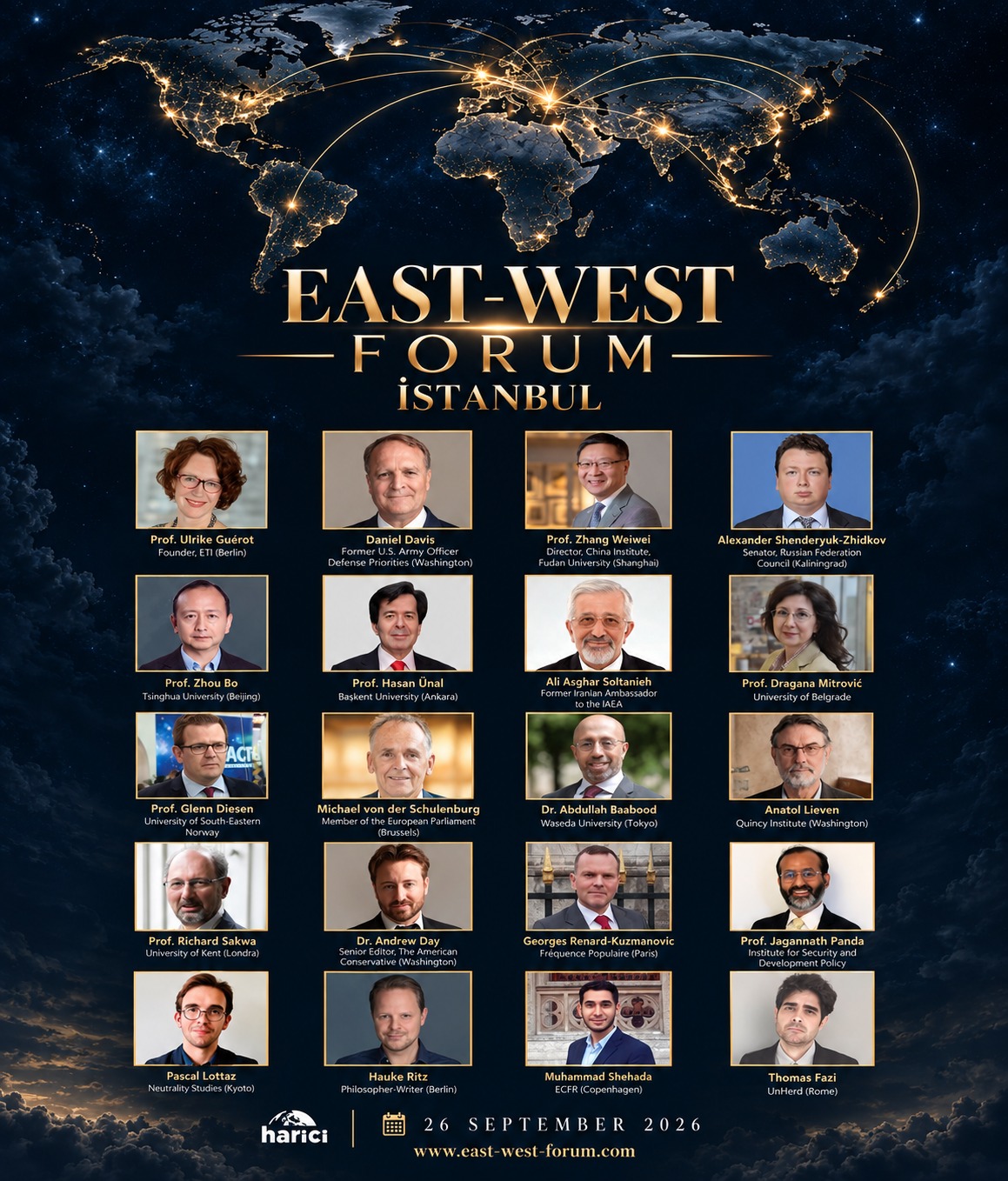
The end of the post-Cold War unipolar world order and the need to redesign the global system are bringing international thinkers and strategists together in Istanbul.
Organised in partnership between Harici Media and the Berlin-based think tank European Transcontinental Initiative (ETI), the East-West Forum (EWF) will convene on 26 September 2026 at the Akatlar Cultural Centre.
Pursuing an independent and non-partisan course, ETI will focus on Europe’s role in a multipolar world in the light of the principles of equality before the law, social responsibility, subsidiarity, federalism, freedom, and social justice.
The forum will focus on simultaneous paradigm shifts such as resource scarcity, climate stress, overpopulation, trade wars, global rearmament races, the artificial intelligence revolution, regional conflicts, and the dysfunction of the United Nations system.
Against the conventional approaches of the G7 and G20 frameworks – which reduce progress solely to technology, recognise power only in states, and do not question capitalism – the EWF will seek heterodox answers, develop alternative social and political concepts, and aim to “debate the impossible”.
Advocating an economic model that serves human beings and respects nature, the organisation will aim to construct a realistic utopia for the 21st century.
Seeking to offer an alternative to traditional security conferences held in Western capitals that interpret the world entirely through a Western-centric lens, the initiative draws its inspiration from the earliest map of Europe, dated 1534.
Aiming to revive this historical perspective – facing East yet standing firmly on Eurasian ground – the forum will open discussions on building a constructive bridge of dialogue between Western countries, BRICS, and the Global South, and, in the long term, on a mediating European identity possessing strategic autonomy beyond the borders of the European Union.
🌐 East-West Forum 26 Eylül’de İstanbul’da!
📍 ABD’den Çin’e, Avrupa’dan Orta Doğu’ya, Rusya’dan İran’a uzanan geniş bir coğrafya İstanbul’da buluşuyor
💬 15 ülkeden 20’yi aşkın seçkin konuşmacı, değişen küresel düzeni, yeni güç dengelerini ve geleceğin güvenlik mimarisini… pic.twitter.com/0n2wmoTom9
— harici (@haricitr) September 1, 2026
Opening panel to debate the end of the liberal order
Following the official opening at 10:00, the conference will begin with the first plenary session moderated by Prof. Ulrike Guérot.
The opening panel, titled “The World in Transition: Multipolarity and the End of the Liberal Order”, will feature Prof. Zhang Weiwei, Prof. Glenn Diesen, Anatol Lieven, and Prof. Jagannath Panda as speakers, with the initial assessment delivered by an official from the Papal Representation.
The panel will examine the consequences of liberal exceptionalism and its capacity to penetrate other cultures, imposed globally by the US since 1989.
The loss of memory and cultural depth experienced by deep-rooted civilisations during colonial and neo-colonial processes, the concept of the “civilisation-state”, and the possibility of carrying pre-modern traditions into the 21st century will be addressed.
Participants will discuss the extent to which the EU reflects European philosophical roots such as Christianity, the Enlightenment, modernity, and peace; the effects of the US on EU architecture; and the role of a neutral Europe as a global mediator.
Assessments will also consider whether rising actors such as China, Russia, India, Iran, and Brazil can rebuild the state as a protector of the public good; how China’s concept of order, prioritising harmony over hegemony and equality over coercion, can be institutionalised with the UN Charter; and the possibilities for transitioning to an equitable partnership.
Experts to discuss escalating war risks and Eurasian security
Beginning at 11:55 under the moderation of Prof. Hasan Ünal, the second plenary session will carry the theme “Escalating Tensions: Preventing a Devastating World War – Co-constructing and Peacefully Institutionalising a New Order”.
The panel will feature Prof. Zhou Bo, Daniel L. Davis, Michael von der Schulenburg, Alexander Shenderyuk-Zhidkov, and Ali Asghar Soltanieh as speakers, while Roger Köppel will deliver the session’s opening evaluation.
The session will focus on the risk of tensions between the West and BRICS or Global South nations escalating into a global war due to blocked diplomatic channels, the absence of arms control mechanisms, and AI-enabled warfare methods.
The possibilities of a balanced Eurasian security architecture covering both Ukraine and the Middle East (Palestine, Israel, Iran, Lebanon, Syria) will be addressed.
Panellists will examine whether Russia can serve as an East-West bridge while preserving its European identity, the EU’s militarist escalation spiral and potential disintegration, the future of the UN Charter, and the threats posed by unmanned aerial vehicles and robotic warfare.
The discussion will also analyse the protection of the civilian sphere against neurological and information warfare, the role of middle powers such as Türkiye in an era shaped by the decline of 500 years of Western hegemony, the necessity for the US to transition from a military empire to a nation-state, Iran’s regional position, concrete regional stability projects of the Gulf Cooperation Council such as water desalination, and the Mecca Joint Defence Agreement.
Discussions to focus on the quest for European autonomy
Following the lunch break, the third plenary session will commence at 14:20 under the direction of Isabelle Casel.
In the panel titled “Europe Beyond the EU and Its Philosophical Foundations: Atlanticism, Eurasia, and Strategic Autonomy”, presentations will be delivered by Hauke Ritz, Thomas Fazi, Prof. Dragana Mitrović, and Georges Renard-Kuzmanovic, with Walter Komarek speaking as the first commentator.
The session will focus on the strategic future of Europe, which currently lacks the character of an independent actor in the global balance of power yet remains vital to establishing a multipolar world.
Discussions will address how Europe can break free from the transatlantic framework, regain its digital sovereignty against US-centred digital platforms, and build long-neglected deep ties with Eurasia, Asia, BRICS, and the Global South.
While trade and energy flows across the Eurasian continent are examined, questions will be raised over the locking down of European state institutions, media, universities, and churches in ways that impede alternative debate.
Panellists will examine proposals to generate an alternative to the American conception of progress based purely on technological advancement by reviving humanism, Enlightenment philosophy, labour movements, and the mixed economy tradition, as well as constraining uncontrolled AI and genetic engineering through balances established with the East.
Panellists to examine regional proxy wars and the Gaza crisis
The fourth and final plenary session of the day will convene at 16:00, moderated by Pascal Lottaz, under the title “Examining the Details: From the Big Picture to the Realities and Prospects of Regional Proxy Wars”.
With Muhammad Shehada, Prof. Richard Sakwa, Andrew Day, and Prof. Abdullah Baabood serving as speakers, the initial evaluation will be presented by Ahmed Moustafa.
The panel will focus on the intersections between regional crises and the transformation of the international system, as well as the risk of global war.
The session will examine how 50 years of US hegemony and prior British influence in the Middle East transformed Arab-Islamic culture, how the genocide in Gaza shook Western legitimacy in the region, and the potential role of BRICS regarding the Palestinian question.
Avenues to halt the expansionist “Greater Israel” visions of the far-right Israeli government and the future of the Hague Group will be scrutinised.
Participants will evaluate the conflict lines in Ukraine and Iran, the military-industrial complex’s relationship with intelligence, media, and academia, and the posture Europe would adopt in the scenario of a collapse of NATO and EU security structures.
The conference will conclude at 17:25 with a closing session featuring general evaluations from a line-up of speakers that includes Serdar Yurtçiçek.
Organisation aims for permanent think tank network and annual books
The East-West Forum will continue on the morning of Sunday, 27 September 2026, between 09:30 and 13:00, with an evaluation meeting and working breakfast.
Five core objectives will be implemented at this stage: turning EWF meetings into a permanent and annual global platform shaping multiple paradigm shifts; publishing conference outputs internationally as an annual book series in partnership with the Germany-based publisher Westend Verlag; establishing three-month EWF expert groups operating year-round; launching the EWF Network representing critical global intellect; and founding the EWF Business Council to ensure coordination with the corporate sector.
Conference to be held at Besiktas Akatlar Cultural Centre
The conference will take place at the Akatlar Cultural Centre in the Besiktas district. The facility, located at Akat Mahallesi Zeytinoglu Caddesi No: 16, is accessible by public transport and private vehicles.
Participants choosing the Yenikapi-Haciosman M2 metro line can transfer at Levent station to the M6 Bogazici Universitesi/Hisarustu line and alight at Nispetiye station, reaching the centre via a short bus or taxi ride.
Passengers using Marmaray can follow the same route via the Yenikapi transfer. Those arriving from Istanbul Airport can access the M2 and M6 connections from the M11 Gayrettepe line.
Bus number 58A departing from the Zincirlikuyu metrobus hub drops passengers at the Zeytinoglu stop, while route 58N stops at Sari Konaklar, immediately adjacent to the cultural centre.







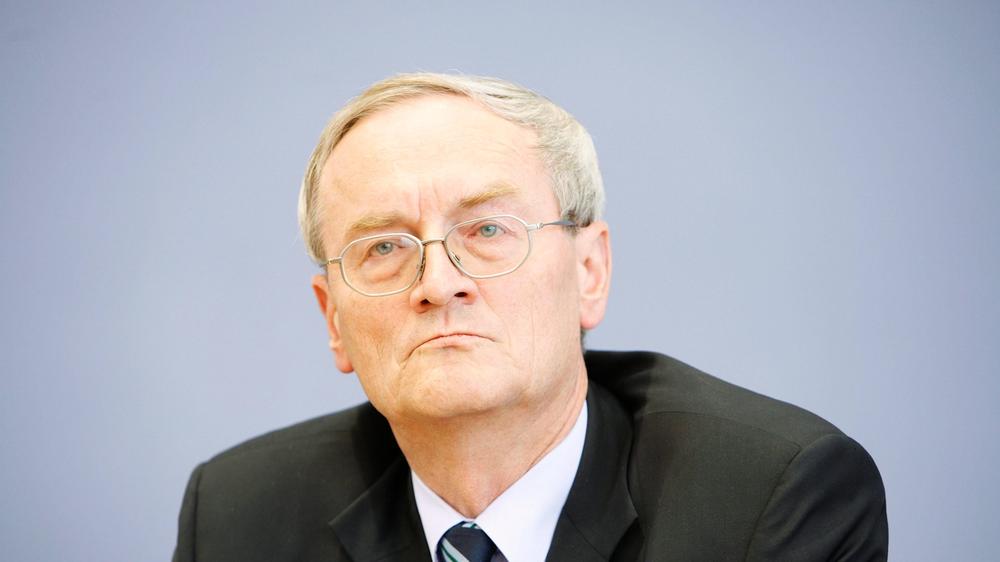
August Hanning, who led Germany’s Federal Intelligence Service (BND) between 1998 and 2005, was arrested on 6 October on allegations that he obtained roughly 2,000 classified agency documents and used them during contacts with intelligence officers from a foreign state.
Accused of high treason and espionage on behalf of a foreign intelligence agency, the former spy chief is alleged to have procured the documents from former BND employee Manfred D.
Prosecutors stated that the leaked records included internal briefing notes presented to senior German officials, though the Berlin government has not yet publicly disclosed which country received the classified data.
According to an exclusive report by Jake Green for The Cradle, seized email exchanges revealed extensive ties between the arrested Hanning and former Mossad director Danny Yatom.
The correspondence shows that the two former intelligence directors built an ongoing network of contacts following their public service, combining commercial ventures, efforts to secure political influence, and intelligence links.
This dynamic has triggered debate that using personal connections and official access for private gain has left Germany’s intelligence apparatus vulnerable.
Intelligence notes for 10,000 euros and campaign proposals
According to the reviewed emails, Hanning told Yatom in a 2018 message that he could prepare an “overall assessment based on information obtained from senior German officials and intelligence agencies” concerning an unidentified candidate.
The former BND head committed to completing the report by 13 July in exchange for 10,000 euros.
Contacts between the two men subsequently expanded to cover domestic political processes in Germany. Ahead of the September 2021 federal election, Yatom asked Hanning to approach leading candidates.
Describing CIY Global as a “political campaign company”, the former Mossad chief noted that he aimed to introduce its capabilities to German politicians, and he mentioned his intention in the same exchange to transfer documents concerning a cybersecurity firm.
Cybersecurity partnership and surveillance operations across Europe
The partnership between Yatom and Hanning reached beyond political lobbying initiatives into the cybersecurity sector.
Hanning reportedly served as a consultant for World Health Energy Holdings, a cybersecurity company linked to Yatom.
Firms of this type, established or managed by former intelligence personnel, provide commercial platforms on the international market for Israeli-origin surveillance, cyber intelligence, and political influence capabilities.
The operational presence of private Israeli-based surveillance technologies across Europe has recently entered judicial records through scandals in Poland, Spain, and Greece.
Polish prosecutors announced on 12 October that data collected under the previous government via Pegasus spyware against political opponents had been transferred out of the country, adding that manufacturer NSO Group maintained access to the technical infrastructure.
In Spain, the 2022 CatalanGate investigation established that at least 65 people, including politicians, lawyers, and civil society representatives, were targeted using Pegasus or Candiru software, with Citizen Lab researchers publishing strong evidence linking the operation to Spanish authorities.
In Greece, the surveillance operation targeting journalist Thanasis Koukakis and Member of the European Parliament Nikos Androulakis was determined to have used Predator software, linked to Intellexa, a company founded by former Israeli intelligence officer Tal Dilian.
In the German espionage investigation, the traffic between Hanning and Yatom involving paid reporting, contacts with electoral candidates, and commercial partnerships does not yet provide conclusive legal evidence regarding the final destination of the roughly 2,000 classified documents.
Nevertheless, the disclosed correspondence gives German investigators a concrete line of inquiry to assess whether classified state secrets reached commercial networks tied to Israeli intelligence.

US President Donald Trump has dismissed Kimberly Guilfoyle, the US ambassador in Athens, following serious press reports concerning her conduct.
White House Press Secretary Katie Zacharia told reporters during her first briefing that Guilfoyle had been asked to resign.
“She was doing a good job, but we didn’t like what we read in the press,” Trump said. “She was not a member of my family. I think she dated my son a long time ago.”
In a social media post, Guilfoyle stated: “These claims are unfounded, and I will resolutely defend my name, reputation, and integrity.” She added that she was particularly proud of the embassy’s work.
According to Kathimerini, her removal came as no surprise in Washington. Days of successive disclosures and vigorous exploitation of the matter by Democrats had been inflicting political damage on the White House ahead of the sensitive midterm elections.
The US State Department was instructed not to comment, with crisis management transferred entirely to the White House.
Reports indicate that most of the president’s team swiftly favoured Guilfoyle’s dismissal, while Secretary of State Marco Rubio was reportedly uneasy with the demonstratively warm public welcome she had staged for him.
Democrats on the House Foreign Affairs Committee have called for an investigation.
“Her resignation does not absolve her of responsibility,” the lawmakers wrote, adding: “While American families struggled to make ends meet, she used her position as a Trump administration official to enrich herself.”
Chargé d’Affaires Josh Huck will assume ambassadorial duties until a successor is chosen.
Meanwhile, Guilfoyle’s departure is expected to cause delays in agreements between Greece and the US.
These include the so-called “Rubio package”, comprising approximately $4 billion in arms deals finalised only days before the secretary of state’s arrival.
Several procedural steps still remain before the contracts can be signed.
In Athens, opposition parties are demanding answers. Dimitris Mantzos of PASOK called for a detailed briefing on the agreements reached during Rubio’s visit.
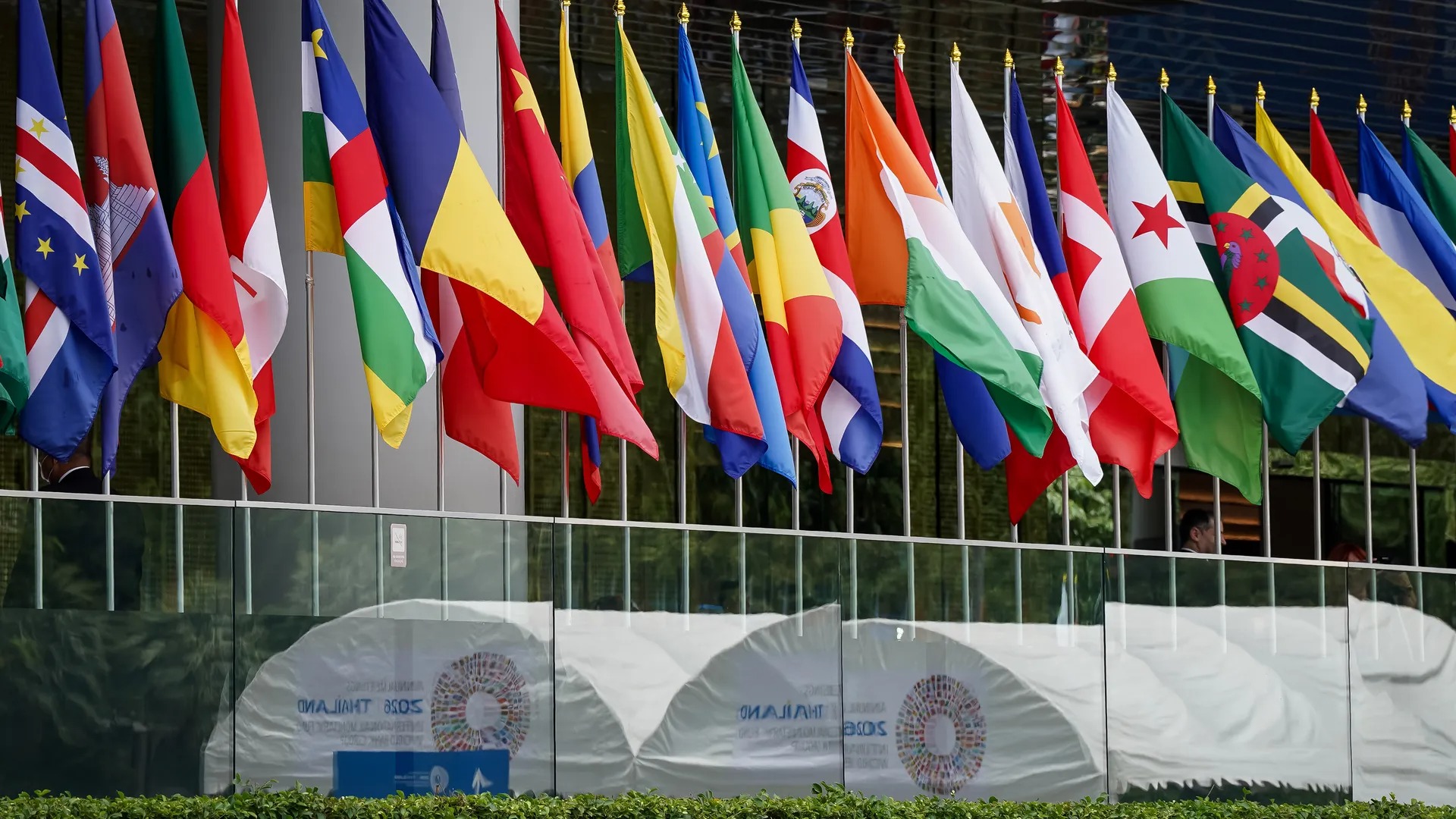
The International Monetary Fund (IMF) has warned that the global economy’s capacity to withstand fresh shocks is coming under strain.
Worldwide growth has exceeded expectations and maintained stability despite the war in the Middle East and surging oil prices.
However, some policymakers worry that dwindling energy reserves, rising debt burdens, and a growing reliance on the artificial intelligence boom will leave the world increasingly vulnerable.
In a blog post, IMF economic counsellor Silvana Tenreyro wrote: “Without strengthening supply capacity and rebuilding policy buffers, the global economy may soon test the limits of its resilience.”
Tenreyro added:
“While tech-related investments are an important advantage against the energy shock, they concentrate risks, making global growth excessively dependent on a small number of companies, sectors, and economies.”
The artificial intelligence (AI) boom has helped offset the economic fallout of the war.
Yet a sharp reversal could leave global GDP 1.1% below the IMF’s baseline forecast by 2028.
US GDP could take an even larger hit of 1.8%.
This scenario assumes that the productivity gains promised by AI fail to materialise, triggering a pullback in investment and a correction in financial markets.
Continued investment in artificial intelligence could also fuel inflation, leading to renewed interest rate increases.
Conversely, a stronger AI investment boom coupled with faster productivity gains could lift global GDP 0.6% above the baseline forecast by 2029.
The IMF largely maintained its global growth projections despite prolonged energy disruptions stemming from the Middle East war.
However, it now expects higher inflation both this year and next year.
The IMF projects global growth of 3.1% in 2026, unchanged from its April forecast, and anticipates 3.4% in 2027, representing a 0.2 percentage point upward revision.
The fund projects that the US economy will expand by 2.3% in both years, marking the fastest growth among G7 economies. The 2027 forecast was revised upwards by 0.2 percentage points.
Global inflation is expected to reach 4.7% in 2026 before easing to 4.1% in 2027.
Driven by the adverse impact of surging energy and food prices, both inflation projections were revised upwards compared with April.
The world had managed the energy shock partly by drawing down oil reserves and rerouting supply sources.
According to the IMF, global oil inventories are declining by approximately 2.7 million barrels per day, elevating the risk of a sharp price spike.
These projections provide the backdrop for global finance officials and central bankers gathering in Bangkok this week for the annual meetings of the IMF and the World Bank.
The IMF underestimated global growth projections for three consecutive years, raising questions over whether economies have become better at weathering shocks.

Ex-BND head Hanning tied to former Mossad chief amid spy inquiry

Iran war costs US economy $265 billion as household burden mounts

Trump dismisses US envoy to Greece Kimberly Guilfoyle

Most EU citizens reject fast-track Ukraine accession, poll finds

Ex-US official says air defences fail against Yemeni airport strike
-

 Europe2 weeks ago
German interior ministers drop unanimity rule to counter AfD veto
-
 Europe2 weeks ago
Key European allies excluded from US-led NATO meeting in Poland
-
 Diplomacy2 weeks ago
While the West breeds crises, Eurasia weaves peace and development, says Prof. Zhang Weiwei
-
 Middle East2 weeks ago
Netanyahu holds secret UAE talks with Saudi Arabia and Arab officials
-

 Diplomacy2 weeks ago
The European Union’s peace project has collapsed, MEP von der Schulenburg says
-
 Opinion2 weeks ago
A new world in the East, old dogmas in the West
-
 America2 weeks ago
Musk appointed co-director of Pentagon future warfare initiative
-
 Asia2 weeks ago
South Korea plans $120B spend on eight US nuclear power plants
