
Asia
Pakistan’s Khan shooting: Who paid for the bullet?

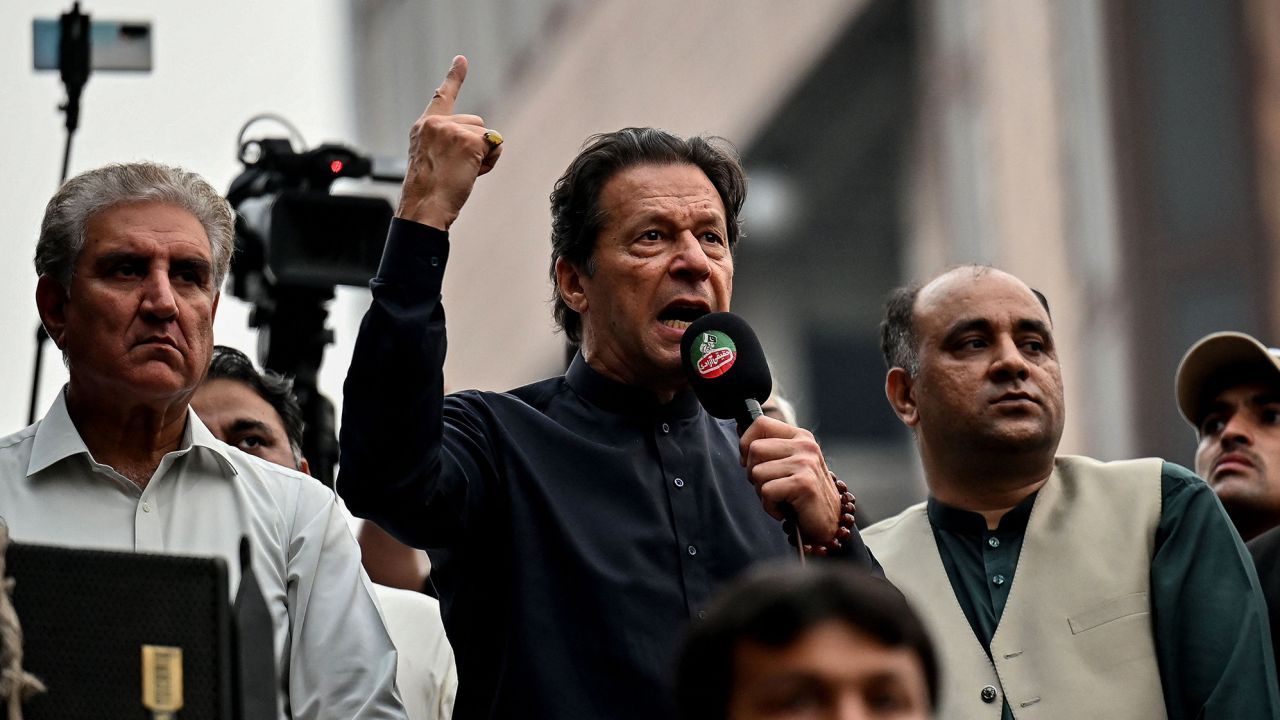
English author Eric Ambler: “The important thing to know about an assassination or an attempted assassination is not who fired the shot, but who paid for the bullet.
The exact word is now being repeated by the former Pakistan Prime Minister Imran Khan, who is recovering in hospital after being shot in the leg on Thursday at a protest march in Wazirabad, in the north-east of the country.
Khan, 70, and the Chairman of Pakistan Tehreek-e-Insaf (PTI), is not giving attention to the man who fired at him, rather revealed several high-ranking names behind his failed assassination plot.
When a key officials, like even the incumbent Prime Minister, and interior minister suspected of murdering plot of a political leader, it clearly reflects about the political intolerance of the certain strata for whom personal interests surpass every moral value.
It is worth mentioning that Pakistan tops the awful list of leaders’ assassination attempts as well and it has a root from the very inception of Pakistan some 75 years ago. There are several examples of Pakistani leader’s assassination attempt; some were killed by the unknown gunmen, while some others killed by direct commands of the establishment.
Pakistan has a long history of assassinations
At the outset we start with Pakistan’s first Prime Minister, Liaqat Ali Khan, who was shot and killed on 16 October 1951 in Rawalpindi. The assailant was shot dead at the very moment, and no other information was given till today. This is interesting; despite the security officials at that time promising a full-swing investigation on the shooting, nothing came out of it. There was only one claim, that the assassin was of Afghan origin.
The only Muslim woman Prime Minister, who ruled Pakistan twice, was Benazir Bhutto. She was assassinated in Lahore in December 2007; despite being escorted with outnumber security forces due to death threats. Later, in an astonishing move, Bhutto’s husband Asif Ali Zardari, didn’t allow the post mortem of her body, which is to ascertain the guilty.
Again, her shooter was never caught, and no investigation has yet been done. The case is still open without any progress. Her son is now a Foreign Minister. The history of Pakistan gives you several examples of leader’s assassination.
Do the Pakistanis and the world remember Zulfikar Ali Bhutto? He was Pakistani Prime Minister, and was hanged by the military regime of Zia-ul-Haq in April 1979 and his body was buried before his death could reach millions of his supporters. His elder son, Mir Murtaza Bhutto, was also murdered in Karachi.
Mr. Khan is on the next list
Now, on Thursday, former Pakistan Prime Minister Imran Khan had been shot and injured after receiving death threats. At least 11 close aides of Mr. Khan was wounded in the shooting, apart from one person who was killed. The shooting happened during his Long March toward the capital city Islamabad.
Imran Khan has been going on about this long march for seven days now and the entire plan was to start from Lahore toward Islamabad. Khan is looking to pressurize the government through nationwide demonstrations to hold elections in a nutshell.
Since his removal from office in April after a no-confidence vote, Khan has gained much more support from his followers after he contested for seven out of eight National Assembly seats and won six. Khan accused the incumbent government and US behind his ouster.
Imran Khan is speaking from hospital
In his briefing a day after he survived assassination attempt, Mr. Khan addressing the nation from a hospital in Lahore, said that he knew he was going to be attacked.
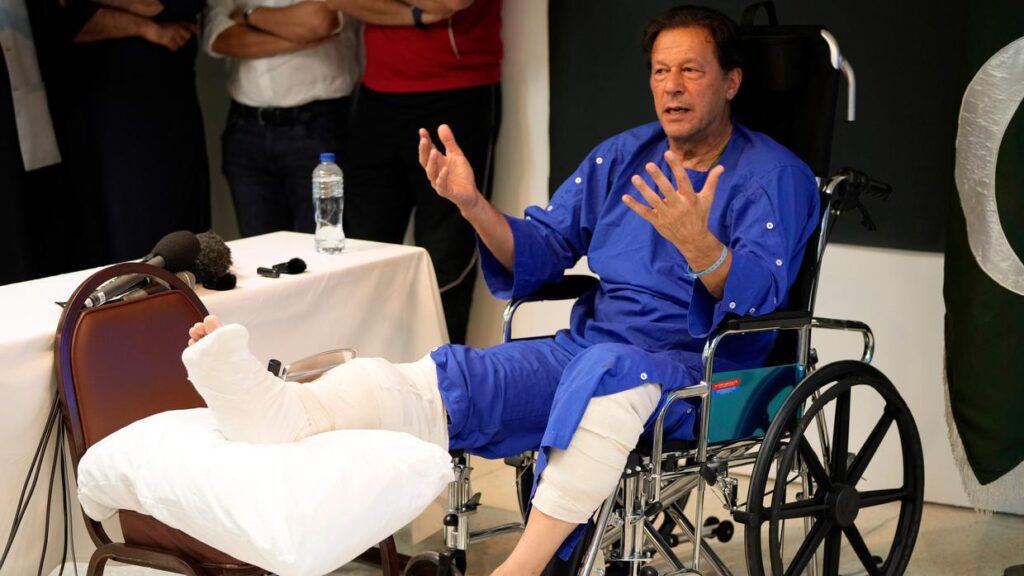
Former Pakistani Prime Minister Imran Khan in hospital. (K.M. Chaudhry/AP)
“I was hit by 4 bullets,” Khan said, adding he got to know one day before the attack that either in Wazirabad or Gujrat, “they planned to kill me.”
Khan said Prime Minister Shehbaz Sharif, Interior Minister Rana Sanaullah and intelligence official Major-General Faisal Naseer were part of the sinister plot to kill him but he provided no evidence for his claim.
Khan also called on his supporters to continue protest across the country and said he will continue his march to Islamabad once he gets out of the hospital.
Khan told his supporters to continue the protests until the three top officials, including Sharif did not resign. “This your constitution that gives you all rights to protests and the religion also gives you the right to carry out jihad against injustice,” Khan told his supporters.
However, Pakistani Interior Minister Sanaullah rejected Khan’s claim of being injured by four bullets and deemed him the biggest “liar” and asked for a thorough inquiry in the shooting incident.
Khan’s supporters protesting across Pakistan
Thousands of Khan’s supporters on Friday took to streets in several cities across the country to condemn his “assassination attempt”, and echo his demand for an early elections.
On Friday afternoon, Khan’s supporters staged protests in Karachi, Rawalpindi, Peshawar, Islamabad, Lahore and Quetta, and had blocked several roads and chanted slogans against the current Pakistani government.
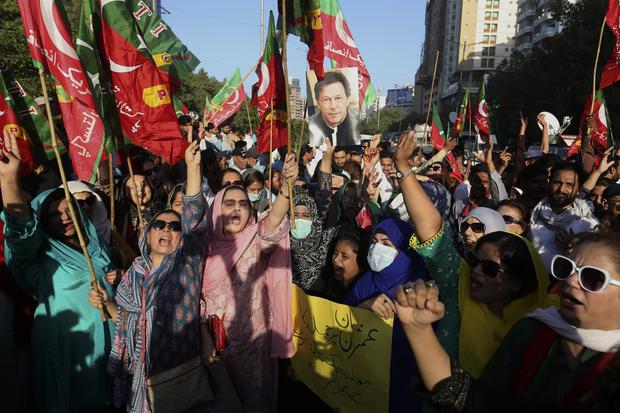
Supporters of Imran Khan’s party, Pakistan Tehreek-e-Insaf, during a protest to condemn a shooting incident on their leader’s convoy, in Karachi (Fareed Khan/AP)
In Islamabad, protestors threw stones at security forces, in which police reacted by firing tear gas shells and rubber bullets at them. Some of the protestors were also arrested.
In Lahore, hundred protesters set the main gate of the governor’s house in the central province of Punjab on fire and blocked several roads in the city.
In Karachi, police and protesters engaged in clashes for several hours.
Undoubtedly, the shooting on Khan was a crime, and it’s the moral obligation of the government to investigate the matter and initiate legal action against those behind this incident.










Financial Times writer Ryan Avent has written that a fresh, rapid surge in China’s trade surplus could signal a new wave of the “China shock”.
Economists define the “China shock” as a spike in Chinese exports to global markets that intensifies competition for manufacturers in advanced economies and curtails employment in certain sectors.
The term gained widespread currency after China joined the World Trade Organization in 2001, accelerating the inflow of inexpensive Chinese goods into the US and other nations.
The US was the country hit hardest by the initial shockwave. Between 1999 and 2011, more than 2 million jobs were lost because domestic producers were unable to withstand the competition.
Avent argued that the effects of the initial wave are still felt across the American economy because China failed to carry out the rebalancing that the world expected.
The share of net exports in China’s gross domestic product contracted during the 2007-2019 period, allowing Western nations to focus on national security and other matters.
Avent reported that the trade surplus is now escalating rapidly once again, posing a threat to the economies of wealthy nations.
The writer pointed to the stagnation of domestic demand following the collapse of the real estate market six years ago as one cause of this surplus. Another prominent factor is the Beijing government’s channelling of massive resources into manufacturing in pursuit of self-sufficiency.
Attention was also drawn to the role of the depreciating yuan. An appreciation of the currency could require China to alter its foreign exchange interventions, reduce purchases of foreign currency and assets, and sell those assets off. That scenario could trigger currency depreciation and rising interest rates in other countries.
The Wall Street Journal also reported in the spring of 2024 on economists’ concerns regarding a potential second wave.
Experts predicted that global markets would once again be flooded with inexpensive goods, stating that China was manufacturing far beyond domestic demand to overcome its economic troubles.
Moreover, it was stressed that China is now competing in high-technology fields such as automobiles, computer chips, and complex machinery manufacturing.
Meanwhile, Vasiliy Kashin, Director of the Centre for Comprehensive European and International Studies at the Higher School of Economics (HSE) University in Moscow, told the Russian media outlet RBC that the US has imposed sanctions on the Chinese economy since the first shock period, adding that these measures would very likely tighten in the event of a fresh export wave.
According to assessments reported by the Financial Times, this new process could also shake China’s own economy. Alongside rising output, entry-level manufacturing plants across the country are turning toward automation and reducing personnel.
This trend could trigger a painful departure from labour-intensive production, leaving millions unemployed. Manufacturing activities in China that previously capitalised on cheap labour are shifting to other Southeast Asian countries.
The Beijing administration rejected allegations that its industrialisation steps pose risks to other countries. As reported by the Xinhua news agency, China’s Ministry of Commerce stressed that claims of a “China shock 2.0” are groundless. The ministry stated:
“The US and other Western countries have circulated the so-called ‘China shock 2.0’ narrative, asserting that China’s industrial development has shaken Western monopolies and narrowed growth space for Global South countries. This claim is unsupported by concrete data and is entirely unfounded.”
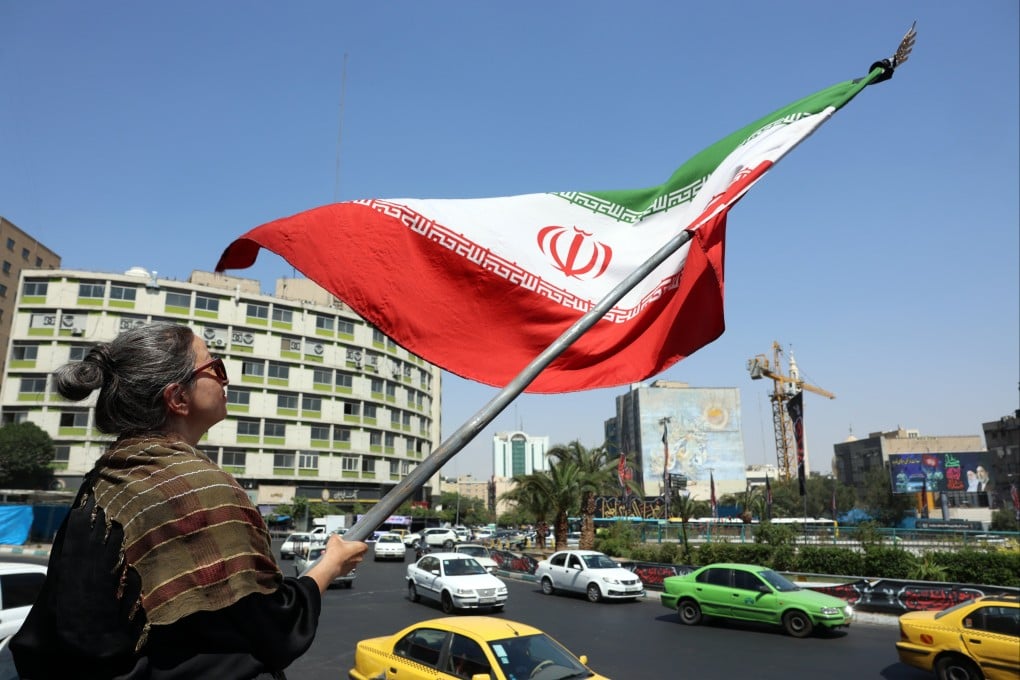
Iran is operating a covert, barter-like trade mechanism to bypass sanctions on its oil sales and procure billions of dollars in goods from China, including military hardware.
Speaking to the Reuters news agency, two senior Iranian officials and three sources closely monitoring the matter said the Tehran administration receives credits for goods imported from China instead of cash in exchange for the oil it sells to the country.
The sources, who spoke on condition of anonymity, emphasised that this method of swapping oil revenues for Chinese goods provides an immediate financial lifeline to the Tehran government at a time when the US has intensified economic and military pressure over its nuclear programme.
China, the world’s largest crude importer, continues to access discounted Iranian oil through this arrangement while shielding its banks and exporting companies from the risk of international penalties.
Although the Washington administration has imposed sanctions on several small-scale Chinese entities facilitating the transport of Iranian oil, it avoids sweeping measures that could shake the global economy.
The US has stepped up its pressure as it seeks to reopen the Strait of Hormuz amid the ongoing war between the two countries.
US Treasury Secretary Scott Bessent said last month that countries failing to cut commercial ties with Tehran would risk exclusion from the dollar system.
It remains unclear how the barter mechanism has been affected by the US naval blockade imposed on Iran as part of the six-month-old war.
However, since the reimposition of the blockade on 14 July, no shipments of Iranian oil passing through the Strait of Hormuz to China have been recorded.
Beijing and Tehran, which describe Western unilateral sanctions as illegal, refrain from disclosing publicly how they sustain their trade.
Sources state that Tehran introduced this system to obtain pharmaceuticals, vehicles, and communications equipment. Chinese manufacturers are said to have no direct contact with Iran, and there is no indication that they are violating sanctions.
On the other hand, the mechanism was utilised at least once last year under contracts supplying Iran with millions of dollars’ worth of air defence equipment. The sources provided no details regarding the shipments in question, and the transactions were not independently verified.
The United Nations conventional arms embargo returned alongside other sanctions in September 2025 following the collapse of the 2015 nuclear agreement between Iran and world powers.
Tehran had withdrawn from the terms of the agreement, while Beijing and Tehran described the European nations’ automatic reimposition of sanctions as legally flawed.
Responding to questions from Reuters, the Chinese Ministry of Foreign Affairs stated that it had no knowledge of the trade structure in question.
Beijing stated that it opposes unilateral sanctions lacking United Nations Security Council authorisation and having no basis in international law.
Iran’s diplomatic missions in New York and Geneva remained silent on the inquiries. A US official speaking on behalf of the White House stated only that they are working with international partners, including the EU, to prevent Tehran from achieving its nuclear goals.
According to data analytics company Kpler, China purchased more than 80% of the crude oil exported by Iran in 2025. This share equates to an average of 1.4 million barrels per day.
Although the two countries signed a 25-year strategic partnership agreement in 2021 covering energy and infrastructure, the operational details of their cooperation remain largely confidential.
The model in question constitutes only one of the networks through which Iran procures goods and services from China without passing through international banking channels.
A Western official and two other individuals tracking the matter said that a buyer acting on behalf of state-owned Chinese oil company Zhuhai Zhenrong deposited hundreds of millions of dollars each month until this year into ChuXin, a shadow financial entity based in China.
These deposits reportedly represent payment for oil purchased from a Hong Kong-based company linked to the National Iranian Oil Company (NIOC).
Approximately 70% of the oil revenues routed through ChuXin is allocated to infrastructure projects in Iran. The remainder is transferred to the accounts of a special purpose vehicle (SPV) established to disburse payments to companies supplying goods to Iran.
Sources close to Iran’s decision-making apparatus confirm the existence of this financial mechanism.
Fund management is shared between a firm acting on behalf of the Chinese Ministry of Commerce and another entity linked to the Central Bank of Iran. When the Central Bank of Iran authorises importers, money transfers are directed to supplier firms. While the name ChuXin does not appear in official records, one source noted that the structure exists solely on balance sheets.
Andrea Ghiselli, an international politics specialist at the University of Exeter, stated that Beijing uses these indirect networks to demonstrate that it will not bow to US secondary sanction threats.
Highlighting that Chinese leaders aim to protect their own banks and firms from being pushed out of the global financial system, Ghiselli said: “They want to create deniability.”
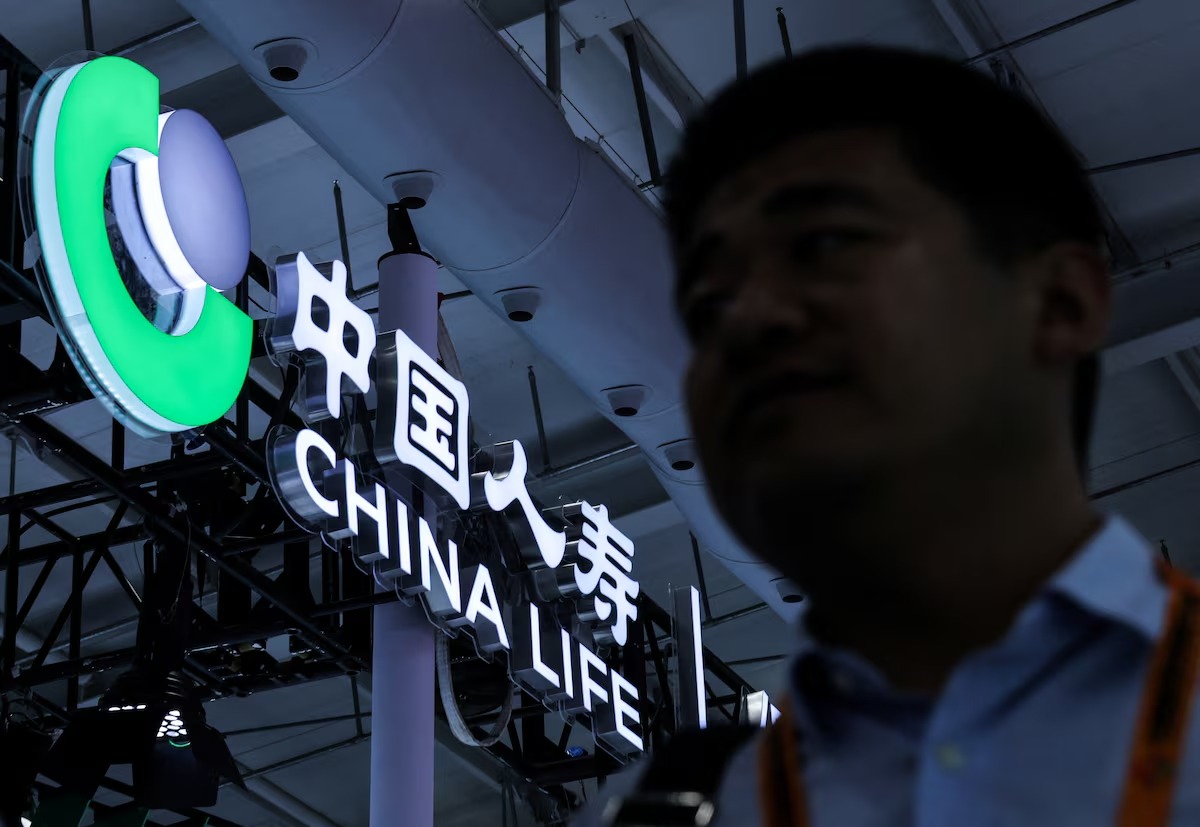
China’s Ministry of Finance will lead a total capital injection of $54 billion into state-owned insurance companies and banks as part of a coordinated push to reinforce the capital structure across the country’s financial system, according to details disclosed by the institutions in statements on Sunday.
China Life Insurance (Group) Co, the country’s largest life insurer, will receive 35 billion yuan ($5.2 billion) in capital support, whilst China Taiping Insurance Group will receive 7 billion yuan.
In a separate announcement, People’s Insurance Company (Group) of China (PICC) said it plans to raise up to 15 billion yuan via a private placement of A-shares to the Ministry of Finance. The company stated that the proceeds will be used to replenish its capital.
The initiative could fortify the financial position of state insurers, which have been called upon to support the equity market with medium- and long-term funds. At the same time, it could position these institutions to help regulatory authorities manage smaller and higher-risk insurance companies.
Financial sector stability
China’s insurance industry has been contending with shrinking profitability caused by prolonged low interest rates. Solvency ratios across numerous small and medium-sized insurers have also deteriorated.
China Export and Credit Insurance Corp stated that the Ministry of Finance will inject 10 billion yuan to boost the company’s core capital. China Reinsurance (Group) announced that it will execute a capital increase of 3 billion yuan.
“The capital injection represents an important step for enhancing the financial sector’s capacity to serve the real economy and promoting high-quality development across the financial and insurance industries,” China Life said in a statement. The insurer added that the capital support will improve the group’s resilience to risks.
Taiping also noted that the funds provided will strengthen the company’s solvency and other core metrics.
Banks benefit from recapitalisation plan
Separately, three state banks announced on Sunday that they will receive capital support totalling 290 billion yuan.
The recapitalisation framework was first announced during the annual parliamentary meetings in March this year. The move broadens a funding mechanism deployed last year to strengthen the capital structures of several other major state-owned lenders.
Agricultural Bank of China and Industrial and Commercial Bank of China (ICBC), two of the country’s largest state-owned lenders, announced plans to raise up to 160 billion yuan and 100 billion yuan, respectively, through private placements of A-shares to the Ministry of Finance, China National Tobacco Corp, and affiliated entities.
Both lenders confirmed that all net proceeds will be deployed to replenish their Core Tier 1 capital. The measure is expected to help sustain credit expansion at a juncture when Beijing is increasingly relying on state lenders to support economic growth.
Weak credit demand remains a persistent headwind for the world’s second-largest economy, while continuing to erode profitability across the banking sector.
Export-Import Bank of China, one of the country’s three policy banks, stated that the Ministry of Finance will inject 30 billion yuan of capital into the institution, thereby bolstering its capital base.

AfD’s Siegmund links German rearmament to remigration plans

Chinese carmakers expand European share as Stellantis loses ground

Iran resumes ballistic missile assembly using stockpiled parts

Analysts warn new surge in Chinese exports threatens global markets

Anthropic uncovers Claude use by Iranian, Houthi, and Russian units
-
 Europe5 days ago
Germany’s CDU drafts tougher citizenship rules to counter AfD
-
 Russia2 weeks ago
What to know about Russia’s upcoming State Duma elections?
-
 Europe2 weeks ago
Marine Le Pen leads all 2027 French presidential scenarios, poll shows
-
 Diplomacy1 week ago
Geoffrey Roberts sees Ukraine war concluding within coming months
-
 Middle East2 weeks ago
Iran expands deterrence as Gulf strikes expose US munitions limits, analysts say
-
 Europe2 weeks ago
German industrial bosses push for return to 40-hour working week
-
 Russia2 weeks ago
Russia warns NATO over Arctic militarisation and conflict risks
-
 Asia2 weeks ago
BOJ faces critical rate decision as US presses for faster hikes
