
America
Pentagon divided over military priorities in Asia and the Middle East

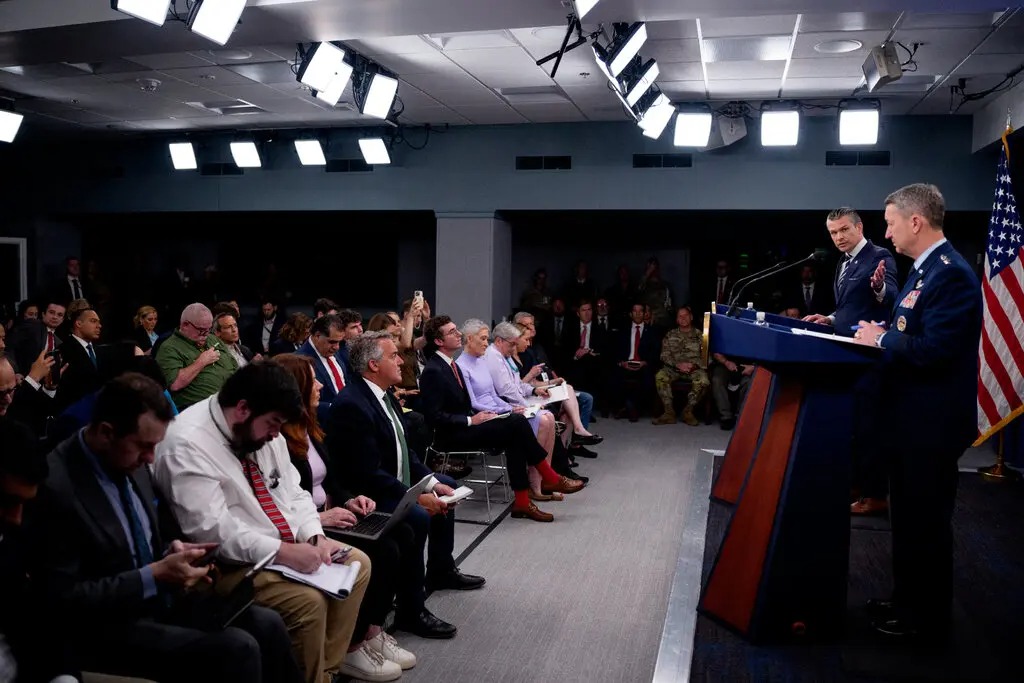
Senior Pentagon officials are reportedly divided over the extent of military support for Israel versus engagement in Asia, a split that could influence the direction of foreign policy in a potential second term for Donald Trump.
Ben Smith, founder of the news site Semafor, explored this issue in a recent special report. According to Smith, General Michael “Erik” Kurilla, the commander of US Central Command (CENTCOM), is advocating for more resources to defend Israel as retaliatory actions from Iran increase.
In contrast, Elbridge Colby, the Under Secretary of Defense for Policy and a proponent of the US military focusing on China and the Indo-Pacific, opposes the diversion of American military assets from Asia to the Middle East.
An Iran war embodies the primary tension for Colby and his allies: the US has long sought to implement its “pivot to Asia,” a strategy first announced by Barack Obama in 2011. However, practical demands and political pressures consistently redirect American military involvement back to the Middle East.
Shifting priorities within the Pentagon
According to Smith, Colby’s opposition stems from concerns that deployments, such as the transfer of a Patriot missile battery from South Korea to the Middle East in April, could compromise US readiness for future conflicts with China or the Democratic People’s Republic of Korea.
Despite providing military aid to Israel, Trump has occasionally shown frustration with open coordination and allegedly dismissed his National Security Advisor, Mike Waltz, due to his close ties with Israeli Prime Minister Benjamin Netanyahu.
Trump’s potential appointment of Colby to a Department of Defense position has raised concerns among pro-Israel hawks, who might interpret it as a sign of diminishing US support.
Although Waltz’s dismissal and Trump’s allowance for an “independent” Israeli strike on Iran suggest a more non-interventionist approach, Colby’s influence appears to be waning.
CENTCOM chief Kurilla gains strength
Secretary of Defense Pete Hegseth reportedly dismissed several of Colby’s allies in April and has cultivated a closer relationship with Kurilla.
Eli Lake of The Free Press reported that the new Deputy Assistant Secretary of Defense for the Middle East, Michael Dimino, who is from the “restrainer” camp, has set off alarm bells among Trump supporters who believe engagement in the region is vital.
Referring to Dimino’s views, one Trump ally joked, “The guy who is going to be his deputy in charge of Middle East policy thinks the US shouldn’t be in the Middle East. Somebody call Elon at DOGE.”
Earlier this month, Al-Monitor reported that Kurilla had requested the deployment of a second aircraft carrier strike group to the region. While the Pentagon has not confirmed this deployment, the US has begun sending warships and aircraft to the area. The planned visit of the USS Nimitz to Vietnam was abruptly canceled due to “urgent operational requirements.”
The future of American policy
A key force behind the “restrainer” ideology is Defense Priorities, a think tank funded by Charles Koch’s Stand Together philanthropy group.
The organization recently published a carefully worded paper arguing for reducing Israel’s reliance on US military guarantees: “A more secure, diplomatically connected Israel would rely less on American military backing and more on regional partnerships to secure its future.”
Colby and the Pentagon press office did not respond to media inquiries, but internal dynamics suggest that those who favor traditional US intervention in the Middle East are gaining an advantage.
According to Smith, as Trump attempts to balance his “America First” policy with regional alliances, the outcome of this internal debate will determine the trajectory of US-Israel relations during a period of regional instability.
Elbridge Colby’s fixation on China
One claim in the report suggests that Colby is so focused on Asia that he “clashes with anyone doing anything else in foreign policy, including loyal Trump supporters.”
After Smith’s report was published, chief Pentagon spokesperson Sean Parnell stated in an email that reports of any internal division were inaccurate and that Colby was “fully aligned with the leadership team and moving in lockstep.”
In an interview with POLITICO last July, Colby emphasized his personal view that defending Eastern NATO requires allocating forces in a way that does not diminish the US’s ability to defend Taiwan.
Colby also identified “key capabilities” such as long-range fire, logistics, command and control (known as C4ISR), and air defense as areas where the US should focus on Asia, not Europe.
Having previously argued that US commitments to Ukraine were excessive, Colby has consistently underlined that the most tangible economic and military challenge to his country and its interests comes from China.
The strategist, who noted that he views Ukraine through a “China lens,” clarified that he was not calling for an immediate halt to all aid to Kyiv. He argued that while Russia’s actions are “evil,” the assistance provided by the US does not align with the tangible interests of Americans.
When asked what he would advise the US President to do now, Colby responded: “I would say, ‘I don’t want to talk about Ukraine right now. We are going to talk about Taiwan, China, and Asia first, and after we have addressed that problem satisfactorily, then we will spend time, political capital, and resources on Ukraine.'”
Last month, the Financial Times (FT) reported that Colby had told British officials a Trump administration would expect the British military to increase its focus on the Euro-Atlantic region.













Wealthy buyers in the US are tearing down multimillion-dollar homes shortly after purchasing them for hundreds of millions of dollars.
According to a report by The Wall Street Journal, the trend is driven by a shortage of land in prestigious locations, particularly along coastlines.
For ultra-wealthy buyers, the prime factor has become the land’s location rather than the structure standing on it. After the acquired properties are flattened, newer, more modern homes are built on the cleared lots.
Drawing attention to the shift in the luxury real estate market, the report noted:
“The home itself, formerly the primary driver of an expensive real estate purchase, is now almost beside the point. Buyers are competing first and foremost for well-located land, situated on the ocean or a mountaintop.”
The newspaper cited moves by US billionaire William Lauder as an example. Lauder purchased the oceanfront estate of radio host Rush Limbaugh, who died in March 2023, for $155 million and had it completely demolished in July.
Lauder had previously torn down two homes situated on roughly 1.2 hectares of land along the Palm Beach coast. Having initially planned to construct his own residence on the parcel, Lauder subsequently sold the cleared plot for approximately $200 million.
Jonathan Miller, a real estate appraiser, stated that such transactions are becoming increasingly common as land prices rise.
Amid this momentum, estate agents have also begun marketing luxury homes directly as teardown lots.
Listings use artificial intelligence-generated imagery to showcase how the land would look without the structures on it.
Marketers avoid using the word “demolition” directly, resorting instead to terms such as “adaptive reuse”.
Teardown listings rise across luxury housing market
The trend is not confined to the coast and is spreading to other regions across the US.
Data from property brokerage Redfin reveals that references to demolishing buildings are becoming more frequent in sales listings.
The share of such listings exceeds 15% in the Bunker Hill Village area of Houston, while standing at 6.67% in Pimmit Hills, Virginia.
Dina Goldenteyer, a real estate agent working in Miami, remarked that serial demolitions have become more frequent because buyers no longer appreciate homes older than a decade.
Former retail executives Jamie Dooley and Christine Scott spent $3.7 million in 2020 to demolish a seaside home near Destin, Florida.
Although the couple spent five years building a modern home on the cleared site, they listed the resulting new structure with a demolition condition, citing the fact that no one wanted to buy the property as it stood.
William Paddock, an employee at the environmental consultancy WAP Sustainability, pointed to the environmental damage caused by this construction cycle.
Paddock emphasized that tearing down a home of roughly 1,000 square metres and replacing it with a new building of approximately 2,700 square metres generates a carbon footprint equivalent to the annual emissions of an average 250 American households.

An uptick in September inflation as the US midterm elections approach has pushed the cost-of-living debate back to the centre of the agenda for Democrats seeking to regain control of Congress from Republicans.
Annual inflation stood at 3.7% in September, according to the Consumer Price Index published by the Bureau of Labour Statistics, with energy, petrol, and electricity costs rising on a monthly basis.
Food prices remained flat from August to September, recording a 2.5% increase compared with the same period last year.
Democrats are anchoring their election campaigns to pledges of easing the cost of living, blaming the price increases on President Donald Trump’s tariffs and the war with Iran.
Trump and Republicans, pointing to the numerous left-wing candidates who won primary elections this year, contend that the opposition has become captive to “communists” within the party.
When annual inflation stood at 2.4% in February, the US and Israel launched the Iran war on the final day of that month, and prices continued to climb throughout the conflict.
The recent acceleration has not entirely reversed the retreat from the 40-year peak of 9.1% recorded in June 2022; however, the rate has remained above the Federal Reserve’s 2% target for over five years.
Fed policymakers raised the benchmark interest rate by a quarter of a percentage point last month, citing the battle against stubborn inflation. Officials will convene again next week to consider whether to raise rates or hold them within the 3.75% to 4% target range.
Energy and fuel record sharpest increase since first month of war
In September, energy prices posted their largest monthly jump since March, the first full month of the war with Iran, climbing 20.4% year-on-year. Energy costs had risen 2.1% from July to August, after falling 1.5% from June to July and 5.7% from May to June.
Recent escalations in Iranian attacks on oil tankers in the Strait of Hormuz, alongside more frequent strikes by Ukrainian forces against Russian refineries, have strained global crude oil and refined product markets, driving up US petrol and diesel prices.
Petrol prices also recorded their sharpest monthly increase since the first month of the war, climbing 9.1% from August to September, bringing the annual increase to 35.3%.
American Automobile Association (AAA) data shows the average price of regular petrol across the US stands at $4.26 per gallon; while below the level of roughly $4.48 recorded a month ago, it remains more than $1.20 higher than a year earlier. Average gallon prices exceed $6 in California and $5 in both Washington state and Nevada.
Electricity prices rose 0.2% from August to September, offsetting the 0.2% decline between July and August, and were up 4.4% year-on-year.
Heavy power demand from new data centres is feeding through into local household electricity bills. Trump argued that companies must cover the cost of the electricity required by their data centres themselves.
In a post on Truth Social, Trump claimed that he was requiring large data centres to generate their own power and feed the surplus back into the local grid, suggesting this could bring about “a major drop” in electricity prices.
Used vehicle market posts monthly rise as food costs stabilise
The cost of food at home fell 0.1% month-on-month in September, while dining out increased 0.2%.
Egg prices dropped to $2.27 a dozen, falling roughly 35% compared with September 2025 and remaining well below the 20-year peak of $6.23 recorded in March 2025.
Ground beef prices rose roughly 2.4% compared with September 2025, but at $6.48 a pound, they remained below the 20-year high of $6.98 reached in June.
Chicken held steady at its year-earlier level of $2.06 per pound last month, having fluctuated between $2.01 and $2.09 since November 2024.
Used car and truck prices fell 1.5% compared with September 2025, but rose 0.7% month-on-month in September following 0.4% increases in both July and August.
Heather Long, chief economist at Navy Federal Credit Union, noted that the sector faces severe pressure stemming from a combination of expensive replacement parts and a shortage of skilled labour.
Speaking to The Hill, Long emphasised that every cost pressure across the market is being felt directly at local auto repair shops.

Anthropic, developer of the artificial intelligence model Claude, reported a net loss of $80.7 billion for the first six months of 2026 ending 30 June.
According to a report by The Wall Street Journal citing the company’s draft initial public offering prospectus, this recorded loss nearly doubled the $42 billion loss incurred across the entirety of 2025.
The vast majority of that enormous figure, accounting for $72 billion, stemmed from accounting-driven book-value write-downs.
In contrast, the company saw a sharp surge in revenue, with turnover in the first half of the year climbing to $16.3 billion from $1.1 billion in the same period of the prior year.
During this period, Anthropic spent approximately $9 billion on computing power and infrastructure needs, surpassing in just six months the $7.3 billion spent across the whole of 2025.
The company has commitments to pay roughly $450 billion over the next seven to 10 years under cloud service contracts.
Under these obligations, contracts are planned for $111 billion with Google Cloud, $110 billion with Amazon Web Services, and $31 billion with Microsoft.
Anthropic will also spend up to $86 billion by 2033 and 2034, respectively, to lease Nvidia chips through smaller AI-focused cloud providers Nscale and Lambda.
The company could spend an additional $750 billion in the coming years to expand its computing capacity.
Roughly a third of the draft IPO prospectus was dedicated directly to risk factors.
The document highlighted the possibility that models could cause tangible real-world harm, noting that artificial intelligence could exhibit a “self-preservation” tendency and produce responses resembling “blackmail”.
Anthropic warned that the scale of damage caused by an AI-driven “catastrophic event” could render insuring against such risks impossible.
According to market expectations, Anthropic’s IPO could rank among the largest transactions in history, potentially surpassing SpaceX’s record.
Following the market debut, the company’s market valuation is projected to reach up to $2 trillion.

German officials urge fighter jet alliance with Sweden and Spain

US wealthy demolish multimillion-dollar mansions for land

US and Israel weigh Iran strikes after midterm vote, reports say

Pentagon plans covert spy ring for economic war on China, report says

EU reopens debate on naming envoy for Ukraine talks with Putin
-

 Europe2 weeks ago
Berlin Left Party backs Israel’s right to exist for coalition pact
-

 America2 weeks ago
How will Brazil’s presidential runoff work?
-

 Diplomacy2 weeks ago
The West is preparing for war not with Russia, but with its own people, French analyst Georges Kuzmanovic insists
-

 Russia2 weeks ago
71 EU lawmakers demand closure of Russian Houses in 15 member states
-

 Russia2 weeks ago
US and Russian figures discuss American stake in Nord Stream lines
-

 Europe2 weeks ago
MI6 investigates potential leaks after former BND chief is detained
-

 Russia2 weeks ago
Drone strike shuts down Yandex data centre in Russia’s Ryazan region
-

 America2 weeks ago
Trump weighs presidential memorandum to cut surging US diesel prices
