
America
Pentagon office takes 35% stake in Venezuela oil venture


The Trump administration’s oil agreement with Venezuela represents the riskiest venture to date for a Pentagon unit originally established for an entirely different purpose.
The White House announced this week that the Office of Strategic Capital (OSC), an entity operating under the Department of Defence, will acquire a 35% stake “at no cost to American taxpayers” in North American Blue Energy Partners, a firm headed by politically connected Venezuelan investor Alejandro Betancourt.
The objective is to make Venezuelan oilfields more attractive to US investors, thereby increasing revenue for Caracas whilst simultaneously squeezing out Chinese and Russian firms.
According to the Council on Foreign Relations (CFR), the OSC has already facilitated equity acquisitions in at least five other companies during President Donald Trump’s second term. The OSC was created to provide loans for the development of critical technologies.
However, because the Venezuelan agreement involves petroleum rather than conventional critical technology, it stretches the agency’s statutory boundaries even further and has already prompted Democrats to pledge congressional investigations.
Should Democrats regain power in Washington this November, any oversight drive could place the office’s efforts to secure state equity positions in private corporations under intense scrutiny.
In an interview with Semafor, a former OSC official stated:
“Acquiring equity was never intended when the OSC was founded; that circumstance alone does not necessarily constitute a problem. Nevertheless, it raises some legitimate legal and ethical questions.”
Jon Hillman, who directs the council’s tracking system, noted in an interview that the Venezuelan oil deal “appears to be uncharted territory”, adding that the office’s “mission is to catalyze private investment into specific, critical supply chain technologies necessary for national security.”
The statute that established the OSC defines its authority to provide “capital support” as extending and guaranteeing loans and offering technical assistance.
A Pentagon spokesperson initially told Reuters that the office was “not acquiring equity” in private enterprises due to this constrained remit.
On Tuesday, however, a US official offered a contrasting account to journalists, stating that the authority to acquire a stake in Betancourt’s company via “penny warrants” was “granted to the OSC when it was enacted into law under the Biden administration.”
A “penny warrant” is a financial contract that confers upon its holder the right to purchase corporate shares at a negligible, nominal price.
The US official added:
“This is an entirely standard arrangement in terms of the OSC’s capacity to maintain the financial position it holds under this agreement, and all financial positions granted to the OSC comply fully with the law.”
Peter Harrell, a visiting scholar at Georgetown University Law Center, said in an interview that it was “impossible to render a definitive legal opinion” because officials had “not advanced a precise legal theory.”
Harrell added that the Trump administration may be banking on no party possessing either the legal standing or the inclination to bring a lawsuit over the transaction.
That calculation encompasses oil corporations hoping to profit from the newly reopened Venezuelan petroleum sector.
Cari Stinebower, an attorney at the law firm Steptoe who advises petroleum firms seeking to conduct business in Venezuela, said: “I suspect everyone may be quietly perplexed. Yet I do not believe anyone will speak out, because virtually everyone wants to participate in the investment opportunities in Venezuela.”
Jack Reed, the senior Democrat on the Senate Armed Services Committee, is among those already demanding further particulars regarding the agency’s statutory authority to conclude the agreement.
Certain Republicans are likewise keen to obtain additional information concerning the Venezuelan deal.
The Biden administration formed the OSC in 2022 to provide loans to businesses developing technologies deemed “vital” to national security.
Recent legislative initiatives aimed at formally expanding its authority to encompass equity investments have so far foundered.
Yet under the direction of Deputy Secretary of Defence Steve Feinberg, the administration pressed forward regardless, enlisting bankers to help deploy a lending authority that surged from $1 billion to $200 billion courtesy of recent party-line Republican tax legislation.
The current director of the OSC, David Lorch, previously served as a managing director at Cerberus Capital Management, the private equity firm founded by Feinberg.











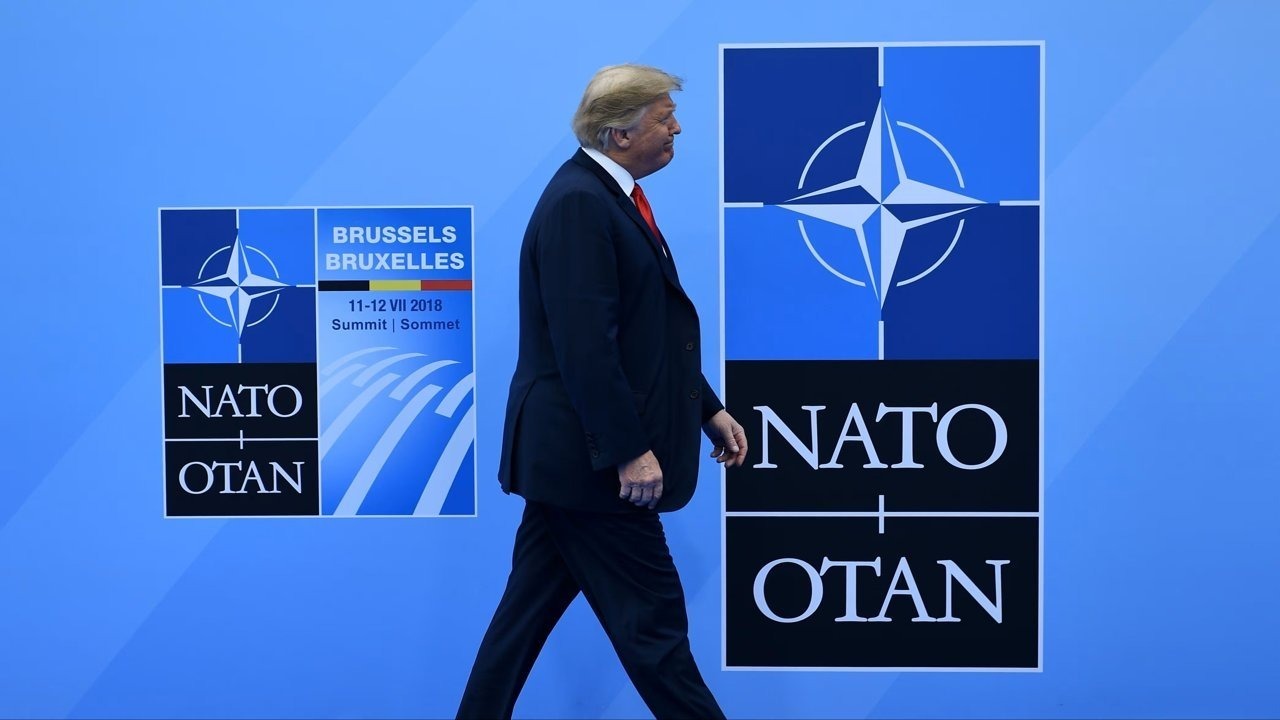
In an in-depth interview broadcast on the Harici YouTube channel, James W. Carden, an American journalist, author, and former foreign affairs adviser to the US State Department during the administration of President Barack Obama, conducted an exhaustive assessment of global geopolitics and Washington’s foreign policy trajectory with journalist Sarp Sinan Hacır. Carden, who served as a special adviser on US-Russia policy, addressed recent international speculation surrounding reported intelligence contacts in Moscow, the long-term drivers of the armed conflict in Eastern Europe, Washington’s military and economic campaign against Iran, shifting dynamics across the Middle East, escalating pressures in Latin America, and the institutional dogma shaping American strategic posture toward major Eurasian powers including Türkiye.
Opening the dialogue, Hacır raised reports concerning a visit to Moscow by US Central Intelligence Agency Director John Ratcliffe amid heightened Western narratives alleging an imminent Russian attack against a North Atlantic Treaty Organization member state. Hacır asked whether Moscow truly represents a threat to Western nations or if the current framing is driven by political rhetoric.
Carden unequivocally dismissed the assertion that Moscow maintains expansionist military ambitions against Western capitals, offering a direct critique of prevailing mainstream media narratives and intelligence leaks.
“No, I don’t think that Russia poses a threat to the West. It certainly doesn’t pose a threat to the United States,” Carden stated. “It does pose a threat to Ukraine and the leadership in Kiev. And I think that part of the reason for Ratcliffe’s trip was to find a way out to perhaps spur the Russians to the negotiating table.”
He explained that official political posturing sharply diverges from the realities established across the battlefront.
“Because the facts on the ground are that the US ally, the European ally in this war, Ukraine, is losing the war,” Carden said. “Ukraine is not winning the war, despite the recent spate of headlines that we see coming out of Western corporate media. So I think that the report in the New York Times today is unfortunately very typical of the sorts of reports that we see from the Times. The Times is basically acting not as reporters and journalists should, but as stenographers for the intelligence community.”
“The Origin Story of the Ukraine Crisis Begins With NATO Expansion”
Asked by Hacır to assess whether the conflict in Ukraine could have been averted through different policy choices under the Obama administration—which faced domestic criticism from hawkish factions over its handling of Russia’s 2014 annexation of Crimea—Carden underscored that the crisis stems from foundational miscalculations dating back decades.
“Well, your second question is the easiest one to answer. And the answer is, yes, of course, this whole thing could have and should have been avoided,” Carden noted. “With regard to President Obama’s interest in Russia and Eastern Europe, it was minimal. Mr. Obama outsourced his policy on Russia and Ukraine to very hawkish people with a long history of wanting to surround and isolate Russia. And the policies reflected that.”
Carden argued that starting the historical timeline in 2014 obscures the root causes of the broader confrontation.
“So while people might claim that, you know, Obama should have met the annexation of Crimea with force or with a stronger reaction, well, they kind of are missing the point,” Carden said. “If you begin your timeline with the Russian annexation of Crimea, then you’re missing the whole story, or at least you’re starting in the middle of the story, and you’re neglecting the beginning of the story. And the beginning of the story goes back even before Mr. Obama took office. It goes back to when President Bill Clinton was in office. And the story begins with NATO expansion. And NATO expansion was the policy that sparked this entire thing.”
He continued: “And it was a bipartisan project launched in the early 1990s for really no apparent reason. And the Russians, whether it be Mikhail Gorbachev, Boris Yeltsin, Vladimir Putin, the entire Russian foreign policy and defence establishment had been warning the United States that their red lines for NATO expansion were Ukraine and Georgia, which, of course, had been integral parts of the Soviet Union. But we ignored those red lines constantly.”
“And so the genesis, right, the origin story of the Ukraine crisis begins in the 1990s with the decision to expand NATO and then later decisions to expand NATO all the way to Russia’s borders,” Carden emphasised. “That’s where the story has to begin. And Mr. Obama and the people that he surrounded himself with did not heed Russia’s red lines, did not heed the advice of people like Bill Burns, who would later become CIA director under Joe Biden. And it was Bill Burns who, while serving as ambassador to Russia, said that Ukrainian membership in NATO was the brightest of Russia’s red lines that we should not cross. But we tried to cross it, and now we see what happened.”
“Ukraine Is Going to Be a Shadow of Itself, a Rump State”
Turning to the internal ideological balance within previous and current administrations, Hacır noted that early realists who cautioned against foreign entanglements appeared to have lost ground. Questioned on the strength of the realist faction during his tenure in the Obama administration, Carden pointed out a recurrent historical trend wherein American chief executives discard initial restraint over the course of their presidencies.
“Yes, at first,” Carden replied. “So during the first year or so, there were people who were inclined, I wouldn’t necessarily even call them realists, but they were people who had learned the lessons of the Iraq War, the 2003 Bush-Cheney War in Iraq. And so Mr. Obama himself was, when he entered office, something of a realist. They were men who were going to be more cautious about the exercise of American power. But with time, and this happens with American presidents, as I document in a new book that I have coming out, what happens is that over time, they become less cautious, progressively less so. And that’s what happened to Mr. Obama.”
Regarding realism within the inner circle of President Donald Trump, Carden expressed deep scepticism about the presence of genuine realist advisers.
“With regard to there being, you know, realists in the Trump administration, I’m not really sure who you could point to anymore,” he said. “One could have made an argument that Tulsi Gabbard was one such realist, but she’s gone. And Donald Trump really only listens to people within his inner circle of friends and family anyway. And those people happen to be—and I think that I’m trying to put this in a charitable way—they tend to be unofficial, perhaps agents of Israeli influence. And so Mr. Trump’s actions with regard to Iran reflect that. They do not reflect in any way the recommendations or advice laid out by the realists in Washington, such as there are. And I think that that’s a very, very small group of people.”
Addressing the military trajectory of the Donbas campaign and the final political disposition of Ukraine, Carden projected severe demographic, territorial, and economic fallout for Kiev.
“Well, I think what Ukraine looks like at the end of this is going to be somewhat similar to what happened in Kosovo, but on a very, very large scale,” Carden stated. “Ukraine is going to be a shadow of itself. It’s going to be a rump state. It is certainly going to, you know, lose the Donbas. It’s never going to get Crimea back and it may also lose the port at Odessa. So it’s going to be hemmed in by Russia.”
Carden argued that a fundamental diplomatic resolution requires political change in Kiev.
“What you are going to see at some point is a change at the top. There has to be a change at the top in Ukraine in order for there to be a serious effort to be made at ending the war,” Carden said. “And it’s my view that, you know, there’s intransigence on both sides. Right. However, Mr. Zelensky has, it seems to me, to be singularly opposed to serious talks about ending the war. And so this is a terrible, in the end anyway, this is a terrible tragedy for Ukraine. It’s a terrible tragedy for its people.”
Outlining the catastrophic structural transformation of the country, he added: “And you know, it’s going to go from a country that at the end of the Cold War had something like 53 to 55 million people and was the largest country in Europe outside of Russia, and now is going to perhaps have 20 million people with Russia controlling fully 20, maybe eventually 25% of the territory that it once had. And the Ukrainians who left, the millions and millions of Ukrainians who have fled are not going to come back.”
Carden also criticised European institutional promises regarding accession: “But still worse is the fact that European Union nations are telling Ukraine, they’re lying to Ukraine, telling them that, ‘Oh sure, we’re going to let you into the EU and everything will be better.’ I don’t believe that for a second and neither should they. So in the process of also losing an entire generation of young people at war with casualties probably well over a million, they’ve alienated what was once their largest trading partner, Russia.”
“So this idea that Ukraine has a happy future in the West, I think is a myth and I think it’s a cruel myth that our leaders in the West have sold credulous leaders like Zelensky,” Carden remarked. “And I think the whole thing was preventable because we didn’t have to and should not have pursued a policy of NATO expansion. So the whole thing is a waste and it’s a terrible stain, I think, on the conscience of the United States and the West.”
“This Has Been a Terribly Counterproductive, Stupid War by Donald Trump”
Hacır moved the conversation to the conflict surrounding Iran, reviewing the legacy of the Joint Comprehensive Plan of Action (JCPOA) negotiated under Obama and subsequently abandoned by the Trump administration. Asked whether a diplomatic framework resembling the JCPOA could be revived, Carden pointed out that American credibility has been severely compromised.
“Well, that second question is a difficult one, because in order for a deal like that to have a chance, you have to have buy-in by the parties,” Carden said. “And it’s very difficult for me to envision Iran ever trusting the word of the United States again, particularly after its experience with Donald Trump. Now, with regard to the JCPOA and its success, I think that it could have been a success. The problem was is that as soon as Donald Trump got into office, he tore it up. But I think that that was one of a handful of actual successes of the Obama administration in the realm of foreign policy.”
Carden warned that coercive policies have produced the exact nuclear escalation they purported to prevent.
“You know, the tragedy of the Iran war, aside from the very obvious human cost, is that what Trump has done is basically ensured the outcome that we have been claiming that we’re fighting against,” he stated. “In other words, there was no evidence that the Iranians were pursuing the nuclear option. None. Even our own intelligence services in the United States had come to that conclusion. Right. But once Trump decided to assassinate, you know, the Iranian leader, the very Iranian leader who issued a fatwa against nuclear weapons, they all but ensured that hardliners would come into the government. And probably now they are going to pursue it when there was no evidence prior that they had any interest in doing so.”
“And so the JCPOA had codified this outcome that we and the Israelis claimed that we wanted,” Carden noted. “So this has been a terribly counterproductive and, if I may say, stupid war on the part of Donald Trump. And we are in far worse shape now strategically in the region than we were six months ago when he decided to launch this thing. So anyway, this has been a terrible, terrible mistake by the administration.”
Asked directly whether he anticipates Tehran developing an operational nuclear deterrent, Carden affirmed: “I think they might try now. I think now they have the motive. Now they’ve seen what the word of the United States is really worth, which is very little, and they may well do so. They have ample motivation now to do it.”
“Washington Doesn’t Learn Very Quickly”
When asked about the future footprint of the US military in the Middle East following drawdowns in Syria and Iraq alongside base damage incurred during hostilities with Iran, Carden expressed deep pessimism regarding Washington’s strategic learning capacity.
“Unfortunately, we don’t have a good track record of learning lessons in the United States,” Carden remarked. “So my wish is very different from what my analysis is going to be. Obviously I would like for the United States to withdraw from the region. I don’t believe that we have any business in the region and that it’s been detrimental to not only the region, but to us. I suspect, however, that we are going to remain and we’re going to find a way to do so.”
He added: “My guess is that the anchor of our presence in the region is going to be the Gulf and on the Arabian Peninsula. And you already see that Trump has been busy deepening our ties to the Kingdom of Saudi Arabia over the past several years. And I think that in short order we will be rebuilding the bases that were destroyed by Iran and rebuilding our presence in the Emiratis. So the short answer is that Washington doesn’t learn very quickly. So we’ll be back to where we were in the Middle East, in West Asia, if you will.”
Hacır then raised the newly emerging Mecca security agreement signed by Saudi Arabia, Pakistan, and Türkiye, querying whether it represented a defensive pact or an anti-Israeli or anti-Iranian alignment.
“That’s a good question,” Carden replied. “I mean, the little that I read about it, there seems to be—and you can correct me on this if I’m wrong—there were some comments coming from the alliance that they were kind of leaving the door open a little bit even for Iran to eventually join, which is pretty notable given the divisions between the Sunni Arab states and Iran. If it’s a purely defensive alliance, I don’t see how we can possibly make an argument against it. After all, for 80 years we’ve been touting the benefits of our so-called purely defensive alliance in Europe.”
“From an American strategic point of view, the way I look at it is that if the major powers in the Middle East want to band together to come up with a way to coordinate regional defence and regional military matters, that’s none of the business of the United States,” Carden stated. “However, and here’s where we come to a lot of the problems in Washington: there is a country in the Middle East that I could see being rather upset about this, and that country is Israel. And so if the Israelis are upset about this, then we’re going to be upset about it.”
He continued: “Our decisions and our force posture is largely dictated by what the Israelis want. So the real question to me anyway is how are the Israelis going to react to this? If they react favourably, then we should be fine. If they begin to find a reason to dislike or disrupt this new alliance, then unfortunately we’re going to be dragged into some kind of confrontation, which I hope doesn’t happen.”
“Netanyahu Is Capable of Any Sort of Atrocity”
Evaluating escalating tensions between Israel and Türkiye following Israeli strikes in northern Syria near the Turkish border, alongside domestic political pressures facing Israeli Prime Minister Benjamin Netanyahu, Carden warned of extreme instability.
“Well, it’s anyone’s guess. You can never really predict what Netanyahu is going to do,” Carden said. “I would say that as the election in Israel approaches and his prospects dim, he’s capable of doing anything. And so I think that we’re in a real, real dangerous period over the next, what is it, about a month and a half or so before the election. He’s capable of any sort of atrocity, as we have seen. So I think it’s a dangerous period. But I can’t predict. I don’t know.”
Hacır noted statements from US Vice President JD Vance criticising foreign lobbying operations that target American public opinion, asking whether Washington’s alignment with Israel faces an institutional fracture.
“I think that’s a possibility,” Carden observed. “I think what’s interesting is that the criticism came from the vice president, and I think this points to something that I long suspected: that views in the United States about Israel are divided along generational lines. So Vice President Vance is fully a generation or more, a generation and a half younger than the president. And among the president’s generation, among the so-called baby boom generation, there’s very little appetite for criticising Israel. But that isn’t so among people of JD Vance’s generation. JD Vance is fully a decade younger than I am. And so people of my generation and younger are more comfortable criticising Israel and want to see the United States treat Israel as just another country.”
“The special relationship has not been good for Israel; it’s not been good for the United States,” Carden stressed. “And what we want is for Israel to exist, but exist as a member in good standing of the international community within recognised borders. And many of us believe that Netanyahu’s project to create a ‘Greater Israel’ out of the territory of his neighbours has been an absolute disaster, resulting in the moral atrocity of Gaza. So I think that Israel will have American support, but down the line, when a new generation of American leaders comes into power, they’re not going to have the blank check that they’ve had since at least 1967. That’s going to change.”
“The Pivot to Asia Is Dead in the Water”
Examining Washington’s strategic prioritisation, Hacır highlighted how initial pledges to pivot resources away from foreign battlegrounds to confront China have stalled amid military entanglements in the Middle East and Eastern Europe.
“Yes, I think that the pivot to Asia, which was a policy that was inaugurated under President Obama, where we were going to spend less of our resources and time meddling in Europe and meddling in the Middle East, and we were going to begin to focus on trying to contain China—that’s dead in the water, at least for now,” Carden said. “Precisely because we are overstretched not only in the Middle East, but in Ukraine. Ukraine has been bleeding the US armaments industry. So we are currently fighting on two fronts in Europe and in the Middle East. Neither effort is going well. So, yes, I think that for now any plans to confront or isolate China are on hold. And I think that that’s a very good thing.”
Regarding Latin American policy, where US actions in Venezuela, covert operations in Mexico, and heightened economic sanctions against Cuba have surged, Carden drew a clear distinction between anti-narcotics policing and ideological regime-change campaigns.
“Well, I think that there’s a difference, or I hope there is, between US involvement in Mexico and US objectives in Cuba,” Carden explained. “The objective in Mexico seems to be aimed at drug running and waging a kind of covert war on the drug cartels. Cuba seems to be an outright case of regime change. I don’t think that, or at least I hope we aren’t trying to overthrow the democratically elected president of Mexico.”
He singled out US Secretary of State Marco Rubio’s ideological priorities regarding Havana: “I do suspect that it is Secretary of State Marco Rubio’s fervent wish to overthrow the Communist regime in Cuba. And this doesn’t get a lot of press here because we’re busy elsewhere, but we’re busy cutting that country off, starving it, waging an economic war on a country that’s already very poor. And it’s unconscionable. But Marco Rubio comes from a community of Cuban exiles in South Florida, and all they care about is Cuba. They don’t care about the United States, and when they do, they only care about it as a means to overthrow the government in Cuba.”
“So I suspect that before Marco Rubio leaves office—and I don’t think that he’s going to serve out the entire term because I strongly suspect he’s going to run for president—Mr. Rubio is going to get his war and get his desired result in Cuba,” Carden said. “Because the administration, the lessons that they learned from the Venezuela operation was that we can do these things quick and easy with very little loss of life, and we can decide the governments of the region. I think that that’s atrocious and wrong and it’s a terrible lesson to draw, but that seems to be the lesson that they’re drawing.”
“American Foreign Policy Elites Believe America Must Rule the World”
Assessing the domestic political landscape ahead of the upcoming US midterm elections, Carden dismissed suggestions that electoral losses for the Republican Party in Congress would constrain White House foreign operations.
“I don’t think that the midterm results are going to affect US foreign policy at all,” Carden said. “I think that the Democrats are going to win the House, but they will not win the Senate, which gives them very limited leverage over the administration. The Iran war will go on as long as Netanyahu wants it to go on. Now, will a change in leadership in Israel mean a different policy? I don’t know. Do I think that there are other surprises in store? I do. I think that Cuba is probably next on the list. So the Trump administration has a lot of life left in it, unfortunately, regardless of what happens in November.”
Addressing the broader structural shift toward multipolarity, Hacır cited remarks by Mark Carney regarding the erosion of the unipolar global order, asking whether a future Democratic administration in 2028 would depart from the interventionist policies of previous decades.
“Well, I’m glad that you mentioned Mark Carney’s speech because I think when we look back at this era, the speech will stand out as a visionary statement,” Carden said. “That was a very, very important statement, especially coming as it did from an American ally. The problem, however, with Carney’s vision is that it is unlikely to be accepted by any Democratic president. The Democrats are every bit as enthralled to the vision and the idea of American exceptionalism and American global leadership as the Republicans are. And that is a function partially of personnel, of the people who make up the Democratic elite.”
“And so I fear that no matter who wins in 2028, be it a Democrat or Republican or even a progressive left-leaning Democrat, as unlikely as that is, nothing will change,” Carden stated. “Because the American foreign policy elite are still united around the idea that America must rule the world. And I think that that’s a very dangerous idea. It’s an idea that we should abandon. It’s an idea that has hurt us and hurt the world. But unfortunately that’s what is on offer in 2028.”
“Erdogan Is Seen as a Force for Authoritarianism”
In the final segment of the interview, Hacır requested Carden’s analysis of US-Turkish bilateral relations, observing that tensions during the Obama and Biden administrations had partially eased under Trump, and asking how a potential Democratic return to power in 2028 might impact ties with Ankara.
Carden detailed how ideological paradigms among Democratic foreign policy thinkers perpetuate friction with Türkiye.
“So with regard to the Democrats, Türkiye has an image problem,” Carden said. “It is an image problem not quite as serious as the image problem that Russia has, but it is an image problem all the same. And the problem is that Democratic foreign policy elites are deeply invested in a vision of the world that is divided. It’s a new Cold War mentality. So the old Cold War, as you remember, the world was divided between capitalists and communists, right? Democracies and communist countries.”
He concluded: “The vision of the world that they now embrace is a world divided between democracies and authoritarians. And the authoritarians in their telling are oligarchic, they’re kleptocratic, they’re deeply corrupt, they kill their own people, etc. And obviously the face of the global authoritarian axis, as they have it, is Vladimir Putin. However, there are other important players on the other side of the democratic divide: Xi Jinping obviously, and President Erdogan. And so Erdogan is seen as a force for authoritarianism. And that’s a big problem because the Democrats deeply believe that the global democracies have to square off against these so-called global authoritarians. So I don’t expect relations between the United States and Türkiye to improve if a Democrat wins in 2028. Quite the contrary.”

How many times does a mode of production die, and how many times is it resurrected? In the historiography of feudalism, we are well acquainted with the designation “Second Feudal Age” to denote the era marked by the “expansion of the money economy,” just as the entrenchment of export-oriented corvée labor across Central and Eastern Europe—predominantly in Bohemia (largely modern-day Czechia), Poland, and Russia—is termed the “second serfdom.” One can venture even further back and touch upon the ancient world: the southern plantation owners of North America were exceptionally adept at placing slavery at the service of the capitalist world market. While the coexistence of divergent modes of surplus-labor appropriation is hardly negligible in defining the overarching facade of a mode of production, it does not alter the fundamental trajectory to which it remains tethered.
Our subject is capitalism and what it does—and does not—resemble. This is intimately bound up with capitalism’s recurring cycle of death and resurrection. Particularly in the wake of the 2008 crisis, the literature chronicling the demise of capitalism spans thousands of pages. What is more, it is often impossible to discern whether what we have been handed is a death certificate or a certificate of inheritance. For this is hardly the first time the death of capitalism has been proclaimed. Setting aside revolutionary epochs—such as Europe in 1848, Russia in 1917, Germany and Hungary in 1918, France and Italy between 1945 and 1947, or Southern Europe and South Asia between 1968 and 1975—prognoses that capitalism would, by virtue of its own internal dysfunctions, yield to another mode of production, specifically socialism, were by no means unique to the pre-1848 optimism of Marx and Engels. In the wake of the 1848 Revolutions, and especially in fin-de-siècle Germany where the labor movement attained its zenith, the pessimistic conviction that “liberal indolence” was hurtling our world toward socialism held sway even among the quintessential mainstream intellectuals of the ruling classes. Tocqueville, Nietzsche, Kierkegaard, and Pareto may be counted among them. In the twentieth century, a cohort of economists and sociologists—chief among them Schumpeter—believed that free-market, competitive capitalism had drawn to a close, and that advanced capitalist nations were now governed in a “non-capitalist” fashion under the hegemony of monopolies, colossal trusts, central planning, welfare provisions, and the “socialization” of the means of production, drifting toward a form of socialism.(1)
Depending on one’s disposition and economic creed, one could affirm or deplore this trajectory; one might even argue for its sheer inevitability.(2) This sentiment was palpable even in the libertarian backlash against the New Deal in the United States: a year prior to Hayek’s The Road to Serfdom, Rose Wilder Lane, author of The Discovery of Freedom, extolled the libertarian ethos of the American frontier mentality, lauded its struggle against an ever-encroaching state bureaucracy, and suggested that this spirit could inspire her contemporaries in their battle against the New Deal, adding: “Social Security is National Socialism.”(3)
Thus, the “welfare state”—which had its genesis prior to the Second World War but burgeoned in its aftermath under the aegis of American hegemony and the systemic pressure of communism—signified, for some, the very demise of capitalism.(4) At the risk of repetition: just as there were those who celebrated this development, there were also those who denounced it, as evidenced by the aforementioned libertarians. Yet nearly everyone was convinced that the end of capitalism, of laissez-faire liberalism, or of “the world as we know it,” had arrived.
A Dialogue with Wolfgang Streeck on the End of Capitalism
It is well known that the notion of the “end of history” first gained currency during this period. European intellectuals spanning disparate political persuasions, such as Alexandre Kojève, Arnold Gehlen, and Raymond Aron, formulated ideas around a common motif. Subsequently, the Frankfurt School, and indeed Fredric Jameson in his Postmodernism, explored the cultural reverberations of this very conception.(5)
What did they mean? Particularly in Europe, the welfare state, full employment, tripartite compromises between labor, capital, and the state, a thriving consumer culture and society, and democratic institutions had all stabilized; meanwhile, the gold-pegged dollar system alongside institutions like the IMF, the World Bank, and the UN had underwritten international trade and security. American and European societies were expanding in tranquil prosperity. The boom-and-bust cycle that had historically scarred capitalism appeared to have finally broken.(6)
There were, of course, those who regarded this veneer of order and stability as an illusion. Integrating his own personal recollections, German sociologist Wolfgang Streeck writes that, owing to Adorno’s melancholic disposition, he always believed the scales would tip (or that once unsettled, equilibrium might never be restored). Streeck himself remains convinced that social orders are fundamentally fragile and unstable, and that “nasty surprises” are an ever-present contingency.
Streeck has reflected deeply on the crisis of capitalism and the potential pathways out of it. Right at the opening of his book How Will Capitalism End?, he observes:
“Capitalism has always been an improbable social formation, rife with conflict and contradiction, therefore permanently unstable and mutable, and historically contingent and fragile, highly dependent on events and institutions that could be supportive as well as constraining. Capitalist society may be defined in short as a ‘progressive’ society in the sense of Adam Smith and the Enlightenment – one that ties its ‘progress’ to the continuous and limitless production and accumulation of productive capital, turning the private vice of material greed into a public virtue through the invisible hand of the market and the visible hand of the state.”
Noting that the tensions and contradictions of the capitalist “political-economic configuration” keep the specter of structural collapse and social crisis perpetually on the agenda, Streeck argues that securing economic and social stability under this mode of production hinges on exceptional conditions: technological innovations emerging at just the right time, perpetual economic growth, and the like.
In another work (Buying Time), Streeck designates the postwar order as “democratic capitalism,” portraying this era as a tenuous equilibrium sustained through concessions and perpetually liable to unravel. This form of capitalism was afflicted by impermanence and harbored its own crisis within its bosom.(7) Stating that the history of modern capitalism can be written as a “sequence of crises,” the German author highlights that the system weathered these crises only at the cost of profound transformations of its economic and social institutions, staving off bankruptcy through “unpredictable and often unintended ways.” In his view, “Viewed in this light, that the capitalist order still exists may appear not so impressive after all, given that it has spent so much time on the brink of ruin, that it had to change so much, and that it had so frequently to rely on contingent support from the outside where its own resources failed to do the work.” (How Will Capitalism End?, p. 17)
Streeck argues that the “gradual and 180-degree turnaround” from this “democratic capitalism” to neoliberalism was brought about by the crisis of the 1970s and the policy responses thereto. We will return to this, but several objections must first be registered. There appears to be a fundamental flaw in Streeck’s conception of the postwar “golden age” ascribed to capitalism. First, it flattens the undulating, tumultuous trajectory of the golden age into a uniform continuum; yet, for example, the “German miracle” did not materialize until the 1950s, the price and currency reform of 1948 met with fierce workers’ resistance, and the miracle was realized only courtesy of the Korean War. Second, and relatedly, it overlooks the continuous state of vigilance maintained against the systemic threat of communism in Western Europe. One need only recall the overt and covert interventions deployed against armed communist parties poised on the threshold of power, particularly in France and Italy. Third, the civil rights movement in the United States, which began to wane after 1968, had gathered steam in the latter half of the 1950s and developed explicitly anticapitalist vanguards. Fourth, Third World movements and the era of decolonization were convulsing both the former colonies and the metropolises long before the capitalist crisis erupted. Consequently, beneath the veneer of “stability,” a revolutionary ferment simmered across the globe.(8)
Nevertheless, it is evident that something shifted profoundly in the 1970s. The return of volatility and stagflation in economic activity dealt a devastating blow to the tranquil facade of the “golden age”—thrusting its fragility into plain view. According to Streeck, capitalism’s response to the crisis of the 1970s was an exercise in “buying time”: first through inflation, then via sovereign debt (privatized Keynesianism), followed by the deregulation and expansion of private debt markets, and ultimately through the absorption of sovereign and banking debt by central banks. In other words, money was used to purchase mass loyalty secured successively by inflation, public deficits, and household credit. Hand in hand with the crisis came a transmutation from Keynesianism into “Neo-Hayekianism.” Casting his critique in apocalyptic terms, Streeck identifies the three horsemen of contemporary capitalism’s apocalypse as (economic) stagnation, debt, and inequality.
The ruling classes responded to the strike waves and wage-hike militancy of 1968 and its aftermath with an inflationary escape. The pie ostensibly grew (“money illusion”). As inflation persisted, holders of monetary assets withheld investment or fled into other currencies. By the 1980s, the restoration of monetary stability was wrought through the uncompromising severity of Reagan and Thatcher: the manufacturing of “sound money” in exchange for mass unemployment and the crushing of trade-union resistance at any cost.
Streeck asserts that it was capital, rather than labor, that triggered the crisis of the 1970s and mounted the primary offensive. This claim strikes me as questionable. Indeed, this Adorno-inflected pessimism in Streeck evolves into the thesis that capitalism post-2008 is bound to destroy itself. If the decline in profit rates at the close of the 1960s merely implies identifying capital as the reactive and crisis-generating element, I have no quarrel with that. However, when one considers that it was the ruling classes—above all the United States—who repelled the volcanic turbulence of the 1970s by mounting an immense counter-offensive, we must disabuse ourselves of the notion that this was a one-sided affair. Surveying the developments unfolding concurrently in Europe, the United States, and across the colonial world, the imperialist metropolises were seized by genuine panic that their world might collapse.
The Long Shadow of the Last Crisis
“The instruments used to master legitimacy crises by manufacturing growth illusions now appear exhausted; in particular, the monetary alchemy produced over the past two decades with the aid of an unchained financial industry has finally become too perilous to dare deploy once more to buy time. Barring another growth miracle, the capitalism of the future will have to manage without debt-financed consumerism. The utopia of contemporary crisis management, moreover, is to complete—by political means—the already far-advanced depoliticization of the political economy, and to anchor it firmly within reorganized nation-states subordinate to the control of an international governmental and financial diplomacy insulated from democratic participation, populated by citizens who, after decades of hegemonic re-education, are expected to have learned to regard the distributional outcomes of unregulated markets as fair, or at least devoid of alternatives.” (Buying Time, p. 85)
The demise of debt-financed consumerism; the rigid interlocking of reorganized nation-states alongside populations pacified into stupor under the dictates of finance capital—the policy apparatus deployed in response to the crisis of the 1970s and imposed upon the peoples of the world had reached its terminus with the 2008 crash. Streeck designates this as the “transition to the international consolidation state.” Moreover, unlike past crisis prescriptions, this transition is to unfold “without anesthesia” (p. 147). Fiscal consolidation proceeds in lockstep with the propaganda that the state will thereby reclaim the reins against the markets. The ruling elites of post-crisis Europe, epitomized by austerity, solicit consent by gesturing toward a promise situated in the distant future. Such is the pledge of neoliberalism: fiscal consolidation and discipline, austerity, robust growth, moderate inflation, and ultimately deliverance from the “tyranny of the markets.” Therein lies the tactical advantage of deregulatory policies in the face of crisis: long-term promises, counterbalanced—whenever those promises fail to materialize—by the pretext of structural obstacles that allegedly prevented deregulation from ever being “fully” implemented in the real world…
But is it still possible to “buy time” in the wake of the financial crash? Streeck terms this granting “a second spring to debt capitalism,” pointing to crisis therapies anchored in fictitious money. In his contribution to Does Capitalism Have a Future? (2013), sociologist Randall Collins delineates five historical “escapes” that previously enabled capitalism to salvage itself, arguing that these exit routes are now sealed: i) compensating for technologically displaced labor; ii) geographic market expansion; iii) the escalation of finance, both speculative and “real”; iv) state intervention to absorb shortfalls in private employment; and v) educational credential inflation functioning as an engine of class mobility. For Collins, all five escape hatches are now shut, and capitalism has reached the end of its tether.
Rather than selecting one crisis scenario from among many and prioritizing it above the rest, Streeck’s response is a “diagnosis of multimorbidities, where different disorders coexist and occasionally reinforce one another.” Contending that numerous vulnerabilities have become acute simultaneously while many remedies have “either been exhausted or obliterated,” Streeck writes: “The end of capitalism can then be imagined as death by a thousand cuts, or by a multiplicity of ailments each becoming more incurable because they all demand treatment at the same time.” (How Will Capitalism End?, p. 29) Consequently, there is no need for a revolutionary alternative to overthrow capitalism or utopian visions of a post-capitalist society. Today, capitalism is disintegrating of its own accord, collapsing under the weight of its internal contradictions, precisely because it has vanquished all its alternatives!
“What comes after capitalism in its final crisis, now under way, is, I suggest, not socialism or some other defined social order, but a prolonged interregnum – not a new world-system equilibrium à la Wallerstein, but an extended period of social entropy or disorder (and for this reason precisely a period of uncertainty and indeterminacy). How a society will and can turn for a significant period of time into less than a society_, into a_ post-social society or an ephemeral society_, so to speak, and whether and how it will ever recover to become a full-fledged society again, are interesting questions for sociological theory.”_ (p. 30)
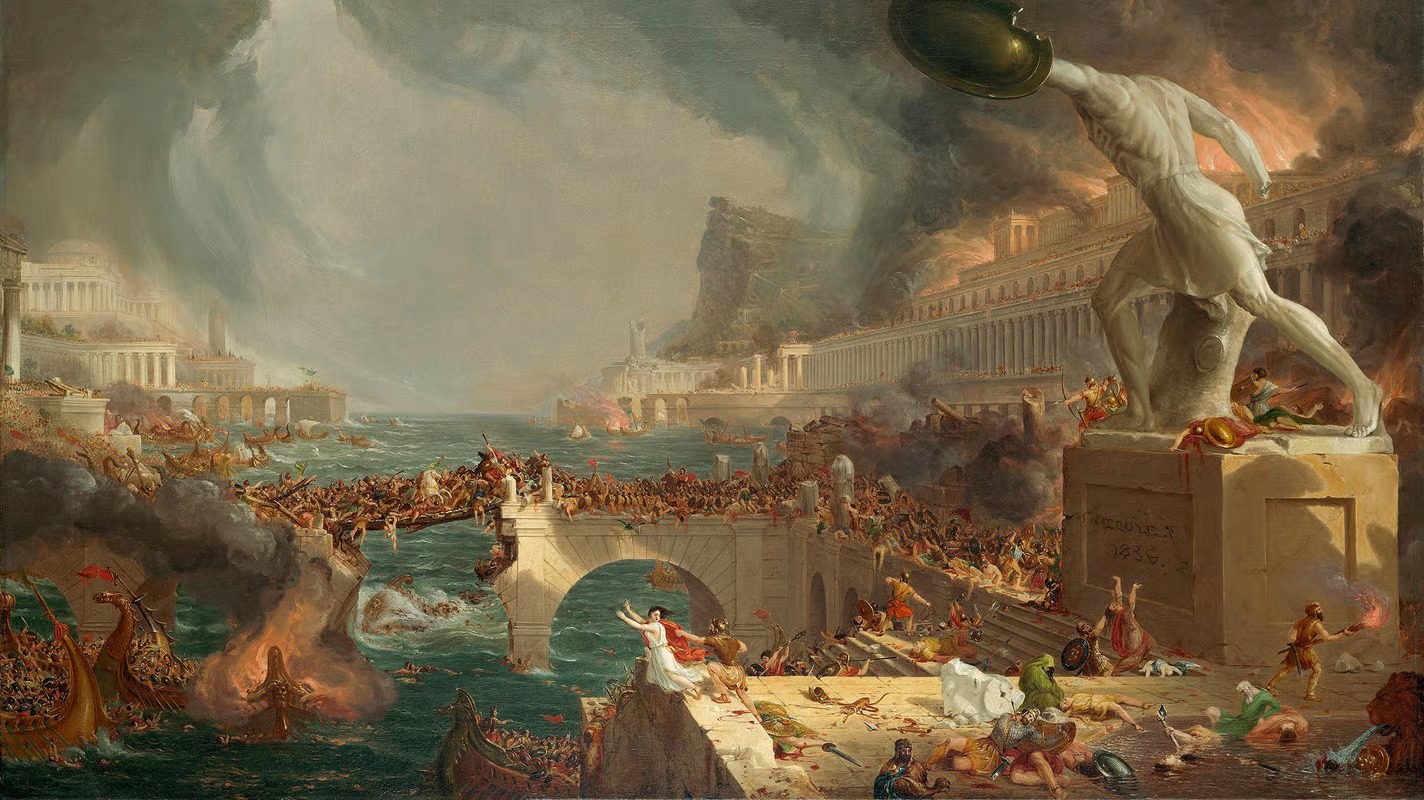
According to one well-known adage, capitalism had rendered itself so devoid of alternatives that it became easier to imagine the end of the world than the end of capitalism. Streeck upends this aphorism, though not in the way one might expect: he equates the end of capitalism with the end of society itself. It recalls the myth of the “Dark Ages” following the collapse of the Roman Empire. Curiously enough, the remedy (or katechon) Streeck devises to forestall this demise—which arrives in the form of a long, drawn-out whimper (or apocalypse)—converges, albeit for different ends, with those on the Old Continent who advocate fracturing supranational sovereignties to salvage Western civilization: exiting the European Monetary Union (EMU), or more commonly, the Eurozone.
Indeed, the post-capitalist (or post-apocalyptic) landscape imagined by the author evokes cyberpunk-libertarian fantasies. In his view, a society in the post-capitalist interregnum will be “a deinstitutionalized or under-institutionalized society” where “expectations can be stabilized only temporarily by local improvisation,” and “for this very reason, such a society will be essentially ungovernable.”
“Contemporary capitalism, then, appears as a society whose system integration has been critically and irreversibly weakened; the continuation of capital accumulation will therefore have to rely – for an indefinite medium term – on nothing other than the opportunism of individualized individuals, collectively incapacitated as they struggle to defend themselves against accidental and structural assaults on their social and economic status.” (p. 31)
Moreover, even within this post-capitalist imaginary, the burden of organizing daily social existence at the micro level need not fall solely upon the individual. Streeck speaks only of the individual, yet he overlooks an array of sub-national institutions. Hierarchies of family, religion, gender, and race are summoned to duty by Silicon Valley-style capital and its ideologues to regiment the masses in the face of this invoked apocalypse. Yet Streeck hits upon an accurate observation: in the behavioral software of this non-society of the interregnum, the “neoliberal ethos of competitive self-improvement” has become thoroughly internalized. One might term this the capillary infiltration of Social Darwinism throughout the interregnum society. This pseudo-sociality, radiating outward from the individual and articulated along the axes of family, religion, gender, and race, can reproduce itself within a zero-sum game plagued by economic stagnation only by rendering itself more competitive than the rest. Pre-modern socialities facilitate the adaptation of individuals to the imperatives of “economic necessity” in the post-apocalyptic landscape of late capitalism. “Capitalism in an interregnum, stripped of sociality,” writes Streeck, “relies on the improvisational performances of structurally self-centered, socially disorganized, and politically disempowered individuals.” (p. 67)
Financialization Against Neoliberalism
Yet could it not be that the emergent order following the interregnum is being organized on the bedrock of a virulent “hyper-liberalism” and Social Darwinism? Is it not plausible that among the ruling classes’ escape vectors, the traditional architecture of promissory pledges has been superseded by a sugarcoated narrative of defeat, mediated through hyper-financialization?
In Speculative Communities, Aris Komporozos-Athanasiou investigates how finance and “populism” have converged and materialized in figures like Trump and Modi. The author highlights the potency of financial speculation, whose core tenets of swift maneuvering and “governing through chaos” stand opposed to neoliberal technocratic rationality and its “liberal slowness” in decision-making. Invoking Max Weber’s analysis of speculation, Komporozos-Athanasiou notes that the German sociologist did not condemn speculation outright as “immoral gambling”; rather, he viewed it as both encompassing and transcending the “instrumental rationality of homo economicus”:
“Speculation may at first glance appear as the embodiment of capitalism’s ‘mimetic,’ ‘atavistic,’ and ‘substantive irrationality.’ Yet for Weber, the speculator is a fascinating, ‘charismatic,’ and socially embedded figure who synthesizes both tradition and personal authority, both passions and interests.”
An affirmative orientation toward risk and uncertainty constitutes, according to the author, the hallmark of speculative communities. An ethnographic study conducted among Tea Party supporters in Louisiana offers crucial insights into the nexus between the “common folk,” finance, and speculation. Party members appeared to reject the neoliberal logic that envisions risk-taking as an investment toward one’s precarious future. Their political instincts did not seem to align with the narrative of an “atomized and anxious entrepreneurial” subjectivity so prevalent in critiques of financialization. Although Tea Party adherents held little sympathy for interventionist measures aimed at “risk management” and “regulation,” their responses to the radical uncertainties confronting them departed from the premise that all problems possess a solution—a conviction the author considers “in sync with the fantasy of the neoliberal mind.”
Thus, speculation can be understood as a complex reaction to the precariousness of economic life under capitalism: an attempt to confront uncertainty through both hedging and wagering. Derivative instruments and their markets appear pivotal in this regard: a derivative is fundamentally a promissory document—a contract resting upon projections of the future that reflects a deliberate anticipation of incalculable unknowns and future unpredictability. In this light, derivatives break free from the “prison of probabilistic thinking” and enter the wild domain of “contingencies.” And here lies the most crucial juncture for our inquiry: one of the seminal transformations wrought by derivative markets is the inversion of neoliberalism’s own logic of promise. To quote Komporozos-Athanasiou directly:
“In politics as in derivative markets, the future no longer typically holds a promise of redemption that legitimates present sacrifice (the logic of austerity); rather, it increasingly signifies a space-time of negation. Speculation can thus be understood as an act of endorsing a broken promise—or, put differently, entering into an intentionally breached contract.”
In a world where labor is precaritized, housing grows increasingly unattainable, household and sovereign debt soar to astronomical heights, and political volatility becomes the baseline norm, finance is the escape hatch proffered by the ruling classes against this tangled web of “radical uncertainties.” Yet, as is evident, there remains a fundamental continuity. Indeed, according to Komporozos-Athanasiou, this contemporary “aristo-populist” alliance has been enabled precisely by the decoupling of finance’s speculative imagination from neoliberal technocratic reason. The collectivization of the sense of uncertainty has prompted the re-summoning of stabilizing narratives and reassuring political mythologies. Consequently, the ascendance of nativism, ethno-nationalism, and gender hierarchies proceeds hand in hand with the vanguard of financial (and digital) technologies—to say nothing of fetishizing our radical ignorance of the future, conjoining an appetite for risk and fatalism with astrology and irrationalist tropes.(9)
Simultaneously infatuated with the future and imprisoned in the present. This is precisely what certain thinkers, who eagerly proclaim the definitive death of neoliberalism and depict capitalism as being, at best, in its death throes, offer to humanity. In their investigation into “financial eschatology,” Samman and Sgambati demonstrate that the self-iterating dynamics of finance capital implant a distinct form of eschatology squarely at the center of everyday life: a financialized eschatology founded upon the infinite circulation and leverage of debt. Nihilistic repetition and apocalyptic obsession operate as two intertwined, potent drives within this dynamic. Echoing Komporozos-Athanasiou, the uncertain future is envisioned as a “source of openness and change,” yet ubiquitously devolves into an “unfulfilled promise.” Indebtedness and the rolling over of debt constitute an endless loop, summoning the apocalypse. A lengthy quote, but well worth quoting:
“On the one hand, there is the mindless repetition involved in the tendency to manage, service, or invest in a debt obligation; on the other hand, the apocalyptic hope that sustains the entire enterprise—the idea that any debt sufficiently leveraged will one day be repaid. Historically speaking, the result is a paradoxical temporality wherein the infinite, cyclical qualities of financial society become the product of a contemporary eschatological imagination: an endless apocalypse based on the end of finance itself.”
Where finance is concerned, it is never Apocalypse Now, but rather Apocalypse Later. Economics is forced to speak the tongue of the Holy Scriptures. Because end-times anticipation commands both the present and the future, eschatology usurps the place of science. It is on these grounds that Samman and Sgambati justly critique Streeck’s explorations into the demise of capitalism as a form of “eschatological disappointment”: it is as though Streeck is rueful that a capitalism perpetually “buying time” stubbornly refuses to meet its end; yet “this time” is supposed to be different, and the system must yield to “something,” even if not to socialism. The crisis that erupted in 1973 and the protracted malaise of 2008 allegedly herald a protracted, terminal depression; capitalism is supposedly gasping its last breath.
Yet, according to the authors, money cannot exist without the co-presence of an unpayable debt that can never be extinguished. The perpetual impossibility of clearance, redemption, or amortization means that Judgment Day is indefinitely deferred. Bearing the full weight of the implication, the authors pose these provocative questions: “What if contemporary capitalism is not attempting to escape long-term stagnation through further debt accumulation? What if the monumental swell of global debt is not a fragile house of cards doomed to collapse? What if the ‘autumn of the system’ signifies not a winter death followed by a vernal rebirth, but an unending winter—a dark age condemned to permanent indebtedness?”
The “final reckoning” between creditors and debtors never takes place “today,” but always “tomorrow.” Because “today” is perpetually the “eve of tomorrow,” the contemporary apparatus of finance feeds daily on apocalyptic lore, “generating and staging millions of endings and terminal points around which countless lives and livelihoods are organized.” While the poor must labor today and service their debts today lest they die bankrupt tomorrow, the wealthy demand the deferral of the apocalypse until tomorrow for the sake of the revenues to be captured today; yet all the while, they know their fortune hangs on borrowed time, harboring the gnawing awareness that one day—perhaps sooner than tomorrow—the hour of reckoning might strike. Yet they have no intention of ever settling accounts. To this end, they flee to far-flung redoubts or perceive the opportunistic silver lining embedded in fantasies of extinction: when the apocalypse strikes, the debts of the wealthy will be wiped clean.(10)
Consequently, abandoning the pledge altogether—and indeed treating a broken promise as a mark of triumph—has become the trademark of the “exit” ideologies incubating in Silicon Valley and digital technology corridors. Nor should this be dismissed as a phenomenon confined to the fringes: across the globe, “post-neoliberal” politicians tread precisely this path. In their examination of how blockchain technologies and libertarian escapisms chart avenues of “new urbanism,” Lynch and Muñoz-Viso deploy the concept of “techno-political failure.” Analyzing the fiascos surrounding “charter cities” and “libertarian city” ventures, the researchers conclude that these escapist narratives trade in notions like the “sovereign individual” and the “opt-in state.” As these concepts become normalized and embedded within broader political discourse, they facilitate a “covert revolution” that erodes democratic norms and ideals. It is for this reason that the collapse of a seaborne “city” off the coast of Thailand is characterized as a “successful failure.”
***
I recount all this not to argue that an exit is impossible. On the contrary, my aim is to underscore that the narrative proclaiming capitalism’s autonomous, self-induced collapse is ideology in the most pejorative sense of the term. What is far more terrifying to the ruling classes is the prospect of capitalism exiting the historical stage through an upheaval stemming from its internal contradictions, yet irreducibly exceeding them. While capitalism’s molting—or the sheer prospect of its transmutation—is read by some as its death knell, the ruling classes weaponize this very perception against the oppressed. Such a sense of an ending induces the resource-starved dispossessed to enlist in the ruling classes’ scrambles for their piece of the pie. Indeed, the quest for an exit strategy spearheaded in the United States—at the apex of this global architecture—threatens to shatter the paradigm of the snake devouring its own tail. In the next essay, we shall embark on a historical excursion to examine American capitalism’s blueprint for escaping the apocalypse.
(1) In his periodization of capitalism, Sombart distinguished between early (merchant), high (industrial), and late capitalism, anticipating Ernest Mandel’s taxonomy as early as the 1920s and 1930s. Hilferding, for his part, viewed the transition from industrial capitalism to the hegemony of finance capital as a transition to something other than capitalism. Meanwhile, James Burnham’s seminal study, The Managerial Revolution, would serve as an intellectual wellspring for all subsequent theses arguing that “organized” capitalism, having undergone bureaucratization, had ceased to be capitalism at all.
(2) Though we shall address this in detail in the subsequent essay, it cannot pass unmentioned: just as (former) Southern slaveholders in the United States viewed desegregation as the end of the world, libertarian polemicists and members of Congress who decried Puerto Rico’s postwar “social-democratic” constitution as an invitation to catastrophe belonged to the very same chorus.
(3) We know that Isabel Paterson—who, alongside Lane and Ayn Rand, constituted the “Three Musketeers” of American libertarianism—harbored identical sentiments regarding social security. Paterson was outspoken enough to proudly assert that, for the minimal-state frontiersman, the only good Indian was indeed a dead Indian.
(4) Lest this essay become overly unwieldy, I deliberately bypass the heated contemporary debates surrounding neo-feudalism, an issue I hope to address in a future piece. For now, it suffices to note that theorists of neo-feudalism may well be conflating rent—their primary economic category—with, say, the turnover time of capital.
(5) One can detect in Jameson the implication that the uneven development of capitalism—or the incomplete realization of real subsumption under capital, as analyzed in Capital—in other words, a historical epoch characterized by the uneven coexistence of disparate modes of production within a hierarchical arrangement, furnishes the necessary fertile ground for revolutionary breakthroughs and the projection of a revolutionary horizon capable of transcending capitalism.
(6) Wolfgang Streeck posits that economic growth under this regime was secured by underwriting aggregate demand. By extending this premise to his diagnosis of crisis, Streeck arrives at an underconsumptionist model. It goes without saying that this formulation has been subjected to robust Marxist critique.
(7) According to Streeck, the neo-Marxist crisis theories emerging from the Frankfurt School around 1968 paid virtually no heed to banks and financial markets because no one had anticipated the “financialization of modern capitalism.” Moreover, these theories fetishized technocratic methods and Keynesian instruments, envisaging a “welfare machine that could be operated in a balanced, crisis-free manner” through regularized corporatist cooperation between states and enterprises. These prognoses failed to hold:
“While the material reproduction of capitalist industrial society thus appeared secure and the crisis tendencies of capitalist development banished, not a trace could be found, even in the longest run, of the ‘pauperization’ of the working class still anticipated by orthodoxy.” (Buying Time, p. 56)
(8) Revolutionaries in the colonies viewed their wars of national liberation as a direct continuation of the anti-fascist struggle of the Second World War, equating Britain, France, or the United States with Nazi Germany.
(9) Komporozos-Athanasiou highlights the affinity that financial titans like J.P. Morgan had for astrology, occultism, and agnostic ideologies. Today, astrology applications rank among the prime frontiers of venture capital investment in financial and digital technologies. The prominent astrology platform Co-Star operates under the banner of “Hyper-personalized, Real-time Horoscopes” and explicitly proclaims the necessity for “irrationality to invade our techno-rationalist way of life.”
(10) The libertarian and neoliberal literature dedicated to profiting from impending financial collapse is voluminous. Quinn Slobodian, whose work I cited extensively in an earlier series, provides abundant examples in his Crack-Up Capitalism. One might also recall “short selling”: a critical financial mechanism that demonstrates how astronomical gains can be harvested not merely from price volatility, but from market crashes themselves.
Works Cited:
Amin Samman and Stefano Sgambati, “Financial Eschatology and the Libidinal Economy of Leverage”, Theory, Culture & Society, 40(3), 103-121.
Aris Komporozos-Athanasiou, Speculative Communities: Living with Uncertainty in a Financialized World, The University of Chicago Press, 2022.
Wolfgang Streeck, Satın Alınan Zaman Demokratik Kapitalizmin Gecikmiş Krizi, çev. Kerem Kabadayı, Koç Üniversitesi Yayınları, 2016, İstanbul.
Wolfgang Streeck, Kapitalizm Nasıl Sona Erecek? Aksayan Bir Sistem Üzerine Yazılar, çev. Bülent Doğan, Tellekt, 2021, İstanbul.

The Pentagon has added ChatGPT and Grok for Government services alongside Google Gemini to its primary portal for artificial intelligence tools.
A Department of Defence official stated that the OpenAI product, designated ChatGPT Mil, will bring new capabilities to the GenAI.mil platform, where military service members and defence-sector civilian personnel can work on controlled unclassified information (CUI) using generative artificial intelligence tools.
A Pentagon official said:
“I prefer Gemini for search functionality or gathering data from specific sources. ChatGPT is more suited to text-based work. We want to provide access to all these different models so that if users prefer one model for a specific task, they can use it.”
Work on creating a version of ChatGPT that could be used for CUI began in February. In June, an OpenAI official said they believed this version would be made available “in early July”.
A Department of Defence press release scheduled for publication today stated that ChatGPT Mil would “bring a familiar commercial experience into the Department’s secure environment, tailored to the needs of warfighters”.
ChatGPT Mil supports document-heavy, unclassified tasks across the Department—including planning, policy, logistics, and administration—and has been scaled to support more than 3 million Department personnel.
An OpenAI official, speaking on condition of anonymity ahead of the official announcement, offered insights into how the military could use this specialised version of ChatGPT.
Operators at Northern Command could use the system alongside FEMA or other arms of the federal government to facilitate planning, resource allocation, or disaster response.
In addition, the Joint Staff’s logistics directorate could use the system to simplify paperwork and documentation.
The official also noted that logisticians across combatant commands would be a “natural audience with use cases such as reconciling supply and maintenance updates, and drafting transportation requirements”.
In background discussions, OpenAI and Pentagon officials said they do not intend to use the models on the GenAI.mil platform for combat purposes.
The Pentagon maintains that it should be able to use artificial intelligence products as it sees fit, which is the focal point of disagreements between the Department and AI model developer Anthropic.
OpenAI, for its part, contends that ChatGPT’s connectivity requirements and large computing power needs make it unsuitable for combat.
The Department continuously tests and explores a range of other tools for such operations and actions.
Like the GenAI.mil version of Gemini, the military version of ChatGPT incorporates built-in additional security features.
The official said: “When dealing with CUI within the Department, it is clear that these cannot reside in a commercial model. We must develop this in a separate environment. It is therefore designed to be separate from the commercial model.”
The Pentagon launched GenAI.mil on 9 December with a single tool, Gemini. Around the same period, Pentagon officials signed an agreement to bring Elon Musk’s xAI tool to the platform, though no official deployment announcement had been made since.
On Monday, the Pentagon announced that Grok for Government, an artificial intelligence product from Musk’s Starshield AI company, is now available on GenAI.mil.

Pentagon office takes 35% stake in Venezuela oil venture

Russia cuts Brussels mission staff in compliance with EU cap

Türkiye shifts oil imports to US amid Russian supply disruptions

Israel sees Türkiye as competitor rather than enemy, diplomat says

James Carden warns US foreign policy elite cling to global dominance
-

 Europe2 weeks ago
Marine Le Pen plans French constitutional referendum on immigration
-
 Diplomacy1 week ago
US strikes fail to break Iran as regional anchors rise, Dr. Moeini says
-

 Diplomacy1 week ago
Blackwater founder Erik Prince creates air defence venture with Kyiv
-

 Asia2 weeks ago
Japan sharpens defense posture while strengthening Turkish ties
-

 Europe1 week ago
UK and Russia edge closer to conflict over long-range drone supply
-

 Asia2 weeks ago
China outpaces India in race for Russian crude oil supplies
-

 Europe2 weeks ago
Europe builds drone defence walls along eastern flank against UAVs
-
 America2 weeks ago
Independent US oil firms set to sign output deals in Venezuela
