
Diplomacy
Cost of living crisis remains top concern for voters in major western economies

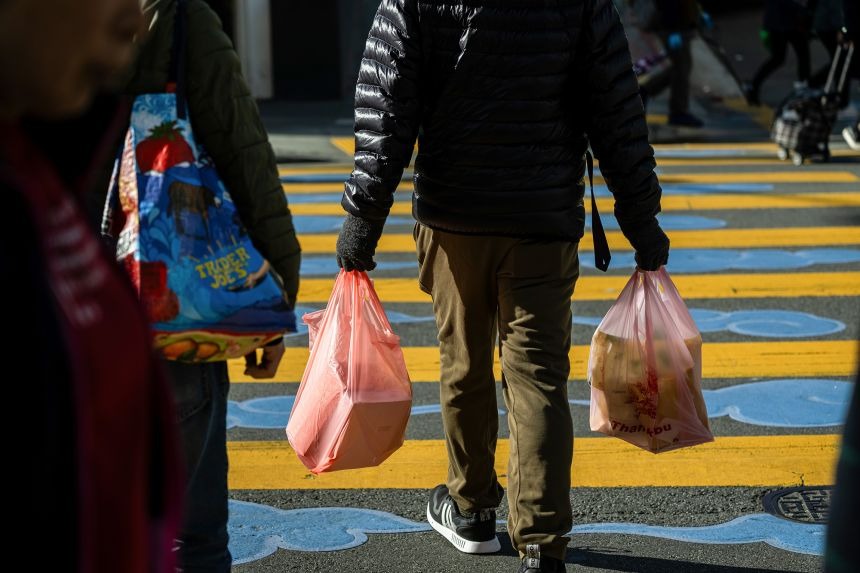
The cost of living crisis that upended global politics last year continues to be the primary issue for populations living in the world’s largest economies.
A new international POLITICO poll shows that voter frustration over persistent financial hardships continues to have a very strong impact today.
The POLITICO poll conducted in five major economies reveals that pressure on the cost of living is reflecting on politics:
In the US, nearly two-thirds of voters (65 %) say the country’s cost of living got worse last year.
In the United Kingdom, where the Conservatives were ousted in 2024 after 14 years in power, 77 % of voters say the cost of living has worsened.
In France, as President Emmanuel Macron grapples with historically low approval ratings, nearly half of adults (45 %) say their country has fallen behind similar economies.
In Germany, following long internal strife over the economy, former Chancellor Olaf Scholz’s ruling coalition collapsed last year. There, 78 % of respondents say the cost of living worsened last year.
In Canada, the post-pandemic economic crisis increased public backlash against the government of then-Prime Minister Justin Trudeau, who resigned earlier this year. According to the POLITICO poll, 60 % of adults in the country say the cost of living is at the worst level they can remember.
The results of the first joint international poll by POLITICO and Public First reveal the difficult struggle many leaders face as they try to contain intertwined economic and political turmoil.
Five years after the coronavirus pandemic upended the global economy, and as the world grapples with competing conflicts and artificial intelligence rapidly becomes a defining force, a significant portion of respondents in the US, Canada, and Europe’s largest economies—Germany, the United Kingdom, and France—view the cost of living as one of the biggest problems currently facing the world.
While leaders claim they are trying to solve economic problems, many people believe their leaders could provide more help regarding living costs but choose not to do so.
Among those surveyed, 71 % in Germany, 70 % in the United Kingdom, 69 % in France and the US, and 64 % in Canada argue that political leaders choose not to do more even though they could.
There is a widespread perception in all five countries that their economies are deteriorating. In France, 82 % of adults, 78 % of respondents in Germany, 77 % of adults in the United Kingdom, and 79 % in Canada say the cost of living in the country has worsened compared to last year.
Most people in the five countries go even further, stating that the cost of living crisis has never been this bad.
As another indicator of the problems leaders face, poll results reveal that many view the livelihood issue as a systemic problem rather than a personal one.
For example, in most of the countries, the majority state that the livelihood problem stems from the high cost of goods.
In the United Kingdom, approximately two-thirds of adults say the country’s economy is worsening; this rate is higher than the 46 % who said their own financial situations worsened last year.
The same trend applies to France, Canada, and Germany, indicating that the public carries widespread concerns about the economy and purchasing power beyond their individual lives.
Voters’ economic concerns are also roiling politics. In 2024, Trump campaigned on economic anxieties without having to manage the economy himself. In recent months, this dynamic has shifted, and voters have started to become dissatisfied with his economic management, highlighting the difficulty of convincing voters of economic progress amidst stubborn cost of living concerns.
This feeling of being left behind was particularly pronounced among Europeans participating in the POLITICO poll. Nearly half of adults in Germany, France, and the United Kingdom said their countries had “generally fallen behind other similar economies.”
More than half of the residents in these countries, excluding the US, believe the livelihood problem will get either “much worse” or “a little worse” in the next five years. In the US, the combined rate for these two options is 44 %. The total rate of those who believe it will get “a little” or “much better” is 31 %.







Diplomacy
Middle East faces insecurity, massacres, and genocide; Iranian diplomat Soltanieh declares
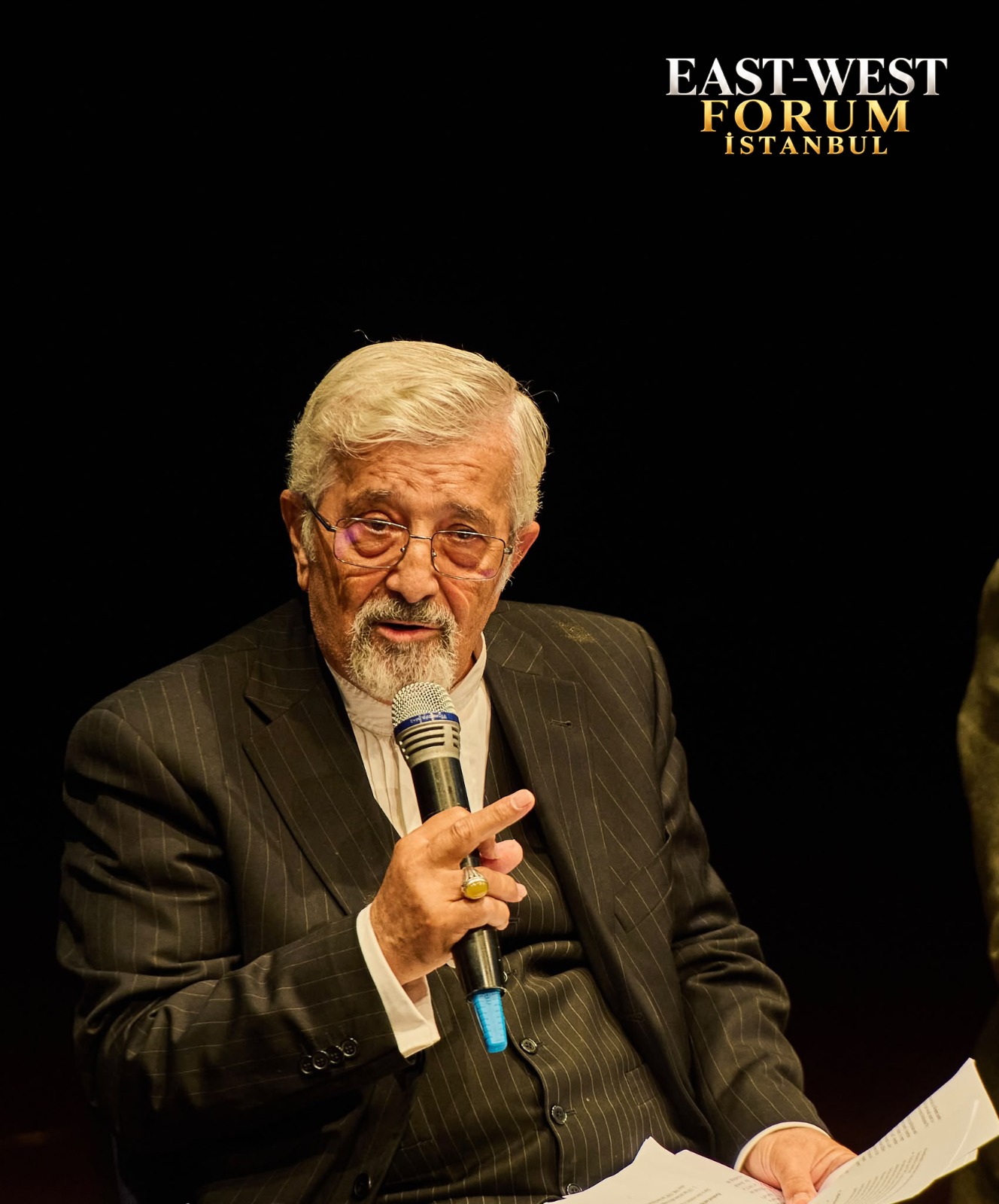
Editor’s note: In his address at the East-West Forum held in Istanbul on September 26, Ambassador Ali Asghar Soltanieh, Iran’s former representative to the IAEA, nuclear scientist, and diplomat, examined the unraveling of Western hegemony and the dynamics driving the transition toward a multipolar new world order. Drawing on more than four decades of international diplomatic experience, he shared firsthand accounts of how global bodies such as the UN, the IAEA, the CWC, and the BWC have been weaponized, particularly by the US and its Western allies. He stressed that the Middle East has been forced to pay the price for historical European crimes and antisemitism through the expulsion of Palestinians and the ongoing genocide in Palestine. Furthermore, he presented concrete instances showing how the NPT regime and international nuclear inspection mechanisms are applied with double standards favoring the West and Israel, with Israel’s acts of aggression being actively covered up by these very institutions.
In the name of God, the most gracious and the most merciful distinguished colleagues,
At the outset allow me to express my sincere appreciation to organizers, Harici and European Transcontinental Initiative, for invitation to this important conference, at this crucial historical time juncture in the fragmented world, and to wish a successful conference.
Some scholars are of the view that we are at the verge of the End of the Western Century and beginning of a Post-Hegemonic World Order.
The simple question is: How has the historical relationship between East and West evolved from Western imperial and liberal dominance toward a contested multipolar order, and how can the transition be managed without reproducing the cultural homogenization, geopolitical confrontation and technological domination associated with hegemony?
In order to make a careful analysis of the “Transition of the East–West Relations, From Western Hegemony to a Multipolar World Order”, one has to identify the main characteristics in Western domination structure that caused it to undermine itself, which in turn would point to some key features in the building block of a new Eastern-oriented Multipolar System.
The emerging multipolar order should not be understood simply as the replacement of western (mainly American) hegemony by Chinese, Russian or another national hegemony. Rather, it represents a deeper contest over the political meaning of modernity itself: whether the future international system will continue to be organized around a universalizing liberal model historically associated with the West, or whether different civilizations and political traditions will coexist within a pluralistic system of states. A peaceful transition will depend not on the restoration of unipolarity or on a new “clash of civilizations,” but on reconstructing international institutions around political equality, cultural pluralism, strategic restraint, technological governance and social solidarity.
In this paper the new world order is analyzed from the prism of West Asia, nowadays known as Middle East.
It has to be recalled that bitter fact that European Jewish communities experienced centuries of discrimination, persecution and antisemitic violence.
European antisemitism created conditions in which the search for a secure Jewish homeland became increasingly urgent. In fact, western powers decided to expel almost all Jews from Europe to the Middle East, to establish a western entity in the heart of East, West Asia, Middle East, by expelling millions of Palestinian from their homeland. Since then, Middle East is facing continuous insecurity, carnage and lastly genocide, in a nutshell Middle East is paying the Price for crimes in Europe.
Given the over 40 years of experience in multilateral diplomacy, working closely with UN and other international organizations, I was asked to focus my analysis on performance of such international institutions during so called “World Order or the Post World War-II era”. The following are part of my own memoir with well documented evidences on instrumental uses of western countries, mostly United State of international organizations. They are neither the position of Iran nor that of VIIMES:
Having in mind the inherited shortcomings of the UN Charter, statutes of such organizations, provisions of relevant treaties and conventions, one could easily notice very disappointing record of negative performance of UN and other international organizations, due to western countries manipulations and imposed obstacles.
I just try to inform distinguished participants some real events which I have personally been involved and witnessed:
Based on text of NPT, it is the most discriminatory security treaty, dividing its parties into “Haves “ , P5, and “ Have Nots”. NWSs are exempted from any inspections by the IAEA. Its article 6, calling for nuclear disarmament has no deadline, no accountability.
Countries of NAM (Non-aligned Movement) proposed a paragraph on Banning nuclear tests for the final document. US, UK, USSR, the 3 Nuclear possessors and party to NPT opposed.
Note: France and China had not joined NPT then.
After 8 hours negotiation until 4 am, at the sideline of the plenary, at the Mission of Sweden, between 3 representatives of NAM, including myself, with representatives of three NWSs, no agreement was made, due to objection of US delegation even to Chair proposal which all agreed to go along with. Therefore, the Conference could not have final document and failed.
NAM, specifically countries in the Middle East emphasized on Establishment of Nuclear Weapons Free Zone in ME. I recall Iran and then Egypt originally had proposed in 1974. Western countries, specially US agreed with condition of indefinite extension of NPT, which would have expired after 25 years. As today, US has not only not complied with the 1995 obligation, but has prevented any other attempt in this regard, to fulfilling Israeli demands, not giving up nuclear weapons and not joining NPT.
US opposed the adoption of the agenda of conference which included the tradition f item of review the implementation of decision of last Review Conference in 2000, since the conference had adopted 13 unequivocal undertakings for nuclear disarmaments. The Conference collapsed.
The first time, after intensive negotiations, the conference accepted by consensus to convene a conference on “Nuclear Weapon Free Zone in the Middle East “ in 2012. After 2 years preparation, shortly before the conference planned to be held in Helsinki, the US (Obama Administration, who has adopted the decision in 2010) unilaterally indefinitely postpend the conference, with disregards of all state parties, in order to satisfy Israel.
The Conference collapsed due to objections of US , UK and Canada to the text of Nuclear Weapon Free Zone in the Middle East.
IAEA was established after the Moto of “Atom for Peaces” by President of US, the only country used nuclear weapons in history. Since then, quantity and quality of US nuclear arsenal have been drastically increased. More countries have joined nuclear club!
IAEA Members States are 3 groups: NNWS parties to NPT subjected to IAEA Safeguards, NWSs parties to NPT (P5), and Non- party to NPT (India, Pakistan, Israel, North Korea), exempted from any inspections. Absolute discrimination
IAEA safeguards, inspections which has to be “Nuclear material-oriented Safeguards” is changed into “Intelligence information-oriented Safeguards” which in in full contravention with the spirit and letter of the IAEA Statutes.
Number of seats are 35 as was the case over 40 years ago, 10 seats called “designated seats” are permanent, and their distribution is in favor of the West. Impartial analyses shall show the murky records of its decisions/resolutions, which have politicized and polarized this so-called international technical organization. The organization expected to promote peaceful uses of nuclear energy has turned into self-styled UN Watchdog with discrimination among member states, P5 and 4 others are exempted from any inspections while others are under comprehensive safeguards, and even a couple of them such as Iran are under the most intrusive inspections much beyond the routine safeguards. The IAEA has shamefully been blocked from conducting preventive or remedial actions in cases of military attacks against peaceful nuclear facilities under its full scope safeguards. Provisions of the IAEA Statutes on structure, mandate, and authority of the Board of Governors has to be reformed by Amendment Conference.
Attacks against nuclear facilities under the IAEA safeguards:
The taboo was broken for the first time ion history by Israel, attacking Iraqi research reactor under construction by France, in 1981.
During the IAEA General Conference in 1982, the US threatened that f a resolution condemning Israel violation is passed, US shall; withdraw from Agency’s membership thus almost 25% of budget will disappear! Iran, myself as representative was sure it was a bluff since US shall not leave IAEA, it need it to put pressure on developing countries, proposed that if US leave, it will compensate financial gap, thus encouraged like minded countries, in the ME and NAM at large to support the draft resolution, even if was proposed by Iraq, Sadam regime, having war imposed on Iran. The resolution passed, US and French delegations left conference room as a protest to decision by General Conference, but continued membership!
Sadam Regime several times attacked Bushehr Nuclear Power Plant in Iran from 1984 to 1988, but neither the IAEA Board of Governors, nor the General Conference condemned, since the whole west were supporting Sadam Regime.
During General Conference in 1990, I propose a resolution which was adopted. According to the resolution 533, any attack and threat of attack against nuclear installations under IAEA Safeguards, constitute violation of UN Charter, IAEA Statute, and international law, and UNSC has to immediately act. All member states are called upon to assist the attacked country.
Israel attacked Syrian site under the pretext of constructing a research reactor, not nuclear weapons. Despite all inspections made and IAEA was not able to definitely prove the allegation, the western countries, US and EU proposed a resolution to the Board of Governors, which was marginally, with only 17 votes, approved. Rather than the aggressor, Israel, the attacked country was sent to UNSC.
Israel and US attacked all nuclear facilities under full scope safeguards in June 2025 and again after February 2026. The IAEA Board of Governors and the Director General did not passed resolution or condemned the aggressions which were in full contravention with IAEA resolution 533.
Note: In a clear double standard and hypocrisy, US and EU summitted a resolution against Rusia on Ukraine Nuclear Power Plant, based on resolution of 533 of 1990, which I proposed, and S and some EU members voted against it then.
Paradoxically, Board of Governor in its recent session decided to remove Syrian issue from agenda after almost 2 decades, under the unfounded technical allegations, since western countries has good relation with new Government. Double Standard and proof of politization of the IAEA
After Chernobyl Nuclear Accident in 1986, negotiation on drafting two conventions, “Early Notification of Nuclear Accident”, and “Emergency Assistance in Case of Nuclear Accident” was intensive held in Vienna, where I was representing on behalf of Islamic Republic of Iran.
The first week, US and Russia announce that both should be exempted from reporting any accident in their nuclear facilities. I rejected any discrimination, specifically by exemption of countries having very active nuclear activities and facilities with more probability of nuclear accidents which shall have transboundary release of radioactive material to other countries in world.
I am proud that after 3 weeks of political challenges, finally they were forced to compromise, and we sat together and prepared the text of article -1 , on scope of the convention accepted by all member states.
Sadam used chemical weapons. About 100 thousand Iranian were killed and injured. Undeniable published documents are available that western countries gave Chemical weapons to Iraq.
Islamic Republic of Iran actively participated in negotiation on Chemical Weapon Convention (CWC) in Geneva, signed and approve it. US and Russia did not destroy their huge chemical weapons, within 10 years dead line envisaged by the convention, thus asked General Conference to exceptionally extend time, bad precedent. Russia did so, but used even went beyond the dead line.
Syrian join CWC, with encouragement of Russi and Iran. It compromised its national security, since Israel has not joined the CWC, for the sake of international security. While parts of Syria were under the control of foreign forces and terrorist, it obviously could not give complete declaration. Western countries created political tension and agenda at the OPCW, to put political pressure on Assad Government. Now the agenda on Syria which involved the OPCW, under technical pretext, obviously with political motivation for over a decade, will be removed since wester countries have good relation with new government.
Almost 10 years of negation on Protocol for Biological Weapons Convention (BWC) in Geneva, aiming at establishment of an international organization, similar to the IAEA and OPCW, collapsed, by US official objection in 2002. The rolling text is now in archive. Absolute disregards for all countries genially opted for disarmament of WMD. Had the such organization been established, it could have helped the world public, facing panic with thousands of dead as the result of Covid outbreak. Being involved in that negotiation, I proposed our EU counterparts to let establish the said organization based on Rolling text, though US is absent, but they privately said that bioindustry in EU will not permit governments to do so, as long as their competitors in US are not covered by the protocol of the BWC. This is another indication that such humanitarian safety and security concerns have no place in western policy.
Due to time constraint, it suffices just to remind some factual cases:
UN has not been able to implement its resolution, on Palestine Statehood since 1948. UNSC has been blocked by US veto, and General Assembly resolutions are not legally binding! Insecurity and bloodshed in the Middle East continue.
UNSC was paralyzed during 2-year genocide in Gaza by Israel, was not even able to force a ceasefire, since US vetoed the resolutions in this regard.
US was humiliated by Israeli Ambassador, who put the Charter of United Nation in shredder machine, in the General Assembly.
ICJ and ICC ruling on Genocide in Gaza has not been implemented, as the results of defiance by most of western countries.
At the General Assembly, this week, US President officially declared the intention of his country for total annihilation of a UN member state, Iran, which is flagrant violation of UN Charter, specifically article 2. EU and other western countries kept silence.
Exceptional developments such as emergence of new multilateral institutions, the Shanghai Cooperation Organization and BRICS shall have serious impact on the process of such transition, with colorful contributions of new eastern emerging powers.
The transition from Western hegemony to multipolarity will have little historical meaning if it merely replaces one form of external domination with another. Its deeper promise lies in creating an international system in which East and West can participate as historically distinct, but coexisting in equal footing with mutual respect.
UN and other international organizations, institutes of Post World War -II so call “World Order”, have continuously instrumentally used mostly by western counties, therefore lack utility and stalemate. There is an immediate need for a fundamental reform, and establishment of a new Multipolar order is a must.
Memories of centuries of peaceful coexistence of followers of three Devine religions, Judaism, Christianity, and Islam shall be revitalized in the Middle East.
Scholars enlighten the public to stand vis-à-vis the status quo and make a new world order based on justice and equality in order to create sustainable Peace and Prosperity in the Middle East and World at large.
Thank you for your kind attention.
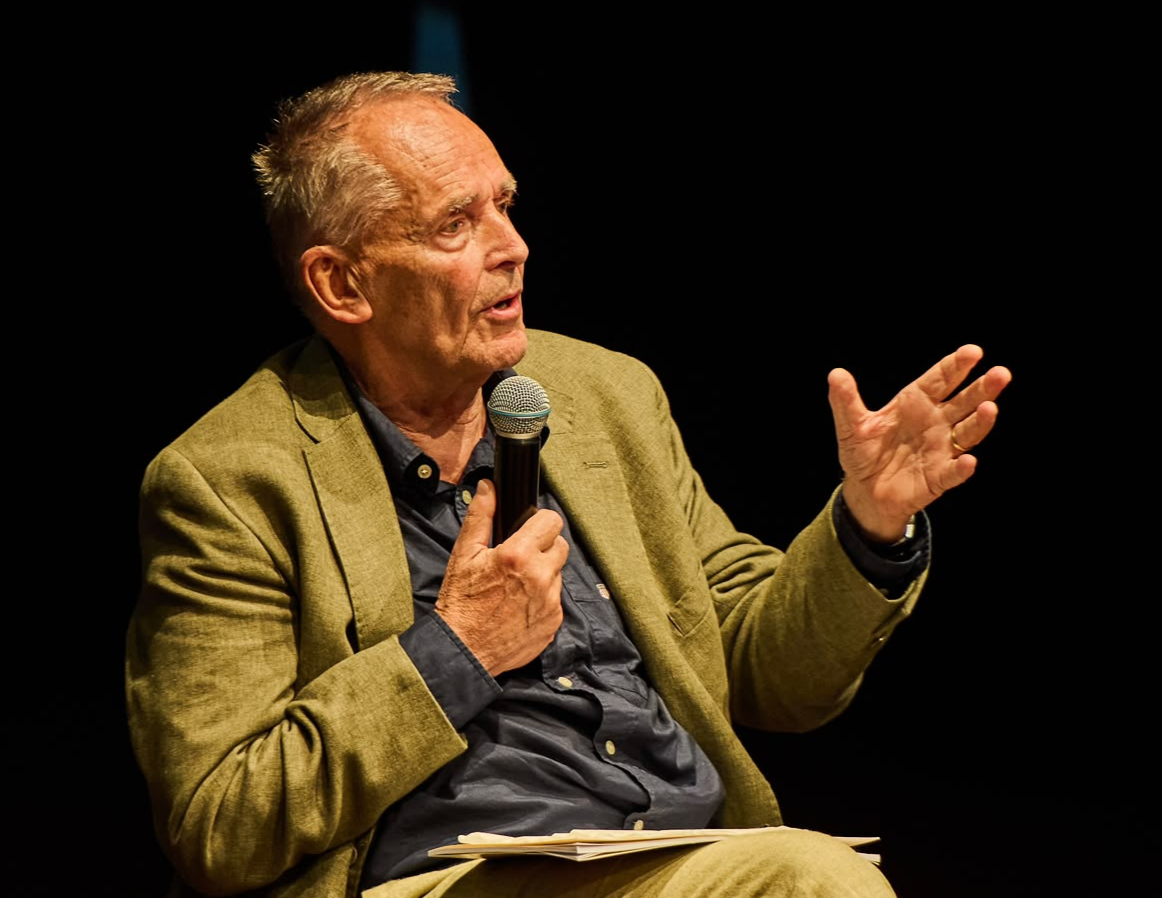
Editor’s note: Speaking at the East-West Forum held in Istanbul on September 26, Michael von der Schulenburg, Member of the European Parliament and former Assistant Secretary-General of the United Nations, offered striking assessments of the European Union’s current trajectory. Schulenburg stated that the Union, established after World War II to build peace, has now abandoned this mission and surrendered entirely to a war-driven rhetoric. He pointed out that Europe, while grappling with structural challenges such as scarce resources, high energy costs, deindustrialization, and a demographic crisis, has been left confronting a ring of active conflicts along its borders. Emphasizing that Brussels has lost its capacity for diplomacy and mediation, the senior diplomat stated that the 27 member states lack the flexibility and collective will to sit at the negotiating table with Russia.
I’m not an academic, as you said. I’m coming from the real world of wars and peace, and I spent all my life outside Europe, actually, but the last two years I spent in the European Union, and I’m quite shocked what I see there. The European Union, as you know, was founded after the Second World War as a peace project.
A peace project, not to repeat the Second World War, bring countries together in Europe, but also reflect to the outside world that there is a sort of peaceful integration where you don’t have to have war. That has completely changed. When I listen today in the Parliament or on the line, actually, war is the main theme of the debate now in the European Union.
I would now characterize the European Union as an organization that is in complete denial of reality, of complete denial of reality, and therefore is completely unable to do any policy. And when the question here in the seminar is whether there is a contribution to the new world order, it will surely not come from the European Union.
Let me just make some comparison, which is closer to my job. When you compare the European Union to the United States, China and Russia, then the European Union is surrounded by most of the wars in the world, active wars. No other of these countries have so many wars around them. And even we have the problem that the United States starts wars like the Iran war and others, and they withdraw over the Atlantic.
But the consequences of the wars will stay next to the European Union. I think about Iran, I think about the many wars Israel does, from Syria to Lebanon to West Bank, Gaza. But I think also about the war between Yemen and Saudi Arabia. And then behind them, there’s all these conflicts in Africa, Mali and so on, and of course, Sudan. And the worst, of course, for us is the Ukraine war, because it’s on our own continent.
When you compare the European Union to the other three powers, you also realize that we are probably the place which have the least natural resources. We have a huge demographic problem. We have a demographic transition in our country, which we like not to speak about, but it will have an enormous influence. We have the most expensive energy. We have lost our comparative advantage. We have deindustrialization. And of course, we now lose what actually made Europe so special in the world, our social system.
You would assume that the European Union, and with this one, I don’t mean only the institution, but also the member states who have created what they call a common foreign and security policy would have be very strong because they would have to react to what happens around them.
Oh, forgot the United States, of course gripping now Greenland because I think that the agreement they just signed is the first step of taking over full control of Greenland. I mean we should not have any. And that’s a European territory. I mean what does the European Union does they have no foreign policy, they have no security policy, at least not that I can detect. They have a lot of political statements. They’re usually full of rearm Europe that we have to finally to become a military power. And they are full of moral.
And you know, in the UN we say always who speaks about war, moral wants war and those who speak about interest look for a solution. There’s nothing speaking about interest in the I can detect in the European Union. So it’s very, very worried. You know, this whole moral. Of course somebody who always thinks that I’m the moral superior is always very close to hypocrisy. And it’s actually sometimes really painful to listen to all these arguments.
But in a sense we have no policy to something which is actually for the European Union, for its future life threatening all these conflicts around them. You cannot speak to anybody. We don’t see anywhere we sit on the table of negotiations. Nowhere we have a proposal, nowhere we try to interfere on saying maybe we can mediate or anything.
There’s nothing of the sort anymore. And despite the fact that the foreign service alone of the European Union not to speak about the member states cost $1 billion a year, $1 billion. I don’t know what they do. I’ve met them in the field. I have no clue what European diplomats do. Anyway,
the most important thing is of course Ukraine. I mean it’s in our continent. If you are in such an insecure situation as we are, I mean the first thing one should come to mind that we need peace on the European continent. Then maybe we can also deal with the others.
Having peace in the European continent means that we have to talk to Russia, we have to negotiate, we have somehow to find a solution to the conflict. But we can’t. We are so blocked in ourselves that we were unable, we would be unable to have a negotiating position with Russia because the 27 countries cannot agree on a changed policy.
They cannot agree on what person should do in negotiations and they would never agree to give this person a certain flexibility people need when they do peace negotiations. And even if you think the E3 take the lead, the interest of the E3 is so completely different that it will not that is even more dangerous because the British would hate anything which is peace with the east because they look to the Atlantic and they see this since 1850, I think, as a great danger.
Germany would be the greatest profiteer from these things, but behaves, of course, irrational, most irrational. And the British would. The French would probably also not like it because the link to Russia and things like this would be of enormous economic and political benefit for you. So we don’t have anything.
What I want to say conclude with this whole thing is that the European Union will be a factor of instability in the world for a long time to come. I think as we go along, it will have also instability within its own borders. It is very sad to say. So the peace project of the European Union has been lost. And this loss of peace, we will all have problems that will make future generations suffer. Thank you very much.
East-West Forum in Istanbul to debate multipolarity and global order
Diplomacy
While the West breeds crises, Eurasia weaves peace and development, says Prof. Zhang Weiwei
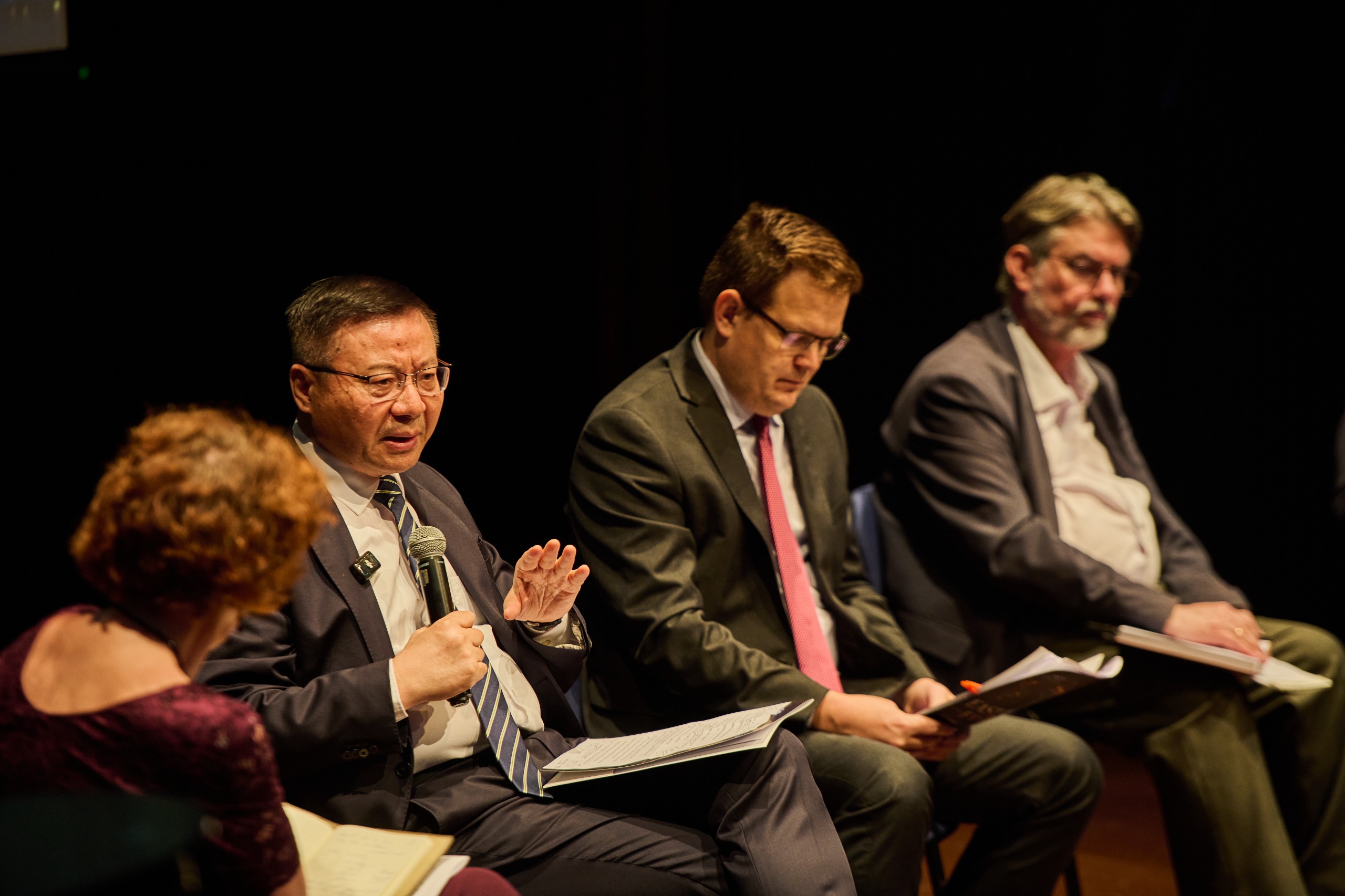
Editor’s note: Prof. Zhang Weiwei, Director of the China Institute at Fudan University and former interpreter for Deng Xiaoping, evaluated the imperatives of a multipolar world and China’s global role as a “civilization-state” at the East-West Forum held in Istanbul on September 25-26. Highlighting China’s distinct framework that integrates ancient history with modern capacity, Prof. Zhang underscored the tangible benefits that meritocracy, public order, and a peace-oriented approach deliver to global stability. In contrast to the Western posture that legitimizes military interventions and polarizes the world, he stated that frameworks such as the Shanghai Cooperation Organisation and ASEAN transform Eurasia into an arena of peace and development. Pointing out that Chinese philosophy sets the threshold for resorting to war at the highest level and centers on forging consensus out of conflict, Zhang noted that maximum restraint is exercised even in border disputes.
Well, I will try to present my view on this whole topic of the world in transition and China as a civilizational state as mentioned in the outline of the program for the conference.
As we all know, I think the world is already multipolar. If you look at the size of the GDP of four BRIC members, it’s already larger than G7; yet the multipolar world order is not yet born.
So that’s something we try to produce and shape, including our foreign East-West Forum here.
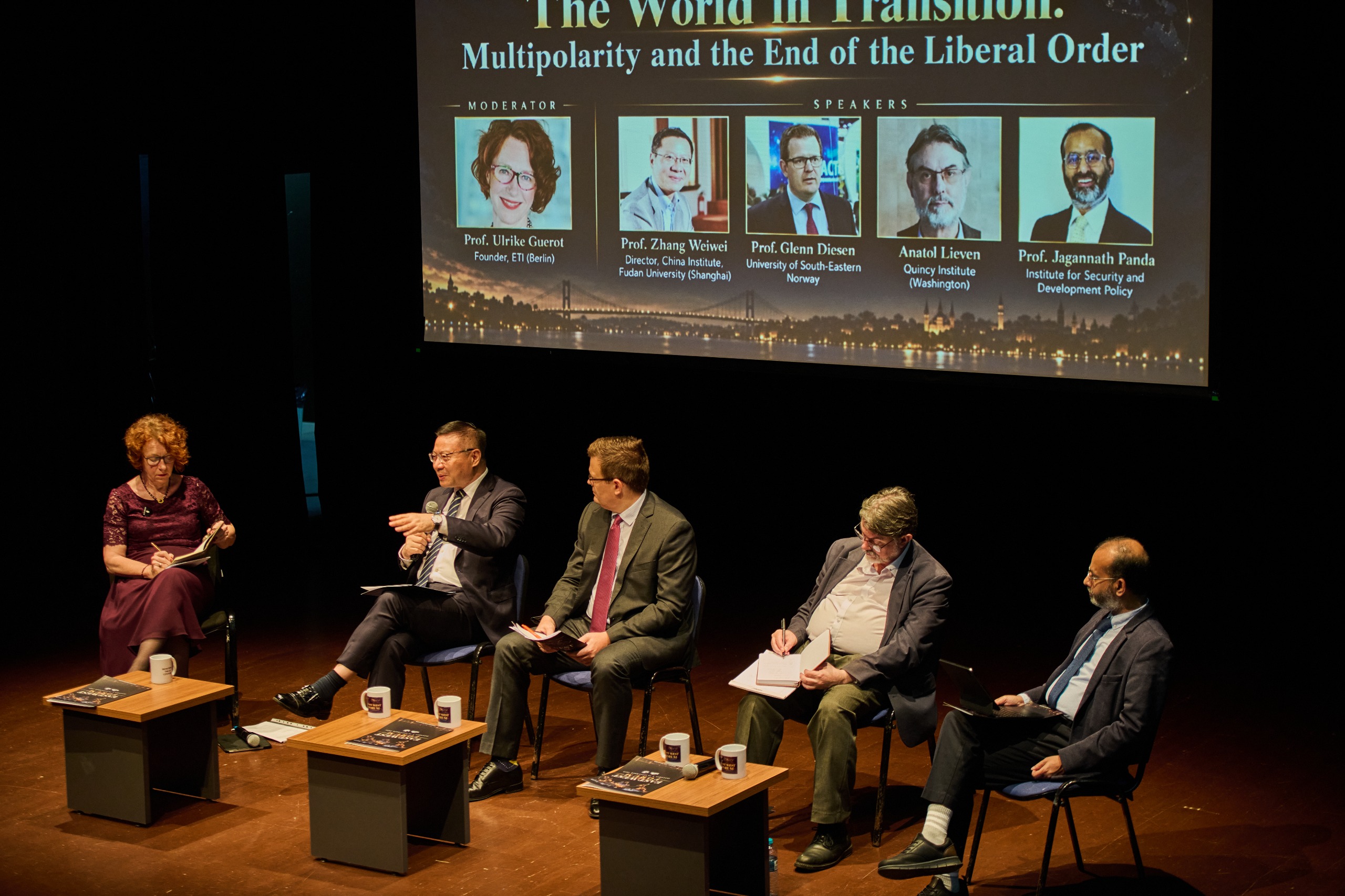
Well, here comes to the role of China. China is indeed a unique country and can make important contribution, perhaps already made very important contribution to a new global order, more fair and more just order.
How to define a civilizational state? It is an amalgam of the world’s longest continuous civilization with a super large modern state. I try to summarize this into four supers: Super large population, super large territory, super long history and super rich cultures. All these four supers, each of which is a blend of old and new, Asian and modern.
For instance, if you talk about the large population; yes, China has always been a populous country since ancient times, yet this population is very well educated.
Every year we produce more scientists and engineers than the Western countries combined. Same with this vast territory: It’s our inheritance from history, yet it’s also very modernized, connected with first-rate infrastructure, the best railway system, best highway system and best digital infrastructure. 5G into every village, no exception. Super long history, it’s also a combination of old and new.
If you look at China’s political system, if the Western system is about election, the Chinese system is about selection plus election: selection from the Chinese tradition and election we adapt from the Western tradition.
Same with super rich culture. If we talk about political culture, the most important priority in China is people’s livelihood. First, it’s very much Confucianism: Whatever you do, the state has to deliver to improve people’s livelihood, both in material terms and non-material terms.
An inaccurate analogy—very inaccurate, just for reference—would be something like dozens of Islamic nations or countries today have amalgamated into one nation with a centralized government, with a very modern economy and speaking the same language. Yes, it’s also a highly developed economy, but it’s one nation. Or another inaccurate analogy, which is not politically correct: Like the Roman Empire has continued to this day with all these different countries uniting into one and speaking Latin.
Yet in the case of China, with a very strong philosophical tradition, we treasure peace, peace above all. Most important thing; highly modern, but also from Asian tradition. This will be a kind of nation-state, a civilizational state, as I try to explain to you.
And now we look at the international order; let’s say we try to build a kind of new order much better than the one we have, from unipolarity to multipolarity. First, let’s look at the ideas or philosophies: In what way does China differ from the United States? Vastly different. For instance, if you look at the Chinese political philosophy, it’s never about “divide and rule”, it’s always about “unite and prosper”. Within China we practice this way, outside China in the world we do the same.
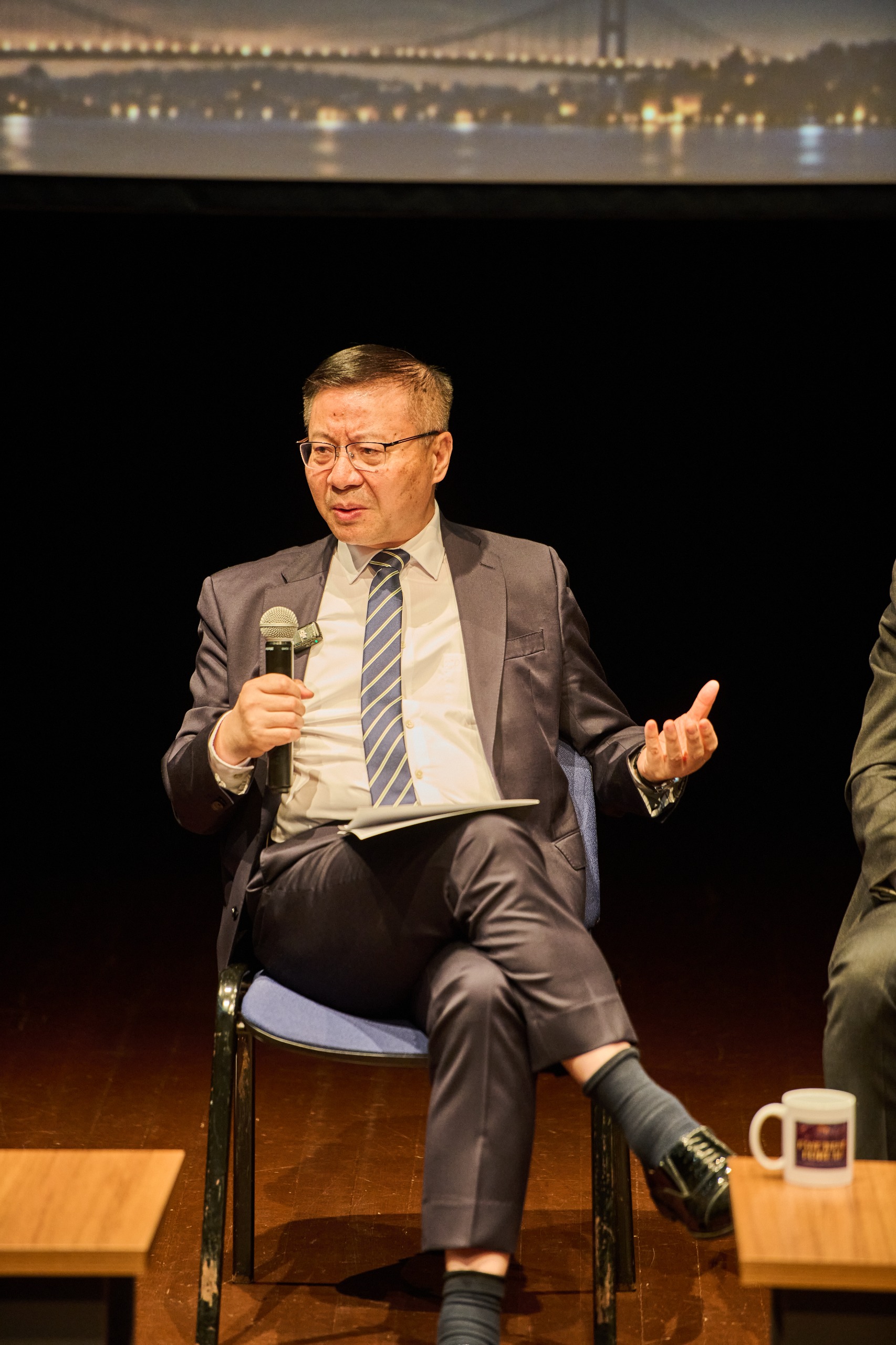
“The Chinese case is friend or potential friend”
And in terms of strategic policies for the United States or the Western philosophy in general, it’s “friend or foe”. You’re either a friend or enemy. But the Chinese case is “friend or potential friend”. In other words, you have a much longer view, longer vision as a civilizational state.
And then it’s very different from the trigger-happy United States. If you look at China’s history, China has the highest threshold for the use of force among the major powers. Of course, China has very clear red lines; this is very important. But also this is strongly influenced by Sun Tzu’s famous book The Art of War: The idea is you try to subdue your opponents or enemy without actual fighting.
So you have this philosophy, and then you have this philosophy of friend and potential friend; you can have already avoided so many wars, you can prevent a lot of wars from happening.
This is the way China handles this philosophical part. Of course, the most important thing is humanity: Humanity has won, rather than “on the table or on the menu”. This philosophy China rejects categorically; it’s very much against Chinese conscience.
Now when we talk about a shared future for mankind or one humanity, some people say it’s idealistic: How do you put this into practice, how to make this into something tangible? I was asked by an American scholar in Xiangshan Forum about this question: Why did Chinese leader Xi Jinping present this whole Global Governance Initiative at the Shanghai Cooperation Organization rather than the United Nations, a more serious forum?
I said it’s very, very simple to understand: Because the Shanghai Cooperation Organization is the embodiment of these four initiatives Xi Jinping has raised—on development, on security, on civilization, on governance. Exactly four pillars of Shanghai Cooperation; that’s my summary.
Now the Shanghai Cooperation Organization has become the world’s largest regional cooperation organization in terms of population, in terms of landmass and in terms of the results. It’s already larger in GDP than the G7.
Same with ASEAN; if you look at China’s partnership with ASEAN, it’s based on the same four pillars. As a result, China now contributes every year 30% to world economic growth; ASEAN produces roughly 7 to 8%.
With this kind of China-ASEAN cooperation, we contribute to close to 40% of global economic growth. Then you look at this whole Eurasian landmass, from Russia to Central Asia, to China, to Southeast Asia: This huge landmass has been a land of peace and development for the past five decades. It’s so important.
In many ways I say, if China had adopted the Western so-called liberal democracy system, maybe China had already produced a Donald Trump and the Third World War had already occurred. With the Chinese political system, as Professor Jeffrey Sachs said, you have the only adult in the room who can make rational decisions about the world, about China, about global affairs.
And finally, just to make a small comment on this practice: If you look at these regional organizations and what they have achieved as a result, both Central Asia and Southeast Asia were described as a “geopolitical curse” for many decades for understandable reasons—complicated geography, complicated religious traditions, complicated different political systems.
Yet today we can see with very high pride that they are geopolitical bonuses. Central Asia used to be landlocked countries; now they are land-linked. With this kind of positive note, China as a civilizational state has produced both ideas and practices for a possibly better world to come.
If you look at the opinion surveys done by reputable opinion survey agencies, what value Chinese treasure most is public order. That’s a vast country the size of 100 European countries put together; and so China hates the word “anarchic”.
So when we talk about the multipolar world order, if you look at the official language, it’s called a more just, orderly public order.
With China, ASEAN, and the Shanghai Cooperation Organization, it’s already possible to foresee—from a Chinese perspective—a future more benign, more just, and fairer international order to come.
I do want to discuss a bit about this China-Philippines case: If China were behaving like the United States, with China’s military power today we could dismantle the Philippine military force within 24 hours. But we did not do that; in whatever problems, we only use, at maximum, water cannons.
Even in our border clash with India, it’s not at all what other major powers would do; it was only fist fighting between soldiers, and then issues are being resolved gradually. At this moment the China-India leaders met each other and relations became more normalized. I hope the world will do better.
“In the Western so-called universal values, they never mention peace”
And now I want to make one or two points here. One is concerning liberal values.
If you look at Xi Jinping’s Global Governance Initiative, he mentioned what is called the common values—six of them: Peace, development, fairness, justice, democracy, and freedom. What’s most important is that peace is top on the list.
Because when you mention Western so-called universal values, they talk about human rights and democracy, but they never mention peace. In other words, the West reserves the right to use military force on Global South countries.
This is totally wrong; we don’t accept this. Peace is at the top of the list of these common values, and I think it is appreciated by most countries and most peoples in the world. Peace is number one.
And second, each civilization has its own values. But now we have the United Nations Charter, which is the broadest common denominator we can share.
When China says we should reform this current international order, we mean we should return to the United Nations Charter, which is the post-World War II arrangement that most countries accept.
With this “rules-based order”, it’s not the United Nations Charter; it’s the so-called liberal values dictated by the United States and the European countries—lieutenants of the United States—imposed on others.
Look at the Arab Spring: Millions died, hundreds of millions lost their homes and became homeless, and yet they don’t feel guilty. “We can do whatever we want because of this liberal order we promote.” We reject that categorically.
I was with Russian friends talking about the origin of the Ukrainian crisis; of course we think there is a problem with NATO’s eastward expansion. Five rounds of expansion.
I said: If you had stopped after four rounds, this crisis could have been avoided. As far as China is concerned, I don’t know why Russia tolerated five rounds of expansion; China would not even allow a single expansion into Asia.

Germany expands North Sea military ports and plans new naval base

Musk appointed co-director of Pentagon future warfare initiative

US waives human rights terms on $320m military aid to Egypt

Putin says Russia did not start war and warns of nuclear risks

European nations unite against US pressure over strategic oil stocks
-

 Europe4 days ago
European unions urge governments to scrap all Palantir deals
-
 Diplomacy4 days ago
East-West Forum in Istanbul highlights irreversible shift to multipolarity
-
 Europe1 week ago
Emmanuel Todd says West faces collapse amid Ukraine and Iran crises
-
 Europe1 week ago
European intelligence chiefs divide over risk of Russian attack
-
 Diplomacy1 week ago
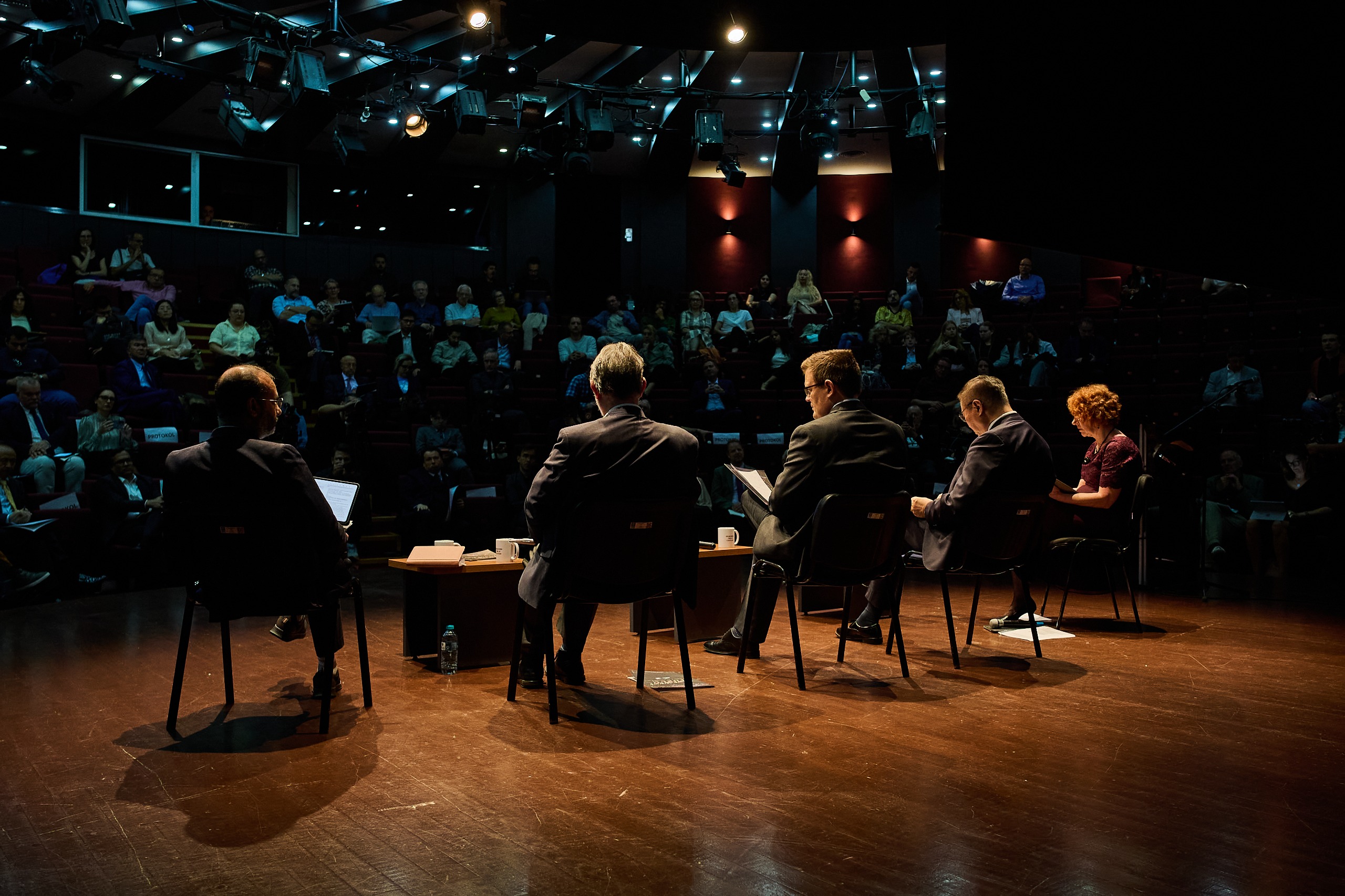
East-West Forum in Istanbul to debate multipolarity and global order
-
 Middle East1 week ago
Sharaa says 7 October must not shape Israel policy on Syria
-
 America1 week ago
Republican support for Trump’s war with Iran drops sharply in polls
-
 Middle East1 week ago
Palestinian factions confront legitimacy crisis at Istanbul talks
