
Opinion
Behind Modi’s success and India’s future

Dr. Duygu Çağla Bayram
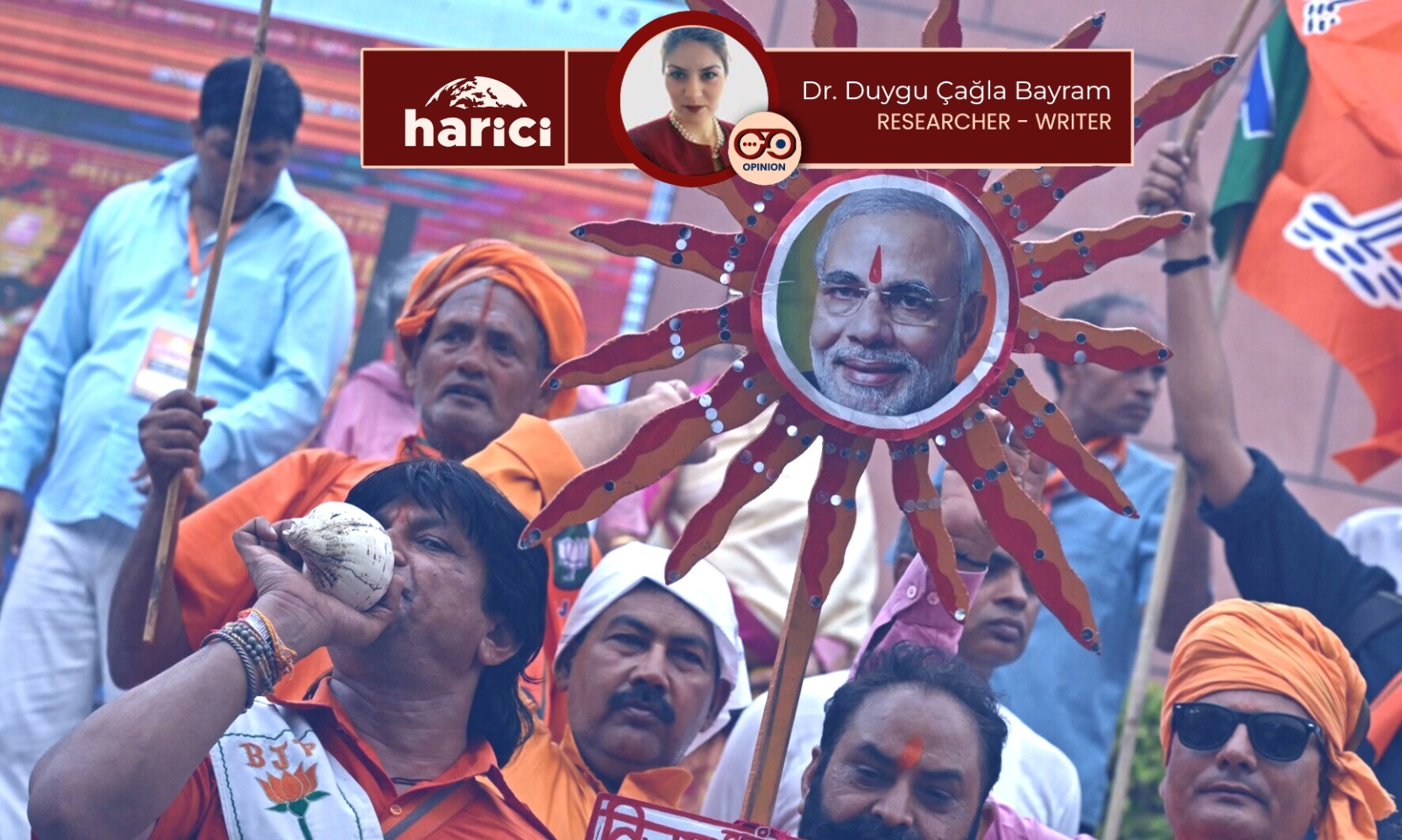
For 44 days, India went to the polls in seven phases of general elections. Almost a billion people, more than a tenth of humanity, were eligible to vote. The result was beyond doubt. Modi won a third term, putting his name next to that of Jawaharlal Nehru, India’s independence leader and one of the architects of the secular India that Modi is rapidly trying to destroy. Nehru-Gandhi is fortunate to have a weak and dynastic opposition led by the Congress Party. He also has unrivalled propaganda skills. In no other country has its leader’s picture been printed on vaccination certificates, as Modi has done in India…
After the Bharatiya Janata Party (BJP) won India’s 2019 general election, its campaign slogan had also set a target: ‘ab ki baar, 300 paar’ (300 seats this time). It worked; the party and its allies won 353 of the 543 seats in the lower house of the national parliament, returning it to power and giving Narendra Modi a second term as prime minister. In the run-up to the 2024 elections, the BJP adopted almost the same slogan. But the bar was set at 400. It had only been crossed once before: In 1984, by the Congress, now the main opposition party. Could the BJP repeat the feat? Modi’s ambitious slogan ‘Ab ki baar, 400 paar’ for the NDA alliance, targeting more than 400 seats, may have backfired this time, raising fears of constitutional change with such a large majority. The unexpected revival of the Congress party, which has almost doubled its tally for 2019, underlines this shift.
India remains an amalgam of several states that even the most charismatic dictators find difficult to govern completely. As expected, there was no third Modi wave in these elections. Ten years ago, Modi led the BJP to India’s first parliamentary majority in three decades, and five years later, amid tensions with Pakistan, he turned that narrow majority into a more decisive one thanks to growing support. In the 2024 general election, which symbolised a return to pre-Modi India, Indian voters focused on local issues and leaders. In Andhra Pradesh, for example, where the BJP has few local party alliances, its ally Pawan Kalyan, a regional film star who has formed his own party and speaks Telugu, the state’s official language, received a more enthusiastic welcome. Or Maharashtra, which has grown much slower than the national average over the past decade and has overtaken Karnataka and Telangana in per capita income, focused on tough issues such as suicides among indebted farmers; the feeling was that Maharashtra was in decline because Modi had favoured the development of neighbouring Gujarat, his home state. Maharashtra’s disappointment was significant because it has more seats in parliament than any other state except Uttar Pradesh, the heartland of the Hindi belt.
In short, while the urban middle class was generally proud of Modi’s basic narrative for a third term – that a booming economy had boosted India’s global standing – most rural voters were not, still citing daily hardships caused by rising food prices and the urgent need for more government aid.
But in mid-March, India’s Home Minister – and Modi’s close friend – Amit Shah, travelled to Gujarat to launch his re-election campaign, and in a speech to a crowd of BJP workers, argued that the BJP had both improved the lot of ordinary Indians and raised India’s standing in the world, saying that only the BJP could ensure that a ‘small party worker’ like himself and a ‘tea vendor from a poor family’ like Modi were the most powerful men in the country, and that only Modi could make India safe and prosperous.
Foreign policy
Priority foreign policy objectives are to lead the Global South, act as South Asia’s ‘first responder’ and obtain the elusive permanent seat on the UN Security Council. Establishing IMEC, SAGAR, Neighbourhood First policy, mine safety, diaspora, bringing back Bharatiya artefacts, promoting Lord Ram’s legacy are other priority foreign policy objectives. But leadership of the global south is the primary objective. It is clear that India wants to strengthen its position as the voice of the Global South BUT everyone wants to be the leader of the Global South and the question is how to make it a reality…
There was not much talk of regional security during the campaign, just a promise to focus on the Indian Ocean. And the focus on national security was ‘terrorism and naxalism’, not China. And there was not much mention of India’s biggest external challenge, which is China. There was no mention of China, but there was also no mention of America, which is India’s main strategic partner. So the campaign was more about economy – development – welfare – and, of course, Hindu nationalism – than it was about foreign or security policy. But they did seem to focus on multilateralism and soft power issues. At this point, we can expect strong South-South cooperation between India, Brazil and South Africa, also known as IBSA, which will play an important role as the G-20 troika this year.
Domestic policy
Acceleration of infrastructure development along the borders with China, Myanmar and Pakistan, making India the third largest economy, implementation of the Citizenship Amendment Act, implementation of the Uniform Civil Code, implementation of One Nation, One Election, free ration cards for 800 million citizens for five years, free electricity for poor households, The creation of infrastructure such as women’s hostels and crèches near industrial and commercial centres to encourage women’s participation in the labour force, the expansion of health services to ensure that women lead healthy lives, access to free and quality health care for senior citizens, continued financial support for farmers and the inclusion of car, taxi, truck and other drivers in all social security programmes are among the important promises made.
The Jekyll and Hyde journey continues…
In India, Modi’s quest for communalism, i.e. the transformation of India from a secular nation into an openly Hindu one, and for the Thatcherite medicine needed to modernise the Indian economy will continue. In his third term, Modi could therefore continue to strengthen Hindu nationalism while accelerating economic reforms. For India’s 200 million Muslims and the country’s various NGOs, academics and secular advocates in the media, life is harder than it was a decade ago and is likely to get harder. India is becoming an elective autocracy. But Modi is also a highly effective project manager. The country’s highways and airports are new and modern (although there are allegations that some highway tenders were not awarded to a single contractor, but were broken up into one-mile segments and awarded to smaller contractors…). Each kilometre of road is of a different quality and level. And note the allegations of some Indians who believe that this was done to win political votes for the BJP, but at the expense of the country’s second-rate infrastructure).
India has seen an increase in internet usage, an increase in air travel, 420 million more bank accounts, 110 million more gas connections, 220 million more insured, an increase in the rate of highway construction, more taxpayers and more taxes paid, the export of anti-covid vaccines to many countries, India’s global prestige has increased, and of course free rations for 800 million people…
India has overtaken China as the fastest growing major country in the world. It has also recently overtaken the UK to become the world’s fifth largest economy and China’s most populous. (It should be noted, however, that Modi is the inheritor, not the inventor, of India’s economic growth momentum). Part of what makes Modi so popular is the sense among ordinary voters and elites that he will bring prosperity to India: India is, after all, the world’s fastest-growing major economy and is expected to become the third-largest by 2027.
Indians are better off than they were ten years ago. There is a sense of pride and belief in a better future, while recognising that there are things that can be done differently, especially with regard to minorities. Further reforms are expected to take India to even greater heights in the period ahead. But while poverty is falling, unemployment remains high (around 8 per cent, the highest rate in 40 years). Every young person who can find the money tries to go to Canada, the United Arab Emirates, Australia or countries like Italy. And the poor are still very poor. Yes, the middle class is growing, the rich are getting richer. But the bottom 40 per cent live in abject poverty. Perhaps it is a Western obsession to compare the GDP of a country with 1.40 billion people with that of the UK with 70 million. The UK’s GDP does not reflect the plight of the bottom 40 per cent. Three-quarters of Indians have no social security, no national health security, no insurance, no travel abroad. Pollution is rife. There is little hygiene. Only 5 per cent of Indians own more than 60 per cent of the country’s wealth, while the bottom 50 per cent of the population own just 3 per cent of it,’ says the Oxfam India report.
On the other hand, the space for dissent in India is shrinking. The courts are mostly compliant and docile. At the administrative level, the autonomy of constitutional institutions has suffered a setback as most governments do Modi’s bidding. The richest names in business, notably Gautam Adani and Mukesh Ambani, work hand in hand with the ruling party. Corporate taxes are falling and regulatory privileges are being handed out to loyal businessmen. But a strategy to rebuild a pluralistic society along religious majoritarian lines is running into trouble.
A 2023 report by the US Commission on International Religious Freedom said: ‘During the year, the Indian government promoted and implemented religiously discriminatory policies at the national, state, and local levels, including laws targeting conversion, interfaith relations, the wearing of the hijab, and cow slaughter that adversely affect Muslims, Christians, Sikhs, Dalits, and Adivasis (indigenous peoples and scheduled tribes). Human Rights Watch summarised the situation of Muslim minorities in India as follows Indian authorities have adopted laws and policies that systematically discriminate against Muslims and stigmatise critics of the government.
The third term is also a mandate to intensify the Hindutva project. This is likely to further deprive India of the culture of polyphonic dissent and tolerance that was the hallmark of the post-independence years. There are already rumblings within the country that the last decade of BJP rule has been a fragment, with more to come… Whatever the word…
Will India become a Hindu society and a dictatorship? No, Indians will find a way to prevent that.
In conclusion, the value of education and scientific research is declining in India, as faith-based knowledge takes precedence over rational thought. I have heard Modi claim that in the past there were plastic surgeons in India who could implant an elephant’s head on a human being, or that planes could not be detected by radar because of clouds, and what is worse, I have heard that there are those who believe all this without hesitation…







In the Middle East, war is no longer waged merely to seize territory. The true contest turns on who will control the energy pipelines, trade routes, ports, and railways of tomorrow. Missiles may strike cities today, but the maps of the future are being drawn through transport and energy corridors.
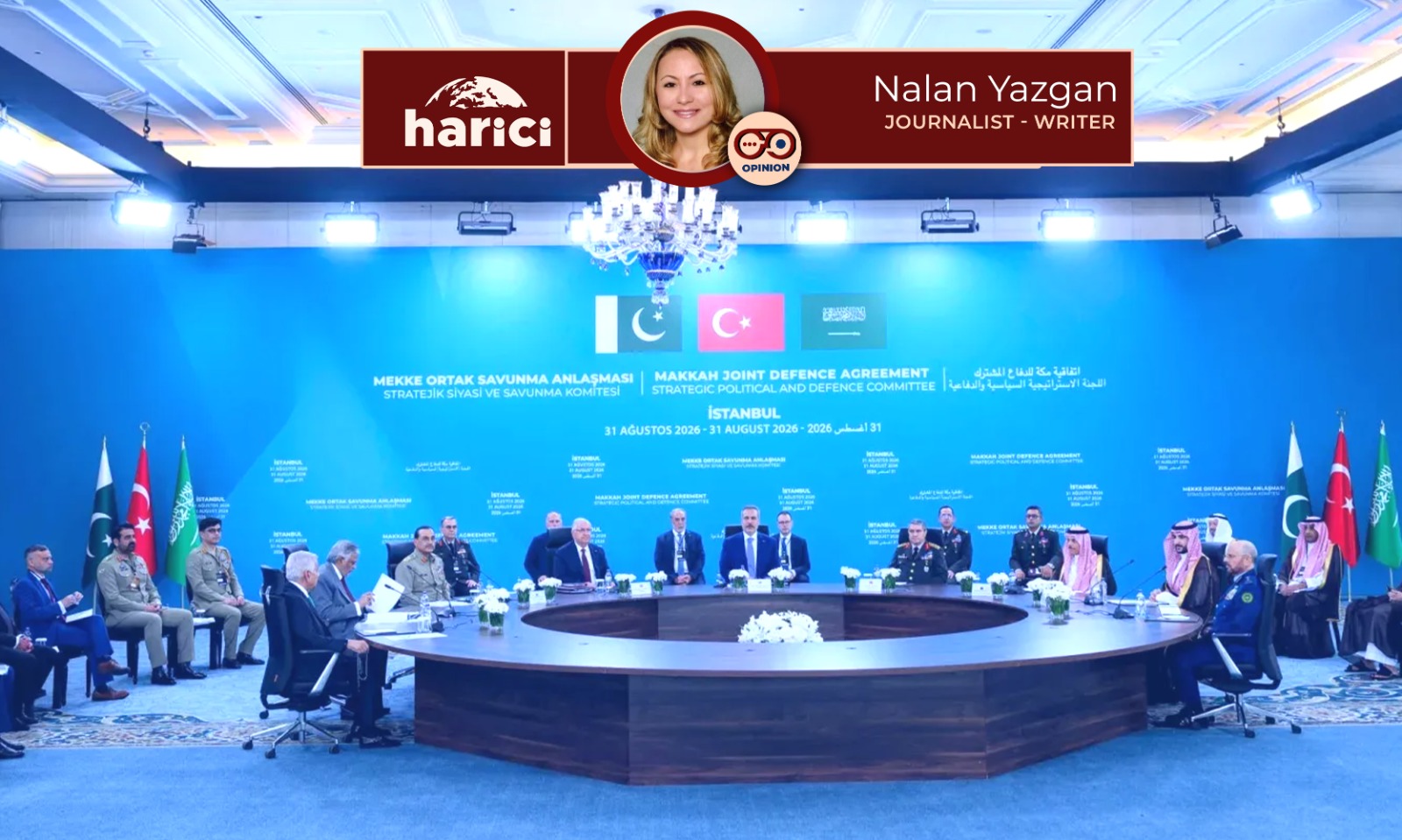
In this context, interpreting Türkiye’s presence in the Mecca Alliance solely as military support for Saudi Arabian security remains incomplete; it fails to explain why two states that viewed each other with mutual suspicion until recently would take steps toward a cooperation close enough to constitute a shared destiny.
Alongside Saudi Arabia’s existential motives, Ankara’s participation in this alliance is anchored in a profound geopolitical foundation: to position itself within, and if possible at the very centre of, the Middle East’s reconfigured energy and transport corridors.
Today, it cannot be said that Riyadh and Ankara see eye to eye on every regional issue. The threat perceptions and priorities of the two countries do not, quite naturally, entirely coincide. On the geopolitical chessboard, partnerships do not always arise from identical agendas. When reasons are sufficiently compelling, particularly existential ones, they can override political differences and enable common ground along the same strategic path.
A new war of corridors unfolds in the Middle East
On one side lies IMEC (India-Middle East-Europe Economic Corridor), planned to extend from India through the United Arab Emirates, Saudi Arabia, Jordan, and Israel to Europe. On the other stands the Development Road, which aims to link the Persian Gulf across Iraq to Türkiye, and onward to Europe.
These two undertakings are, of course, far more than mere transport projects. They represent two divergent geopolitical answers to where the future flow of trade and energy between Asia and Europe will traverse; for Türkiye, this issue is of vital importance.
If a corridor system taking shape to Türkiye’s south, beyond Ankara’s orbit, becomes permanent, Türkiye could forfeit not only an economic opportunity but also a substantial portion of its strategic centrality in the Middle East. It is through this prism that the Mecca Alliance must be evaluated.
Türkiye’s seat at the same table with Saudi Arabia signifies more than military solidarity. Riyadh and Ankara must sit together to avoid exclusion from the region’s emergent security and economic architecture, for the security of a corridor and the corridor itself are no longer separate matters.
The Strait of Hormuz, the Red Sea, the Bab al-Mandab, and the Suez Canal are links in the very same chain. A security crisis in one directly impacts the others. While the vulnerability of Hormuz makes alternative export routes for Gulf oil indispensable, instability across the Red Sea heightens the strategic cost of Suez.
Saudi Arabia’s alternative pipelines connecting its eastern oil fields to Red Sea terminals are therefore not merely energy infrastructure; they are strategic bypasses mitigating dependence on Hormuz.
For Türkiye, the Development Road fulfills the same function across a broader geography. Stretching from the Persian Gulf through Iraq to Türkiye, and from Türkiye into Europe, this artery possesses the potential to forge a new overland backbone connecting the Gulf to the Mediterranean and Europe. As security concerns in the Red Sea mount and the vulnerability of Suez deepens, the value of this route rises accordingly.
The Hejaz Railway: Revived once again
The return of the Hejaz Railway to the regional agenda signifies far more than mere nostalgia. Once linking Istanbul to Damascus, Amman, and the Hejaz, the railway served as one of the primary transport and logistical arteries of the Ottoman geography.
Reviving the idea of the Hejaz Railway could become the emblem of Türkiye’s drive to reimagine its historical transport connections between the Gulf, the Hejaz, and the Levant through modern rail, energy, and logistics networks.
The objective here is not to restore the past, but to transpose the strategic logic of that historical geographical linkage into the twenty-first century. For this reason, Türkiye’s role in the Mecca Alliance and the resurgence of the Hejaz Railway project must be viewed as components of the same overarching picture.
Corridors do not consist solely of energy pipelines. Railways, ports, highways, electrical interconnectors, logistical hubs, and security architectures are all facets of the same geopolitical grid, and safeguarding these networks requires political alliances.
Herein lies the strategic significance of Saudi Arabia and Türkiye sitting at the same table in Mecca, even at a juncture when their views on Syria diverge.
Ankara and Riyadh do not need to agree on every subject. Yet neither wishes to see the new map of the Middle East drawn to its detriment. Türkiye’s aim is not to build an anti-bloc against any specific country alongside Saudi Arabia; rather, the goal is to avoid exclusion from the future energy and trade systems of the Middle East, while securing a decisive voice in establishing their security architecture.
Hence, for Türkiye, the Mecca Alliance is far more than a simple defence pact. Securing the Development Road, shielding Gulf energy corridors, stabilising the Red Sea, rethinking connections across the Hejaz and the Levant, and bolstering trade corridors reaching Europe all intersect within this single strategic equation.
In this equation, Türkiye’s foremost advantage remains its geography. Ankara sits at the northern terminus of the overland routes linking the Gulf to Europe; within NATO; and at the crossroads connecting the Black Sea, the Caucasus, the Eastern Mediterranean, and the Middle East.
Will Türkiye become one of the powers shaping the Middle East’s energy and trade architecture over the coming decades, or will it be reduced to a mere transit state traversed by routes designed by others? That question defines the true strategic significance of the Mecca Alliance for Ankara.
In the Middle East of tomorrow, it will be impossible to separate the corridor carrying energy, the security framework protecting that corridor, and the alliance constructing that security framework.
Whoever controls the corridor shapes commerce. Whoever guarantees the routes through which trade flows holds sway over the regional balance of power. This is the true dimension of the contest currently underway in the Middle East.
A succession of distinct and largely mutually exclusive ambitions are competing for dominance in the current climate: India’s linkage to Europe, the Gulf’s new economic horizons, Saudi Arabia’s alternative energy routes, the security crisis in the Red Sea, the strategic weight of Hormuz, and Türkiye’s aspiration to open outward to Europe via the Development Road. Ironically, perhaps, the conflict that will decide which corridor underpins global stability has already begun, and it will likely continue spreading to new fronts. Regrettably, the fires in our region appear poised to intensify long before they abate.

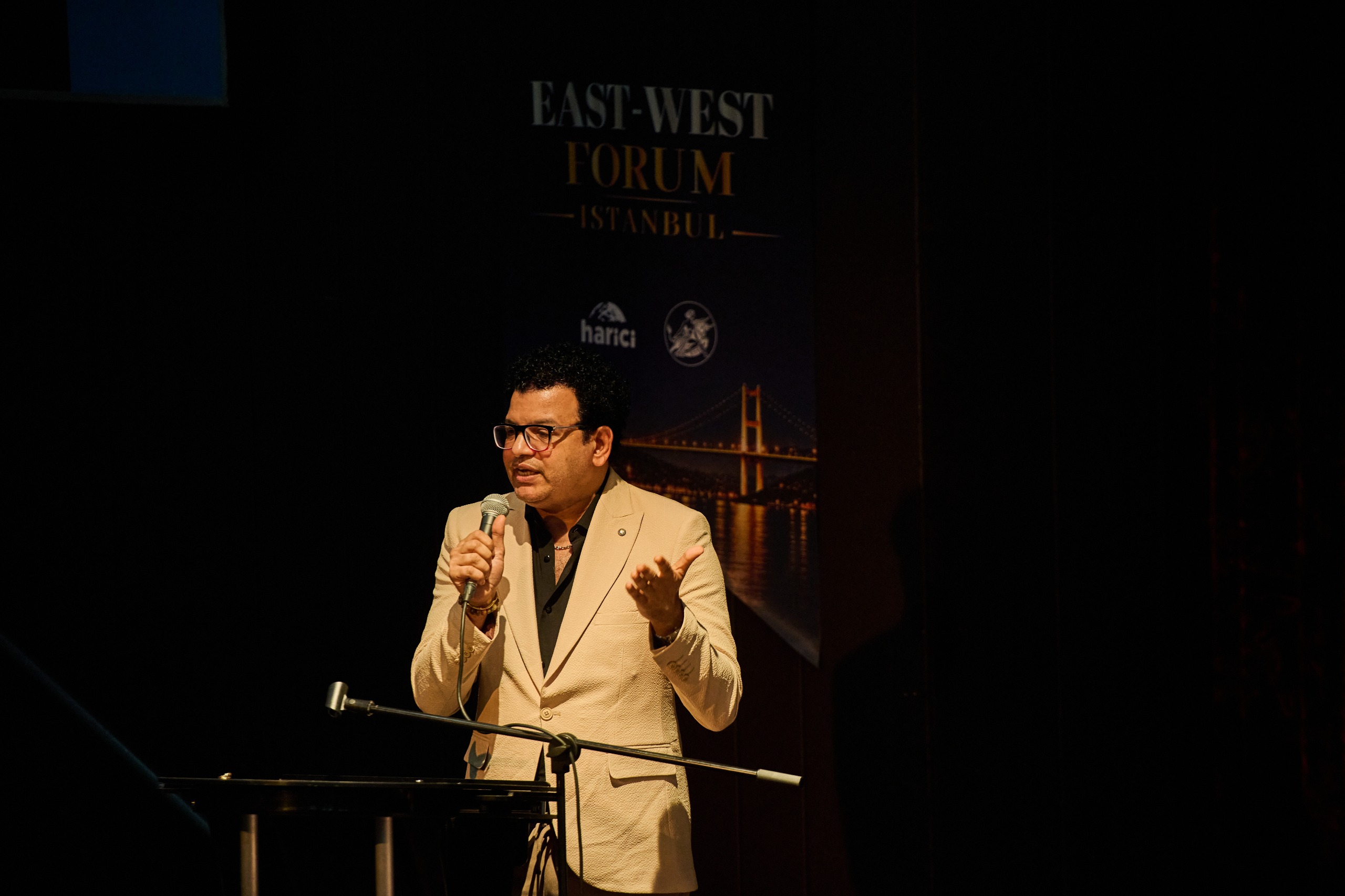
Dr. Ahmed Moustafa, Director & Founder, Asia Center for Studies & Translation, Egypt
In a city that has spent centuries translating the language of one civilization to another, the first East-West Forum arrived at a moment when the world itself seemed to have lost the vocabulary for talking across its divisions.
Held in Istanbul on Sept. 26–27 and preceded by meetings around the event, the forum brought together diplomats, academics, journalists, strategists and political thinkers from a wide range of countries. Hosted by Harici Media in partnership with the Berlin-based European Transcontinental Initiative, the gathering was conceived as an attempt to examine a world increasingly defined by competing power centers, regional wars, economic fragmentation, artificial intelligence and the erosion of confidence in institutions created after the Second World War. Harici reported that participants came from roughly 30 countries.
For us, the significance of Istanbul was not simply a matter of the speakers on the panel or the structure of the programme. Its deeper importance lay in the willingness to put difficult — and sometimes uncomfortable — questions on the table.
We would like to extend our sincere thanks and appreciation to my friend and brother, Mr. Tunç Akkoç, Founder and Editor-in-Chief of Harici Media, for his gracious invitation to a representative of the Asia Center for Studies & Translation, Egypt, to participate in the Forum as a speaker and commentator. His initiative in creating a platform where competing geopolitical narratives could meet directly deserves recognition.
In his opening remarks, Akkos stressed that the initiative was intended to establish a permanent platform where people representing different political and intellectual traditions and perspectives could meet and engage in direct dialogue.
This vision is particularly significant because the traditional language used in international relations has increasingly struggled to explain the realities of a rapidly changing world.
The Problem of Proxy Wars
During the session that discussed proxy wars in the region and ways to reach solutions to their crises, the Center put forward the view that the Middle East cannot simply be understood through the traditional map that divides the parties into “good” and “evil,” or into “responsible states” and “rogue states.”
Such terms, in our assessment, often reflect the perspective of powers that possess extensive influence over international media and financial and security institutions.
The Center particularly criticised what we see as political bias within important sectors of the Western media and some non-governmental organisations that receive Western funding. From our perspective, these institutions can, in some cases, move from being mere observers of geopolitical conflicts to becoming influential parties in the battle over the narrative and the story.
However, this view should remain open to debate and should not automatically be accepted as an absolute truth.
The more important question is not whether every Western journalist, every NGO, or every Western institution works to serve a single geopolitical agenda clearly, this is not the case, but whether the information environment itself has become so highly polarised that the public is now receiving radically different interpretations of the very same war.
In our assessment, the answer is increasingly approaching “yes.”
The problem becomes particularly clear when searching for the term “proxy wars” in the Middle East. Some of the first results focus on groups associated with Iran, including Hezbollah and the Houthis, as well as Hamas, whereas the history of regional conflicts is far more complex.
Al-Qaeda and ISIS emerged through different historical trajectories, with Anglo-Saxon support that was “created by Britain and the United States.” In environments dominated by the United States and Britain, Al-Qaeda emerged from the environment associated with Osama bin Laden and the Afghan jihad, while ISIS developed largely from Al-Qaeda in Iraq, under American sponsorship, to pursue a certain agenda in the region and advance the scenario of “creative chaos” promoted by Condoleezza Rice, the radical US Secretary of State.
At the same time, US policy toward Afghanistan during the Cold War contributed to shaping the broader environment from which some militant jihadist movements later emerged.
These distinctions matter.
Because propaganda often begins where complex historical details end.
Who Has the Right to Define a “Rogue State”?
The same problem appears in the vocabulary used to describe states.
Countries such as China, Russia, Iran and North Korea are frequently portrayed in Western strategic discourse as states challenging the existing international order.
Egypt, despite the different nature of its relationship with Washington, can also become the subject of criticism when its foreign policy does not conform to certain Western expectations.
The question is not whether these governments should be exempt from criticism. Of course not.
The deeper question is this: can the international system remain sustainable when one geopolitical camp increasingly assumes the authority to define which governments are legitimate, which movements are terrorist, which wars are defensive and which forms of resistance are acceptable?
That was one of the central questions behind our intervention in Istanbul.
The Middle East has repeatedly been presented through the lens of the “Iranian threat” as the principal strategic danger.
There is no question that Iran possesses significant military and regional capabilities, and that its policies are deeply contested by many neighbouring states. At the same time, reducing virtually every regional security problem to Tehran can obscure the interests and roles of other actors, including Israel, the United States, Gulf states, armed groups and local political forces.
The region has repeatedly paid a heavy price for simplistic interpretations of complex conflicts.
The Economics of Fear
The discussions in Istanbul also led us to a broader American question: to what extent can fear itself become a source of political and economic power?
Historically, the United States has experienced intense political campaigns shaped by perceived racial, ideological and security threats.
One does not need to accept every interpretation of this history to recognise that fear can become a factor with tangible economic consequences.
A 2020 study by Citi estimated that racial discrimination against Black Americans had cost the US economy approximately $16 trillion in lost economic output since 2000, based on an analysis of disparities in wages, education, housing and investment.
This figure demonstrates the extent of the economic losses associated with racial discrimination and exclusion. It also raises questions about the relationship between fear-based narratives concerning Black Americans, media influence, the political power of the gun lobby and the broader economic consequences of insecurity.
More importantly, however, the study highlights a fundamental point: bias and insecurity carry substantial and measurable economic costs.
The broader lesson has direct relevance to foreign policy.
When societies are continually presented with existential enemies, military spending and the expansion of security institutions become politically easier to justify.
America After Iran
In Istanbul, we also advanced the view that the United States after its confrontation with Iran in 2026 should not simply be understood through the traditional image of unlimited American power.
The conflict exposed economic and strategic vulnerabilities.
The Strait of Hormuz emerged as a major strategic pressure point for global energy markets, amid disruptions to international trade that forced governments and companies to search for alternative routes and supplies.
The consequences were reflected in oil prices and energy costs in Europe and elsewhere.
This does not mean that American power has disappeared. Rather, it suggests that military power is no longer synonymous with strategic control.
The rise of China, Russia, ASEAN, Iran and other centres of economic and diplomatic influence has made the international order increasingly complex and dispersed.
The East-West Forum itself reflected this reality, bringing together voices from Europe, Asia, the Middle East and North America while explicitly addressing multipolarity and the ongoing transformation of the global order.
America Is Changing From Within
The domestic dimension of American politics also deserves attention.
The emergence of figures such as Zohran Mamdani in New York and Abdul El-Sayed in Michigan reflects changes in the American political debate over inequality, foreign policy, healthcare, identity and the influence of established political and economic interests.
Their political trajectories should not be treated as evidence of a predetermined future for the United States.
They do, however, illustrate how issues that were once treated as peripheral including the costs of war, US policy toward Israel, economic inequality and the political influence of younger and more diverse generations have moved closer to the centre of American political debate.
This is another reason why East-West dialogue cannot remain confined to foreign ministries and military institutions.
A Dinner for Dialogue
One of the most memorable moments on the margins of the Forum was the private dinner held on the evening of Friday, September 25, hosted by H.E. Mr. Hasan Capan, Chairman of the Turkish-Chinese Friendship Foundation, and H.E. Ambassador Ersin Erçin, Vice Chairman of the Foundation, in honour of the speakers and participants.
We extend our sincere thanks and appreciation to both of them for their generosity, friendship and support.
The gathering was more than simply a dinner. It provided an opportunity for personal interaction, an exchange of ideas and the building of relationships among participants — precisely the kind of human diplomacy that formal conferences sometimes lack.
Real dialogue does not always begin behind conference podiums.
Very often, it begins around a single table.
Istanbul’s Larger Message
The first East-West Forum should be regarded as the beginning of a dialogue, not the end of a debate.
The organisers have already articulated a vision of transforming the initiative into an annual gathering in Istanbul, developing expert working groups, establishing an East-West Forum network and potentially creating a business council capable of connecting intellectual dialogue with economic cooperation.
This may ultimately prove to be one of its most important contributions.
The world that emerges from the current conflicts including the crisis surrounding the Strait of Hormuz will require more than ceasefire agreements.
It will require a new conversation about security, energy, sovereignty, development, technology and coexistence.
Istanbul is an exceptional setting for such a dialogue. One participant even proposed moving the headquarters of international organisations, including the United Nations, to Istanbul.
For centuries, the city has stood between two continents without belonging exclusively to either.
The East-West Forum can follow the same principle: not choosing one civilisation against another, but creating a space in which East and West can confront their differences without turning disagreement into permanent conflict.
For this reason, we see the Istanbul gathering as an announcement of intent.
It was not an attempt to erase differences.
It was an attempt to make dialogue possible despite them.
At a time when proxy conflicts increasingly risk evolving into direct confrontations, this may be among the most important political conversations the world can undertake today.

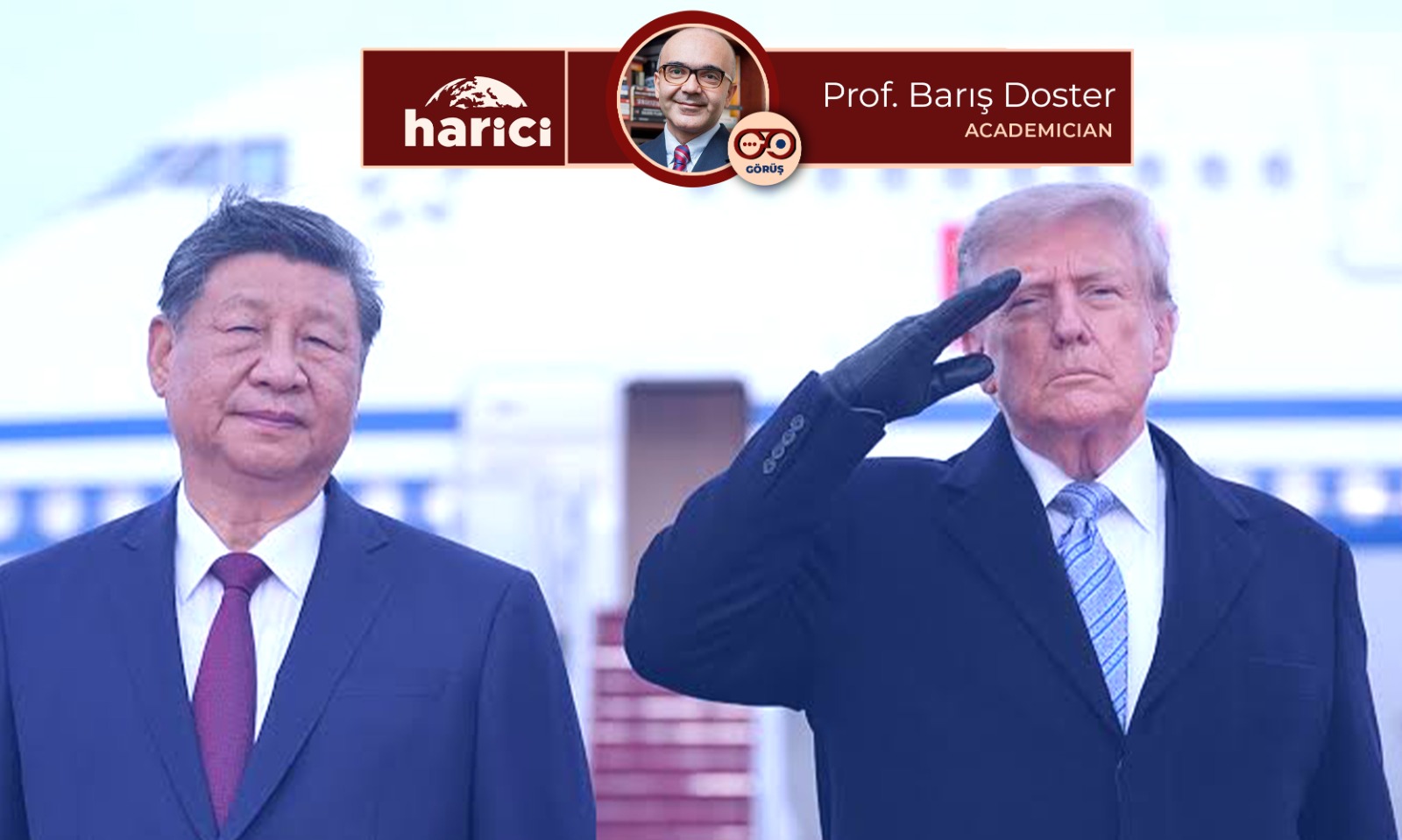
Much commentary followed the US president greeting the visiting Chinese leader at the foot of the aircraft stairs: both because a US president had not done so in many years, and because the leader he welcomed heads a state that the US defines as a competitor, an adversary, and an enemy. That photograph demonstrated that the US itself now recognizes China not merely as an economic power, but as a political, military, scientific, industrial, and technological one; yet it revealed other realities as well.
It showed that a multipolar order has arrived. It showed that the failure of the US to abide by the order whose rules it laid down and whose institutions it established has exacted a heavy toll on the US itself. It showed that the US-centric Atlantic system is unravelling. It showed that the collapse of a world order flouted, and indeed subverted, by its own rule-maker is both legitimate and inevitable. It showed that East-centred institutions, such as the Shanghai Cooperation Organisation and BRICS, enjoy an open path against Western-dominated bodies. It showed that the US regards China as a rival not merely economically, but ideologically and technologically. It showed that the US has proven unable to exercise deterrence against China, Russia, and Iran to the degree it desires.
Let us admit it: after the Cold War ended, the US assumed it could act as it pleased by bringing the European Union to its side and constantly invoking human rights, democracy, and freedom. It was mistaken. The more it spoke of a rules-based world order, of a liberal world order, the more it flouted those very rules. In the end, that order collapsed as well. The birth of a multipolar, multilateral, and multicentric world accelerated; and it was just as well. Now is the time to debate the rules, institutions, traditions, and solutions of this new order.
Yet who will conduct this debate? Who will take part in this search?
It is not right to expect this from the US; nor is it realistic. It is likewise impossible to expect it from the European Union. Europeans follow so subserviently in Washington’s wake that they refuse to consider even Russia as European, despite the fact that, alongside its Eurasian identity, millions of its citizens live across territory spanning Europe and Asia while viewing their nation as historically, politically, socially, culturally, artistically, and intellectually European. They attempt to construct a European defence and security architecture by excluding Russia, in defiance of Russia, and by harbouring hostility toward Russia. In the end, they are both mistaken and defeated.
As the new order emerges, India must also be examined under a distinct heading, alongside China and Russia. For India is a nuclear power possessing the world’s largest population and its 5th largest economy. It maintains disputes with China and Pakistan, yet enjoys good relations with Russia, the US, and Britain. It is a member of both the SCO and BRICS. On the other hand, within the Quad grouping, alongside the US, Japan, and Australia, it positions itself against China.
In summary, as an order takes shape in which the West runs out of breath while the East rises, and Atlantic institutions dissolve while those of Eurasia and the broader Global South come to the fore, we must first rid ourselves of Cold War dogmas and habits.

European industry urges EU action against China trade practices

Israel opposition seeks Netanyahu probe over 7 October call logs

German exports pivot to Eastern Europe amid drops in US and China

Thiel targets Pope and Obama over AI in new ‘Antichrist’ lectures

Energy firms enlist ex-US officials to tap Venezuelan oil
-
 Diplomacy2 weeks ago
East-West Forum in Istanbul highlights irreversible shift to multipolarity
-
 Europe2 weeks ago
European unions urge governments to scrap all Palantir deals
-
 Europe2 weeks ago
Rome protests AfD poster depicting South Tyrol as independent state
-

 Europe1 week ago
German interior ministers drop unanimity rule to counter AfD veto
-
 Europe2 weeks ago
German industry stockpiles critical minerals before EU-China talks
-
 Europe1 week ago
Key European allies excluded from US-led NATO meeting in Poland
-
 Diplomacy2 weeks ago
US Ambassador Guilfoyle faces backlash in Greece over alleged remarks
-
 Europe2 weeks ago
EU drafts plan to curb national vetoes in radical expansion reform
