
Opinion
Israel’s reoccupation of Gaza will bury the “Oslo Accords”

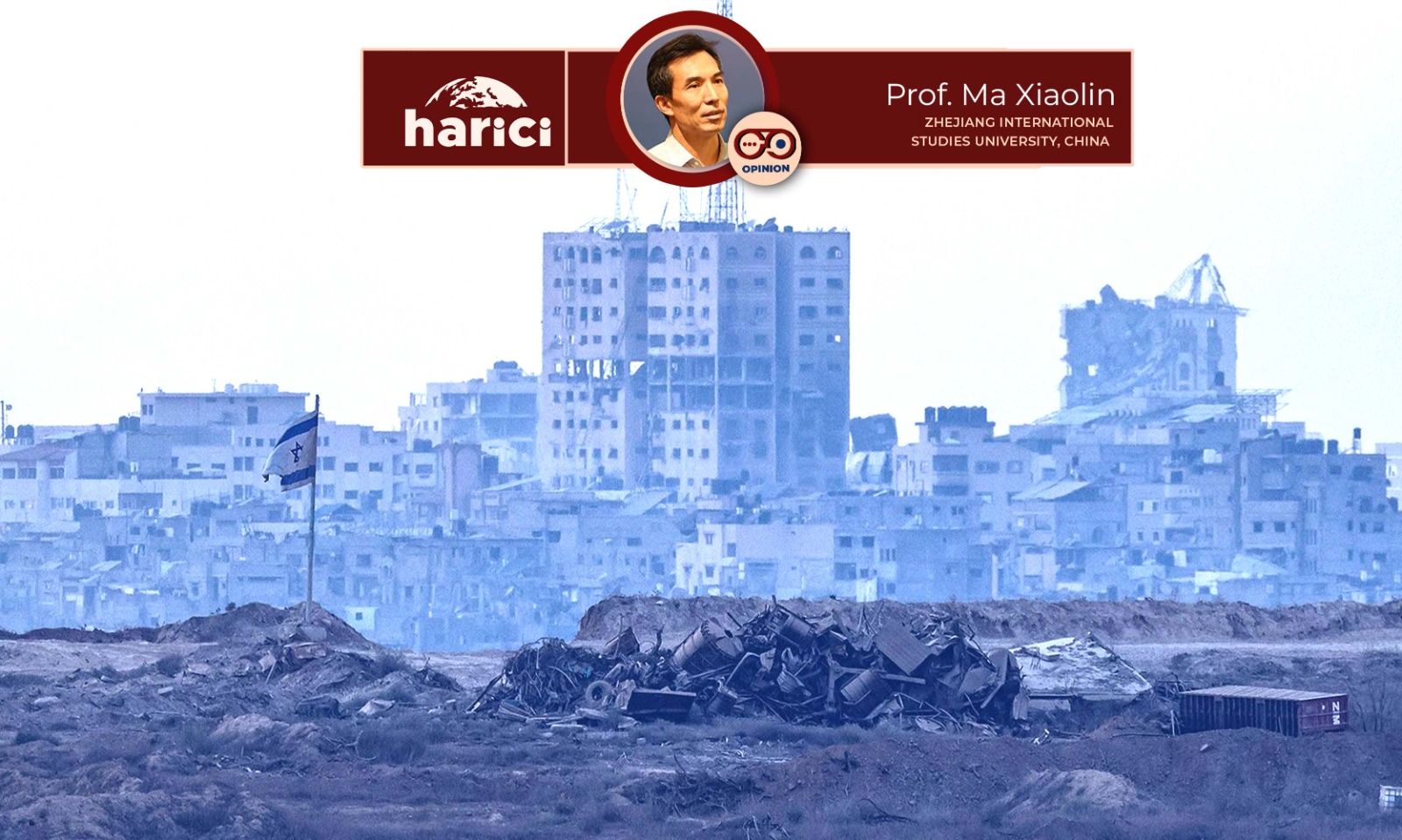
On August 8, under the coercion of far-right forces such as Prime Minister Netanyahu, Israel made a major and historic decision that completely reverses the peace process between Palestine and Israel, announcing that it will fully reoccupy the Gaza Strip, completely eliminate the Palestinian Islamic Resistance Movement (Hamas), and establish a new civil government. The Israeli Prime Minister’s Office stated that the Israel Defense Forces will be prepared to take over Gaza City while providing humanitarian aid to civilians outside the war zone.
It is reported that the Israeli Security Cabinet approved by majority vote Netanyahu’s strongly advocated “final solution” for Gaza, passing the so-called “Five Principles to End the War,” which include disarming Hamas; returning all Israelis held captive, whether alive or dead; achieving the demilitarization of the Gaza Strip; maintaining Israel’s security control over the Gaza Strip; and establishing a civil government that belongs neither to Hamas nor to the Palestinian National Authority.
This move by Israel is enough to shock and deeply worry world public opinion. When Israel, after ending 20 years of institutionalized garrison in the Gaza Strip, once again imposes full military administration, it is tantamount to declaring the complete death of the “Oslo Accords,” that the Palestinian National Authority recognized by the international community is no longer a peace partner, that the Gaza Strip is no longer “owned and governed by Palestinians,” and that Israel will once again become the overlord of this land.
From a broader and longer-term perspective, this move will weaken Israel’s strategic mutual trust and reconciliation cooperation with its peace partner and the sole legitimate representative of the Palestinian people, the PLO, and may reset the reconciliation process between Israel and Arab countries based on the “Abraham Accords,” possibly further worsening Israel’s relations with the international community, and even creating new troubles for the United States, which fully supports Israel, increasing its heavier strategic liabilities.
Reoccupying the Gaza Strip and dominating its future governance is to put the historically turbulent train of the Palestinian-Israeli and Arab-Israeli peace process into reverse, pushing Israel to repeat the mistakes of history. It will neither help effectively resolve the Gaza war predicament it is deeply mired in, nor help achieve lasting peace and stability, especially the historical reconciliation with Palestine and Arab countries.
Since October 7, 2023, when Hamas carried out the “Al-Aqsa Flood” operation and crossed the border to attack Israel, only a year and a half has passed, yet the Palestinian-Israeli conflict has escalated into the “Sixth Middle East War,” with the flames of war extending to the Eastern Mediterranean, the Red Sea region, and the Persian Gulf. Israel appears to have achieved military victories over most of its opponents in the “Axis of Resistance,” even hardline adversary Iran, and unexpectedly reaped the “fruit” of the Syrian regime’s collapse. However, it has never managed to conquer the Gaza Strip, which is only 360 square kilometers, has not eliminated Hamas despite the leadership being reportedly “wiped out,” has not eradicated the remnants of Hamas engaged in “ruins guerrilla warfare,” and has not rescued nearly 50 hostages on the brink of death.
Netanyahu and his government, using near-genocidal “scorched-earth tactics” and “starvation tactics,” have created a contemporary, horrific humanitarian disaster that shocks the conscience, challenges the principles of international and humanitarian law and the bottom line of human civilization, humiliates the international community, especially the United Nations composed of 193 sovereign states and two observer states, triggers a global wave of condemnation and anti-Israel sentiment, and revives non-mainstream antisemitic thought in both Eastern and Western societies. In addition, major Western countries that originally adopted indulgent and appeasing policies toward Israel have successively changed their positions—Canada, France, the UK, and Australia are preparing to recognize the State of Palestine, with some countries taking various forms of sanctions and restrictions against Israel. Some developing countries have long since imposed harsher sanctions on Israel, including severing or downgrading diplomatic relations, cooperating with the International Criminal Court in issuing “war crimes” warrants for Netanyahu and other Israeli political and military leaders.
However, Netanyahu, regardless of Israel’s historic political and diplomatic failures, and ignoring opposition from intelligence chiefs, in order to please far-right forces and avoid the collapse of his ruling coalition, as well as to evade legal accountability likely to arise from corruption cases and national security crises, has recklessly led the full reoccupation of the Gaza Strip, expanding the scale and intensity of the war, and increasing Palestinian suffering.
Netanyahu’s latest risky Gaza strategy is actually the result of excessive personal self-interest and an extreme obsession to fight to the end, ignoring that the whole country has fallen into a long war and is fighting on multiple fronts, ignoring the daily casualties at the front line, ignoring the gradual exhaustion of manpower to the point of overturning decades-old national policy to forcibly conscript religious students, ignoring that the entire country’s main trajectory has shifted from peace and development to war and conquest, ignoring the continuous deterioration of the investment climate, the ongoing withdrawal of foreign capital and expatriates, and the constant hemorrhaging of economic development.
Netanyahu’s “scorched-earth tactics” have completely deprived the geographically small Gaza Strip of any security space. Not only are Palestinians losing their lives at the rate of hundreds per day, but the plight of Israeli hostages is also worsening. Especially when combined with the “starvation tactics,” it not only continuously causes a systemic crisis in the basic food and nutrition supply for Palestinians, but also objectively turns surviving Israeli hostages into burial companions.
After Hamas and other organizations recently released the latest hostage status video, the world was shocked, and Israel suffered another heavy blow: Evyatar David, trapped in a confined space, is skin and bones, estimated to have lost half his body weight. Evyatar was even forced to dig his own grave in the reinforced concrete tunnels under Hamas control. Although Hamas’s inhumane acts are certainly condemnable, they show that Netanyahu’s military pressure policy has completely failed—the clearing strategy that nearly flattened Gaza and dug three feet underground cannot completely eliminate Hamas.
It can be said that Hamas, by torturing and starving hostages in extreme retaliation for Israel’s “starvation tactics” and mocking Israel’s “scorched-earth tactics,” has severely provoked Israel’s political nerves and emotions across society. Evyatar’s family accuses Netanyahu’s Gaza policy of failure, and more Israeli citizens, former senior officials, and intelligence chiefs are urging an end to the war to secure the release of hostages. Perhaps the tragic scene of Evyatar being on the verge of starving to death will become a watershed moment in the Gaza war, placing the warlike Israeli right-wing ruling coalition on the fire, and forcing the cornered Netanyahu to take his final gamble—staking his political future, the destiny of Israel, and the Palestinian-Israeli and Arab-Israeli peace process.
In 1993, the Israeli Labor Party government, suffering from the multiple torments of the long-term occupation of Palestine, reached the “Oslo Accords” with the PLO regarding transitional autonomy. Then Prime Minister Rabin, who had once served as Defense Minister, had always sought to free Israel from the “Gaza nightmare,” because since seizing the Gaza Strip from Egypt in 1967, “peace under Israeli rule” had lasted only 20 years. In 1987, the spark of the “Intifada (uprising)” was ignited in the Gaza Strip, quickly sweeping into a prairie fire and spreading to the broader West Bank.
Rabin himself had also sworn to “break the bones of the Palestinians,” and more Israeli generals cursed Gaza as a “damned strip,” a “hateful hornet’s nest,” because the Israeli army occupied this area during the day, while at night control shifted to various resistance forces. The conflict over the occupied territories, with Gaza as its focus and symbol, plunged Israel into an unprecedented predicament under international law and a whirlpool of world public opinion, while also paying a heavy security and economic price. Today, Netanyahu has forgotten the lessons of history, willingly returning to the old path of the occupier that runs counter to the correct direction of human civilization and history, once again mortgaging Israel’s national image, national development, and international status to the occupation of the Gaza Strip.
On August 7, the Israeli right-wing mouthpiece The Jerusalem Post published an editorial warning Netanyahu to “heed the warning and avoid the Gaza quagmire,” pointing out that fully reoccupying it would worsen the humanitarian crisis in the Gaza Strip and give Hamas a propaganda victory, portraying Israel as an occupier and inspiring resistance.
The paper pointed out that historical experience and military analysis show Netanyahu may believe that occupying the Gaza Strip will bring the hostages home and crush Hamas, but this is wishful thinking. The paper quoted famous retired U.S. General David Petraeus, comparing the Gaza ground campaign to “Mogadishu on steroids,” which would lead to rapidly escalating casualties and chaos.
Petraeus, a renowned special warfare expert, U.S. Army general, former commander of the Multinational Force in Iraq, commander of U.S. Central Command, top commander of the International Security Assistance Force in Afghanistan, and director of the CIA, was later forced to resign due to an extramarital scandal. Petraeus is far more aware than Netanyahu, who is not from a military background, of the heavy costs and political consequences if the Gaza Strip becomes “Mogadishu-ized.”
In October 1993, U.S. peacekeeping forces stationed in Mogadishu fell into an urban warfare trap while trying to capture aides of warlord Aidid. The U.S. forces killed more than 1,000 fearless militiamen but suffered 19 dead, one captured, and two Black Hawk helicopters destroyed. When televised images reached the U.S. of the captured soldier begging Washington for rescue and Mogadishu mobs dragging the bodies of dead American soldiers through the streets, public opinion pressure skyrocketed, forcing the Clinton administration to announce withdrawal from Somalia four days later.
Today, Evyatar, emaciated and displayed in a Hamas video, is in a situation eerily similar to the U.S. military’s Mogadishu defeat back then. Petraeus’s reminder of this American heartbreak is actually a warning to Netanyahu and his government that if they insist on reoccupying Gaza and causing an even more severe disaster, it could trigger a reversal in America’s one-sided favoritism toward Israel.
The Jerusalem Post also pointed out that fully occupying the Gaza Strip would not ensure Israel’s security; rather, it would trap Israel in the Gaza Strip, in an expensive, endless war with no visible end, making all Israelis bear the consequences, whether reduced income or long-term military service. The paper cited data released by Bank of Israel showing that the war has already caused serious damage to Israel, with all war-related activities—including reserve mobilization, reduced labor force, and disruption of high-tech supply chains—costing more than $600 million per week, about 6% of GDP. By the end of 2025, the cumulative economic burden is expected to reach $5.3 billion to $6.7 billion, close to 10% of GDP.
In 1994, based on the “Oslo Accords,” both sides launched the peace process, starting with “Gaza-Jericho First Autonomy,” later expanding to all Palestinian-populated cities in the Gaza Strip and the West Bank. After the five-year transitional autonomy ended, the two sides failed to reach a compromise on a series of final status issues, the peace process reversed, Palestine launched the second violent resistance, the “Al-Aqsa Intifada,” and Palestinian-Israeli relations deteriorated rapidly, leading to the demise of the relatively moderate Israeli left-wing camp.
With the rise of Israeli right-wing leader Sharon and the Likud bloc to power, and the Bush administration’s “Axis of Evil” doctrine and anti-terrorism strategy after 9/11, the nature of the Palestinian-Israeli conflict was deliberately distorted and deconstructed by Israel and the U.S., demonizing the core relationship of “occupation and anti-occupation” into “terror and anti-terror.” Fatah, the long-term ruling party of Palestine advocating peace, suffered joint suppression by the U.S. and Israel, and its widely recognized political leader Arafat died under Israeli siege. The Palestinian political landscape was thus fundamentally reshaped, with the hardline positions of Hamas and others gradually winning mainstream public opinion.
In 2005, at the critical moment when pro-peace and pro-war forces within Palestine were subtly reversed, the Sharon government unilaterally announced withdrawal from the Gaza Strip, ultimately allowing Hamas to completely gain the upper hand and drive Fatah, which insisted on cooperating with Israel, out of the Gaza Strip, turning this small area into its exclusively controlled “Hamastan.”
In 2006, Hamas, by participating in the Palestinian Legislative Council elections, indirectly acknowledged and accepted the “Oslo Accords” and even the “two-state solution,” because whether the Palestinian transitional autonomy government or the legislative body, their establishment and operation were legally based on the “Oslo Accords.” This move was actually a key change in Hamas’s policy toward Israel, but because it did not amend the “Hamas Charter” in time—i.e., did not explicitly and publicly abandon the fundamental position of “eliminating Israel”—its governing legitimacy was not recognized by Israel and the U.S., instead leading to a harsher blockade of the Gaza Strip, creating the “world’s largest open-air prison.”
Since then, as Israeli right-wing forces became more aggressive, continually nibbling away at occupied West Bank territories and intensifying “Judaization” measures in East Jerusalem, it triggered two major Palestinian-Israeli conflicts from 2008 to 2014, i.e., what Israel defines as the “Israel-Hamas wars.” Over the past 20 years, the Netanyahu government has deliberately adopted a “strike but not destroy” approach toward Hamas, intentionally creating two Palestinian power centers, aggravating their geographic, social, political, and governance divisions, and maintaining the enormous and one-sided benefits Israel reaps from long-term occupation.
In 2017, when the U.S. Republican Party returned to power, Hamas seized the opportunity once again, issuing a declaration on May 1 that year accepting the existence of Israel, reaffirming the establishment of an independent Palestinian state with East Jerusalem as its capital and the Gaza Strip and West Bank as its territory, and expressing hope that the Trump administration would promote the resumption of Palestinian-Israeli peace talks. This was originally another rare window for the Palestinian issue, but it was jointly shut by the unprecedentedly pro-Israel Trump administration and the Israeli right-wing, greedy for immediate interests: the U.S. moved its embassy in Israel to Jerusalem, introduced the “Deal of the Century” that sacrificed Palestinian national interests, promoted the “Abraham Accords” that betrayed the Palestinian cause, and encouraged Israel’s far-right forces to further expand illegal settlements.
Hamas’s slow strategic shift and repeated gestures of goodwill abroad were met with humiliation, “warm faces pressed against the cold backsides” of the U.S. and Israel, while domestically facing doubts and challenges from radicals such as the Islamic Jihad Organization and Jihadist Salafists. Thereafter, Hamas returned to hardline and violent policies, becoming involved in multiple large-scale conflicts with Israel, while the “Abraham Accords,” which abandoned the Palestinian cause, created a new reconciliation trend for Israel, paving the way for normalization talks between Saudi Arabia, the new “leader” of the Arab world, and Israel.
Beset by internal and external troubles and despairing about the prospects for peace and reconciliation, at the latest low point and turning moment in the fate of the Palestinian people, on the eve of the fiftieth anniversary of the “Ramadan War” when Israel had suffered heavy losses, and at the last moment before Saudi Arabia, Israel, and the U.S. might cross the key threshold of sacrificing Palestinian interests, Hamas carefully planned and tightly executed the largest-ever single “suicidal” cross-border attack in world military history with 2,000 people at once, attempting through the predictable ruthless retaliation by Israel and the heavy Palestinian casualties to attract the world’s attention and sympathy, push the long-marginalized Palestinian issue back to the center of the world stage, and thereby cause rare mutual fatal injuries and cycles of violence between the two sides, triggering the “Sixth Middle East War,” surpassing all previous Middle East wars in scale and losses.
Strictly speaking, Israel’s unilateral withdrawal from the Gaza Strip in 2005 did not mean what Israel claimed as the “end of the occupation,” and naturally meant that Hamas retained the right to armed resistance granted by international law. Because the Gaza Strip is part of the occupied Palestinian territory, Hamas claims to represent the interests of all Palestinians and indeed has won the support and recognition of most Palestinians. Because Israel has not returned Gaza’s airspace and territorial waters, has not returned control of Gaza’s external crossings and residents’ freedom of movement, has not ended the collective punishment of Gaza’s 2.3 million people, and has not alleviated the historical suffering of the Palestinian people.
After the “Al-Aqsa Flood” ignited a new round of Palestinian-Israeli conflict, UN Secretary-General Guterres, a former Prime Minister of Portugal, stated: “Hamas’s attack on Israel did not happen without reason.” This statement is entirely from the standpoint of international law, and also represents the mainstream value judgment and main empathy of the international community. Over the past two years, the international attention received by Israel and Palestine has been completely reversed; politically and morally, the Palestinians have achieved victory and honor, and Hamas has realized its strategic vision, even though I personally firmly and consistently oppose resolving the Palestinian-Israeli conflict through violent means.
Therefore, Netanyahu’s scheme to fully reoccupy the Gaza Strip, or the plan to continue besieging the Gaza Strip that may be rejected, are not fundamental solutions to breaking the Gaza deadlock and achieving lasting security for Israel, but are two different strategies for maintaining the illegal occupation, different cost-performance schemes for internal calculations of gains and losses. Has Israel’s de facto occupation and blockade of the Gaza Strip over the past 20 years not ended in failure? Has it not led to the national disaster and national humiliation of the “Israeli 9/11”? Whether full reoccupation or continued blockade, the essence is to maintain the illegal occupation of the Gaza Strip and the entire Palestine, prolong the long suffering of the Palestinian people, and create endless national hatred, family feuds, and cycles of violence—it is the typical act of drinking poison to quench thirst, ladling water onto boiling soup, or extinguishing a fire with fuel. In the end, it is still a dead end.
Lives are of paramount importance, whether Israeli hostages or Palestinian civilians. The most feasible emergency choice is for Israel to immediately and unconditionally cease fire, fully open humanitarian aid to Palestine, in exchange for the early release of Israeli hostages, and then to study and review whether Israel’s war goals of “de-Hamasization, de-militarization, and de-violence” are reasonable and realistic, and whether they can once and for all end Israel’s security predicament and the historical tragedy of the Palestinian people.
Continuing to put faith in iron and blood and the big stick will lead Israel away from the original intentions and vows of independence and statehood, further from the political legacy of compensation for the Jews’ suffering in the Holocaust, and closer to the racism, militarism, and fascism that once persecuted the Jews. The latest cover article of The Economist points out that “a state that ignores the laws of war and feels no shame for illegal acts, without correcting them, not only harms the victims but also harms itself. Israel has a survival interest in achieving justice. Conversely, if it glorifies those who planned famine and ethnic cleansing in Gaza, its politics and society will tilt toward demagoguery and authoritarianism. The young, idealistic state born in May 1948 will cease to exist.”
In any case, the actions of the non-state actor Hamas in killing more than 1,000 Israelis cannot be the reason for the state actor Israel to cause the deaths of more than 60,000 Palestinians. Perhaps Israel’s reoccupation of the Gaza Strip is as irreversible as Caesar’s crossing of the Rubicon in 49 BC, but it must never be allowed to repeat the unrestrained annexation of Austria by the Third Reich in 1938.
Prof. Ma is the Dean of the Institute of Mediterranean Studies (ISMR) at Zhejiang International Studies University in Hangzhou. He specializes in international politics, particularly Islam and Middle Eastern affairs. He previously worked as a senior Xinhua correspondent in Kuwait, Palestine, and Iraq.









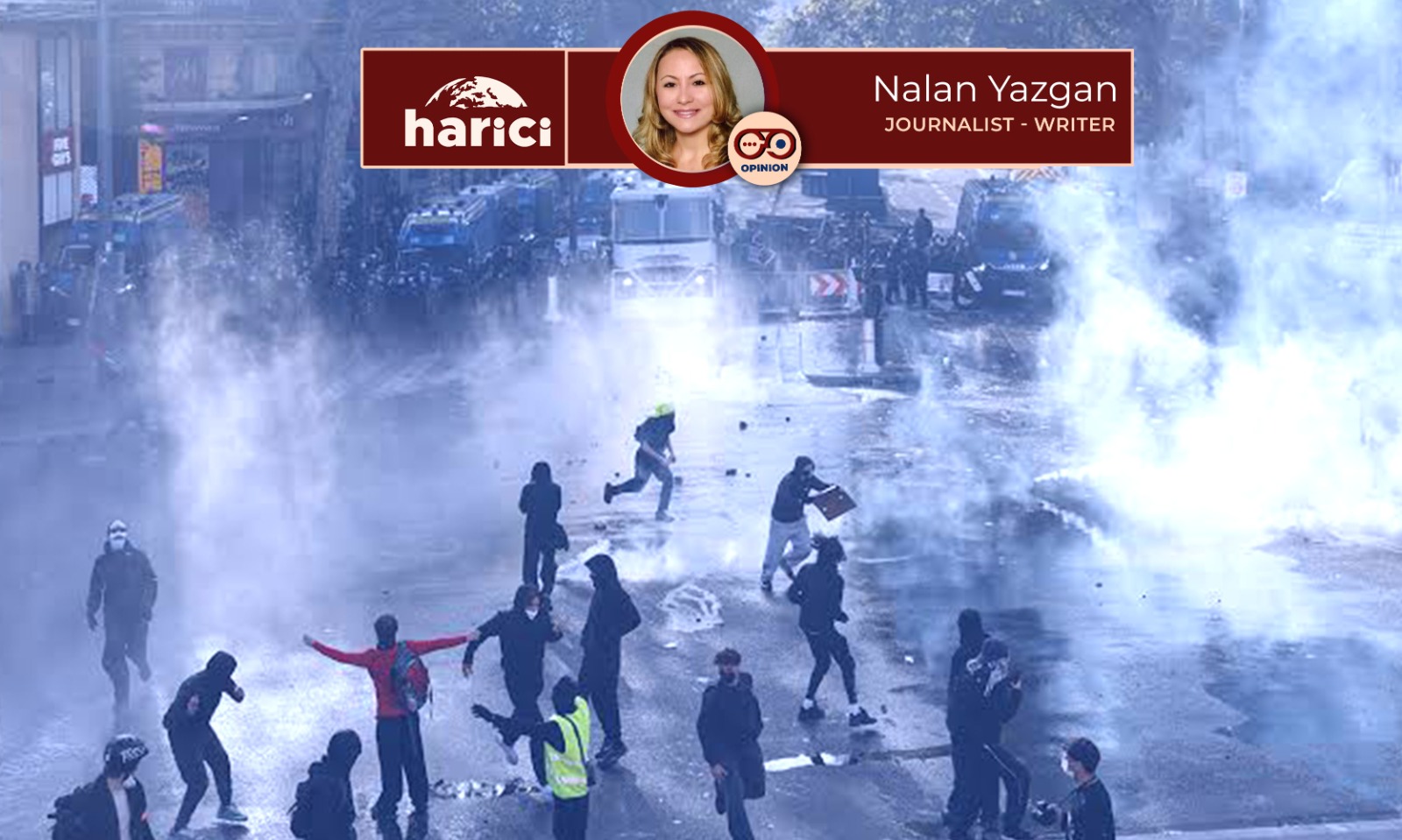
The streets of France have turned into a stage not merely for anger against the government, but for a deep-seated mistrust of the state’s approach to security. The blurring of the line between peaceful demonstrators and looters, lingering questions over police conduct, and the media’s refocusing on the immigration debate are bringing the country to the brink of a political reckoning far deeper than a routine public-order crisis.
In France, a government does not have to wait for an electoral defeat to lose its legitimacy. Sometimes, slogans chanted in a public square, tear gas fired down a boulevard, crowds penned in at the exit of a cordoned-off street, and testimonies of unhindered looting in shops only hundreds of metres away suffice to expose just how fragile the bond of trust between state and society has become.
Events in Paris on Saturday, 17 October point to precisely such a political fracture. Planned demonstrations with the participation of student unions, trade unions, and the Yellow Vests were marked throughout the day by police crackdowns, disputes over march routes, looting in the city centre, and widespread criticism of the government’s perceived inadequacy. The scene that emerged by evening suggested that France was grappling not merely with an issue of public order, but with a burgeoning crisis of confidence regarding the state’s impartiality and political motives.
Whom does the state permit to take to the streets, whom does it obstruct, and which forms of violence does it intervene against, and to what degree? The answer to this question may prove decisive in understanding France’s current political impasse.
The shadow of 17 October 1961
It is impossible to view the date of these demonstrations as a mere coincidence on the calendar. On 17 October 1961, a peaceful demonstration in Paris supporting Algerian independence was brutally crushed by the French police. Scores of people were killed, with some demonstrators drowned after being thrown into the River Seine. The event remains etched in memory as one of the darkest chapters in France’s colonial history and state-sponsored violence.
Sixty-five years later, as police interventions, youth rage, and the state’s stance on the right to protest are debated once again on the streets of Paris on 17 October, the resurgence of this historical memory was inevitable.
This memory may hold a distinct meaning, especially for French citizens of North African descent. Yet it would also be a mistake to reduce all the young people taking part in the demonstrations to a single identity, immigrant origin, or political motivation.
To what extent has the French Republic truly reckoned with the legacy of its colonial past and the relationship its security apparatus maintains with diverse segments of society?
Looters on the streets, where are the police?
Individuals dressed in black and associated in the public eye with the Black Bloc broke into shops at various locations, damaged businesses, and engaged in looting.
While peaceful demonstrators marched under a heavy police presence, fierce criticism arose that looting in certain areas had been allowed to unfold unchecked.
It is striking that while 14,000 police officers were deployed across the capital during the Pope’s visit to Paris, only 10,000 officers in total were assigned across the whole of France for the demonstrations of 17 October.
To which areas were police resources allocated? Had intelligence services assessed the risk of looting beforehand? While a robust security presence flanked the routes of peaceful marches, why was the same effectiveness not demonstrated in safeguarding commercial districts?
The deployment of elite units trained to quell urban unrest, such as CRS 8, does not resolve these questions. On the contrary, the failure to contain the incidents despite the presence of specialized units calls the quality of planning and coordination into question.
A political reckoning extending from Marseille to Limoges
The debate in Paris soon reverberated across the country’s other cities. In a televised address, the socialist mayor of Marseille stated that he had requested police reinforcements from the government, yet the units dispatched fell short given the scale and requirements of the city.
The mayor’s most striking allegation was that while looters stormed Marseille City Hall, the Hôtel de Ville, police officers stood roughly 200 metres away and failed to intervene. Stating that he possessed security camera footage, the mayor affirmed that he would await the scrutiny of a Parliamentary Commission of Inquiry and demand an explanation from the government.
The mayor of Limoges likewise issued what amounted to an ultimatum to the government, demanding the reconstruction of the torched town hall and the full reimbursement of costs. According to the mayor, the government had failed to protect a public building and neglected to provide the police with the necessary resources and backing.
These statements emerging from two distinct cities demonstrate that a new confrontation over security policy has arisen between local authorities and the central government. How security resources are allocated, which risks are prioritized, and whether the warnings of local administrations are heeded must all be brought to light.
The deepening scrutiny over the administration’s stance was compounded by President Emmanuel Macron’s refusal to accept the resignation tendered by Interior Minister Laurent Nuñez. The rejection of the resignation raises the question of whether the executive aims to preserve the chain of accountability, or fears that a political reshuffle would only exacerbate the crisis.
In either case, the government faces a crisis of trust.
An eight-minute speech and unanswered demands
Macron’s roughly eight-minute televised address failed to meet expectations regarding the political dimensions of the crisis. The president announced that he would meet with student unions and that the prime minister would engage with political parties, yet he presented neither tangible decisions nor a comprehensive political roadmap.
Education spending, police violence, the Palestinian cause, anti-fascism, and backlash against the Macron administration appear to have ceased being disparate issues in the eyes of the youth.
To be sure, the true strength of a state lies not in silencing its people and streets, but in addressing legitimate demands. It must not be forgotten that institutions unable to adapt and change are destined to break.


By its very nature, foreign policy feeds into and draws nourishment from numerous, disparate, and varied fields. It is a domain with manifold and diverse inputs. For foreign policy is examined alongside a broad array of subjects, ranging from geography to history, economics to intelligence, and military might to public diplomacy, commonly termed soft power elements.
The capacity of the state, that is, the scale of the state, or in other words the aggregate of its elements of power (namely political, economic, military, and soft power components), is decisive in foreign policy. Geography is decisive in foreign policy. Commercial relations are decisive in foreign policy. Energy dependence on another country or countries, if present, is decisive in foreign policy. Foreign policy cannot be conducted in spite of these four factors.
There is more. A country’s capacity, its scale, does not increase overnight, from one day to the next. It requires planning. It requires national consensus. It requires time. It requires preparation. Nor are these enough. The regional and global environment, the conjuncture, and the international plane must also allow for it. The stance of allies and adversaries is, of course, also important.
For the international environment is, by its nature, complex. It is an environment rife with contradiction, turmoil, conflict, and tension. To draw an analogy, the person in the driver’s seat of foreign policy is not a motorist speeding along the road as they please. There are things they must not forget, rules they must obey, red lights, vehicles speeding up from behind, a truck moving ahead, and a heavy vehicle hurtling toward them from the opposite direction.
Success in foreign policy does not arrive simply because a politician we like has become foreign minister. For a foreign minister is only as effective as the power, capacity, and weight of their country. One must accept this plain truth.
Moreover, there are simple, straightforward questions that reveal whether foreign policy, which some find deeply complex and inscrutable, is successful or not.
There are undoubtedly ways to measure the effectiveness, prestige, influence, and success of foreign policy.
For instance, the number of countries that respect a passport, how many countries can be visited visa-free, and how many countries impose visa requirements and grant those visas only with great difficulty are important indicators of a country’s standing.
Let us take ourselves as an example. Which countries require a visa for the Turkish passport? Which ones do not? Is it easy for our citizens to obtain visas for the countries they primarily wish to visit?
Let us give another example from the Turkic world.
On the Cyprus issue, which we regard as a national cause across government and opposition, right and left, Kemalist and Milli Görüş adherents alike, how many countries have we succeeded in having recognize the TRNC? Why do the Turkic states (Azerbaijan, Kazakhstan, Kyrgyzstan, Turkmenistan, Uzbekistan) not recognize the TRNC? Far from recognizing the TRNC, how do the Turkic states in Central Asia (Turkistan) explain to Ankara their developing relations with the Greek Cypriot Administration of Southern Cyprus, which Türkiye does not recognize, their appointment of ambassadors, and their recognition of Southern Cyprus as the island’s sole legitimate government?
We must also ask this question, of course: What is the state of Türkiye’s bilateral trade with the Turkic states?
Let us give an example of the relationship between foreign policy and big capital.
In which countries are big capital circles, among the greatest supporters of the ruling bloc, winning major tenders?
In our country, across both ruling and opposition ranks, there is a political party order that supports Türkiye’s EU membership. Yet how much progress has been made on EU membership?
Why is US President Trump not keeping the promises he made to Türkiye at the NATO summit held in Ankara a few months ago?
How many contracts has the new regime in Syria, the al-Sharaa administration, awarded to Turkish companies for the reconstruction of its country?
Has the government in Libya that Türkiye supports paid the money owed to Turkish construction firms, outstanding for years?
How does Qatar, with whom our relations are very good, explain its developing ties, energy agreements, and joint military drills with Greece and the Greek Cypriot Administration, disregarding our sensitivities?
Who is the addressee of the harsh statements used in recent weeks by Azerbaijan, which we view as “two states, one nation”? To what extent does Azerbaijan share Türkiye’s policy on Israel? What does Türkiye think about the scale, depth, and intimacy of Azerbaijan-Israel relations?
These questions can certainly be multiplied.
Yet without taking into account the scale of the state and observing the criteria for measuring foreign policy, no sound assessment can be made.
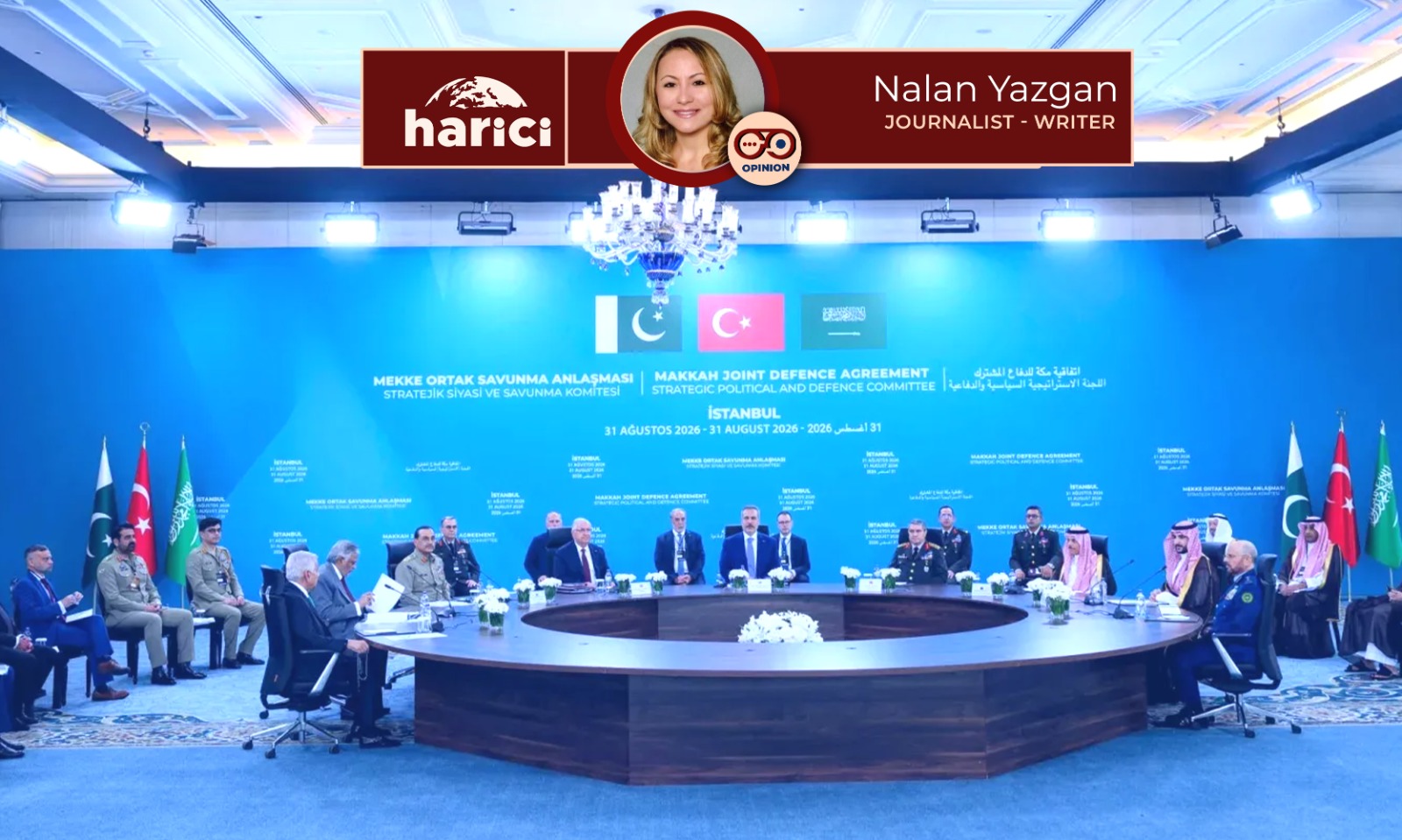
In the Middle East, war is no longer waged merely to seize territory. The true contest turns on who will control the energy pipelines, trade routes, ports, and railways of tomorrow. Missiles may strike cities today, but the maps of the future are being drawn through transport and energy corridors.
In this context, interpreting Türkiye’s presence in the Mecca Alliance solely as military support for Saudi Arabian security remains incomplete; it fails to explain why two states that viewed each other with mutual suspicion until recently would take steps toward a cooperation close enough to constitute a shared destiny.
Alongside Saudi Arabia’s existential motives, Ankara’s participation in this alliance is anchored in a profound geopolitical foundation: to position itself within, and if possible at the very centre of, the Middle East’s reconfigured energy and transport corridors.
Today, it cannot be said that Riyadh and Ankara see eye to eye on every regional issue. The threat perceptions and priorities of the two countries do not, quite naturally, entirely coincide. On the geopolitical chessboard, partnerships do not always arise from identical agendas. When reasons are sufficiently compelling, particularly existential ones, they can override political differences and enable common ground along the same strategic path.
A new war of corridors unfolds in the Middle East
On one side lies IMEC (India-Middle East-Europe Economic Corridor), planned to extend from India through the United Arab Emirates, Saudi Arabia, Jordan, and Israel to Europe. On the other stands the Development Road, which aims to link the Persian Gulf across Iraq to Türkiye, and onward to Europe.
These two undertakings are, of course, far more than mere transport projects. They represent two divergent geopolitical answers to where the future flow of trade and energy between Asia and Europe will traverse; for Türkiye, this issue is of vital importance.
If a corridor system taking shape to Türkiye’s south, beyond Ankara’s orbit, becomes permanent, Türkiye could forfeit not only an economic opportunity but also a substantial portion of its strategic centrality in the Middle East. It is through this prism that the Mecca Alliance must be evaluated.
Türkiye’s seat at the same table with Saudi Arabia signifies more than military solidarity. Riyadh and Ankara must sit together to avoid exclusion from the region’s emergent security and economic architecture, for the security of a corridor and the corridor itself are no longer separate matters.
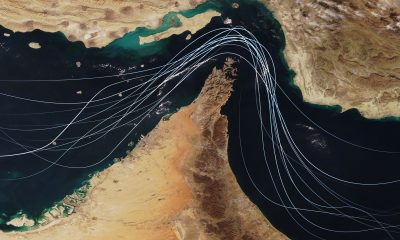
The Strait of Hormuz, the Red Sea, the Bab al-Mandab, and the Suez Canal are links in the very same chain. A security crisis in one directly impacts the others. While the vulnerability of Hormuz makes alternative export routes for Gulf oil indispensable, instability across the Red Sea heightens the strategic cost of Suez.
Saudi Arabia’s alternative pipelines connecting its eastern oil fields to Red Sea terminals are therefore not merely energy infrastructure; they are strategic bypasses mitigating dependence on Hormuz.
For Türkiye, the Development Road fulfills the same function across a broader geography. Stretching from the Persian Gulf through Iraq to Türkiye, and from Türkiye into Europe, this artery possesses the potential to forge a new overland backbone connecting the Gulf to the Mediterranean and Europe. As security concerns in the Red Sea mount and the vulnerability of Suez deepens, the value of this route rises accordingly.
The Hejaz Railway: Revived once again
The return of the Hejaz Railway to the regional agenda signifies far more than mere nostalgia. Once linking Istanbul to Damascus, Amman, and the Hejaz, the railway served as one of the primary transport and logistical arteries of the Ottoman geography.
Reviving the idea of the Hejaz Railway could become the emblem of Türkiye’s drive to reimagine its historical transport connections between the Gulf, the Hejaz, and the Levant through modern rail, energy, and logistics networks.
The objective here is not to restore the past, but to transpose the strategic logic of that historical geographical linkage into the twenty-first century. For this reason, Türkiye’s role in the Mecca Alliance and the resurgence of the Hejaz Railway project must be viewed as components of the same overarching picture.
Corridors do not consist solely of energy pipelines. Railways, ports, highways, electrical interconnectors, logistical hubs, and security architectures are all facets of the same geopolitical grid, and safeguarding these networks requires political alliances.
Herein lies the strategic significance of Saudi Arabia and Türkiye sitting at the same table in Mecca, even at a juncture when their views on Syria diverge.
Ankara and Riyadh do not need to agree on every subject. Yet neither wishes to see the new map of the Middle East drawn to its detriment. Türkiye’s aim is not to build an anti-bloc against any specific country alongside Saudi Arabia; rather, the goal is to avoid exclusion from the future energy and trade systems of the Middle East, while securing a decisive voice in establishing their security architecture.
Hence, for Türkiye, the Mecca Alliance is far more than a simple defence pact. Securing the Development Road, shielding Gulf energy corridors, stabilising the Red Sea, rethinking connections across the Hejaz and the Levant, and bolstering trade corridors reaching Europe all intersect within this single strategic equation.
In this equation, Türkiye’s foremost advantage remains its geography. Ankara sits at the northern terminus of the overland routes linking the Gulf to Europe; within NATO; and at the crossroads connecting the Black Sea, the Caucasus, the Eastern Mediterranean, and the Middle East.
Will Türkiye become one of the powers shaping the Middle East’s energy and trade architecture over the coming decades, or will it be reduced to a mere transit state traversed by routes designed by others? That question defines the true strategic significance of the Mecca Alliance for Ankara.
In the Middle East of tomorrow, it will be impossible to separate the corridor carrying energy, the security framework protecting that corridor, and the alliance constructing that security framework.
Whoever controls the corridor shapes commerce. Whoever guarantees the routes through which trade flows holds sway over the regional balance of power. This is the true dimension of the contest currently underway in the Middle East.
A succession of distinct and largely mutually exclusive ambitions are competing for dominance in the current climate: India’s linkage to Europe, the Gulf’s new economic horizons, Saudi Arabia’s alternative energy routes, the security crisis in the Red Sea, the strategic weight of Hormuz, and Türkiye’s aspiration to open outward to Europe via the Development Road. Ironically, perhaps, the conflict that will decide which corridor underpins global stability has already begun, and it will likely continue spreading to new fronts. Regrettably, the fires in our region appear poised to intensify long before they abate.

Nokia and ICEYE sign deal to build sovereign Ukraine satellite network

Mélenchon’s “new France” vision triggers fierce cross-party debate

US envoy says Syria interim leader Sharaa seeks Israel normalization

Unauthorised AI agents access customer accounts at major US banks

US drafts Ukraine plan with Nord Stream restart and sanctions relief
-

 Europe2 weeks ago
Berlin Left Party backs Israel’s right to exist for coalition pact
-

 America2 weeks ago
Trump weighs presidential memorandum to cut surging US diesel prices
-
 Diplomacy2 weeks ago
EU and China reach preliminary deal to curb hybrid car imports
-
 Diplomacy1 week ago
SWP urges backing for Gulf trade routes bypassing Strait of Hormuz
-

 Europe1 week ago
LSE study finds post-bailout Greece turned into a cafe economy
-
 America2 weeks ago
Energy firms enlist ex-US officials to tap Venezuelan oil
-

 America2 weeks ago
Thiel targets Pope and Obama over AI in new ‘Antichrist’ lectures
-

 Russia2 weeks ago
Russia relaxes diesel export curbs after talks with Trump
