
Opinion
The Christian liar

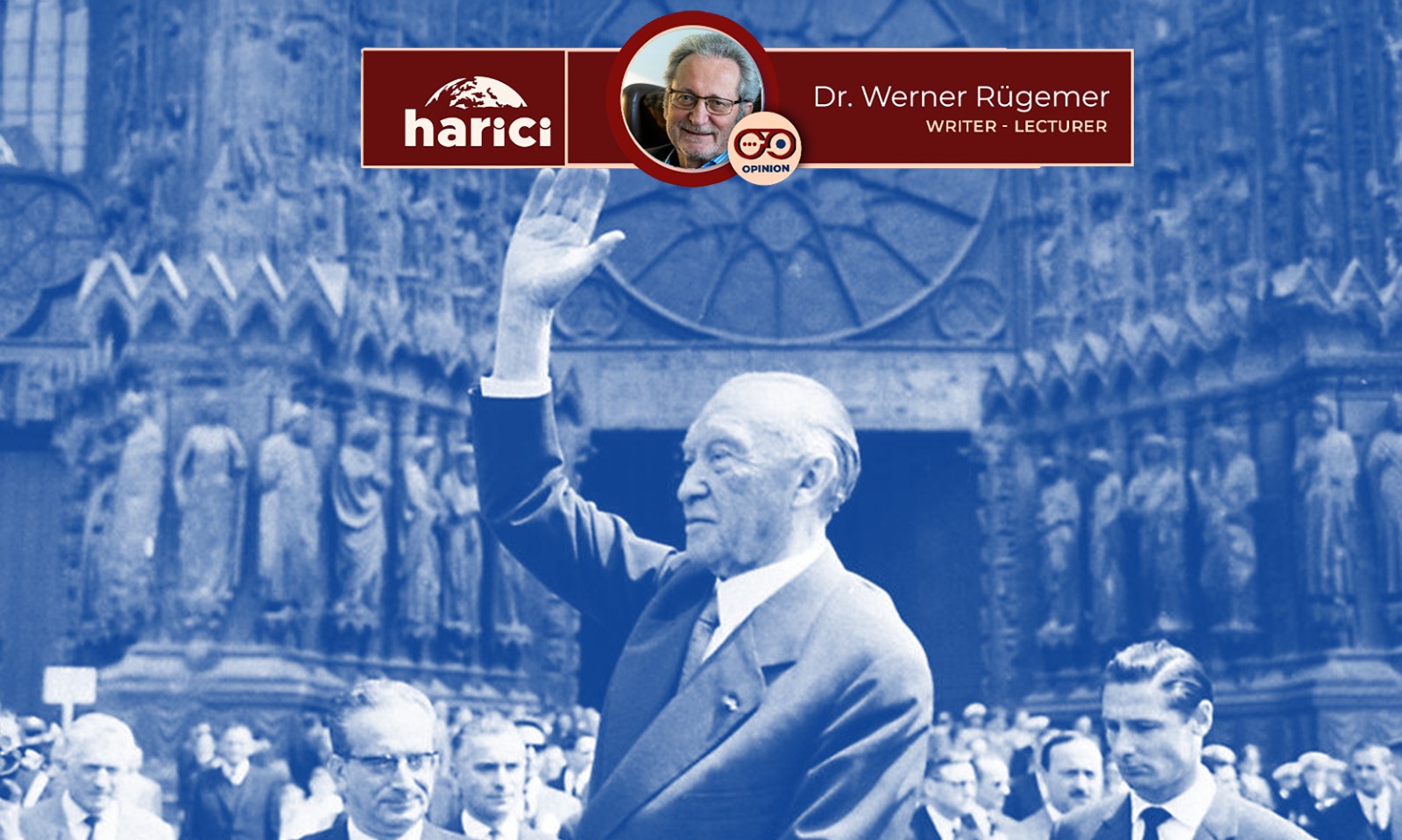
On the occasion of Konrad Adenauer’s 150th birthday, the prevailing foundational narrative of the Federal Republic is seldom called into question. Werner Rügemer‘s sketch, however, does precisely that. It portrays Adenauer not as the architect of a democratic new beginning, but as a consistent power politician in the service of capital—from the Empire to Weimar, from the Nazi state to the yoke of the United States. A necessary act of demystification.
German Chancellor and CDU Chairman Friedrich Merz has bowed to the world’s most powerful far-right figure, US President Donald Trump. This submission entails further militarization, accompanied by the impoverishment of the majority of the population and the peril of nuclear annihilation. This has a history, and that history began with the first Chancellor and CDU Chairman, Konrad Adenauer. His current successor, Friedrich Merz, has confirmed that Adenauer “set the decisive course for the Federal Republic.”
I. Catholic Ascent in a Protestant Empire
The rise of the Catholic Adenauer began within the Protestant German Empire.
Following the end of Napoleon’s brief dominion, the Kingdom of Prussia succeeded in annexing the Ruhr and the Rhineland, including its largest city, Cologne. Prussia and rising capitalism had discarded old feudal Catholicism as an ideology: Protestantism became the state religion. After the feudal lords with their Catholic blessings, it was now the turn of the new holders of private power—the capitalists—and their profits, blessed by Protestantism.
Protestant Prussians Complete the Catholic Cologne Cathedral
Consequently, the Prussians were extremely flexible in their use of religion: Since the Rhineland and Cologne were Catholic, replete with an Archbishopric and Romanesque churches, the Prussian Protestants promoted the Catholicism of their new subjects there as well.
Thus, the Prussian kings showed benevolence and, from 1842 onwards, financed the completion of the 157-meter-high cathedral towers. What the wealthy Catholic Archbishopric of Cologne had failed to achieve in 600 years, the Protestant Prussians accomplished in a few. And the Catholics were now obliged to be grateful to the Prussians.
Incidentally, the Prussians did not achieve this alone. The Jewish owners of the Sal. Oppenheim bank, rising in tandem with Prussia, also performed political groundwork; some converted to Catholicism, but mostly to Protestantism. They became the second-largest donors for the completion of the “Catholic” cathedral. This bank, ideologically highly flexible, would play a significant role in Adenauer’s ascent as Lord Mayor (Oberbürgermeister) of Cologne and subsequently as Chancellor of the Federal Republic.
Rise in a Catholic Milieu under Prussian Patronage
Konrad, the third son of a father who had risen from a craftsman via military service to a Prussian judicial officer, was permitted to attend the Gymnasium—specifically, the Royal Catholic Apostel Gymnasium. The school was financed by the Kingdom of Prussia and built directly adjacent to the Catholic Church of the Apostles. The aim here was to support aspiring individuals from the Catholic milieu to serve in the Prussian administration, corporations, and banks. Indeed, in 1894, former Chancellor Bismarck personally congratulated the high school graduate: The 18-year-old Konrad was now “one of us.”
After high school, Konrad remained within the Catholic milieu; during his law studies in Bonn, Munich, and Freiburg, he joined the relevant Catholic student fraternities. He later began working at Hermann Kausen’s law firm in Cologne; his boss was simultaneously a Royal Prussian Notary and the chairman of the Catholic Centre Party (Zentrum) in the City Council. Konrad joined the Centre Party to become a Council Member in 1906 and, as early as 1909, First Deputy Mayor. This rising star was elected with the approval of the Liberal Party—that is, the entrepreneurs, bankers, and, for instance, the bosses of the dominant media clan DuMont Schauberg, whose Kölnische Zeitung was distributed throughout Prussia. Thus, at the unusually young age of 33, this ascending man took charge of the city administration; the Catholic Lord Mayor Max Wallraf, also of the Centre Party, held the office only in an honorary capacity.
Under Prussia’s three-class franchise system, only wealthy men could vote in Cologne. Rich capitalists were in the Liberal Party; artisans and civil servants were in the Centre Party. The SPD [Social Democratic Party] could not be elected at the local level; it held only a seat in the Reichstag in Berlin.
Adenauer also ensured the proliferation of his own wealth. He joined the Pudelnaß Tennis Club—not because he could, or wanted to, play tennis. Rather: The youth of Catholic high society met there. It was there he met his first wife, Emma Weyer, the daughter of the director of the Cologne Reinsurance Company. Thus, the rising Adenauer, with a suitable loan, was soon able to purchase a large plot of land in the developing Catholic villa district of Cologne-Lindenthal and have a 14-room villa with a wine cellar constructed.
Administrative Chief of the Frontline City of Cologne in WWI
As administrative chief, Adenauer had fostered the rise of Cologne’s industry, financed by the Oppenheim, Levy, Seligmann, and J.H. Stein banks. These were also the financiers of industry and railways in the Ruhr area and neighboring cities like Wuppertal.
The Lord Mayor of Cologne was subordinate to the Prussian military governor and the Prussian-appointed district president of Cologne. With the outbreak of war in 1914, martial law was declared. Thus, in World War I, Cologne became the German Empire’s frontline city against the nearby enemy states of Belgium, France, and England.
Prior to the war, Adenauer had constructed the Butzweiler Hof airfield as well as another airfield for Zeppelins, and had brought Zeppelin production to Cologne. As soon as the war began, Zeppelins rained bombs on cities in Belgium, the Netherlands, Poland, Lithuania, and London—the first instance in human history of the aerial bombardment of enemy cities and civilians.
Stinnes and Krupp shifted munitions production to Cologne, while Bayer in Wuppertal produced poison gas: deadly weapons had to reach the front as quickly as possible. Cologne was also a transit station for soldiers, supplies, and prisoners of war moving to and from the front. Occupied Belgium was also administered from Cologne. Adenauer cultivated close friendships with leading industrialists and took over the war economy management of the frontline city; the municipal department tasked with this had 4,500 employees.
Cologne: Execution of Christian Sailors
It was no coincidence that Cologne was chosen for the execution of sailors Albin Köbis and Max Reichpietsch, who were sentenced to death for “mutiny” in 1917 for protesting the war. Both were Christians, but members of the New Apostolic Church: This church had been founded because Pope Leo XIII had openly embraced capitalism. The “mutineers” followed early Christianity; Adenauer, the capitalist Christian, had no objection to the execution of such Christians.
When the incumbent Lord Mayor of Cologne, Wallraf, was called to the stumbling imperial government in Berlin as a (penultimate) last resort, Adenauer became his successor; no one else was even considered. Precisely because a “politician of endurance” was needed for the frontline city of Cologne in a war that could no longer be won, Adenauer, upon his demand, immediately received the highest salary of any mayor in the Empire. He concluded his inaugural speech in October 1917 with an “oath of loyalty to the Kaiser and the Empire, with the call glowing with warm gratitude: His Majesty, our all-highest Kaiser and King, hurrah, hurrah, hurrah!”
“They Died for Germany”
Together with his corporate friends, Adenauer rejected peace negotiations in 1917. Millions of dead soldiers and civilians were, for the well-ensconced Christian civil servant-politician, merely collateral damage, ruthlessly factored in.
In the final year of the war, he declared in the city council that just as “the people of Cologne have endured these hardships to this day,” Germans must “endure all the hardships of war with patience and patriotism.” He justified the 41 deaths in a British air raid on Cologne in May 1918 by stating: “They too died for Germany.”
“Germany”; this would remain a core value for Adenauer: Dependent laborers are exploited and, for the sake of capitalists masquerading as “Germany” and their privileged accomplices, are expendable even in war.
End of War: Flattering and Destroying Revolutionaries
Fighting rising democratic resistance, saving capitalism: This was Adenauer’s mission at the end of the war.
Therefore, although the SPD was banned from standing for election under Prussian electoral law, from 1916 onwards he gave compliant SPD politicians positions in the administration and the city council. The SPD politician Wilhelm Sollmann became his special adjutant.
When a Workers’ and Soldiers’ Council was formed in Cologne as well, Adenauer allocated them rooms, telephones, and typewriters in the city hall. At the same time, he ensured that Sollmann became the chairman of this council and could denounce capitalism as a warmonger at large rallies.
The Christian liar Adenauer walked around with a revolutionary armband on his sleeve, but simultaneously established the “Welfare Committee”: Here, he gathered his banker friends and entrepreneurs; Sollmann was also present. In the final year of the war, the Kaiser awarded Adenauer the Order of the Red Eagle and membership in the Prussian House of Lords, the upper house of the Reichstag.
Saving the State and City from “Bolshevism”!
When Kaiser Wilhelm II fled abroad shortly before the war ended in November 1918, Adenauer remained true to his oath and sharply condemned the Kaiser’s “shameful, ominous flight.” Now, “the country could be dragged into the embrace of Bolshevism.”
But Adenauer’s Welfare Committee outmaneuvered the penniless activists of the Workers’ and Soldiers’ Council, who lacked political experience. Thus, Adenauer had averted the “Bolshevik danger” on behalf of the fled Kaiser. Later, he boasted of having tricked the Workers’ and Soldiers’ Council together with Sollmann, thereby “saving the city from revolution.”
It was here that he learned ruthless ideological opportunism and the merciless defense of capitalism. With this, he would continue to rise as a politician—and very soon, as a multimillionaire.
II. Continued Rise in the Hated Republic
Demagoguery regarding the “Bolshevik danger” remained Adenauer’s leitmotif. He carried as much of the monarchy as possible into the Weimar Republic: Relations with the peaks of private capital, and the continuation of the Free State of Prussia within the German Reich. In this way, he would contribute to the NSDAP [Nazi Party] coming to government by 1933.
Against the “Dictate of Versailles”
Adenauer railed against the “Dictate of Versailles”: He argued that this “intolerable slavery and bondage” destroyed “national and state existence,” ruined the German economy, caused “our children to wither,” and abandoned millions of Germans to “a slow death.” Adenauer said this as President of the German Catholics’ Day in Munich in 1922; yet he never mentioned the architect of the dictate, US President Wilson, who, by designating Germany as the sole guilty party, secured Wall Street’s war loans and the profits of US arms companies.
However, Adenauer tore into the spreading socialism that sought to “alienate the German people from Christianity.” He condemned the “lack of morality and authority” appearing in the “tortured people,” equating it with “materialism and Mammonism.”
What distinguished Adenauer from the far-right and the NSDAP was initially his concept of a solution: Catholic Christianity and the Catholic Centre Party. But since he shared the fundamental critique of the Versailles Dictate, his solution, polished with a Christian veneer, would step by step converge with the far-right solution. And as in the monarchy, he would bind himself not even to his own party, but to leading capitalists.
Thus, Adenauer expanded his personal and institutional relationships with leading capitalists to the entire German Reich and the USA.
In the Cologne Rotary Club
In 1928, Adenauer was a founding partner in the small men’s circle of the Cologne Rotary Club, established on the US model, alongside bankers Hagen (Bank Levy), the Oppenheims, Pferdmenges (Schaafhausen, later Oppenheim), and Baron von Schröder (J.H. Stein), industrialists Silverberg (Rheinbraun), Stollwerck (Chocolate), Clouth (Rubber), Tietz (Department Stores), and publisher Neven DuMont (Kölnische Zeitung). The president was Pferdmenges.
Pferdmenges’ influence had long since transcended the Rhine and Ruhr: In 1929, the Schaafhausen Bank Association merged with Deutsche Bank. During the nationalization of the bankrupt Dresdner Bank and Commerzbank in 1931, he advised the government of Chancellor Brüning (Centre Party) and in the process joined the Supervisory Board of Dresdner Bank and the Board of the Reichsbank [Central Bank].
A Favorite in the Circle of Ruhr Industrialists
The bosses of the four Cologne investment banks sat on dozens of supervisory boards of Ruhr conglomerates such as Flick, Klöckner, Thyssen, Stinnes, and IG Farben.
Consequently, Adenauer became a sought-after member of their lobbying associations:
- League for the Renewal of the Empire: With slogans like “People without Space,” “Strengthening the Führer idea,” the necessity of a “Third Reich,” and “overcoming conflicts” through a uniform “healthily structured nation,” this league formed a programmatic cross-front with Hitler’s NSDAP.
- Reich Economic Council: Coordinated industrialists and large landowners throughout the Reich with the Reich Association of German Industry (RDI).
- Ruhrlade: This secret organization financed the “conservative” parties DVP, DNVP, and Adenauer’s Centre Party, and ultimately the NSDAP.
Adenauer became the politically desired candidate here. In 1925, steel baron August Thyssen wrote to him: “I hope the hour will soon come when you, with capable people, will stand at the head of the government and understand our needs.”
“Germany’s Right to Colonies”
The German Colonial Society (DKG) had been founded in 1885. However, at Versailles, Germany had been stripped of its colonies, which were given to US allies. The DKG subsequently fought for the return of the colonies. This was also in the NSDAP’s program. Only the KPD [Communist Party] and USPD explicitly rejected it.
In 1931, Adenauer became Vice President of the DKG. The President was Heinrich Schnee, the former Governor of German East Africa. In Cologne’s great banqueting hall, the Gürzenich, Adenauer criticized the “inconsistency of the colonial guilt lie” propagated by the victorious powers.
Separatism: Prussian State, Rhenish State
Within the Weimar Republic, the Free State of Prussia was preserved as a semi-monarchical extension with its own parliament (Landtag) and government. It covered two-thirds of the German Reich and was a counterweight to the newfangled democracy of the Weimar Constitution.
President of the Prussian State Council
The Prussian State Council existed as the upper house of the Prussian Landtag from 1920 onwards. Adenauer served as its President from 1921 to 1933, attending 222 sessions. In return, he received a free residence in Berlin. The expense allowance was 12,000 Reichsmark annually, plus daily allowances.
In Berlin, he met with ambassadors of other states, the Vatican representative and later Pope Pius XII, Eugenio Pacelli, Reichsbank President Hjalmar Schacht, and members of the Deutsche Bank board, on whose supervisory board he sat. He also met with Wall Street banker Thomas McKittrick of the Lee Higginson investment bank, the leading lender to the German Reich.
From this perspective, too, the attitude cultivated by Adenauer and his spin doctors—that he was anti-Prussian and disliked the Prussian capital—is revealed as a lie.
Western Separatist State: Direct Capital
Adenauer and his friends felt their existing freedoms were violated not only by Versailles but also by the fashionable democracy of the Weimar Republic: Now all adults, regardless of wealth—even women!—could vote. The influence of trade unions, the SPD, and even more dangerous leftists was too great! A capital-friendly separatist state, in addition to the Prussian state, seemed like a solution to them.
The spokesman was the billionaire Ruhr baron Hugo Stinnes. Adenauer experimented with concepts named “Rhenish Republic,” “Rhenish State,” or “Rhenish-Westphalian Republic,” or sometimes “West German Republic”: In one variant, it would remain part of the German Reich; in another, it would not.
Such a separatist state was to include the predominantly German-speaking French region of Alsace, conquered by the German Empire in 1870 and forced back to France by the Treaty of Versailles. In 1923, bypassing the German Foreign Office, Stinnes took Adenauer to Paris to ask if the government there was interested in a Western European economic union. The French government and the Bank of England refused: That was the end of the project.
Secret Tax Advantages for Prestige Projects
Furthermore, after the war, the USA had established itself in Western Europe. They organized the Dawes Plan for the German Reich, named after Charles Dawes of the National City Bank in New York. US companies opened branches in Germany and opened the country to their products.
US Bonds and Ford to Cologne!
Adenauer utilized this more than any other mayor. Through Wall Street banks, he had Cologne municipal bonds sold to US investors with a 7.5 percent yield to finance his major projects: the Niehl industrial estate, the airport, the Nürburgring, the stadium, the Rhine bridge, the university, and the first section of autobahn in Germany.
Automotive giant Ford had opened its first branch in Berlin in 1926. In 1930, Adenauer brought the second Ford branch and the US company’s German headquarters to Cologne. To achieve this, he granted secret tax advantages, bypassing the city council.
Adenauer saw no harm in flattering Adolf Hitler’s most influential financier and the world’s leading antisemite. The German edition of his book “The International Jew” had reached its 26th printing by 1926.
The New Albertus Magnus University!
The University of Cologne had been founded in the 14th century but was closed by Napoleon in 1798 due to “bigotry”: The Malleus Maleficarum (“Hammer of Witches”), the theological justification for the torture and public burning of thousands of women (“witches”) until the 18th century, had originated here.
Adenauer had the university rebuilt, referring to its great past at the opening in 1919, but mentioning nothing of its diabolical aberrations. He named the university once again after its founder, the medieval theologian Albertus Magnus. Funding was provided by Adenauer’s capital friends with their Christian veneer: Bayer boss Carl Duisberg, for example, donated 200,000 RM. Banker Pferdmenges collected two million. He would remain the most important collector of legal and illegal donations for Adenauer after 1945 as well.
Courting Hitler’s Future Crown Jurist
In 1932, Adenauer secured the appointment of constitutional lawyer Carl Schmitt to the old-new university. Adenauer had been gravitating toward this intellectual father of the authoritarian “Führer State” since 1925.
Both admired Mussolini. To be close to Hitler, Schmitt was appointed to the University of Berlin as early as the summer semester of 1933, becoming the “Crown Jurist of Hitler.”
Multifaceted Self-Enrichment
Adenauer’s income and wealth were the highest of any politician in the German Reich.
Salary, Perks, Supervisory Board Memberships, Interest-Free Loans
The highest mayoral salary—twice that of the Reich President—was accompanied by the highest overt and covert perks. As of 1930: Annual salary 41,250 RM, plus pensionable housing allowance of 37,000, and 6,000 for electricity and heating. (For comparison: A worker’s annual wage: 1,680 RM; a civil servant: 2,520 RM).
Added to this were profits from stock transactions, interest-free loans from the city treasury and banker friends, and above all: income from 11 supervisory board memberships (Deutsche Bank, Lufthansa, RWE, Rheinische Braunkohle, etc.).
Millions in Loans for Stock Speculation: Never Repaid
In the spring of 1928, Glanzstoff AG, which had a branch in the Cologne industrial estate of Niehl, listed new shares of its newly founded US artificial silk subsidiary, American Glanzstoff Corporation, on the New York Stock Exchange.
Adenauer bought a package of shares with a loan of millions from Deutsche Bank. In 1928, the market value was 1.33 million Marks; by October 1929, due to the financial crisis in the US, it had fallen to just 110,000 Marks. Deutsche Bank demanded repayment of the loan.
Adenauer never repaid the loan; he did not want to, nor was he compelled to under any regime. Thus, in 1949, Adenauer would begin his duties as CDU Chairman and founding Chancellor of the Federal Republic as a speculator indebted to Deutsche Bank.
On the Road to Fascism
In 1929, Dictator Mussolini signed the Lateran Treaty with the Vatican: Catholicism became the state religion. Mussolini-admirer Adenauer sent congratulations: “The name Mussolini will be written in golden letters in the history of the Catholic Church!” Mussolini thanked “dottor h.c. adenauer primo borgomastro Koeln” on behalf of all Catholics and all Italians.
Cultural Institute with Mussolini
Thus, in 1931, the Lord Mayor of Cologne signed an agreement between Cologne and Italy with the leading ideologue of Italian fascism, Minister of Culture Giovanni Gentile (“The Foundations of Fascism”): The establishment of an Italian Cultural Institute, against the will of the Reich government and with a fascism-friendly administration.
Permission to Hoist Swastika Flags
Adenauer later successfully spread the lie that he had resisted the hoisting of swastika flags in the city in February 1933. The reality was this: The NSDAP had secretly hung flags on the Mülheim Bridge to advertise a Hitler event in the Cologne exhibition halls. Adenauer had the flags removed because the bridge was municipal property! However, the Mayor permitted the NSDAP to hang flags on the exhibition halls, which also belonged to the municipality: This is how Adenauer lied using partial truths.
NSDAP into the Prussian and Reich Government!
As early as August 1932, the Centre Party demanded that the National Socialists take “open and full responsibility” in both the Prussian government and the Reich government.
On the same day in Cologne, Adenauer visited his Rotary brother Baron von Schröder, who was mediating between the Centre Party and the NSDAP. In the banker’s neighboring villa in Cologne-Lindenthal, Adenauer gave a written guarantee on his host’s letterhead: The Centre Party would “judge Hitler without prejudice solely by his actions and tolerate him as Reich Chancellor.”
On behalf of the Prussian State Council, Adenauer declared in February 1933 that in Prussia, “the formation of a government between the NSDAP and the Centre Party under the Premiership of Hermann Göring is immediately possible.” Two months later, Göring became Prussian Prime Minister. Hitler was already Reich Chancellor.
III. During the Nazi Era: Luxury Living with a State Pension
During the Nazi regime, Adenauer was able to lead a luxurious, privileged, and free life, including trips abroad, thanks to a high state pension and his status as a multimillionaire. He observed the injustice with immense knowledge and mercilessness. Yet nothing in life is as far from innocence as allowing visible injustice to persist. He had helped the Nazis into government and offered no resistance despite—or rather, because of—his highly privileged position. He made himself permanently complicit.
Defeat of a Politically Bankrupt Man
Adenauer’s Centre Party fell from power in the local elections of March 1933 because its reputation had already been ruined by high municipal debts. However, the majority for the NSDAP candidate could only be achieved because the 10 seats of the Communists were declared invalid; Adenauer and the Centre Party did not protest this.
Refuge with Enthusiastic Nazi Christians: Maria Laach Abbey
Adenauer was expelled from Cologne by the Nazi regional administration. He quickly found accommodation with his friend Ildefons Herwegen, Abbot of the Benedictine Abbey of Maria Laach in the Eifel.
In the weeks that Herwegen hosted Adenauer, the Abbot was enthusiastically greeting the Hitler government: “People and state have become one again through the action of Führer Adolf Hitler.” At a memorial service for the NSDAP martyr Albert Leo Schlageter in the Cologne Gürzenich hall on May 26, 1933, the Abbot invoked God’s blessing upon the Führer.
The Centre Party supported the Concordat Hitler concluded with the Vatican. Pope Pius XI had praised Hitler as a “reliable pioneer against Bolshevism.” Vice-Chancellor Franz von Papen, who had been in the Centre Party until shortly before, came to Maria Laach on July 21, 1933: The Concordat was celebrated. The rule now was: With the blessing of God and Hitler, one could be a member of the Catholic Church and the NSDAP simultaneously!
June 1933: “It Makes No Difference to Me, Hitler Will Do”
In June 1933, Adenauer wrote from the monastery to his friend, the banker’s wife Dora Pferdmenges: My party, the Centre Party, has failed because “in recent years it did not fill itself with a new spirit in time,” and: “In my conviction, our only salvation is a monarch, a Hohenzollern, or for all I care, Hitler will do; first Reich President for life, then comes the next stage. Thus the movement enters a calmer channel.”
Adenauer determined that the other bourgeois parties were also incapable of saving the existing “order” against the power of the labor movement and mass democracy. Thus, he approved of war and fascism as necessary collateral damage; incidentally, a significant side benefit emerged for Adenauer’s clientele, just as it did for Adenauer himself.
Pferdmenges: “We Follow the Will of the People’s Chancellor”
In 1933, right at the beginning of the Hitler government, Pferdmenges—Adenauer’s most important advisor and financier, who at that time sat on the supervisory boards of both Dresdner Bank and Bank Oppenheim—declared: “We follow the will of the People’s Chancellor to create work and bread for the unemployed.”
From 1932 onwards, Pferdmenges was a presbyter and treasurer on the board of the Protestant congregation in Cologne’s millionaire district of Marienburg: This congregation had adopted the newly founded Nazi church, the “German Christians.” Therefore, a new, much larger community center had to be built, with rooms for the Hitler Youth and the Nazi Women’s League.
Carved in stone at the entrance, immortalized in colossal size, was not only Martin Luther with a Christian cross, but also an SA soldier with a swastika and imperial eagle. In 1934, Pferdmenges inaugurated the community center. Thus, in Cologne, not only the Catholic but also the Protestant church entered into a demonstrative, public alliance with Hitler within the milieu of bankers and industrialists.
Free, Luxurious Mobility Under the Nazi Regime
Adenauer was not removed from office as Lord Mayor of Cologne in 1933, as he later lied; on the contrary, he was retired with a high pension.
High Pension, Compensation, Preservation of Wealth
Initially, he received an annual pension of 12,165 Reichsmark, then 15,000 RM permanently from 1937 onwards, plus compensation at market value for the villa in Cologne. His wealth remained completely intact. As part of the arrangement, Adenauer joined the NS-People’s Welfare, a Nazi organization, in 1936.
Villa Residence in Berlin
Thus, in 1934, after his stay in Maria Laach, Adenauer was able to rent the villa of an emigrated Jewish owner in the celebrity district of Griebnitzsee/Neubabelsberg in Berlin. He was able to bring his family to live with him and wanted to become a bank director.
On June 20, 1934, during Hitler’s murderous purge of the SA leadership (the Röhm Putsch), Adenauer was placed under house arrest, but this ended two days later. He was able to vacation comfortably with his wife in the Black Forest.
Land Purchase and New Villa Construction in Rhöndorf
With the compensation for his villa in Cologne, he was able to buy a large plot of 6,000 square meters in the spa and villa resort of Rhöndorf, south of Cologne. He had a residence built like his previous 14-room villa: four living levels, private and representative rooms, a wine cellar, a pantry built into the mountain, an air-raid shelter, several terraces and entrances, a farmyard for animals, and a large garden. Domestic staff were employed during the Nazi era as well. Later, as Chancellor of the Federal Republic, he would reside here.
In Intense Contact with the Organizers of the Nazi Regime
He continued to move within the wealthy milieu.
Visits to Ruhr Industrialists
In 1939, Adenauer and his wife were invited by steel industrialist and Hitler financier Peter Klöckner. A large gathering met at the Villa Hartenfels near Duisburg. The Pferdmenges couple was also present.
Long discussions were held with General Hans Günther Kluge on the comparison of German and US armament capacities; the General was knowledgeable: In 1941, he became Commander of Army Group South in the Wehrmacht’s war of annihilation against the Soviet Union.
The group stayed overnight in the spacious villa and spent the weekend together. For the return journey, Klöckner provided the Adenauers with a car and, as the host noted in a thank-you letter, sent a batch of “those exquisite wines you tasted with us” after them. In the same year, Adenauer also attended a family reception of another friend, Hitler financier Fritz Thyssen.
Baron Kurt von Schröder
The Cologne banker and Rotary brother had engineered Hitler’s chancellorship on January 4, 1933. He joined the SS and the NSDAP, and in May 1933 became President of the Cologne Chamber of Industry and Commerce. Adenauer sent him a “letter of heartfelt congratulations.” Far beyond Cologne, the banker became an ultimate actor in the Nazi system: organizer of the Circle of Friends of the Reichsführer SS (comprising 30 industrialists), spokesman for the Reich Group of Private Banks, member of the Administrative Council of the Reichsbank, and member of the Administrative Council of the Bank for International Settlements in Basel, Switzerland, led by Thomas McKittrick—whom Adenauer had met in Berlin before 1933.
Robert Pferdmenges
Adenauer’s fundraiser Pferdmenges was also a key banker in the Nazi financial system. Adenauer asked him, for instance, whether their mutual friend Friedrich Flick (“decent and honest as a man and businessman”) had sold his RWE shares and bought a new company. Bank Oppenheim, managed by Pferdmenges and renamed Bank Pferdmenges in 1938, was a “war-essential” bank until 1945.
Goebbels and Abs Protect Adenauer’s Speculation Losses
Hermann Josef Abs had started at the Bankhaus Delbrück in Cologne in 1923. During the Nazi era, he rose to the board of Deutsche Bank: Until 1945, he organized war loans, sat on the supervisory boards of three dozen systemically important banks and companies, and organized Aryanizations (the confiscation of Jewish property). As a devout Catholic, he welcomed the attack on the Soviet Union enthusiastically, for to him, it was “the greatest enemy of freedom and humanity.”
At shareholder meetings, a small shareholder repeatedly demanded: Adenauer must repay his million-mark loan, otherwise it is a loss for Deutsche Bank and its shareholders! But Abs imposed his will: The motion will not be processed! Nazi Propaganda Minister Goebbels instructed the media not to report on the matter.
Adenauer: Best Informed on War and Jewish Extermination
Franz-Rudolph von Weiss, who had worked at the Swiss Consulate General in Cologne since 1920 and became Consul in 1936, became Switzerland’s Consul General for the Rhineland in 1943. Weiss had been a close friend of Adenauer since his time as mayor and would become a key advisor for Adenauer’s Swiss relations after 1945.
During the Nazi era, the two met regularly and socially. Adenauer’s wife called Weiss “dear good uncle.” The good uncle sent his reports regularly to his boss, the Swiss Ambassador in Berlin, Hans Frölicher—an enthusiastic Nazi sympathizer who secured arms deliveries from Swiss companies and financial transactions of German companies via Switzerland. At the same time, Weiss held an internationally crucial position from the start of the war: He took over the consular representation of the USA and England, which had severed diplomatic relations with Germany upon their military entry into the war.
Von Weiss maintained a “fine network with politicians, bankers, economic leaders, and high representatives of the Catholic Church.” From 1941 onwards, he reported to his government on, for example, the Warsaw Ghetto, the deportation of Cologne’s Jews, the extermination of Jews in Eastern Europe, and forced laborers in Rhineland factories.
Hitler’s secret police, the Gestapo, documented that Weiss was “one of the best sources of news for foreign countries” due to his “excellent connections to various circles of society and the economy”: Adenauer sat at the source of one of the best intelligence networks in the Nazi state.
Good Relations with the USA
US companies equipped Hitler’s army; Ford Cologne was now producing war vehicles. Adenauer’s second wife came from a Wall Street banking family. He hosted US visitors in Rhöndorf. His son Max won a scholarship to the elite US university Georgetown in Washington in 1937/38.
Adenauer’s longest-standing friend since 1920 was the US entrepreneur Daniel Heineman. Since 1905, he had managed the electrical holding company SOFINA, with its European headquarters in Brussels. In Europe, and in Cologne while Adenauer was mayor, he had built tramways. Due to his Jewish origins, he managed SOFINA from New York following the German occupation of Belgium in 1940; collaboration with the Nazi occupation continued smoothly thereafter.
From 1933 to 1937 alone, Heineman gifted Adenauer a total of 20,000 RM in 1,000-mark notes; in today’s purchasing power, over 100,000 euros. This also provided Adenauer with foreign currency for Swiss vacations without running afoul of the Nazi state’s otherwise strict foreign exchange controls. Heineman would remain an important permanent advisor on US matters for the subsequent Federal Chancellor.
On Principle: No Resistance with Anyone!
Adenauer was able to receive countless visitors undisturbed. However, he rejected all attempts to win him over for any form of resistance. In 1934, Karl Mewis of the Cologne KPD tried via a Catholic industrialist. The industrialist returned with Adenauer’s answer: “Resistance, absolute nonsense!”
In 1936, the Christian trade unionist Jakob Kaiser returned from a three-hour conversation: “He cannot be counted on.” Adenauer likewise rejected contact with the conservative Mayor of Leipzig, Carl Goerdeler, who was building a resistance circle against Hitler with military officers.
In 1944, the Christian trade unionist Heinrich Körner tried. Adenauer refused again: “I want nothing to do with it.” He mocked any resistance with his visitor Franz Thedieck, a Senior War Administration Councillor in the military command in occupied Belgium.
Luxury Detention 1944
In 1944, on the occasion of the assassination attempt on Hitler by conservative officers, he was temporarily arrested. It was a luxury detention: In the exhibition camp of the city of Cologne, Russian prisoners of war had to clean a bathtub so he could bathe. A fellow prisoner had to iron his trousers.
His daughter and wife brought him socks, shirts, and better food, and were able to chat with him for hours. Unlike his fellow prisoners from the SPD, KPD, and Centre Party, he was not drafted into labor duties or sent to a concentration camp. With a doctor’s note, he was finally transferred to the hospital in Cologne-Lindenthal, as he wished: After the war, he told the lie, “I was in a concentration camp.” (The Adenauer Foundation, Wikipedia, etc., and artificial intelligence continue to propagate such lies today.)
Without Remorse and Repentance: Forever Guilty
After the Nazi regime, as an indebted millionaire, in the capacity of CDU Chairman and Federal Chancellor, he would continue his guilt in a new form.
He would help persecute people who had offered resistance to the unjust system, even having them imprisoned, while protecting his accomplices. He would present himself as the “antithesis of the Nazi system.” He would preach Christianity and the Christian West but never fulfill Christianity’s demand for remorse and repentance.
On the contrary: He would lie. He would lie to himself and to the people he governed and administered, exposing them to new injustices and even the danger of a new war.
IV. After Hitler and the World War: “Politics of Humility”
After the war, the Western military administrations led by the USA reorganized the separated West Germany. They helped Adenauer, who had been selected long beforehand, to the chairmanship of the CDU, sidelining competitors and anti-fascists. Many decisions were made in Switzerland, where the chosen one often went disguised as a tourist and also underwent expensive cell revitalization therapy at a private clinic on the shores of Lake Geneva.
In the separatist state of the Federal Republic of Germany (FRG), founded with Adenauer in 1949, occupation law remained in force. This authority initially lay with the leading US banker John McCloy as US High Commissioner: His apartment in Frankfurt/Main had more staff than the Adenauer government—which was initially not allowed to have its own foreign ministry—and the secret service remained a department of the CIA. Through the Marshall Plan and the NATO clamp, the Adenauer state became a forward US bastion and a “showcase” toward the “East.”
Kissinger: Adenauer’s “Politics of Humility”
Henry Kissinger, the most important advisor to US presidents in the 20th century, published his life’s balance sheet shortly before his death: “Leadership: Six Studies in World Strategy” (New York and Munich 2022). Kissinger had also advised Federal Chancellor Adenauer: The first chapter in the book was dedicated to him, under the title “The Politics of Humility.”
The meaning was this: German capitalists were allowed to keep their war profits and also the profits from the Aryanization of thousands of Jewish banks, companies, and shares; not only those in Germany but also those in occupied Austria, France, Belgium, Luxembourg, the Netherlands, Italy, Greece, Poland, Denmark, Norway, as well as the Soviet Union, Slovakia, Yugoslavia, and North Africa. 98 percent of their legal, media, and scientific accomplices also went unpunished; however, they now had to place their proven anti-communist, anti-Russian, economic, and technical potentials humbly at the service of a higher power—the USA.
Practices of Federal German Humility Before the Master
To mask this humility, this submission, with lies of “new self-confidence” and “we are somebody again”: This kind of humility was embodied and practiced at the highest level by the trained Christian liar and political actor Konrad Adenauer, and it remains decisive for his successors and the Federal Republic to this day; just as today Adenauer’s successor, Chancellor and CDU Chairman Merz, continues to stage the role—fulfilling all fundamental demands of the US government while feigning that he is increasing Europe’s sovereignty with lies.
- The Basic Law, approved by the Western military administrations led by the USA, precisely does not contain the rights decided by the UN as a result of the World War: No reference to international law, e.g., the UN Charter; no reference to the labor and social rights of the UN or its sub-organization the ILO; instead, vague, non-binding verbiage about “human dignity,” which is concretely violated millions of times.
- Parties selected, deemed suitable for government, and continuously financed by corporations and banks—primarily the CDU and CSU—were and are open to the far right, including internationally via party foundations.
- No other European state “hosts” as many US military bases as the Federal Republic: Nuclear bombs are stored here, global drone murders are committed from here, supplies for wars in other states are routed from here without the participation of the German government, and military personnel are not subject to German law.
- Adenauer approved: If the USA decides, nuclear war with Russia will be fought in Europe; this applies again now, should the exhausted US proxy warrior Ukraine be replaced by the arming European NATO states as a much larger US proxy warrior, by order of the current US President Trump.
- From Adenauer to the present day, the following applies: The Federal Republic is not a sovereign state—neither militarily, economically, nor digitally—but a provisional entity subordinate to the USA, especially in foreign and geopolitical affairs; this also applies to the construct of the European Union.
- The Western military administrations and then, from 1949, the US High Commissioner licensed the leading mainstream media (Spiegel, ZEIT, Süddeutsche, Springer, FAZ, as well as regional ones like Kölner Stadt-Anzeiger) with Nazi executive staff to this day; this includes decisive public opinion “research” (= opinion forming: The Allensbach Institute for Demoscopy, founded by Goebbels’ student Noelle-Neumann, which receives permanent commissions from federal governments to this day).
- Labor Injustice: The Federal Republic is the only Western state where political strikes are effectively banned (already banned for civil servants and in church enterprises); while millions of mostly illegal migrant low-wage women work in prostitution (Germany: “The Brothel of Europe”), construction, home care, security, gastronomy, etc., civil servants since Adenauer have become increasingly numerous and highly privileged in the public service, ministries, outsourced agencies, the military, secret services, and diplomacy.
- Since the old Nazi bankers and Nazi entrepreneurs were allowed to continue with their old privileges under Adenauer/McCloy, the “Economic Miracle” also turned out to be a lie: As early as 1967 there were 670,000 unemployed, over a million from 1975, over two million from 1983, three million in 1989; under Adenauer’s successor Helmut Kohl, East Germany was impoverished in favor of Western banks and entrepreneurs from 1990 onwards with US advisors in the Treuhand agency; then all of Germany became the “sick man of Europe” again, further deindustrialized from 2000 onwards with the help of US “locust” investors, especially in medium-sized businesses; and then came Adenauer’s successors Merkel and Merz and the very large US investors like BlackRock, Vanguard, and State Street, who are now leading shareholder groups in Germany’s most important companies, such as the DAX, and are reducing employment here with high profits while investing in the USA and China. And now the accomplice Merz, Adenauer’s successor, plays the role of the great economic savior for the “new sick man of Europe” with lies.
Fulfillment of the Adenauer Legacy: Humility Before Donald Trump!
To this day, the Federal Republic has no valid constitution, only a provisional and constantly amended “Basic Law”; and under US leadership, with the technocratically named “2+4 Treaty” of 1991, there is still no peace treaty in Europe, no reparation regulations: Thus, the further advance of NATO led by the USA against Russia remains valid: Germany remains a provisional entity.
This is how Adenauer’s legacy is fulfilled today: His current successor as CDU Chairman and Federal Chancellor fulfills all key demands of the most powerful and dangerous far-right figure of the “free world”—in humility before Donald Trump.
Therefore: The demolition of the Adenauer legends is also part of the construction of a democratic, peaceful, secure, prosperous Germany and Europe within the context of a multipolar world order, in which labor and social rights are also included in human rights.
Note by author Werner Rügemer:
In autumn 2026, the comprehensive Adenauer biography with numerous new sources, many from the USA, will be published by Papyrossa Verlag, Cologne.
First appearing on the NachDenkSeiten portal on January 5, 2026, this article was translated from German to English by the Harici team, following a request from Rügemer.


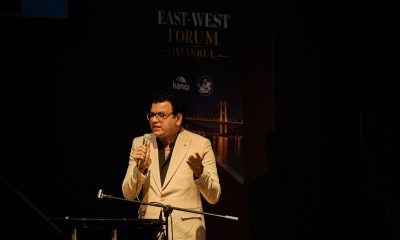





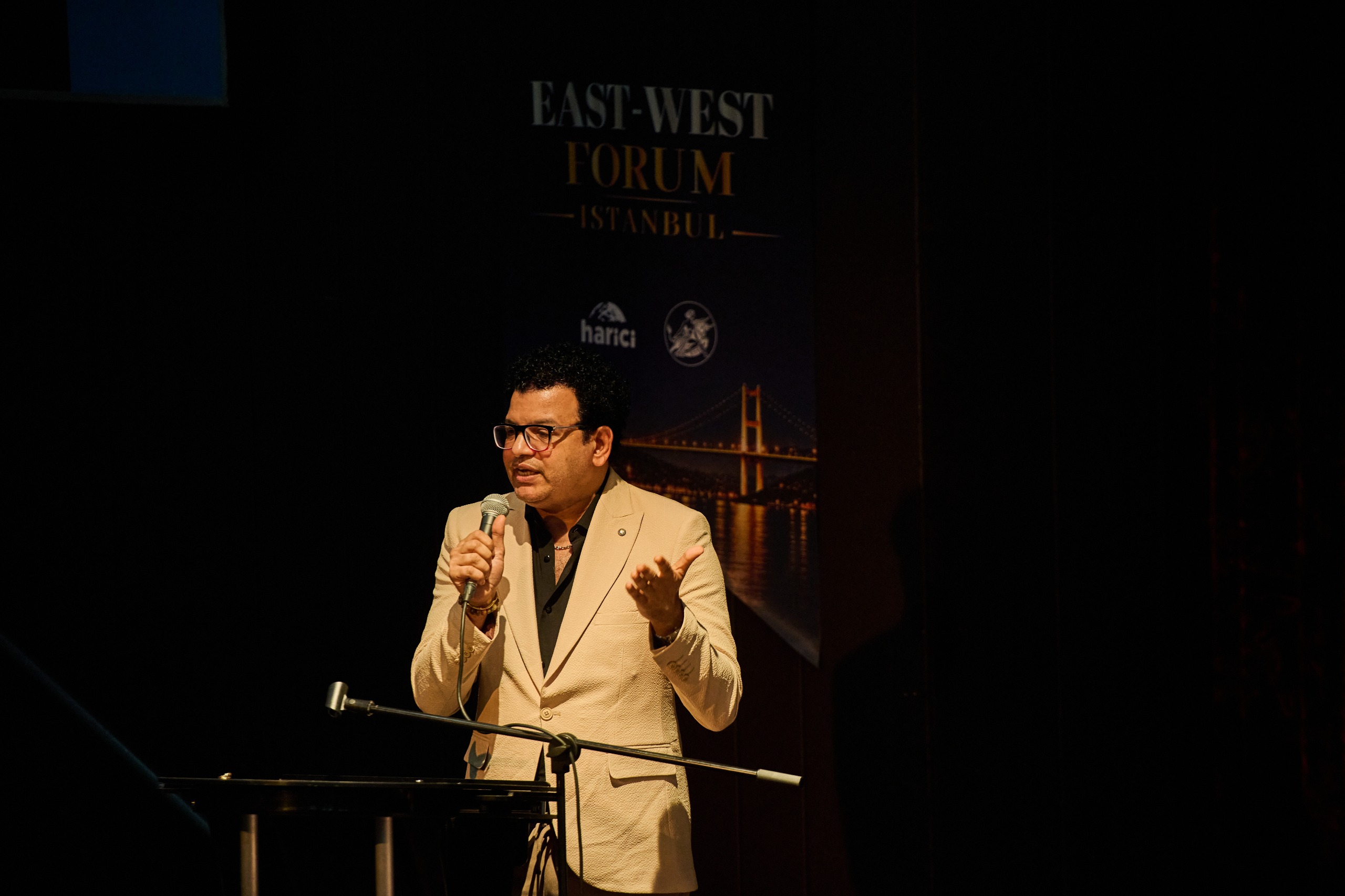
Dr. Ahmed Moustafa, Director & Founder, Asia Center for Studies & Translation, Egypt
In a city that has spent centuries translating the language of one civilization to another, the first East-West Forum arrived at a moment when the world itself seemed to have lost the vocabulary for talking across its divisions.
Held in Istanbul on Sept. 26–27 and preceded by meetings around the event, the forum brought together diplomats, academics, journalists, strategists and political thinkers from a wide range of countries. Hosted by Harici Media in partnership with the Berlin-based European Transcontinental Initiative, the gathering was conceived as an attempt to examine a world increasingly defined by competing power centers, regional wars, economic fragmentation, artificial intelligence and the erosion of confidence in institutions created after the Second World War. Harici reported that participants came from roughly 30 countries.
For us, the significance of Istanbul was not simply a matter of the speakers on the panel or the structure of the programme. Its deeper importance lay in the willingness to put difficult — and sometimes uncomfortable — questions on the table.
We would like to extend our sincere thanks and appreciation to my friend and brother, Mr. Tunç Akkoç, Founder and Editor-in-Chief of Harici Media, for his gracious invitation to a representative of the Asia Center for Studies & Translation, Egypt, to participate in the Forum as a speaker and commentator. His initiative in creating a platform where competing geopolitical narratives could meet directly deserves recognition.
In his opening remarks, Akkos stressed that the initiative was intended to establish a permanent platform where people representing different political and intellectual traditions and perspectives could meet and engage in direct dialogue.
This vision is particularly significant because the traditional language used in international relations has increasingly struggled to explain the realities of a rapidly changing world.
The Problem of Proxy Wars
During the session that discussed proxy wars in the region and ways to reach solutions to their crises, the Center put forward the view that the Middle East cannot simply be understood through the traditional map that divides the parties into “good” and “evil,” or into “responsible states” and “rogue states.”
Such terms, in our assessment, often reflect the perspective of powers that possess extensive influence over international media and financial and security institutions.
The Center particularly criticised what we see as political bias within important sectors of the Western media and some non-governmental organisations that receive Western funding. From our perspective, these institutions can, in some cases, move from being mere observers of geopolitical conflicts to becoming influential parties in the battle over the narrative and the story.
However, this view should remain open to debate and should not automatically be accepted as an absolute truth.
The more important question is not whether every Western journalist, every NGO, or every Western institution works to serve a single geopolitical agenda clearly, this is not the case, but whether the information environment itself has become so highly polarised that the public is now receiving radically different interpretations of the very same war.
In our assessment, the answer is increasingly approaching “yes.”
The problem becomes particularly clear when searching for the term “proxy wars” in the Middle East. Some of the first results focus on groups associated with Iran, including Hezbollah and the Houthis, as well as Hamas, whereas the history of regional conflicts is far more complex.
Al-Qaeda and ISIS emerged through different historical trajectories, with Anglo-Saxon support that was “created by Britain and the United States.” In environments dominated by the United States and Britain, Al-Qaeda emerged from the environment associated with Osama bin Laden and the Afghan jihad, while ISIS developed largely from Al-Qaeda in Iraq, under American sponsorship, to pursue a certain agenda in the region and advance the scenario of “creative chaos” promoted by Condoleezza Rice, the radical US Secretary of State.
At the same time, US policy toward Afghanistan during the Cold War contributed to shaping the broader environment from which some militant jihadist movements later emerged.
These distinctions matter.
Because propaganda often begins where complex historical details end.
Who Has the Right to Define a “Rogue State”?
The same problem appears in the vocabulary used to describe states.
Countries such as China, Russia, Iran and North Korea are frequently portrayed in Western strategic discourse as states challenging the existing international order.
Egypt, despite the different nature of its relationship with Washington, can also become the subject of criticism when its foreign policy does not conform to certain Western expectations.
The question is not whether these governments should be exempt from criticism. Of course not.
The deeper question is this: can the international system remain sustainable when one geopolitical camp increasingly assumes the authority to define which governments are legitimate, which movements are terrorist, which wars are defensive and which forms of resistance are acceptable?
That was one of the central questions behind our intervention in Istanbul.
The Middle East has repeatedly been presented through the lens of the “Iranian threat” as the principal strategic danger.
There is no question that Iran possesses significant military and regional capabilities, and that its policies are deeply contested by many neighbouring states. At the same time, reducing virtually every regional security problem to Tehran can obscure the interests and roles of other actors, including Israel, the United States, Gulf states, armed groups and local political forces.
The region has repeatedly paid a heavy price for simplistic interpretations of complex conflicts.
The Economics of Fear
The discussions in Istanbul also led us to a broader American question: to what extent can fear itself become a source of political and economic power?
Historically, the United States has experienced intense political campaigns shaped by perceived racial, ideological and security threats.
One does not need to accept every interpretation of this history to recognise that fear can become a factor with tangible economic consequences.
A 2020 study by Citi estimated that racial discrimination against Black Americans had cost the US economy approximately $16 trillion in lost economic output since 2000, based on an analysis of disparities in wages, education, housing and investment.
This figure demonstrates the extent of the economic losses associated with racial discrimination and exclusion. It also raises questions about the relationship between fear-based narratives concerning Black Americans, media influence, the political power of the gun lobby and the broader economic consequences of insecurity.
More importantly, however, the study highlights a fundamental point: bias and insecurity carry substantial and measurable economic costs.
The broader lesson has direct relevance to foreign policy.
When societies are continually presented with existential enemies, military spending and the expansion of security institutions become politically easier to justify.
America After Iran
In Istanbul, we also advanced the view that the United States after its confrontation with Iran in 2026 should not simply be understood through the traditional image of unlimited American power.
The conflict exposed economic and strategic vulnerabilities.
The Strait of Hormuz emerged as a major strategic pressure point for global energy markets, amid disruptions to international trade that forced governments and companies to search for alternative routes and supplies.
The consequences were reflected in oil prices and energy costs in Europe and elsewhere.
This does not mean that American power has disappeared. Rather, it suggests that military power is no longer synonymous with strategic control.
The rise of China, Russia, ASEAN, Iran and other centres of economic and diplomatic influence has made the international order increasingly complex and dispersed.
The East-West Forum itself reflected this reality, bringing together voices from Europe, Asia, the Middle East and North America while explicitly addressing multipolarity and the ongoing transformation of the global order.
America Is Changing From Within
The domestic dimension of American politics also deserves attention.
The emergence of figures such as Zohran Mamdani in New York and Abdul El-Sayed in Michigan reflects changes in the American political debate over inequality, foreign policy, healthcare, identity and the influence of established political and economic interests.
Their political trajectories should not be treated as evidence of a predetermined future for the United States.
They do, however, illustrate how issues that were once treated as peripheral including the costs of war, US policy toward Israel, economic inequality and the political influence of younger and more diverse generations have moved closer to the centre of American political debate.
This is another reason why East-West dialogue cannot remain confined to foreign ministries and military institutions.
A Dinner for Dialogue
One of the most memorable moments on the margins of the Forum was the private dinner held on the evening of Friday, September 25, hosted by H.E. Mr. Hasan Capan, Chairman of the Turkish-Chinese Friendship Foundation, and H.E. Ambassador Ersin Erçin, Vice Chairman of the Foundation, in honour of the speakers and participants.
We extend our sincere thanks and appreciation to both of them for their generosity, friendship and support.
The gathering was more than simply a dinner. It provided an opportunity for personal interaction, an exchange of ideas and the building of relationships among participants — precisely the kind of human diplomacy that formal conferences sometimes lack.
Real dialogue does not always begin behind conference podiums.
Very often, it begins around a single table.
Istanbul’s Larger Message
The first East-West Forum should be regarded as the beginning of a dialogue, not the end of a debate.
The organisers have already articulated a vision of transforming the initiative into an annual gathering in Istanbul, developing expert working groups, establishing an East-West Forum network and potentially creating a business council capable of connecting intellectual dialogue with economic cooperation.
This may ultimately prove to be one of its most important contributions.
The world that emerges from the current conflicts including the crisis surrounding the Strait of Hormuz will require more than ceasefire agreements.
It will require a new conversation about security, energy, sovereignty, development, technology and coexistence.
Istanbul is an exceptional setting for such a dialogue. One participant even proposed moving the headquarters of international organisations, including the United Nations, to Istanbul.
For centuries, the city has stood between two continents without belonging exclusively to either.
The East-West Forum can follow the same principle: not choosing one civilisation against another, but creating a space in which East and West can confront their differences without turning disagreement into permanent conflict.
For this reason, we see the Istanbul gathering as an announcement of intent.
It was not an attempt to erase differences.
It was an attempt to make dialogue possible despite them.
At a time when proxy conflicts increasingly risk evolving into direct confrontations, this may be among the most important political conversations the world can undertake today.

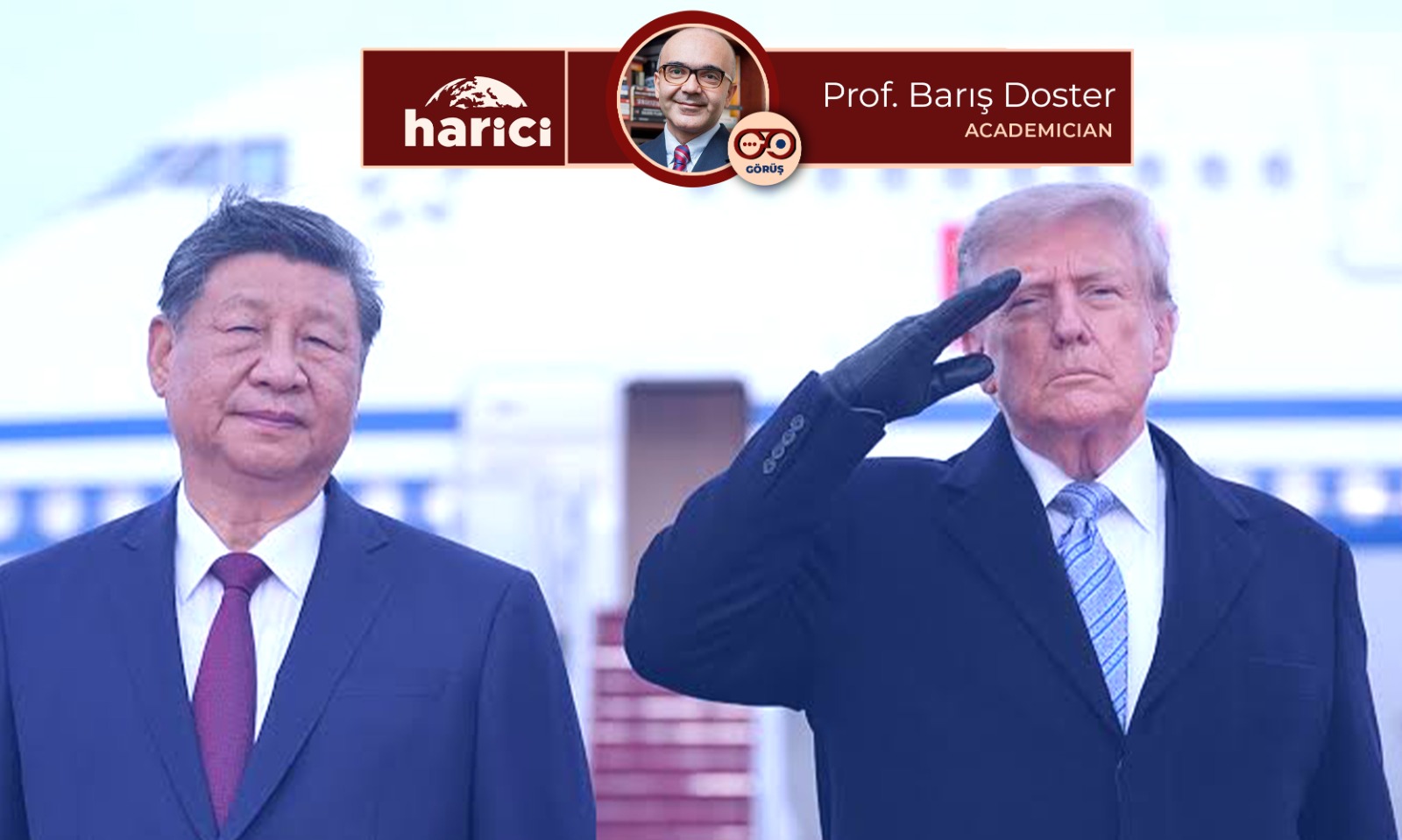
Much commentary followed the US president greeting the visiting Chinese leader at the foot of the aircraft stairs: both because a US president had not done so in many years, and because the leader he welcomed heads a state that the US defines as a competitor, an adversary, and an enemy. That photograph demonstrated that the US itself now recognizes China not merely as an economic power, but as a political, military, scientific, industrial, and technological one; yet it revealed other realities as well.
It showed that a multipolar order has arrived. It showed that the failure of the US to abide by the order whose rules it laid down and whose institutions it established has exacted a heavy toll on the US itself. It showed that the US-centric Atlantic system is unravelling. It showed that the collapse of a world order flouted, and indeed subverted, by its own rule-maker is both legitimate and inevitable. It showed that East-centred institutions, such as the Shanghai Cooperation Organisation and BRICS, enjoy an open path against Western-dominated bodies. It showed that the US regards China as a rival not merely economically, but ideologically and technologically. It showed that the US has proven unable to exercise deterrence against China, Russia, and Iran to the degree it desires.
Let us admit it: after the Cold War ended, the US assumed it could act as it pleased by bringing the European Union to its side and constantly invoking human rights, democracy, and freedom. It was mistaken. The more it spoke of a rules-based world order, of a liberal world order, the more it flouted those very rules. In the end, that order collapsed as well. The birth of a multipolar, multilateral, and multicentric world accelerated; and it was just as well. Now is the time to debate the rules, institutions, traditions, and solutions of this new order.
Yet who will conduct this debate? Who will take part in this search?
It is not right to expect this from the US; nor is it realistic. It is likewise impossible to expect it from the European Union. Europeans follow so subserviently in Washington’s wake that they refuse to consider even Russia as European, despite the fact that, alongside its Eurasian identity, millions of its citizens live across territory spanning Europe and Asia while viewing their nation as historically, politically, socially, culturally, artistically, and intellectually European. They attempt to construct a European defence and security architecture by excluding Russia, in defiance of Russia, and by harbouring hostility toward Russia. In the end, they are both mistaken and defeated.
As the new order emerges, India must also be examined under a distinct heading, alongside China and Russia. For India is a nuclear power possessing the world’s largest population and its 5th largest economy. It maintains disputes with China and Pakistan, yet enjoys good relations with Russia, the US, and Britain. It is a member of both the SCO and BRICS. On the other hand, within the Quad grouping, alongside the US, Japan, and Australia, it positions itself against China.
In summary, as an order takes shape in which the West runs out of breath while the East rises, and Atlantic institutions dissolve while those of Eurasia and the broader Global South come to the fore, we must first rid ourselves of Cold War dogmas and habits.
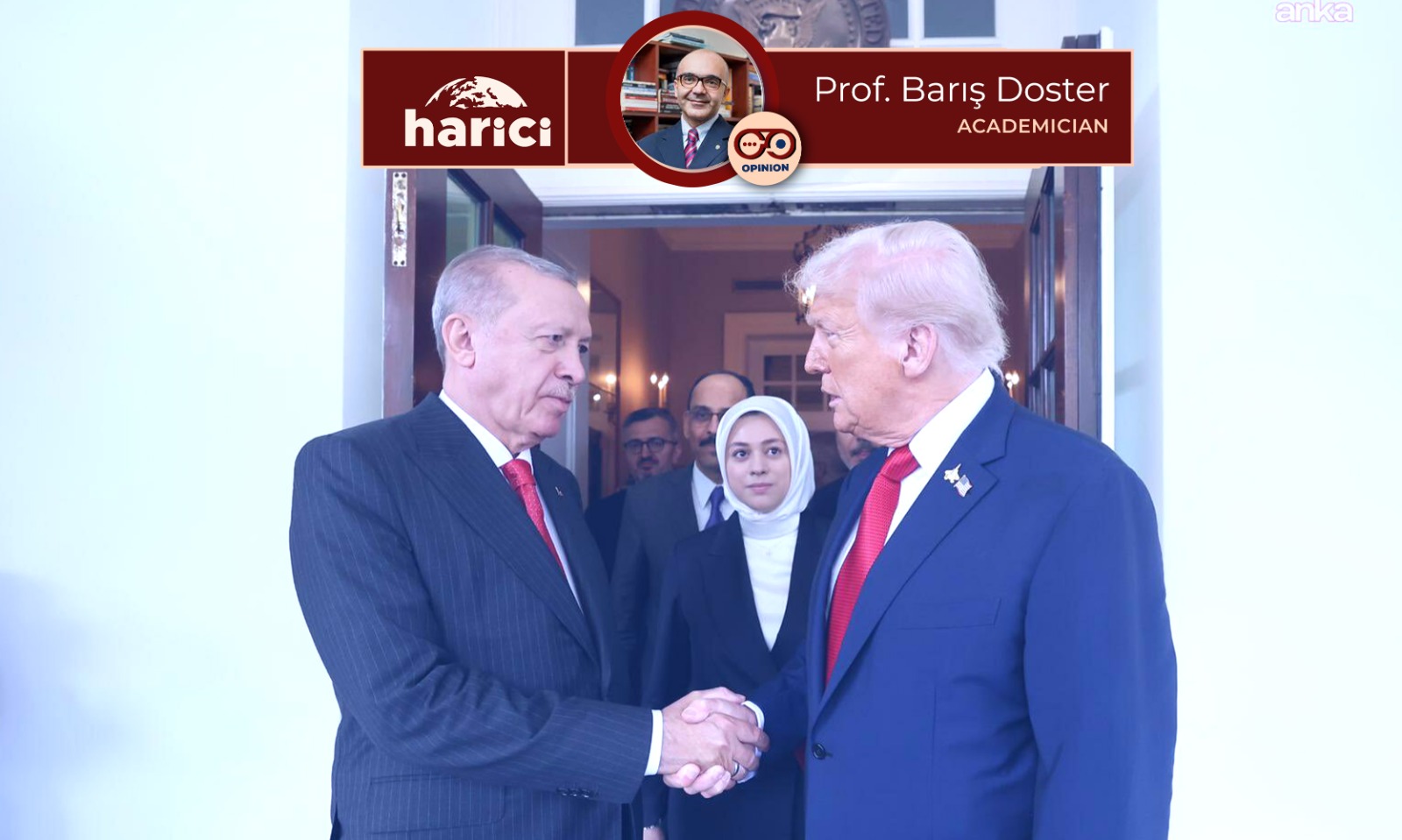
At the NATO summit held in Ankara last month, US President Donald Trump made promising remarks to Türkiye regarding the lifting of CAATSA sanctions, clearing the path for the sale of F-35 fighter jets to Türkiye, and supplying the engines required for the domestic Kaan aircraft. He has yet to keep his word.
This is quintessential Trump. He is neither a reliable nor a predictable leader. He approaches diplomacy like a merchant. In bargaining, he opens with the highest possible bid. Rather than institutional consultations, negotiations, formal diplomatic channels, and classical statecraft, he favours personal ties, bilateral encounters, and leader-to-leader diplomacy. He is notoriously erratic. A figure he praises one day, he drags through the mud the next, humiliating, scolding, and even insulting them.
US moves in the Mediterranean
Failing to honour the promises made to Türkiye, the US eased and partially lifted the arms embargo it had enforced on the Greek Cypriot Administration (GCA) since 1987 in 2020, before abolishing it entirely in 2022. Not content with this, the US signed a military cooperation agreement with the GCA in 2024 and hosted its leader at the White House. The GCA, whose path to acquiring weaponry from the US was cleared in 2024, has also recently been deepening its relations with France. Even though two British sovereign bases already exist in the southern part of Cyprus, with the US utilizing them whenever necessary, both the US and France signed separate basing agreements with the GCA. The GCA’s relations with Israel are also remarkably sound, as are those with Qatar. Meanwhile, relations between Greece and France have been exceptionally warm in recent years.
Amid all these tangible developments, Türkiye has largely relinquished its vigilance regarding the Blue Homeland. Drilling vessels and seismic survey ships have been withdrawn from the eastern Mediterranean.
The most distressing of these developments has been that four Turkic states in Central Asia (Kazakhstan, Uzbekistan, Turkmenistan, and Kyrgyzstan), none of which officially recognize the Turkish Republic of Northern Cyprus (TRNC) as a state, expanded their ties with the GCA and opened embassies in exchange for European Union financial assistance. Through this recognition, by acknowledging the Greek Cypriot Administration as the sole representative of the entire island under the name of the Republic of Cyprus, they effectively rejected the existence of the TRNC, whatever they might claim to the contrary.
Whatever anyone may say, and from whichever angle one evaluates it, the conduct of these four friendly and brotherly states cannot be explained merely by their lack of loyalty or their disregard for Türkiye’s sensitivities on this matter. Alongside this, one must acknowledge the failure of Turkish foreign policy. If Türkiye cannot convince even fellow Turkic states, let alone others, on an issue where its position is most legitimate and justified, such as Cyprus; if, far from persuading them, it cannot prevent them from cultivating relations with the GCA and opening embassies, this represents a monumental failure on the part of Turkish foreign policy.
Moreover, the failure in the Mediterranean is not confined to Cyprus. There is more.
Who is sidelining Türkiye in Syria?
Türkiye is persistently excluded from European-organized meetings on Syria. Türkiye’s views are not sought. So much so that even Qatar, our closest ally in the Arab world, on whose soil we established a military base and to whom we sold major assets, does not hesitate to take part in initiatives that exclude Türkiye from energy projects in the Eastern Mediterranean, or to cooperate with Greece and the Greek Cypriot Administration.
Much has changed in Syria since the days when Ahmet Davutoğlu, former prime minister, former foreign minister, former AKP chairman, and leader of the now-dissolved Future Party, carried away by his own momentum, declared: “Not a bird can fly in the Middle East without our knowledge”, “We know the Middle East street by street, inch by inch”, and “We are the masters, pioneers, and spokesmen of the emerging Middle East”, all while eagerly seeking to act as a subcontractor on behalf of the US. The regime has changed. The government has changed.
So let us ask: did we get what we wanted?
Israel, which most recently struck Abu al-Duhur Military Airbase east of Idlib in northern Syria; Israel, a backer of the PKK-PYD-YPG terrorist organization; Israel, which usurped Syrian land in the Golan Heights, attacking Syria and rolling in its tanks whenever it pleases; Israel, which seeks to partition Syria into four entities (Kurdish, Alawite, Arab, and Druze): Israel got what it wanted. And it continues to do so.
Does Israel, which directs scathing rhetoric at Türkiye, fortified by immense US backing and sustained by Europe’s three major powers (Germany, Britain, and France), draw this audacity solely from the imperialist powers standing behind it? Or does Türkiye’s inefficacy in the Turkic world and across the Arab sphere, alongside that backing, also embolden Israel?
In answering this question, we will arrive at a far more accurate assessment if we take into account the depth of Israel’s relations with Azerbaijan.

Germany expands North Sea military ports and plans new naval base

Musk appointed co-director of Pentagon future warfare initiative

US waives human rights terms on $320m military aid to Egypt

Putin says Russia did not start war and warns of nuclear risks

European nations unite against US pressure over strategic oil stocks
-
 Europe5 days ago
European unions urge governments to scrap all Palantir deals
-
 Diplomacy5 days ago
East-West Forum in Istanbul highlights irreversible shift to multipolarity
-
 Europe1 week ago
Emmanuel Todd says West faces collapse amid Ukraine and Iran crises
-
 Europe1 week ago
European intelligence chiefs divide over risk of Russian attack
-
 Diplomacy1 week ago
East-West Forum in Istanbul to debate multipolarity and global order
-
 Middle East1 week ago
Sharaa says 7 October must not shape Israel policy on Syria
-
 America1 week ago
Republican support for Trump’s war with Iran drops sharply in polls
-
 Middle East1 week ago
Palestinian factions confront legitimacy crisis at Istanbul talks
