
Opinion
God’s most powerful country – once again and forever!

Werner Rügemer, writer and lecturer
In his National Security Strategy, US President Donald Trump calls for intervention by the “God-given nation” on all continents. He is (still) holding back against Russia and China, but vassals such as those in Europe are to bleed even more than they already do.
“Make America Great Again”: Trump has now summarized his campaign slogan in a comprehensive strategy. He presents himself as a peacemaker. But “peace” as in the Middle East is primarily a pretext for new investments. With his younger, more aggressive capital faction, which still has little global presence, he is looking for gaps in the globalization process to date. The major conflicts are being saved for later.1
Principles for renewed world leadership
“America, with its God-given natural rights… remains the greatest and most successful nation in human history and the home of peace on earth,” Trump’s memorandum begins. Following the mistakes of Democratic Party administrations—Bill Clinton, Barack Obama, Joe Biden—the US’s leadership position should not only be restored. Rather, in order to “make our country even greater than it has ever been,” Trump sets out the following guidelines:
- Military:
“To protect our national interests, we want the most powerful, lethal, and technologically advanced military in the world. We want to recruit, train, equip, and deploy it to prevent wars or, if necessary, win them quickly and decisively, with as few casualties as possible for our own forces.”
- Economy:
“We want the strongest, most dynamic, most innovative, most advanced economy in the world, the cornerstone of our global leadership and necessary for our military, with the most robust industrial base, including for military production.”
- Energy:
“We want the most robust, productive, and innovative energy sector in the world, not only for American economic growth, but also as one of our leading export industries.”
- Soft power:
“We want to maintain the United States as a unique ‘soft power’ with which we can exert our influence throughout the world in our national interest. Long-term national security is only possible with spiritual and cultural health, i.e., with religion, patriotism, family… To this end, we want to honor our glorious deeds and heroes and look forward to a new golden age.”
Modernization of the Monroe Doctrine
Trump refers to the Monroe Doctrine: He is updating it for the present.
In 1823, the US Congress adopted the “Monroe Doctrine,” named after then-President James Monroe. He was one of the founding fathers of the United States. The doctrine establishes the “prohibition of intervention by foreign powers”: The US, founded with 13 states on the east coast of North America and now expanded to 24 states, must not be hindered by other states in its further military, economic, and political expansion on North American territory towards the east coast, according to the doctrine! This was directed primarily against the European colonial powers of England and France.
“National interest” as understood by the US and according to the Monroe Doctrine therefore means that the US may expand beyond its existing territory by any means necessary, including military assistance. If other states attempt to prevent the US from doing so, war may be waged against them.
This also included the right to expropriate, expel, and, if necessary, kill the inhabitants of conquered territories, i.e., genocide: this was initiated in the wake of the Monroe Doctrine in 1830 by the Indian Removal Act.
It also included the right to wage war, for example against the state of Mexico, to take territories from it, to form new US states such as New Mexico, California, Utah, and Nevada, and to reintroduce slavery there, which had been abolished in Mexico.2
In summary: “National” security for the US means access not only to the US state, but to the entire world, in principle to all other states, and with practices that apply in the US itself.
The Department of Defense is once again called the War Department
Trump himself refers specifically to two important 19th-century US politicians who represent these structural US practices:
- Alexander Hamilton; he was one of the founding fathers of the US. He was the first Secretary of the Treasury, founded the first US bank, increased the national debt, and imposed tariffs on imports.
- William McKinley; this US president waged war against the colonial power Spain at the end of the 19th century; in accordance with the Monroe Doctrine, the US expanded to include the Philippines (US protectorate until 1945), Puerto Rico, and Guam (annexed by the US to this day), secured access to Cuba, occupied the island of Hawaii, and later made it another state.
Thus, since its inception, the US has been the only major country without a foreign ministry, but rather a state ministry: the “national interest” of the US government refers to every area of the world defined by the US itself.
For this reason, the US has also never had a Department of Defense since its founding, but rather a Department of War: it was only renamed the Department of Defense in 1947 as a euphemism for the wars and regime changes waged after World War II. But with the updated Monroe Doctrine, the Trump administration has renamed the department back to the Department of War, as it was in Monroe’s time and for most of its history.
The younger, more aggressive capitalist faction, with Trump as its political leader, is therefore not doing anything fundamentally new, but is simply expressing the traditional US practice more openly, returning to its roots and to the practices that have been in place for the longest time anyway.
That is why Trump’s National Security Strategy states that the “Cold War” is finally over. That is also why, for example, “development aid” is coming to an end: now it’s time to invest! That is also why the euphemistic babble of ‘defense’ is coming to an end: now it’s time for war again!
However, the “great war” is being scaled back for the time being. In the coming years, the vassals in Europe and Asia are to arm themselves, rearm themselves, and buy US military equipment to counter the most important adversaries, Russia and China. They are to be built up as US proxy warriors, as Ukraine and Israel have already been.
Penetration of the “Western Hemisphere”
“What do we want in and from the world?” Trump’s National Security Strategy continues. The answers are structured according to the most important US spheres of influence in the world and their order of importance.
First and foremost is the “Western Hemisphere.” These are the “rich countries,” traditionally known as the “West,” which has been led by the US since the end of World War II: militarily, but also with the presence of banks, corporations, foundations, consultants, agencies, and, last but not least, secret services.
These allies or vassals are supposed to support the US in the fight against “mass migration, drug terrorists, and other criminal organizations.” These are the directly right-wing narratives that also apply to the Trump administration in the US. In reality, however, the main issue is this: the “Western Hemisphere” should remain free from “enemy forces” gaining access to important property. And the US allies are to protect important supply chains and “secure permanent access to key strategic positions” for the US. On this basis, the US should be able to expand its multifaceted, comprehensive leadership position. The “hostile forces” are primarily China, which, however, is treated with caution and not mentioned by name out of pragmatic insight.
Trump has already shown his support for nationalist, reactionary, even fascist forces in his racist, nationalist, right-wing extremist group around Ukrainian President Zelensky, as well as in his fundamental support for the government of his most important political friend of three decades, his “Bibi” Netanyahu in Israel.
Merz & Co. submit to the most powerful right-wing extremist in the world
In Germany, Trump has lured the AfD, okay. Our broken mainstream media are getting upset about that. But Trump has long been pursuing his right-wing extremist realpolitik with Europe’s leading politicians, including Friedrich Merz/Germany, Macron/France, Starmer/England, Tusk/Poland, and Kaja Kallas and Ursula von der Leyen/EU:
- Doubling the defense budgets of European NATO members to five percent of GDP, with the help of extreme government debt and social cuts
- Deindustrialization with the relocation of parts of companies to the US, with high subsidies and low energy prices there
- Agreement to tariffs on cars, steel, and aluminum from Europe
- Even more purchases of US military equipment and expensive and extremely environmentally harmful US fracking gas
- Digitization of EU countries by large US digital corporations, which also pass on their data to US authorities and pay virtually no taxes in EU countries.
Submission to Trump’s Israel policy
And last but not least: strong support for the genocide and the policy of expropriation and expulsion of the racist, nationalist, fascist US proxy warrior Israel, and now also support for the fake Gaza “peace plan,” under which the expulsion, starvation, and killing of Palestinians continues, in Gaza and increasingly in the West Bank.
Europe: Not involved in Ukraine negotiations
The European US vassals are complaining that Trump is not involving them in the ceasefire negotiations with Ukraine. But that is the situation: the US has been preparing and financing this war for three decades, organized the definitive regime change in 2014, and has been waging the war ever since.
And the vassals who are now complaining agreed to this and have increasingly helped according to US specifications. The US, with British help, trained the military, supplied most of the weapons, and also decided which missiles would be supplied and which would not. And the US is also conducting Ukraine’s war operationally via US missiles in space, US intelligence agencies, and the Military Command in Wiesbaden.
Never heard of it, Mr. Merz?
The Asian vassals are also being used
Trump’s National Security Strategy puts the Indo-Pacific in second place: “The Indo-Pacific, with its central sea lanes, must be kept open and free” against “foreign actors who damage the American economy.” “Reliable supply chains” must be guaranteed, as must “access to critical materials.” To put it mildly, this is directed against China and linked to armament and investment by US allies in Asia.
The Trump administration is forcing Japan, South Korea, Taiwan, and the Philippines to increase their military budgets and invest in the US. These are the countries of the “first island chain” closest to China. Like the European NATO countries, they are to increase their military spending to five percent of GDP. They themselves are suffering from economic decline, as is Germany in particular in Europe, but are also expected to invest even more in the US. And they are to accept even more US military personnel, either directly or as advisors.
This also applies in a different way to Australia. Incidentally, the “German” arms manufacturer, whose leading shareholders now come from the US and which now operates most of its branches in the US, is building a new branch there for the construction of tanks adapted to local conditions.
Middle East: Greater Israel with Arab states
The National Security Strategy states in its third point on the Middle East: “We want to prevent an adversary from invading the Middle East, gaining access to its oil and gas reserves, and blocking the chokepoints of the sea lanes.”
This includes the transformation of the Middle East by Israel, which also expanded its existing occupation zone in Syria during the Gaza war and operates half a dozen military bases. Israel bombs Syria and Lebanon with or without US approval, and bombed Iran, which the US government escalated with Operation Midnight Hammer.
The Gaza “ceasefire agreement” orchestrated by Trump does not even bring about a ceasefire, has actually expanded Israel’s military occupation of Gaza, and does not recognize any Palestinian representation.
With the help of the Abraham Accords, Trump has gradually reconciled Gulf and other Arab and Muslim states with Israel (somehow) since his first term in office and ended support for the Palestinians. Continuing and completing what Democratic administrations in the US, with EU support, have been preparing for decades: Israel now exercises (proxy) “imperial power” in the Middle East after the Gaza war: Even the leading US media outlet, the New York Times, notes this: “‘Imperial Israel’ in the New Middle East”: “Israel’s reach extends almost everywhere, as it constantly bombs regional enemies.3
With the help of the US proxy warrior, the expanded Middle East is to be opened up as a new investment area: not only the Gaza Strip initially, but also the West Bank. Above all, however, the leading US digital, defense, energy, and tourism companies are active in the Gulf states. They have to say goodbye to oil and gas anyway, but are also investing hundreds of billions of dollars in the US. The US government agreed with the Prince of Saudi Arabia that his sovereign wealth funds would invest at least one trillion (in the US: “trillion”) dollars in the US, including in defense.4
From December 8 to 10, 2025, the United Arab Emirates (UAE) organized what it called “the world’s largest media event” at the palace of the oil company Adnoc, with 60,000 participants from 132 countries, including media representatives, PR agencies, and companies in the fields of digital media, gaming, music, and marketing, “to transform journalism” – certainly an urgent desire of Trump’s, and not only his.5
Global South: US even more aggressive
Trump’s memorandum states: “America and its allies have not yet developed a common plan for the so-called Global South, including with regard to its vast resources.” . It goes on to say that although Europe, Japan, South Korea, and others have invested seven trillion dollars there, and “multinational banks” have loans there, the US in particular has hardly any presence, and China has long since made inroads.
Traditionally, Latin America’s “backyard” is actually closest to the US empire. But according to Trump, the digital corporations promoted primarily by the Democratic Party and its governments have criminally neglected it in their globalization efforts. He now wants to make up for this as quickly as possible, selectively and uncertainly. The strategy statement does not provide any further details.
Panama Canal
Trump’s wish was relatively easy to fulfill: We want Panama back, it belonged to us for over 100 years! The first step was made possible by BlackRock, now the largest US investor. Although he was closely associated with the US administrations of Bill Clinton, Barack Obama, and Joe Biden, and became big thanks to them, he quickly declared his support for Trump. BlackRock bought the two ports of the Panama Canal in early 2025, meaning that the fees end up in the US and the US controls passage through the canal.
Argentina: Billions in aid for chainsaw politicians
As in Europe and around the world, Trump seeks out nationalist, right-wing extremist, even fascist media, partners, and parties. For example, he promoted Elon Musk imitator and chainsaw neoliberal Javier Milei in Argentina: although the country is one of the most indebted countries after Ukraine, it received $20 billion in extra aid from the Trump administration that it would not have received from any bank.6
Venezuela: Military regime change
Venezuela’s development into a postcolonial, sovereign state, especially since President Hugo Chavez, has been opposed by all US administrations, with the help of NGOs in Venezuela as well as external sanctions, including the US-funded alternative president Guaido, who ultimately failed. Trump wants to depose the current president, Nicolas Maduro, and has offered a $50 million reward for his arrest.7 Conspiracy-practical pretext: Maduro is the drug lord of South America and thus threatens the “national security” of the US.
The US military has now sunk several ships and killed hundreds of people, including survivors of such attacks. In the annexed US territory of Puerto Rico, Trump has revived the military base and stationed thousands of soldiers there. The US secret services are involved. A military strike will be carried out as soon as it is considered promising.
The fact that the drug conspiracy is only a pretext is also confirmed in public: Trump has pardoned Juan Orlando Hernandez. The former president of Honduras was abducted to the US and sentenced to 45 years in prison for drug trafficking. Now, after four years, he is a free man again—and a hoped-for accomplice of Trump in Latin America.8
Africa and peripheral regions
The Trump administration is also looking for further gaps in the current globalization process, in “peripheral regions” on all continents. Everywhere, the aim is to push back China. The exact measures are not mentioned at all in the strategy concept, especially here.
In Africa, the initial focus is on rare earths and other “critical minerals,” which are needed even more than before for the AI hype that has been greatly accelerated by Trump’s capitalists. The rising US proxy warrior, the United Arab Emirates—home to the Gulf Air Warfare Center, a US military base central to the Gulf region—is therefore supporting the terrorist paramilitary organization Rapid Support Forces (RSF) in Sudan.9
As in the well-known case of the Gaza “peace agreement,” Trump has developed a method of bringing together conflicting parties at short notice, proclaiming ‘peace’ or “ceasefire,” and thereby securing long-term investments for US companies in his circle—even if the conflicts continue. This applies, for example, to Armenia and Azerbaijan, where Trump has secured the long-term operation of the Sangesur Corridor. The same applies to the Democratic Republic of Congo and Rwanda, India and Pakistan, Thailand and Cambodia, Egypt and Ethiopia, and Serbia and Kosovo.10
The limits of Trump’s national global strategy
The vast majority of investors, entrepreneurs, speculators, and real estate sharks in Trump’s circle, many of whom are also represented in the government, have so far had little global presence. Elon Musk, who was briefly involved in the government, was an exception. Trump and his son-in-law Jared Kushner do have golf courses in Scotland and the Gulf states, as well as real estate in Israeli settlements in the West Bank. But they also want to catch up globally with large corporate investments. That is why they are looking for gaps, and that is why they are more aggressive.
But they are misjudging the situation, not in all cases, but in principle. Trump’s model of the unhindered rise of a great power in the 19th century, the direct combination of military, expropriation, investment, and regime changes in Latin America and then also in Asia’s backyard—that is nostalgia.
Sure, the UN, historically humanity’s greatest achievement for international order, has become increasingly helpless in all major wars and conflicts – but yes, above all because of the co-founder, the US itself. From the beginning, the US has increasingly waged its wars and regime changes alongside and also against the UN, with “coalitions of the willing” convened for each, or even without them. Trump was able to make fun of this so ostensibly during his appearance before the UN in September 2025 that even the otherwise Trump-obedient German mainstream media recognized the fakes.11
However, the “rest of the world,” which Trump mentioned in passing in his memorandum, has been gradually organizing itself for about three decades, even alongside the UN. The fact that the US did not succeed with the corrupt first head of government of post-socialist Russia, Boris Yeltsin, but is now confronted with an increasingly sovereign, important, and globally networked state under Putin’s successor government was one of the beginnings of the end of US hegemony. This was to be overturned with the US proxy warrior Ukraine – but even the Trump team now has to admit that this has not succeeded, and is trying to extract a few advantages from it at the expense of its European “friends.”
Above all, the non-military, economic, cooperative, rapidly expanding and deepening multipolarity with the formats BRICS, CELAC (Latin America), FOCAC (Africa), SCO (Asia), and EEF (East Asia) practice an alternative structure that the US can no longer counter – which makes it all the more dangerous.12
1 National Security Strategy of the United States of America, Washington, The White House, November 2025
2 For more details on the following, see Werner Rügemer: Verhängnisvolle Freundschaft (Fateful Friendship), 4th updated edition, Cologne 2024, pp. 12–89
3 ‘Imperial Israel’ in the New Middle East, New York Times November 28, 2025
4 Fact Sheet: President Donald J. Trump Solidifies Economic and Defense Partnership with the Kingdom of Saudi Arabia, The White House November 18, 2025
5 Bridge Summit Looks to Become the Largest Cross-Sector Media Event in the World, New York Times, November 28, 2025
6 Trump supports Milei with $20 billion, www.amerika21.de October 14, 2025
7 US doubles reward for Maduro’s arrest, tagesschau.de August 8, 2025
8 Pardon by Trump – Honduras’ former president released from prison, Der Spiegel December 2, 2025
9 Why is the UAE involved in Sudan’s bloody war? https://www.middleeasteye.net November 4, 2025
10 How many wars has President Trump really ended? bbc.com/news October 15, 2025
11 Trump at the UN General Assembly. A speech full of false claims, https://wwwtagesschau.de September 24, 2025
12 Werner Rügemer: Trump’s “America First” – A Change in US Strategy, World Marxist Review 2/2025, https://dx.doi.org/10.62834/8j5fth62
Dr. Werner Rügemer, Köln/Germany, interventionist philosopher, Member of the Council of World Association for Political Economy; member of the editorial board of World Marxist Review. www.werner-ruegemer.de






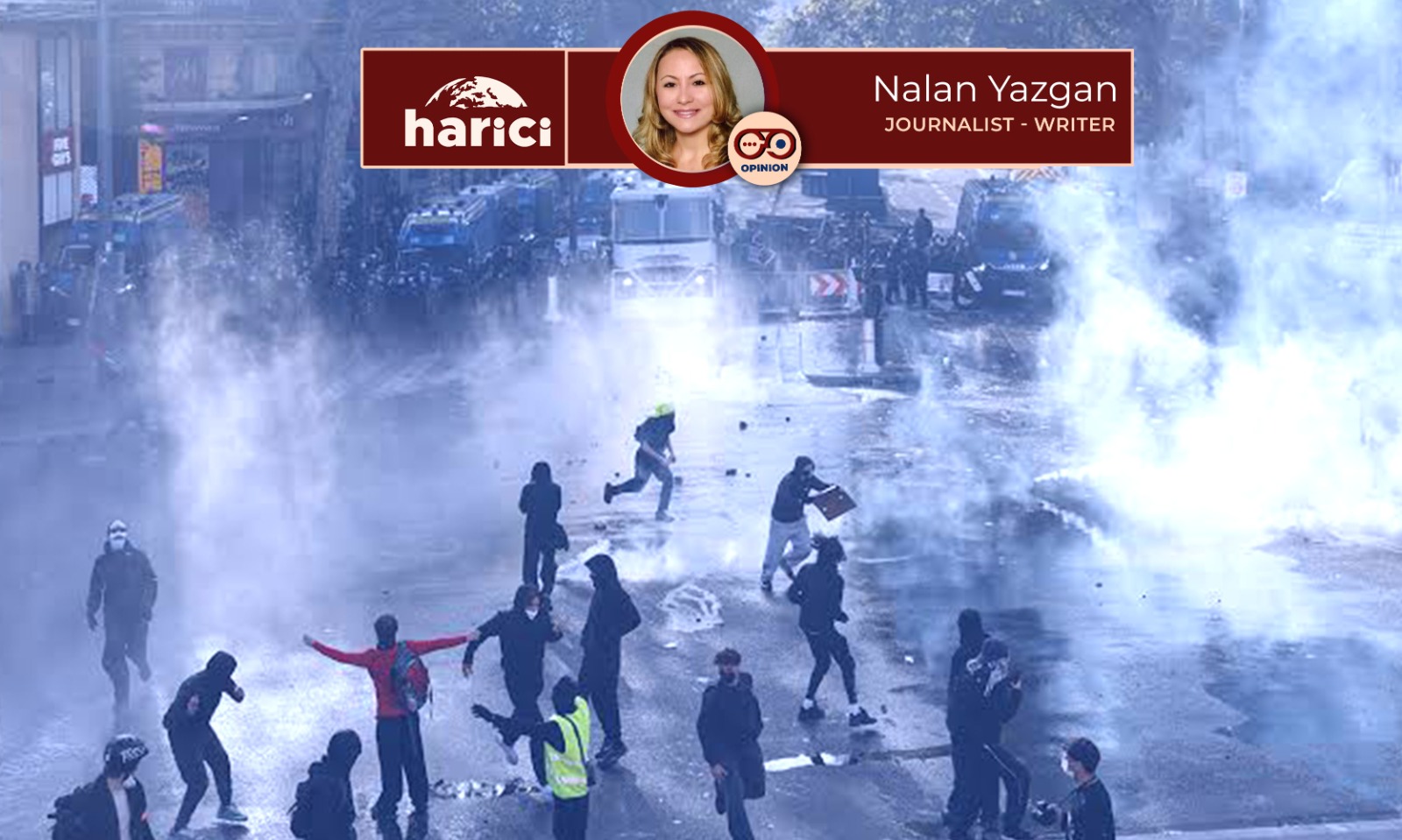
The streets of France have turned into a stage not merely for anger against the government, but for a deep-seated mistrust of the state’s approach to security. The blurring of the line between peaceful demonstrators and looters, lingering questions over police conduct, and the media’s refocusing on the immigration debate are bringing the country to the brink of a political reckoning far deeper than a routine public-order crisis.
In France, a government does not have to wait for an electoral defeat to lose its legitimacy. Sometimes, slogans chanted in a public square, tear gas fired down a boulevard, crowds penned in at the exit of a cordoned-off street, and testimonies of unhindered looting in shops only hundreds of metres away suffice to expose just how fragile the bond of trust between state and society has become.
Events in Paris on Saturday, 17 October point to precisely such a political fracture. Planned demonstrations with the participation of student unions, trade unions, and the Yellow Vests were marked throughout the day by police crackdowns, disputes over march routes, looting in the city centre, and widespread criticism of the government’s perceived inadequacy. The scene that emerged by evening suggested that France was grappling not merely with an issue of public order, but with a burgeoning crisis of confidence regarding the state’s impartiality and political motives.
Whom does the state permit to take to the streets, whom does it obstruct, and which forms of violence does it intervene against, and to what degree? The answer to this question may prove decisive in understanding France’s current political impasse.
The shadow of 17 October 1961
It is impossible to view the date of these demonstrations as a mere coincidence on the calendar. On 17 October 1961, a peaceful demonstration in Paris supporting Algerian independence was brutally crushed by the French police. Scores of people were killed, with some demonstrators drowned after being thrown into the River Seine. The event remains etched in memory as one of the darkest chapters in France’s colonial history and state-sponsored violence.
Sixty-five years later, as police interventions, youth rage, and the state’s stance on the right to protest are debated once again on the streets of Paris on 17 October, the resurgence of this historical memory was inevitable.
This memory may hold a distinct meaning, especially for French citizens of North African descent. Yet it would also be a mistake to reduce all the young people taking part in the demonstrations to a single identity, immigrant origin, or political motivation.
To what extent has the French Republic truly reckoned with the legacy of its colonial past and the relationship its security apparatus maintains with diverse segments of society?
Looters on the streets, where are the police?
Individuals dressed in black and associated in the public eye with the Black Bloc broke into shops at various locations, damaged businesses, and engaged in looting.
While peaceful demonstrators marched under a heavy police presence, fierce criticism arose that looting in certain areas had been allowed to unfold unchecked.
It is striking that while 14,000 police officers were deployed across the capital during the Pope’s visit to Paris, only 10,000 officers in total were assigned across the whole of France for the demonstrations of 17 October.
To which areas were police resources allocated? Had intelligence services assessed the risk of looting beforehand? While a robust security presence flanked the routes of peaceful marches, why was the same effectiveness not demonstrated in safeguarding commercial districts?
The deployment of elite units trained to quell urban unrest, such as CRS 8, does not resolve these questions. On the contrary, the failure to contain the incidents despite the presence of specialized units calls the quality of planning and coordination into question.
A political reckoning extending from Marseille to Limoges
The debate in Paris soon reverberated across the country’s other cities. In a televised address, the socialist mayor of Marseille stated that he had requested police reinforcements from the government, yet the units dispatched fell short given the scale and requirements of the city.
The mayor’s most striking allegation was that while looters stormed Marseille City Hall, the Hôtel de Ville, police officers stood roughly 200 metres away and failed to intervene. Stating that he possessed security camera footage, the mayor affirmed that he would await the scrutiny of a Parliamentary Commission of Inquiry and demand an explanation from the government.
The mayor of Limoges likewise issued what amounted to an ultimatum to the government, demanding the reconstruction of the torched town hall and the full reimbursement of costs. According to the mayor, the government had failed to protect a public building and neglected to provide the police with the necessary resources and backing.
These statements emerging from two distinct cities demonstrate that a new confrontation over security policy has arisen between local authorities and the central government. How security resources are allocated, which risks are prioritized, and whether the warnings of local administrations are heeded must all be brought to light.
The deepening scrutiny over the administration’s stance was compounded by President Emmanuel Macron’s refusal to accept the resignation tendered by Interior Minister Laurent Nuñez. The rejection of the resignation raises the question of whether the executive aims to preserve the chain of accountability, or fears that a political reshuffle would only exacerbate the crisis.
In either case, the government faces a crisis of trust.
An eight-minute speech and unanswered demands
Macron’s roughly eight-minute televised address failed to meet expectations regarding the political dimensions of the crisis. The president announced that he would meet with student unions and that the prime minister would engage with political parties, yet he presented neither tangible decisions nor a comprehensive political roadmap.
Education spending, police violence, the Palestinian cause, anti-fascism, and backlash against the Macron administration appear to have ceased being disparate issues in the eyes of the youth.
To be sure, the true strength of a state lies not in silencing its people and streets, but in addressing legitimate demands. It must not be forgotten that institutions unable to adapt and change are destined to break.

By its very nature, foreign policy feeds into and draws nourishment from numerous, disparate, and varied fields. It is a domain with manifold and diverse inputs. For foreign policy is examined alongside a broad array of subjects, ranging from geography to history, economics to intelligence, and military might to public diplomacy, commonly termed soft power elements.
The capacity of the state, that is, the scale of the state, or in other words the aggregate of its elements of power (namely political, economic, military, and soft power components), is decisive in foreign policy. Geography is decisive in foreign policy. Commercial relations are decisive in foreign policy. Energy dependence on another country or countries, if present, is decisive in foreign policy. Foreign policy cannot be conducted in spite of these four factors.
There is more. A country’s capacity, its scale, does not increase overnight, from one day to the next. It requires planning. It requires national consensus. It requires time. It requires preparation. Nor are these enough. The regional and global environment, the conjuncture, and the international plane must also allow for it. The stance of allies and adversaries is, of course, also important.
For the international environment is, by its nature, complex. It is an environment rife with contradiction, turmoil, conflict, and tension. To draw an analogy, the person in the driver’s seat of foreign policy is not a motorist speeding along the road as they please. There are things they must not forget, rules they must obey, red lights, vehicles speeding up from behind, a truck moving ahead, and a heavy vehicle hurtling toward them from the opposite direction.
Success in foreign policy does not arrive simply because a politician we like has become foreign minister. For a foreign minister is only as effective as the power, capacity, and weight of their country. One must accept this plain truth.
Moreover, there are simple, straightforward questions that reveal whether foreign policy, which some find deeply complex and inscrutable, is successful or not.
There are undoubtedly ways to measure the effectiveness, prestige, influence, and success of foreign policy.
For instance, the number of countries that respect a passport, how many countries can be visited visa-free, and how many countries impose visa requirements and grant those visas only with great difficulty are important indicators of a country’s standing.
Let us take ourselves as an example. Which countries require a visa for the Turkish passport? Which ones do not? Is it easy for our citizens to obtain visas for the countries they primarily wish to visit?
Let us give another example from the Turkic world.
On the Cyprus issue, which we regard as a national cause across government and opposition, right and left, Kemalist and Milli Görüş adherents alike, how many countries have we succeeded in having recognize the TRNC? Why do the Turkic states (Azerbaijan, Kazakhstan, Kyrgyzstan, Turkmenistan, Uzbekistan) not recognize the TRNC? Far from recognizing the TRNC, how do the Turkic states in Central Asia (Turkistan) explain to Ankara their developing relations with the Greek Cypriot Administration of Southern Cyprus, which Türkiye does not recognize, their appointment of ambassadors, and their recognition of Southern Cyprus as the island’s sole legitimate government?
We must also ask this question, of course: What is the state of Türkiye’s bilateral trade with the Turkic states?
Let us give an example of the relationship between foreign policy and big capital.
In which countries are big capital circles, among the greatest supporters of the ruling bloc, winning major tenders?
In our country, across both ruling and opposition ranks, there is a political party order that supports Türkiye’s EU membership. Yet how much progress has been made on EU membership?
Why is US President Trump not keeping the promises he made to Türkiye at the NATO summit held in Ankara a few months ago?
How many contracts has the new regime in Syria, the al-Sharaa administration, awarded to Turkish companies for the reconstruction of its country?
Has the government in Libya that Türkiye supports paid the money owed to Turkish construction firms, outstanding for years?
How does Qatar, with whom our relations are very good, explain its developing ties, energy agreements, and joint military drills with Greece and the Greek Cypriot Administration, disregarding our sensitivities?
Who is the addressee of the harsh statements used in recent weeks by Azerbaijan, which we view as “two states, one nation”? To what extent does Azerbaijan share Türkiye’s policy on Israel? What does Türkiye think about the scale, depth, and intimacy of Azerbaijan-Israel relations?
These questions can certainly be multiplied.
Yet without taking into account the scale of the state and observing the criteria for measuring foreign policy, no sound assessment can be made.
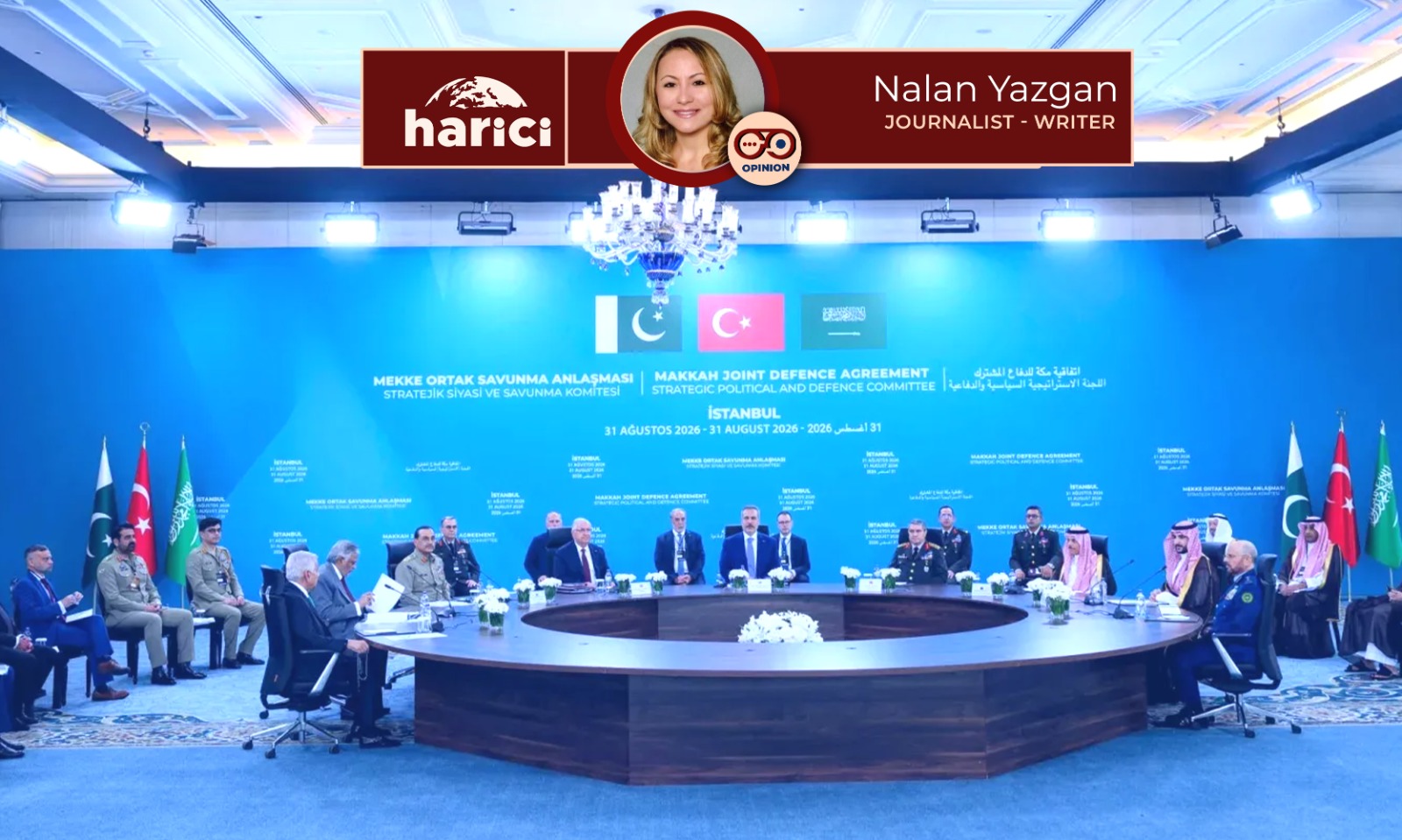
In the Middle East, war is no longer waged merely to seize territory. The true contest turns on who will control the energy pipelines, trade routes, ports, and railways of tomorrow. Missiles may strike cities today, but the maps of the future are being drawn through transport and energy corridors.
In this context, interpreting Türkiye’s presence in the Mecca Alliance solely as military support for Saudi Arabian security remains incomplete; it fails to explain why two states that viewed each other with mutual suspicion until recently would take steps toward a cooperation close enough to constitute a shared destiny.
Alongside Saudi Arabia’s existential motives, Ankara’s participation in this alliance is anchored in a profound geopolitical foundation: to position itself within, and if possible at the very centre of, the Middle East’s reconfigured energy and transport corridors.
Today, it cannot be said that Riyadh and Ankara see eye to eye on every regional issue. The threat perceptions and priorities of the two countries do not, quite naturally, entirely coincide. On the geopolitical chessboard, partnerships do not always arise from identical agendas. When reasons are sufficiently compelling, particularly existential ones, they can override political differences and enable common ground along the same strategic path.
A new war of corridors unfolds in the Middle East
On one side lies IMEC (India-Middle East-Europe Economic Corridor), planned to extend from India through the United Arab Emirates, Saudi Arabia, Jordan, and Israel to Europe. On the other stands the Development Road, which aims to link the Persian Gulf across Iraq to Türkiye, and onward to Europe.
These two undertakings are, of course, far more than mere transport projects. They represent two divergent geopolitical answers to where the future flow of trade and energy between Asia and Europe will traverse; for Türkiye, this issue is of vital importance.
If a corridor system taking shape to Türkiye’s south, beyond Ankara’s orbit, becomes permanent, Türkiye could forfeit not only an economic opportunity but also a substantial portion of its strategic centrality in the Middle East. It is through this prism that the Mecca Alliance must be evaluated.
Türkiye’s seat at the same table with Saudi Arabia signifies more than military solidarity. Riyadh and Ankara must sit together to avoid exclusion from the region’s emergent security and economic architecture, for the security of a corridor and the corridor itself are no longer separate matters.
The Strait of Hormuz, the Red Sea, the Bab al-Mandab, and the Suez Canal are links in the very same chain. A security crisis in one directly impacts the others. While the vulnerability of Hormuz makes alternative export routes for Gulf oil indispensable, instability across the Red Sea heightens the strategic cost of Suez.
Saudi Arabia’s alternative pipelines connecting its eastern oil fields to Red Sea terminals are therefore not merely energy infrastructure; they are strategic bypasses mitigating dependence on Hormuz.
For Türkiye, the Development Road fulfills the same function across a broader geography. Stretching from the Persian Gulf through Iraq to Türkiye, and from Türkiye into Europe, this artery possesses the potential to forge a new overland backbone connecting the Gulf to the Mediterranean and Europe. As security concerns in the Red Sea mount and the vulnerability of Suez deepens, the value of this route rises accordingly.
The Hejaz Railway: Revived once again
The return of the Hejaz Railway to the regional agenda signifies far more than mere nostalgia. Once linking Istanbul to Damascus, Amman, and the Hejaz, the railway served as one of the primary transport and logistical arteries of the Ottoman geography.
Reviving the idea of the Hejaz Railway could become the emblem of Türkiye’s drive to reimagine its historical transport connections between the Gulf, the Hejaz, and the Levant through modern rail, energy, and logistics networks.
The objective here is not to restore the past, but to transpose the strategic logic of that historical geographical linkage into the twenty-first century. For this reason, Türkiye’s role in the Mecca Alliance and the resurgence of the Hejaz Railway project must be viewed as components of the same overarching picture.
Corridors do not consist solely of energy pipelines. Railways, ports, highways, electrical interconnectors, logistical hubs, and security architectures are all facets of the same geopolitical grid, and safeguarding these networks requires political alliances.
Herein lies the strategic significance of Saudi Arabia and Türkiye sitting at the same table in Mecca, even at a juncture when their views on Syria diverge.
Ankara and Riyadh do not need to agree on every subject. Yet neither wishes to see the new map of the Middle East drawn to its detriment. Türkiye’s aim is not to build an anti-bloc against any specific country alongside Saudi Arabia; rather, the goal is to avoid exclusion from the future energy and trade systems of the Middle East, while securing a decisive voice in establishing their security architecture.
Hence, for Türkiye, the Mecca Alliance is far more than a simple defence pact. Securing the Development Road, shielding Gulf energy corridors, stabilising the Red Sea, rethinking connections across the Hejaz and the Levant, and bolstering trade corridors reaching Europe all intersect within this single strategic equation.
In this equation, Türkiye’s foremost advantage remains its geography. Ankara sits at the northern terminus of the overland routes linking the Gulf to Europe; within NATO; and at the crossroads connecting the Black Sea, the Caucasus, the Eastern Mediterranean, and the Middle East.
Will Türkiye become one of the powers shaping the Middle East’s energy and trade architecture over the coming decades, or will it be reduced to a mere transit state traversed by routes designed by others? That question defines the true strategic significance of the Mecca Alliance for Ankara.
In the Middle East of tomorrow, it will be impossible to separate the corridor carrying energy, the security framework protecting that corridor, and the alliance constructing that security framework.
Whoever controls the corridor shapes commerce. Whoever guarantees the routes through which trade flows holds sway over the regional balance of power. This is the true dimension of the contest currently underway in the Middle East.
A succession of distinct and largely mutually exclusive ambitions are competing for dominance in the current climate: India’s linkage to Europe, the Gulf’s new economic horizons, Saudi Arabia’s alternative energy routes, the security crisis in the Red Sea, the strategic weight of Hormuz, and Türkiye’s aspiration to open outward to Europe via the Development Road. Ironically, perhaps, the conflict that will decide which corridor underpins global stability has already begun, and it will likely continue spreading to new fronts. Regrettably, the fires in our region appear poised to intensify long before they abate.

German officials urge fighter jet alliance with Sweden and Spain

US wealthy demolish multimillion-dollar mansions for land

US and Israel weigh Iran strikes after midterm vote, reports say

Pentagon plans covert spy ring for economic war on China, report says

EU reopens debate on naming envoy for Ukraine talks with Putin
-
 Europe2 weeks ago
Berlin Left Party backs Israel’s right to exist for coalition pact
-
 America2 weeks ago
How will Brazil’s presidential runoff work?
-
 Diplomacy2 weeks ago
The West is preparing for war not with Russia, but with its own people, French analyst Georges Kuzmanovic insists
-

 Russia2 weeks ago
71 EU lawmakers demand closure of Russian Houses in 15 member states
-
 Europe2 weeks ago
MI6 investigates potential leaks after former BND chief is detained
-
 Russia2 weeks ago
US and Russian figures discuss American stake in Nord Stream lines
-
 Russia2 weeks ago
Drone strike shuts down Yandex data centre in Russia’s Ryazan region
-
 America2 weeks ago
Trump weighs presidential memorandum to cut surging US diesel prices
