
Opinion
The Syrian Regime Change Further Alters the Middle East Landscape

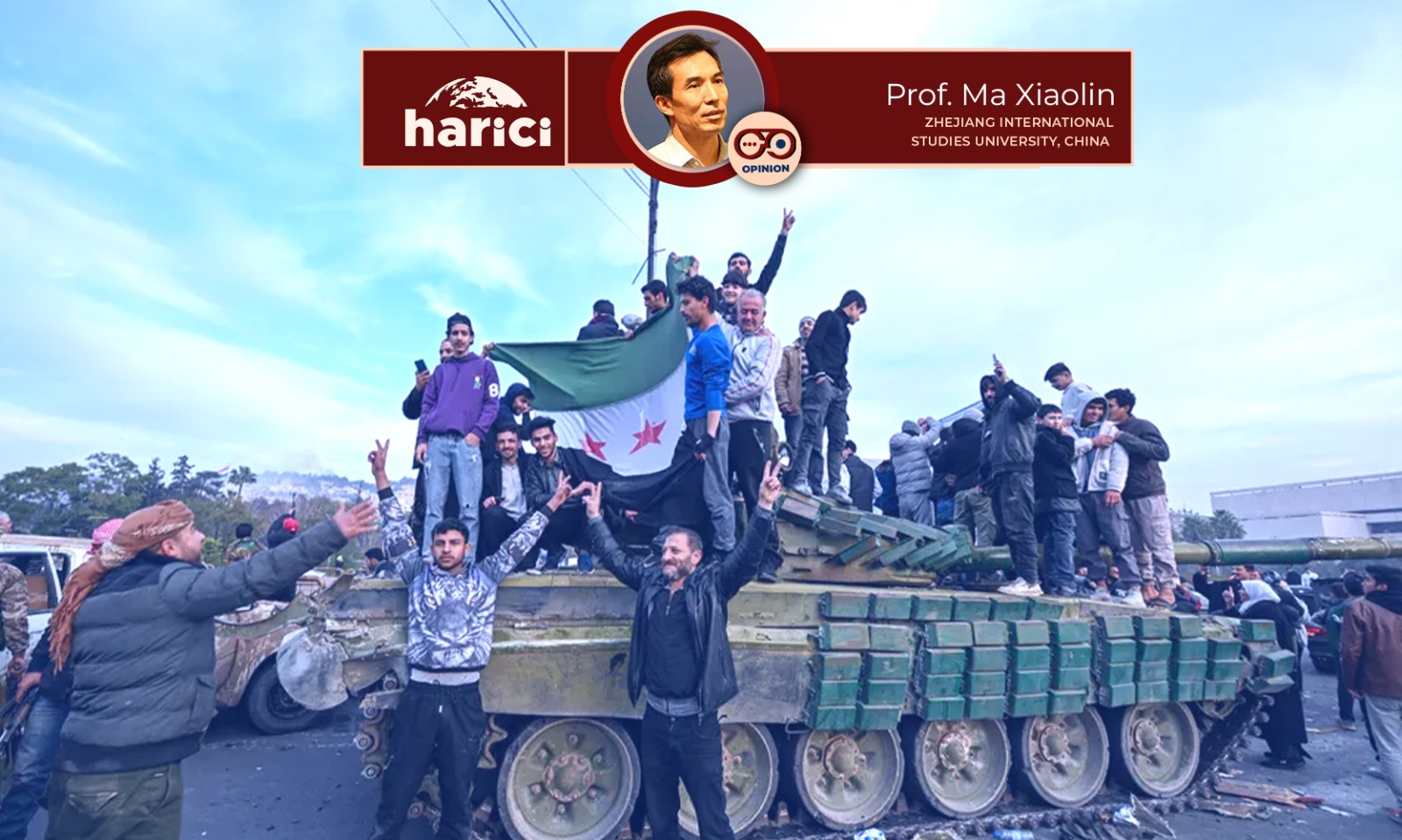
On December 18, just ten days after the fall of Syria’s capital and the collapse of Bashar al-Assad’s regime, the opposition, which had not yet firmly seized power, gained preliminary recognition and acceptance from all adversaries. This rare “political favor” is dazzling and even somewhat difficult to comprehend. Not to mention that Russia and Iran, which were still directly confronting opposition forces ten days ago, suddenly reversed their stance and reconciled with their long-standing enemies. Even the United Nations, the United States, and the European Union, which had previously designated the main opposition force, the “Liberation of Syria” Front, as a terrorist organization, reversed their policies, selectively forgot their long-standing crimes, and quickly engaged with them face-to-face. They are now prepared to collectively promote the construction of a “New Syria” under the framework of UN Resolution 2254.
If the new round of Palestinian-Israeli conflict, which has lasted for more than a year, has profoundly reshaped the Middle East landscape, then “Syria War 2.0,” as the “black swan event” of the Palestinian-Israeli conflict, will further accelerate this transformation.
The latest round of the Palestinian-Israeli conflict erupted on October 7 last year, triggering the “Sixth Middle East War.” This war is a genuine hybrid war, encompassing Israeli Prime Minister Netanyahu’s “Seven-line Combat,” as well as what I define as the “Eighth Front,” which is Israel’s civil and military confrontation with the United Nations.
I support the term “Sixth Middle East War” because, in terms of its duration, scope, participating forces, casualties, material losses, and impact on global security and stability, this war qualifies as a large-scale regional war, fundamentally different from the five Middle East wars between 1948 and 1982.
The first five Middle East wars began with the partition of Palestine in 1948. At that time, World War II had just ended, and the Cold War structure had yet to form. The United States and the Soviet Union, which had rapidly ascended to superpower status by leading the world in defeating the fascist Axis powers, sought to use the Palestine issue to expel the three traditional hegemons – the Ottoman Empire, the British Empire, and the French Republic – from the Middle East, thereby establishing a new regional order and power structure.
Meanwhile, the number of newly independent Arab states emerging from the ruins of the Ottoman Empire was limited and lacked unity. As a result, Palestine was forcibly partitioned and handed over to the Jewish people as compensation for Europe’s long-standing persecution and massacres against them. The establishment of Israel constituted a great injustice to the Arab nations and the indigenous Palestinians because, for nearly two thousand years, Jews had not been the dominant indigenous population of Palestine. However, under the auspices of the United Nations, the great powers imposed the “State of Israel” on the Arabs, particularly the Palestinians, whom we are familiar with today.
In 1956, the Suez Canal War broke out, and the United States and the Soviet Union jointly thwarted the joint invasion of Egypt by Britain, France, and Israel. This further weakened the declining British Empire’s control over the Eastern Mediterranean region, particularly the Suez Canal. Subsequently, the 1967 “Six-Day War,” the 1973 “Yom Kippur War,” and the 1982 “Lebanon War” were all proxy wars between the US and the Soviet Union for dominance in the Middle East. Arab countries either followed the Soviet Union in an attempt to recover lost territory or stood by as spectators, pursuing self-preservation. However, Israel was, without a doubt, the “Middle Eastern orphan.”
The historical context and factions involved in the “Sixth Middle East War” have undergone a complete and transformative shift. More than 40 years after the end of the Cold War, Russia, as the successor to the Soviet Union, has seen its strength significantly weakened by focusing on the Russia-Ukraine battlefield. Meanwhile, the United States, as in the previous three Middle East wars, spares no effort in supporting and defending Israel. The vast majority of Arab countries remain on the sidelines, avoiding entanglement in this new war centered around Israel. Jordan, Saudi Arabia, and the UAE even assisted in defending Israel during Iran’s airstrike in April.
In the “Sixth Middle East War,” Israel’s primary opponent is no longer a coalition of Arab nations but the “Axis of Resistance,” which bears a far stronger pan-Islamist hue than pan-Arab nationalism. The Pahlavi dynasty of Iran, which stayed out of the first five Middle East wars, has long since passed. The Islamic Republic, which came to power through the 1979 revolution, has long engaged in proxy and shadow wars with Israel, driven by its dual motivations of Islamic revolutionary ideology and the ambition to become a Middle Eastern superpower. However, through Israel’s bombing of Iranian diplomatic facilities in Syria and the assassination of Hamas leaders in Tehran, Iran was forced into the open and directly involved.
Since 1973, Syria had maintained a cold peace with Israel and lacked the capacity to confront Israel alone. Moreover, after 13 years of civil war, Syria was fragmented and could only passively serve as the battleground for the Israel-Iran confrontation. Two state actors, Iran and Syria, along with four non-state actors – Hamas in Palestine, Hezbollah in Lebanon, the Houthis in Yemen, and the Popular Mobilization Forces in Iraq – collectively assumed the main role in resisting Israel, forming what is known as the “Axis of Resistance.”
At the same time, the United States, the United Kingdom, and France continued to defend Israel by imposing sanctions and containing Iran and Syria. Through limited military operations, they targeted and restrained the Houthis in Yemen and the Popular Mobilization Forces in Iraq, carefully avoiding escalation and expansion of the conflict, especially to prevent being dragged into this century-defining war in the Middle East.
Meanwhile, peripheral actors such as the “Liberation of Syria” alliance and the “Syrian National Front” supported by Turkey seized the opportunity in the later stages, becoming involved in this new Middle Eastern war, which initially had little to do with them. They easily reaped significant benefits, unexpectedly toppling the Bashar al-Assad regime.
The “Sixth Middle East War” unfolded in three major phases. The first phase lasted for a full year until September, with Gaza as the primary battlefield, where Israel focused on the “southern campaign” against Palestine. The second phase, lasting from September to the end of November, saw Israel shift focus to the “northern campaign” against Lebanon, targeting the leadership and forces of Hezbollah, destroying its infrastructure, and cutting off its strategic route to Iran through Syria.
The third phase, from late November to December 9, saw Israel reach a ceasefire with Hezbollah while completely destroying its land routes to and from Syria. Simultaneously, Israel carried out heavy bombardment of Syria’s northwestern military frontlines, causing the already weakened and demoralized Syrian army to collapse. This cleared the path for the mixed opposition forces, which had been planning an offensive for six months, allowing them to accelerate the disintegration of the Damascus regime.
The “Sixth Middle East War” led to the collapse of the Assad regime, surprising all parties involved. Perhaps Israel only intended to use opposition forces to further reduce the Damascus regime’s control and weaken the “Shia Crescent” and the “Axis of Resistance.” The opposition forces did not anticipate their adversary’s vulnerability, nor did they expect that Russia and Iran, which were supporting Assad, would be so depleted. Alternatively, it is possible that through Turkey and the framework of the “Astana Process,” the three parties had already negotiated a deal, ultimately collaborating to bring an end to the Assad regime.
The sudden collapse of the Bashar al-Assad regime took both the United States and Israel by surprise. As a result, the U.S. deployed heavy weaponry, including B-52 strategic bombers, to launch intense airstrikes against the remaining forces and controlled areas of ISIS. Meanwhile, Israel exerted maximum effort to completely destroy Syria’s defense forces, which it had tolerated for decades, to prevent them from falling into the hands of the new regime. Israel also expanded its illegal occupation of the Golan Heights, advancing closer to Damascus to deepen its defensive buffer zone.
The reason is simple – the “Liberation of Syria” alliance originated from Al-Qaeda, with its ideology rooted in “Jihadist Salafism.” The U.S. and Israel are seen as its natural strategic and ultimate enemies, regarded as the “forces of evil” and the “new crusaders” that must be completely eradicated. Compared to the Assad regime, which sought to reclaim occupied territories, and the Iranian Islamic government, which aimed to expand its geopolitical influence through Middle Eastern issues, the answer to who poses the most dangerous and deadly threat is evident.
The “Sixth Middle East War” has triggered a chain reaction, leading to a “Syrian Civil War 2.0.” This has resulted in the unexpected victory of Al-Qaeda’s Syrian branch, the global enemy, marking a shocking and ironic twist. However, the strange aspect of this new Middle Eastern war is that the new rulers, who captured Damascus and declared it an “Islamic victory,” openly announced that they would not consider Israel an enemy. They expressed no intention to initiate new conflicts but instead showed willingness to establish normal relations with all parties, focusing on stability, development, and improving livelihoods – as if demons had transformed into angels overnight.
The “Sixth Middle East War” appears to be nearing its end and may conclude with Hamas releasing hostages and reaching a long-term ceasefire with Israel. The “Shia Crescent” is already crippled, the “Axis of Resistance” is in full retreat, and the Damascus regime has shifted allegiance. With Trump, a staunch supporter of Israel, about to take office, media attention on the Middle East will shift from Gaza, the starting point of the Palestinian-Israeli conflict, to Damascus. The world will scrutinize whether the new regime can stabilize its base, quickly reconcile with the international community, including its former strategic adversaries – the U.S., the West, and Israel – and establish an inclusive transitional government under UN Security Council Resolution 2254. The goal will be to restart the constitutional amendment process and eventually build a new Syria where multiple ethnic groups and sects coexist, balancing the interests of all parties.
In theory, the transformation of a Syria that has been “torn apart” does not depend entirely, or even primarily, on the will of the new rulers in Damascus. Rather, it hinges on the bargaining between the United States, Turkey, Russia, Iran, Israel, and even the Gulf Arab states, which had been previously sidelined from the Syrian chessboard but are now reengaging. This reflects the historical reality that small countries cannot independently determine their own futures. It is an inevitable result of great power competition in the Middle East and a fundamental obstacle to the systematic resolution of Middle Eastern issues.
The apparent winners of the “Sixth Middle East War” are Israel and Turkey, as they have expanded their influence and control over Syria. However, this also heightens competition and friction between the two, adding a new layer of Israeli-Turkish rivalry to the traditional Israel-Arab and Israel-Iran conflicts. In the long run, this will inevitably increase the financial and resource burdens on both countries, potentially turning their regional expansion policies into a new quagmire.
The apparent losers of the “Sixth Middle East War” are Russia and Iran, as they have lost a key Middle Eastern hub where they had long exerted independent influence and deep control. For Russia, this reveals its limitations in opening a second front and highlights its declining influence as a global power. At least in the Middle East, Russia is now reduced to the role of an ordinary player, struggling to maintain a military base presence.
For Iran, the loss exposes the fatal weakness that its geopolitical ambitions far exceed its national strength. Losing the western flank of the “Shia Crescent” after over 40 years of effort, as well as the weakening of the “Axis of Resistance,” forces Iran to contract its sphere of influence back to the Tigris-Euphrates region. This severely undermines Iran’s ambitions to reconnect the Syrian corridor and extend its reach to the Eastern Mediterranean.
However, for Russia, losing Syria may not be a crippling blow. It merely represents the loss of a once-premier geopolitical and diplomatic stronghold. Russia can instead focus on the Ukraine war to preserve existing gains and seek some form of balance with the United States. Russia may even shift its diplomatic and strategic priorities toward Eurasia and the Global South to expand its influence and construct a new world order.
For Iran, the dual blow to its leadership of both the “Shia Crescent” and the “Axis of Resistance” not only constitutes a severe military and diplomatic failure but also risks domestic political fallout. Reformists and moderates may hold conservatives and hardliners accountable, further fueling public anger and dissatisfaction. This presents an unprecedented challenge to the long-standing rationality of Iran’s foreign and strategic policies.
In this sense, the ripple effects of the “Sixth Middle East War” will extend beyond Syria. They could destabilize Iran’s political system, pushing it to a difficult crossroads: should Iran continue its decades-long Islamic revolutionary policy of denying Israel’s legitimacy as a sovereign state, or should it gradually adjust its national strategy and dilute its revolutionary ideology? By adopting a more pragmatic stance, Iran could engage with the Middle East peace process, improve the overall geopolitical climate, and ultimately push Israel to withdraw from occupied Arab territories. This could lead to comprehensive regional peace, reconciliation, and cooperation, paving the way for mutual stability, development, and prosperity.
For Palestine, especially for radical forces like Hamas, the third major catastrophe, which has lasted over a year, has inflicted severe damage on the Palestinian people. Whether they can seize the opportunity presented by the Beijing reconciliation and sincerely unite under the unified leadership of the Palestine Liberation Organization (PLO) will be crucial. Through genuine negotiations, Palestinians could reclaim Gaza, the West Bank, and share East Jerusalem. This represents the second historical window for resolving the Israeli-Palestinian conflict since the 1993 Oslo Accords and serves as a critical moment and strategic opportunity for the survival of the Palestinian nation.
Prof. Ma is the Dean of the Institute of Mediterranean Studies (ISMR) at Zhejiang International Studies University in Hangzhou. He specializes in international politics, particularly Islam and Middle Eastern affairs. He previously worked as a senior Xinhua correspondent in Kuwait, Palestine, and Iraq.







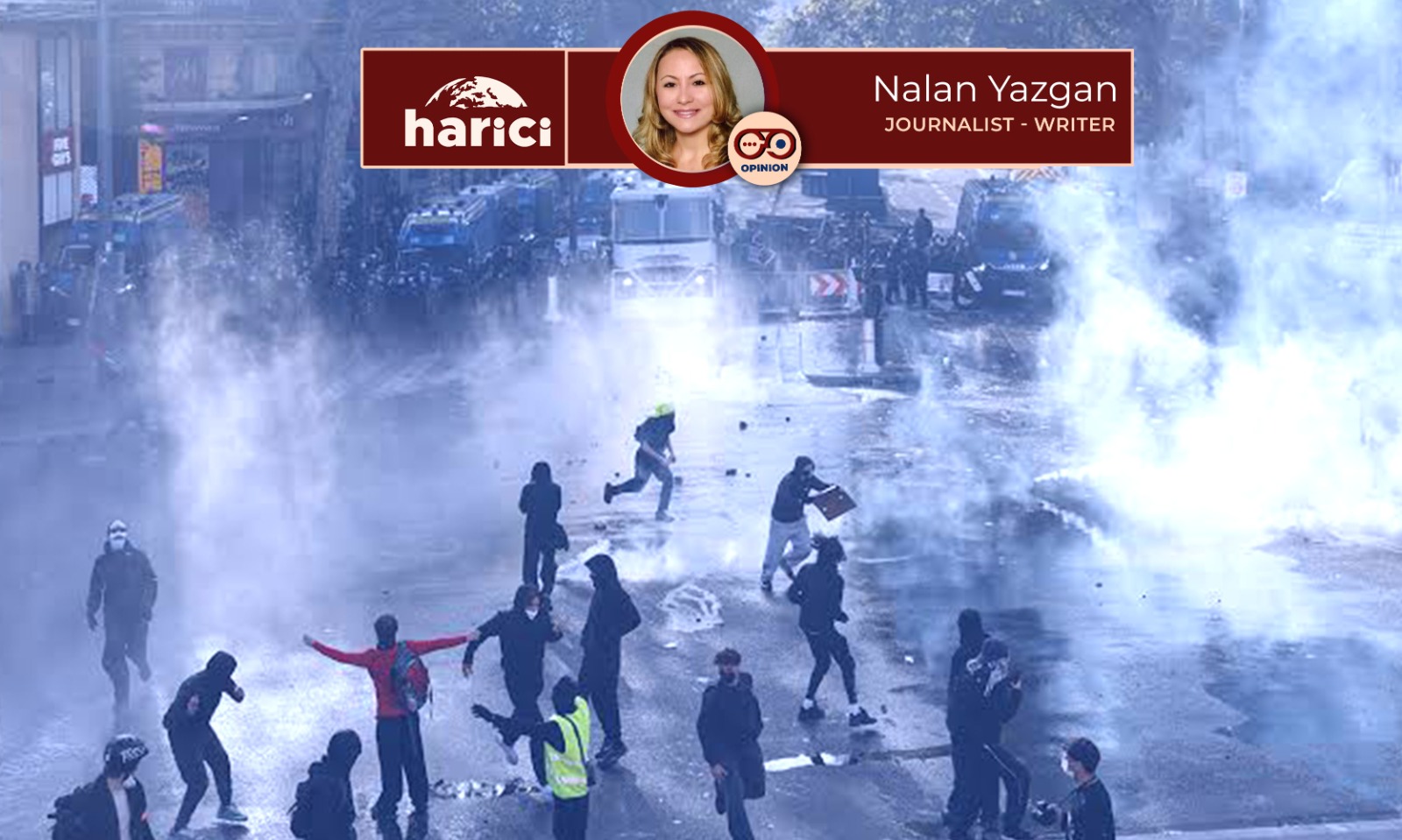
The streets of France have turned into a stage not merely for anger against the government, but for a deep-seated mistrust of the state’s approach to security. The blurring of the line between peaceful demonstrators and looters, lingering questions over police conduct, and the media’s refocusing on the immigration debate are bringing the country to the brink of a political reckoning far deeper than a routine public-order crisis.
In France, a government does not have to wait for an electoral defeat to lose its legitimacy. Sometimes, slogans chanted in a public square, tear gas fired down a boulevard, crowds penned in at the exit of a cordoned-off street, and testimonies of unhindered looting in shops only hundreds of metres away suffice to expose just how fragile the bond of trust between state and society has become.
Events in Paris on Saturday, 17 October point to precisely such a political fracture. Planned demonstrations with the participation of student unions, trade unions, and the Yellow Vests were marked throughout the day by police crackdowns, disputes over march routes, looting in the city centre, and widespread criticism of the government’s perceived inadequacy. The scene that emerged by evening suggested that France was grappling not merely with an issue of public order, but with a burgeoning crisis of confidence regarding the state’s impartiality and political motives.
Whom does the state permit to take to the streets, whom does it obstruct, and which forms of violence does it intervene against, and to what degree? The answer to this question may prove decisive in understanding France’s current political impasse.
The shadow of 17 October 1961
It is impossible to view the date of these demonstrations as a mere coincidence on the calendar. On 17 October 1961, a peaceful demonstration in Paris supporting Algerian independence was brutally crushed by the French police. Scores of people were killed, with some demonstrators drowned after being thrown into the River Seine. The event remains etched in memory as one of the darkest chapters in France’s colonial history and state-sponsored violence.
Sixty-five years later, as police interventions, youth rage, and the state’s stance on the right to protest are debated once again on the streets of Paris on 17 October, the resurgence of this historical memory was inevitable.
This memory may hold a distinct meaning, especially for French citizens of North African descent. Yet it would also be a mistake to reduce all the young people taking part in the demonstrations to a single identity, immigrant origin, or political motivation.
To what extent has the French Republic truly reckoned with the legacy of its colonial past and the relationship its security apparatus maintains with diverse segments of society?
Looters on the streets, where are the police?
Individuals dressed in black and associated in the public eye with the Black Bloc broke into shops at various locations, damaged businesses, and engaged in looting.
While peaceful demonstrators marched under a heavy police presence, fierce criticism arose that looting in certain areas had been allowed to unfold unchecked.
It is striking that while 14,000 police officers were deployed across the capital during the Pope’s visit to Paris, only 10,000 officers in total were assigned across the whole of France for the demonstrations of 17 October.
To which areas were police resources allocated? Had intelligence services assessed the risk of looting beforehand? While a robust security presence flanked the routes of peaceful marches, why was the same effectiveness not demonstrated in safeguarding commercial districts?
The deployment of elite units trained to quell urban unrest, such as CRS 8, does not resolve these questions. On the contrary, the failure to contain the incidents despite the presence of specialized units calls the quality of planning and coordination into question.
A political reckoning extending from Marseille to Limoges
The debate in Paris soon reverberated across the country’s other cities. In a televised address, the socialist mayor of Marseille stated that he had requested police reinforcements from the government, yet the units dispatched fell short given the scale and requirements of the city.
The mayor’s most striking allegation was that while looters stormed Marseille City Hall, the Hôtel de Ville, police officers stood roughly 200 metres away and failed to intervene. Stating that he possessed security camera footage, the mayor affirmed that he would await the scrutiny of a Parliamentary Commission of Inquiry and demand an explanation from the government.
The mayor of Limoges likewise issued what amounted to an ultimatum to the government, demanding the reconstruction of the torched town hall and the full reimbursement of costs. According to the mayor, the government had failed to protect a public building and neglected to provide the police with the necessary resources and backing.
These statements emerging from two distinct cities demonstrate that a new confrontation over security policy has arisen between local authorities and the central government. How security resources are allocated, which risks are prioritized, and whether the warnings of local administrations are heeded must all be brought to light.
The deepening scrutiny over the administration’s stance was compounded by President Emmanuel Macron’s refusal to accept the resignation tendered by Interior Minister Laurent Nuñez. The rejection of the resignation raises the question of whether the executive aims to preserve the chain of accountability, or fears that a political reshuffle would only exacerbate the crisis.
In either case, the government faces a crisis of trust.
An eight-minute speech and unanswered demands
Macron’s roughly eight-minute televised address failed to meet expectations regarding the political dimensions of the crisis. The president announced that he would meet with student unions and that the prime minister would engage with political parties, yet he presented neither tangible decisions nor a comprehensive political roadmap.
Education spending, police violence, the Palestinian cause, anti-fascism, and backlash against the Macron administration appear to have ceased being disparate issues in the eyes of the youth.
To be sure, the true strength of a state lies not in silencing its people and streets, but in addressing legitimate demands. It must not be forgotten that institutions unable to adapt and change are destined to break.


By its very nature, foreign policy feeds into and draws nourishment from numerous, disparate, and varied fields. It is a domain with manifold and diverse inputs. For foreign policy is examined alongside a broad array of subjects, ranging from geography to history, economics to intelligence, and military might to public diplomacy, commonly termed soft power elements.
The capacity of the state, that is, the scale of the state, or in other words the aggregate of its elements of power (namely political, economic, military, and soft power components), is decisive in foreign policy. Geography is decisive in foreign policy. Commercial relations are decisive in foreign policy. Energy dependence on another country or countries, if present, is decisive in foreign policy. Foreign policy cannot be conducted in spite of these four factors.
There is more. A country’s capacity, its scale, does not increase overnight, from one day to the next. It requires planning. It requires national consensus. It requires time. It requires preparation. Nor are these enough. The regional and global environment, the conjuncture, and the international plane must also allow for it. The stance of allies and adversaries is, of course, also important.
For the international environment is, by its nature, complex. It is an environment rife with contradiction, turmoil, conflict, and tension. To draw an analogy, the person in the driver’s seat of foreign policy is not a motorist speeding along the road as they please. There are things they must not forget, rules they must obey, red lights, vehicles speeding up from behind, a truck moving ahead, and a heavy vehicle hurtling toward them from the opposite direction.
Success in foreign policy does not arrive simply because a politician we like has become foreign minister. For a foreign minister is only as effective as the power, capacity, and weight of their country. One must accept this plain truth.
Moreover, there are simple, straightforward questions that reveal whether foreign policy, which some find deeply complex and inscrutable, is successful or not.
There are undoubtedly ways to measure the effectiveness, prestige, influence, and success of foreign policy.
For instance, the number of countries that respect a passport, how many countries can be visited visa-free, and how many countries impose visa requirements and grant those visas only with great difficulty are important indicators of a country’s standing.
Let us take ourselves as an example. Which countries require a visa for the Turkish passport? Which ones do not? Is it easy for our citizens to obtain visas for the countries they primarily wish to visit?
Let us give another example from the Turkic world.
On the Cyprus issue, which we regard as a national cause across government and opposition, right and left, Kemalist and Milli Görüş adherents alike, how many countries have we succeeded in having recognize the TRNC? Why do the Turkic states (Azerbaijan, Kazakhstan, Kyrgyzstan, Turkmenistan, Uzbekistan) not recognize the TRNC? Far from recognizing the TRNC, how do the Turkic states in Central Asia (Turkistan) explain to Ankara their developing relations with the Greek Cypriot Administration of Southern Cyprus, which Türkiye does not recognize, their appointment of ambassadors, and their recognition of Southern Cyprus as the island’s sole legitimate government?
We must also ask this question, of course: What is the state of Türkiye’s bilateral trade with the Turkic states?
Let us give an example of the relationship between foreign policy and big capital.
In which countries are big capital circles, among the greatest supporters of the ruling bloc, winning major tenders?
In our country, across both ruling and opposition ranks, there is a political party order that supports Türkiye’s EU membership. Yet how much progress has been made on EU membership?
Why is US President Trump not keeping the promises he made to Türkiye at the NATO summit held in Ankara a few months ago?
How many contracts has the new regime in Syria, the al-Sharaa administration, awarded to Turkish companies for the reconstruction of its country?
Has the government in Libya that Türkiye supports paid the money owed to Turkish construction firms, outstanding for years?
How does Qatar, with whom our relations are very good, explain its developing ties, energy agreements, and joint military drills with Greece and the Greek Cypriot Administration, disregarding our sensitivities?
Who is the addressee of the harsh statements used in recent weeks by Azerbaijan, which we view as “two states, one nation”? To what extent does Azerbaijan share Türkiye’s policy on Israel? What does Türkiye think about the scale, depth, and intimacy of Azerbaijan-Israel relations?
These questions can certainly be multiplied.
Yet without taking into account the scale of the state and observing the criteria for measuring foreign policy, no sound assessment can be made.
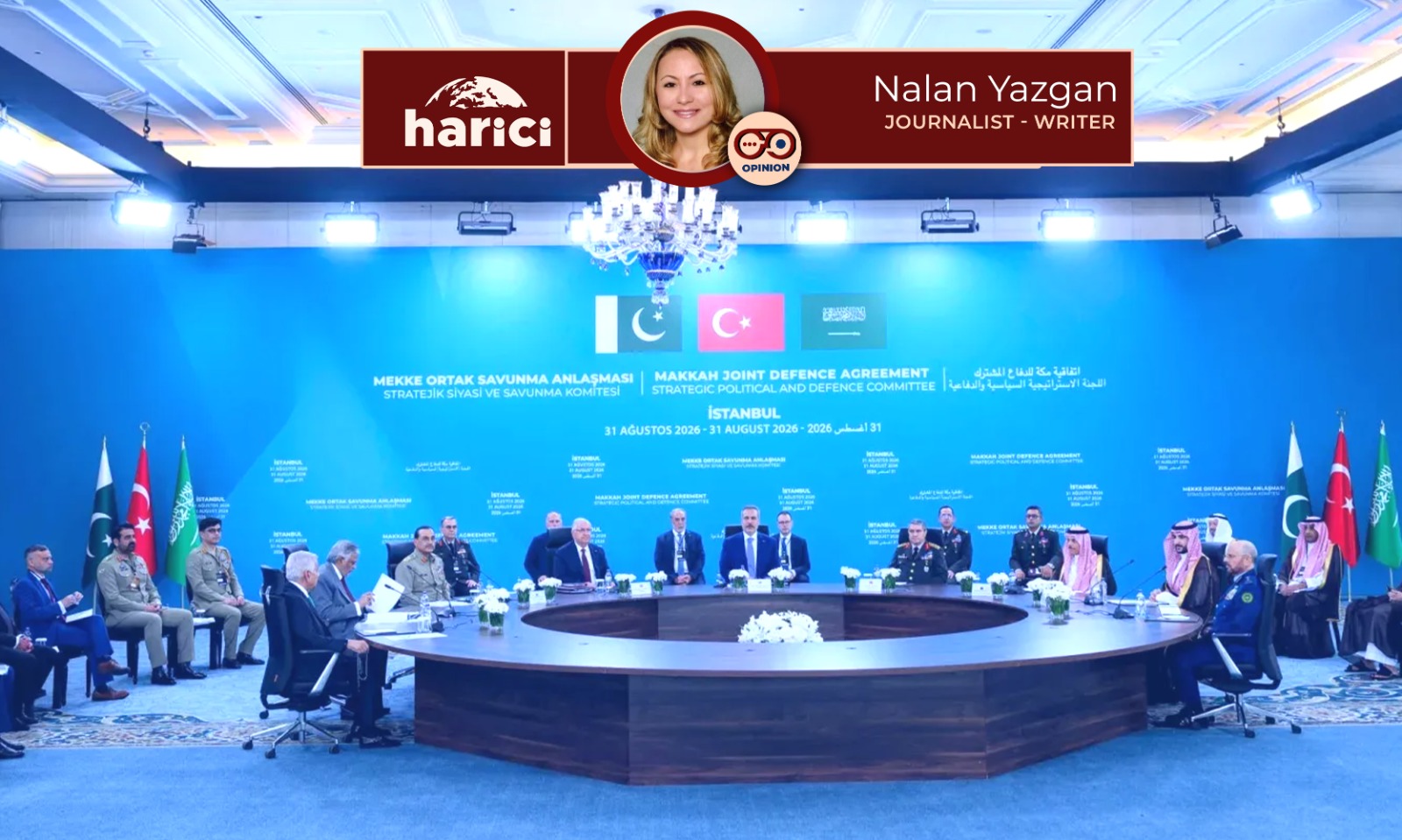
In the Middle East, war is no longer waged merely to seize territory. The true contest turns on who will control the energy pipelines, trade routes, ports, and railways of tomorrow. Missiles may strike cities today, but the maps of the future are being drawn through transport and energy corridors.
In this context, interpreting Türkiye’s presence in the Mecca Alliance solely as military support for Saudi Arabian security remains incomplete; it fails to explain why two states that viewed each other with mutual suspicion until recently would take steps toward a cooperation close enough to constitute a shared destiny.
Alongside Saudi Arabia’s existential motives, Ankara’s participation in this alliance is anchored in a profound geopolitical foundation: to position itself within, and if possible at the very centre of, the Middle East’s reconfigured energy and transport corridors.
Today, it cannot be said that Riyadh and Ankara see eye to eye on every regional issue. The threat perceptions and priorities of the two countries do not, quite naturally, entirely coincide. On the geopolitical chessboard, partnerships do not always arise from identical agendas. When reasons are sufficiently compelling, particularly existential ones, they can override political differences and enable common ground along the same strategic path.
A new war of corridors unfolds in the Middle East
On one side lies IMEC (India-Middle East-Europe Economic Corridor), planned to extend from India through the United Arab Emirates, Saudi Arabia, Jordan, and Israel to Europe. On the other stands the Development Road, which aims to link the Persian Gulf across Iraq to Türkiye, and onward to Europe.
These two undertakings are, of course, far more than mere transport projects. They represent two divergent geopolitical answers to where the future flow of trade and energy between Asia and Europe will traverse; for Türkiye, this issue is of vital importance.
If a corridor system taking shape to Türkiye’s south, beyond Ankara’s orbit, becomes permanent, Türkiye could forfeit not only an economic opportunity but also a substantial portion of its strategic centrality in the Middle East. It is through this prism that the Mecca Alliance must be evaluated.
Türkiye’s seat at the same table with Saudi Arabia signifies more than military solidarity. Riyadh and Ankara must sit together to avoid exclusion from the region’s emergent security and economic architecture, for the security of a corridor and the corridor itself are no longer separate matters.
The Strait of Hormuz, the Red Sea, the Bab al-Mandab, and the Suez Canal are links in the very same chain. A security crisis in one directly impacts the others. While the vulnerability of Hormuz makes alternative export routes for Gulf oil indispensable, instability across the Red Sea heightens the strategic cost of Suez.
Saudi Arabia’s alternative pipelines connecting its eastern oil fields to Red Sea terminals are therefore not merely energy infrastructure; they are strategic bypasses mitigating dependence on Hormuz.
For Türkiye, the Development Road fulfills the same function across a broader geography. Stretching from the Persian Gulf through Iraq to Türkiye, and from Türkiye into Europe, this artery possesses the potential to forge a new overland backbone connecting the Gulf to the Mediterranean and Europe. As security concerns in the Red Sea mount and the vulnerability of Suez deepens, the value of this route rises accordingly.
The Hejaz Railway: Revived once again
The return of the Hejaz Railway to the regional agenda signifies far more than mere nostalgia. Once linking Istanbul to Damascus, Amman, and the Hejaz, the railway served as one of the primary transport and logistical arteries of the Ottoman geography.
Reviving the idea of the Hejaz Railway could become the emblem of Türkiye’s drive to reimagine its historical transport connections between the Gulf, the Hejaz, and the Levant through modern rail, energy, and logistics networks.
The objective here is not to restore the past, but to transpose the strategic logic of that historical geographical linkage into the twenty-first century. For this reason, Türkiye’s role in the Mecca Alliance and the resurgence of the Hejaz Railway project must be viewed as components of the same overarching picture.
Corridors do not consist solely of energy pipelines. Railways, ports, highways, electrical interconnectors, logistical hubs, and security architectures are all facets of the same geopolitical grid, and safeguarding these networks requires political alliances.
Herein lies the strategic significance of Saudi Arabia and Türkiye sitting at the same table in Mecca, even at a juncture when their views on Syria diverge.
Ankara and Riyadh do not need to agree on every subject. Yet neither wishes to see the new map of the Middle East drawn to its detriment. Türkiye’s aim is not to build an anti-bloc against any specific country alongside Saudi Arabia; rather, the goal is to avoid exclusion from the future energy and trade systems of the Middle East, while securing a decisive voice in establishing their security architecture.
Hence, for Türkiye, the Mecca Alliance is far more than a simple defence pact. Securing the Development Road, shielding Gulf energy corridors, stabilising the Red Sea, rethinking connections across the Hejaz and the Levant, and bolstering trade corridors reaching Europe all intersect within this single strategic equation.
In this equation, Türkiye’s foremost advantage remains its geography. Ankara sits at the northern terminus of the overland routes linking the Gulf to Europe; within NATO; and at the crossroads connecting the Black Sea, the Caucasus, the Eastern Mediterranean, and the Middle East.
Will Türkiye become one of the powers shaping the Middle East’s energy and trade architecture over the coming decades, or will it be reduced to a mere transit state traversed by routes designed by others? That question defines the true strategic significance of the Mecca Alliance for Ankara.
In the Middle East of tomorrow, it will be impossible to separate the corridor carrying energy, the security framework protecting that corridor, and the alliance constructing that security framework.
Whoever controls the corridor shapes commerce. Whoever guarantees the routes through which trade flows holds sway over the regional balance of power. This is the true dimension of the contest currently underway in the Middle East.
A succession of distinct and largely mutually exclusive ambitions are competing for dominance in the current climate: India’s linkage to Europe, the Gulf’s new economic horizons, Saudi Arabia’s alternative energy routes, the security crisis in the Red Sea, the strategic weight of Hormuz, and Türkiye’s aspiration to open outward to Europe via the Development Road. Ironically, perhaps, the conflict that will decide which corridor underpins global stability has already begun, and it will likely continue spreading to new fronts. Regrettably, the fires in our region appear poised to intensify long before they abate.

German officials urge fighter jet alliance with Sweden and Spain

US wealthy demolish multimillion-dollar mansions for land

US and Israel weigh Iran strikes after midterm vote, reports say

Pentagon plans covert spy ring for economic war on China, report says

EU reopens debate on naming envoy for Ukraine talks with Putin
-
 America2 weeks ago
How will Brazil’s presidential runoff work?
-

 Europe2 weeks ago
Berlin Left Party backs Israel’s right to exist for coalition pact
-

 Diplomacy2 weeks ago
The West is preparing for war not with Russia, but with its own people, French analyst Georges Kuzmanovic insists
-

 Russia2 weeks ago
71 EU lawmakers demand closure of Russian Houses in 15 member states
-

 Europe2 weeks ago
MI6 investigates potential leaks after former BND chief is detained
-

 Russia2 weeks ago
US and Russian figures discuss American stake in Nord Stream lines
-
 Russia2 weeks ago
Drone strike shuts down Yandex data centre in Russia’s Ryazan region
-

 America2 weeks ago
Trump weighs presidential memorandum to cut surging US diesel prices
